Managed EDR Services: A Practical Guide for Canadian SMBs
Learn how managed EDR services detect, contain, and respond to threats around the clock. A practical guide for Canadian SMBs evaluating providers, pricing

Learn how managed EDR services detect, contain, and respond to threats around the clock. A practical guide for Canadian SMBs evaluating providers, pricing
At 6:48 on a Monday morning, most IT leaders aren't thinking about malware. They're checking production schedules, opening tickets, and trying to get ahead of the week. Then an alert appears: a laptop has launched an unfamiliar process, attempted to read stored credentials, and contacted an external system. The question isn't whether the alert exists. It's whether someone qualified is watching it right now.
That distinction defines managed EDR services. Endpoint detection and response software can collect detailed activity, but a managed service adds analysts who investigate alerts, decide what matters, and contain threats. For Canadian SMBs with lean IT teams, that operational layer often determines whether a suspicious event becomes a contained incident or a business interruption.
The manufacturer has 45 employees and operates from Ontario. Its operations manager also handles IT, which means Monday mornings already include production checks, vendor calls, and password resets. At 6:48 a.m., an alert lands in the inbox.
A laptop on the shop floor has triggered a behavioural flag. An unfamiliar process is reading credentials and reaching out to an external IP address. The manager doesn't have time to reverse-engineer the process before the shift begins, so they forward the alert to the managed EDR provider.
Within minutes, a remote security operations centre analyst isolates the laptop from the network, reviews the process tree, and confirms a credential-stealing payload. The analyst checks the device's recent activity, identifies the affected user, and gives the manager a clear recovery path. Production resumes before the 7:30 a.m. shift meeting.
That outcome depends on more than an agent installed on the laptop. The service must collect useful telemetry, send it somewhere analysts can review, maintain a response playbook, and authorise containment actions. If any of those pieces is missing, the alert may sit untouched while the attacker searches for file shares, privileged accounts, or backup systems.
Practical rule: An EDR alert is an unfinished task. Someone must validate it, contain the device, preserve evidence, and communicate what happens next.
The alternative is familiar. A silent alert sits in a console no one is watching. The team discovers a ransomware note at lunch, starts rebuilding systems, and spends the next two days recovering operations. Security awareness training still matters, and organisations can reinforce it through resources such as security awareness training guidance, but training can't replace continuous endpoint visibility and response.
For small Canadian teams, the Monday-morning context matters. Attackers don't wait for the person who owns the security console to finish a production meeting. Managed EDR turns endpoint signals into an operational response, so a lean IT function doesn't have to choose between keeping the business running and investigating a live threat.
Managed EDR has three connected layers. Treating it as one product creates confusion during procurement, especially when a provider uses “managed” to describe little more than alert forwarding.
An endpoint agent runs on workstations and servers. It records process execution, file activity, registry changes, network connections, and other behaviour that helps analysts reconstruct what happened. The agent isn't just an antivirus replacement. Its value comes from the context surrounding an event, such as which user launched a process, what the process accessed, and where it attempted to connect.
Consider a laptop in a Vancouver office. The agent observes a new process, encrypts the telemetry, and sends it to the provider's cloud platform. The quality of the service depends on coverage. An unprotected server, disconnected laptop, or excluded workstation creates a blind spot in the incident timeline.
The platform applies detection logic to the telemetry. That can include behavioural rules, signatures, threat intelligence, and correlations across events. A single unusual action may be harmless. A sequence involving credential access, suspicious scripting, and outbound communication deserves a different priority.
The platform scores and enriches the event, but automation shouldn't be the final decision in every case. An analyst needs to understand the user's role, the device's normal activity, related alerts, and possible business impact.
A 24/7 SOC analyst reviews the alert, checks identity and network context, and either closes it with a reason or pushes an isolation command back through the agent. Depending on the contract, the provider may terminate a malicious process, quarantine a file, revoke a compromised credential, or guide the client's IT team through remediation.
That last point separates managed EDR from standalone EDR. Software generates visibility. Managed EDR adds investigation and response. Broader MDR may also cover identity, Microsoft 365, networks, and cloud systems, so buyers should confirm the scope rather than assume the labels mean the same thing. CloudOrbis's overview of what endpoint detection and response means provides useful background on the technology layer.
The Canadian consideration is data handling. The cloud tier may be hosted in Canada or in the United States. The Canadian Centre for Cyber Security's guidance on managed services warns that organisations should review applicable laws and privacy impacts when managed services store data outside Canada. Ask where telemetry, forensic artefacts, backups, and support data reside.
Managed EDR also isn't automatically a firewall, email security, identity protection, vulnerability scanner, backup platform, or complete incident-response retainer. Those controls may integrate with the service, but the contract should name them explicitly.
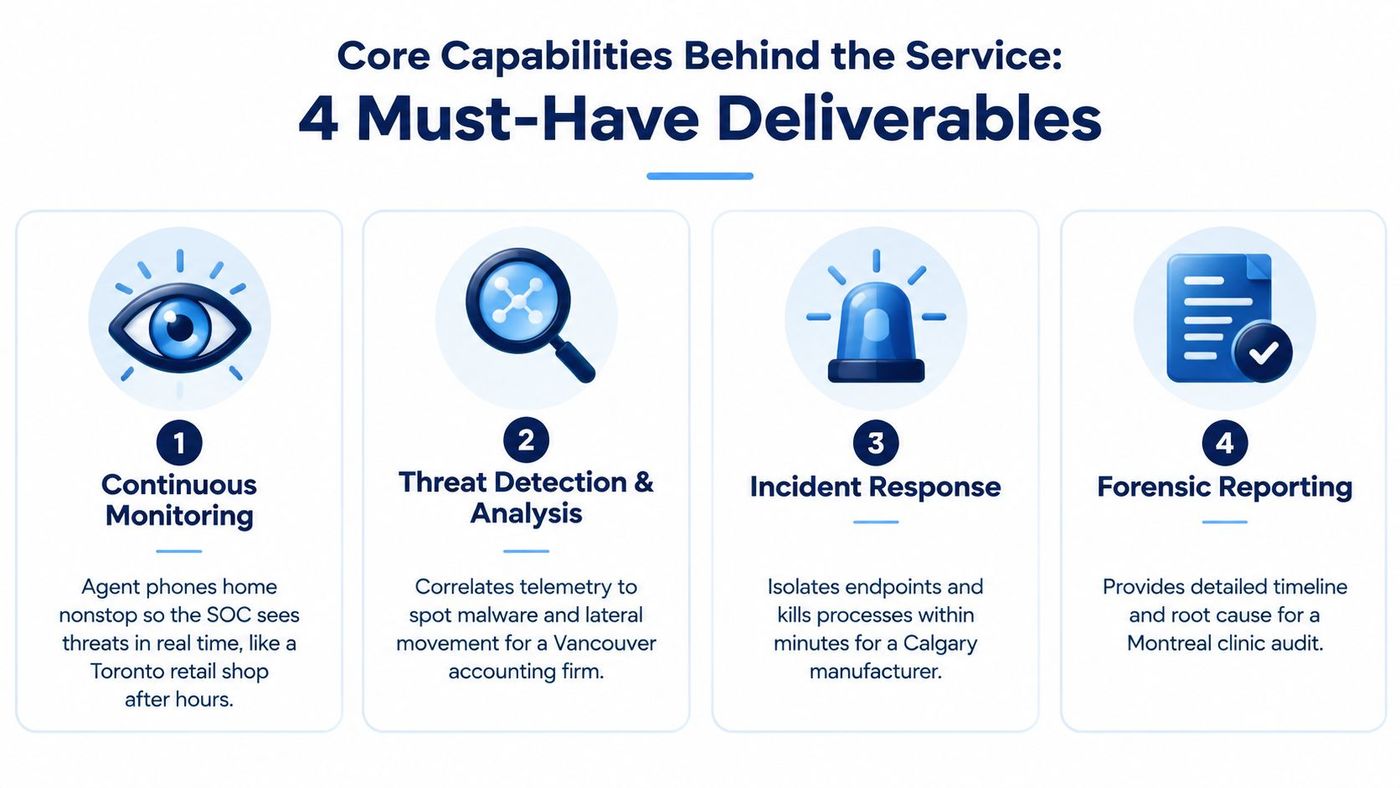
A managed EDR contract should deliver an operating service, not only an endpoint agent and dashboard. Four capabilities show whether a provider is monitoring, investigating, and responding, or reselling software.
The agent should send telemetry from every endpoint in scope. A Brampton logistics workstation connecting at 11 p.m. on a Saturday should not become visible only when the IT coordinator checks the console Monday morning.
Ask how the provider handles offline devices, servers, remote workers, and agents that stop communicating. Confirm whether analysts staff the service around the clock, or whether automated alerts wait for business-hours review. Coverage also depends on contract scope. Per-endpoint pricing can leave shared servers, contractor devices, or intermittently used equipment outside the service unless they are listed explicitly.
Signatures identify known files. Behavioural detection examines process activity. If a finance clerk's laptop launches PowerShell, accesses browser credentials, creates persistence, and begins communicating externally, the service should correlate those actions even without a familiar malware signature.
Providers may use Sigma rules, behavioural analytics, threat intelligence, and MITRE ATT&CK mapping. The procurement question is whether analysts explain the observed behaviour, identify the likely technique, and tune detections to your environment without weakening coverage. Confirm whether the service includes investigation and response, rather than assuming EDR software alone provides 24/7 MDR.
Threat hunting gives analysts a proactive way to query recent telemetry across the fleet for patterns that have not produced a high-confidence alert. An IOC sweep may find a suspicious hash, domain, or process pattern. A broader hunt may uncover a dormant implant that entered the environment weeks earlier.
Providers handle hunting differently. Some include it, some sell it as an add-on, and others perform it on a defined cadence or only during an incident. Put the frequency, scope, and deliverable in writing. A report without recommended remediation has limited operational value.
Response determines whether the service can affect the outcome. The provider should be able to isolate a host, terminate a malicious process, quarantine a file, and give your team guided recovery steps. Those actions require authorisation rules because automatic isolation may protect the business while disrupting a production system.
Ask who can push containment, what requires client approval, and how the provider handles a device supporting manufacturing, healthcare, or logistics operations. Canada's federal vulnerability-management guidance treats EDR as part of continuous assessment and remediation, not merely an alerting layer.
A structured threat detection and response framework should connect these capabilities to reporting. Request an incident timeline, affected assets, containment actions, root-cause findings, and open remediation items, not only a notification that an alert was closed.
The software-only model can work for an organisation with dedicated security staff, established escalation procedures, and someone accountable for the queue at all hours. It usually fails when an already busy IT generalist becomes responsible for every alert, investigation, patch, access request, and outage.
The comparison below focuses on the operating model, not the brand of EDR platform.
| Dimension | Unmanaged EDR | Managed EDR |
|---|---|---|
| Coverage | Depends on internal staff checking the console | A provider monitors the service continuously, according to the contract |
| Staffing | Your team triages, investigates, tunes, and responds | Analysts handle alert review, investigation, escalation, and agreed response actions |
| Response | Internal tickets and informal priorities determine action | Written SLAs and response workflows define ownership |
| Total cost | Agent licences, storage, training, staffing, and operational overhead remain with you | A recurring service fee includes defined technology and operational support |
An EDR platform can collect telemetry while nobody reviews it. That isn't the same as protection. Managed providers can maintain monitoring across different Canadian working hours and overnight periods, but you should verify the actual SOC model, analyst location, escalation process, and holiday coverage.
A provider that can only email an alert may reduce visibility without reducing risk. Ask whether analysts can isolate endpoints, stop processes, block indicators, and coordinate credential actions. Also clarify what happens when the incident affects a server or a workstation tied to production.
The unmanaged path often looks cheaper because the quote contains only the agent licence. Add SIEM storage, alert triage, analyst time, training, detection tuning, reporting, and incident support. Then compare that total with a managed per-endpoint or per-user proposal.
CloudOrbis's EDR versus MDR comparison is useful when deciding whether endpoint-focused coverage is sufficient or whether broader monitoring is warranted. The practical test is simple: if no internal person owns the queue and response process, software alone leaves the most important part unfinished.
A managed EDR contract can support compliance work, but it does not transfer legal responsibility from your organisation. Your privacy officer, executives, and counsel still need to determine which obligations apply to your data, sector, and province.
Ask where endpoint telemetry and forensic records are stored, where analysts access them, and whether support teams can export or process them outside Canada. Cross-border storage can affect privacy assessments, contractual controls, subpoena exposure, and internal approvals. The Canadian Centre for Cyber Security advises managed-service customers to review applicable laws and privacy impacts when data is stored outside Canada.
For personal information, map the service to PIPEDA. Quebec's Law 25 may require privacy governance, consent, breach handling, and clear responsibility for privacy oversight. Healthcare organisations also need to assess provincial requirements, including Ontario's PHIPA and Alberta's Health Information Act, rather than assuming a generic EDR report meets sector obligations. For a fuller breakdown, see this guide to Canadian data privacy laws.
Security monitoring can record user activity, so privacy and employment obligations may intersect. For a practical reference on that relationship, see this overview of employment compliance for startups. Canadian buyers should involve privacy and legal stakeholders before deployment, especially when analysts or support teams can access detailed endpoint records.
The provider should preserve evidence in a usable format and support escalation to the correct reporting channel. Ontario's cyber security standard was amended on September 22, 2025, requiring licensed transmission and distribution entities to report qualifying incidents through IESO's Lighthouse portal, as described by Cyber Security Ontario's incident-reporting guidance. Other organisations may need channels directed by Cyber Security Ontario or the Canadian Centre for Cyber Security.
Put the workflow into the contract. Can the provider assemble the timeline, affected systems, containment record, and supporting evidence required by your reporting deadline? The answer should identify named contacts and escalation paths for Ontario, Alberta, and every other province where you operate.
Request reporting at three levels:
Canada's federal audit found gaps in cyber-security services, monitoring, and response during active attacks, and recommended defence sensors on all IT endpoint devices so vulnerabilities can be identified and remediated promptly. Use that finding as a buying standard: coverage, monitoring, and remediation must be measurable, documented, and reviewed.
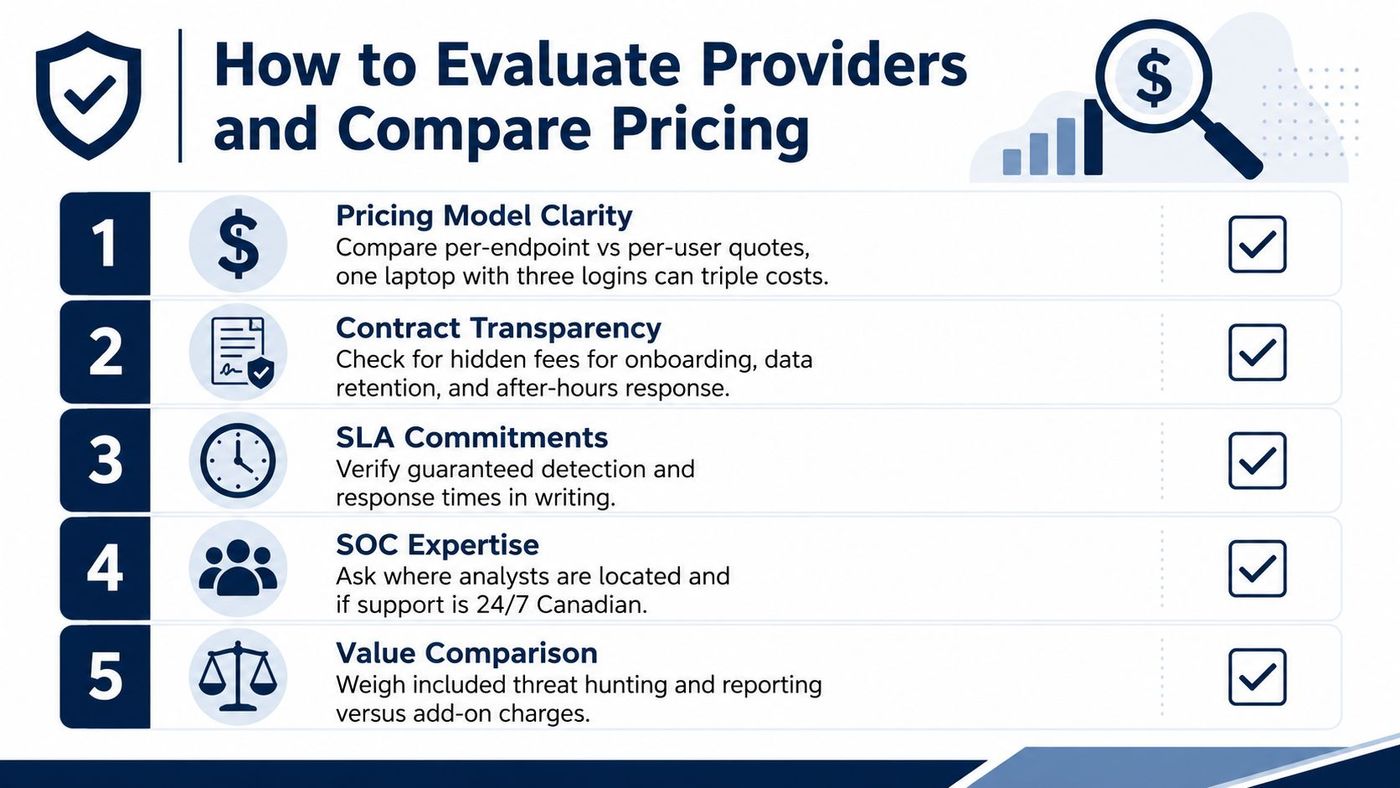
Pricing becomes difficult when one provider charges by endpoint and another charges by user. Canadian SMB guidance places endpoint-only MDR at about CA$10 to CA$25 per endpoint per month, while broader endpoint, identity, and Microsoft 365 monitoring can be about CA$130 to CA$180 per user per month, according to CloudOrbis's managed endpoint detection and response pricing discussion. These are different scopes, not interchangeable quotes.
A laptop used by one employee is simple. A shared device used by three contractors may produce a very different per-user calculation, depending on whether identity and Microsoft 365 signals are included. Extract the effective cost for your actual environment, then separate endpoint protection from identity, cloud, email, and response services.
Ask each provider to state the following in the same format:
A low quote can be reasonable, but a provider pricing below $15 per endpoint should explain exactly what it excludes. The issue isn't the threshold itself. It's whether monitoring, human triage, threat hunting, response authority, and reporting have been removed.
Request a 30-day pilot across a representative group of laptops, servers, remote users, and high-value systems before accepting a multi-year commitment. Test whether analysts understand your business, whether alerts arrive with useful context, and whether the provider can isolate a device without creating unnecessary disruption.
Ask for answers to these questions:
Use a managed services questionnaire to keep vendor responses comparable. Red flags include an unnamed SOC location, alert volumes padded with marketing notifications, unclear containment authority, and an exit clause that doesn't explain how to retrieve evidence.
Canadian organisations face a practical endpoint problem, not a theoretical one. In 2023, Canada's EDR market generated USD 275.1 million in revenue and is projected to reach USD 1,213.9 million by 2030, implying a 23.6% CAGR from 2024 to 2030, according to Grand View Research's Canada EDR market outlook. The same source identifies software as the largest segment in 2023, with a 65.5% revenue share, while services are the fastest-growing solution segment, and Canada represented 7.7% of global EDR revenue in 2023.
The buying pattern makes sense. Canadian businesses aren't only purchasing endpoint software. They're looking for ongoing monitoring, response, and support that their internal teams may not be able to provide consistently.
Ransomware pressure reinforces the need. The cited 2025 CIRA Cybersecurity Survey found that 24% of Canadian organisations were victims of ransomware in the previous 12 months; among those victims, 74% had data exfiltrated and 74% paid a ransom, while Canada recorded 352 confirmed ransomware cases in 2025, a 46% increase from the prior year, as reported in this Canadian ransomware preparedness analysis. Earlier, Statistics Canada's 2023 cybercrime survey found that 16% of Canadian businesses experienced a cybersecurity incident, with ransomware accounting for 13% of those incidents, up from 11% in 2021.
Managed EDR should feed verified endpoint signals into identity controls, Microsoft 365 protection, SIEM, backups, vulnerability management, and incident reporting. It doesn't replace those systems. It gives them a monitored response layer and a clear owner.
A major Canadian cybersecurity study found mean detection time of 7.1 days, mean response time of 14.9 days, and mean recovery time of approximately 48 days. The same study reported that 39.8% of companies considered EDR a priority and 29.5% prioritised MDR, according to the 2023 Canadian Cybersecurity Study. For a five-to-fifteen-person IT operation, outsourcing continuous monitoring is often more realistic than expecting one engineer to match an attacker's speed without burning out.
Proactive IT management depends on endpoint visibility, response runbooks, and compliance evidence. Without those foundations, the rest of the security stack becomes harder to operate and harder to defend during an audit. A managed security services model can connect those operational responsibilities, provided the contract defines scope, authority, reporting, and data handling clearly.
Book a scoped assessment before signing an MSA, request a sample detection report, and pressure-test the provider against the checklist in this guide. CloudOrbis Inc. provides managed EDR with real-time endpoint monitoring, investigation, threat hunting, alert analysis, and response, including endpoint isolation when a threat is detected. Visit CloudOrbis Inc. to discuss your environment, review the required coverage, and build a managed security plan that fits your Canadian operations.
Book a 30-minute call with a senior engineer. No sales script, just straight answers about your environment.


