

September 26, 2026
On-Premise to Cloud Migration Checklist: 10 StepsUse this on-premise to cloud migration checklist to plan assessment, compliance, backups, sequencing, testing, cutover, and optimization for SMBs.
Read Full Post%20(1).webp)
Usman Malik
Chief Executive Officer
August 12, 2026
You're probably dealing with this already. A clinic, law office, or accounting firm buys a cloud tool, staff keep working, and nobody thinks about privacy until a patient record, client file, or employee note crosses a provincial line. That's where Canadian data privacy laws stop being a policy binder and start becoming an operations problem.
For SMBs, the hard part isn't just knowing that PIPEDA exists. It's knowing when federal rules apply, when Quebec or Alberta rules take over, and what your IT setup, vendors, and staff behaviour need to do differently. The practical answer is a layered rules matrix, not a single checklist.
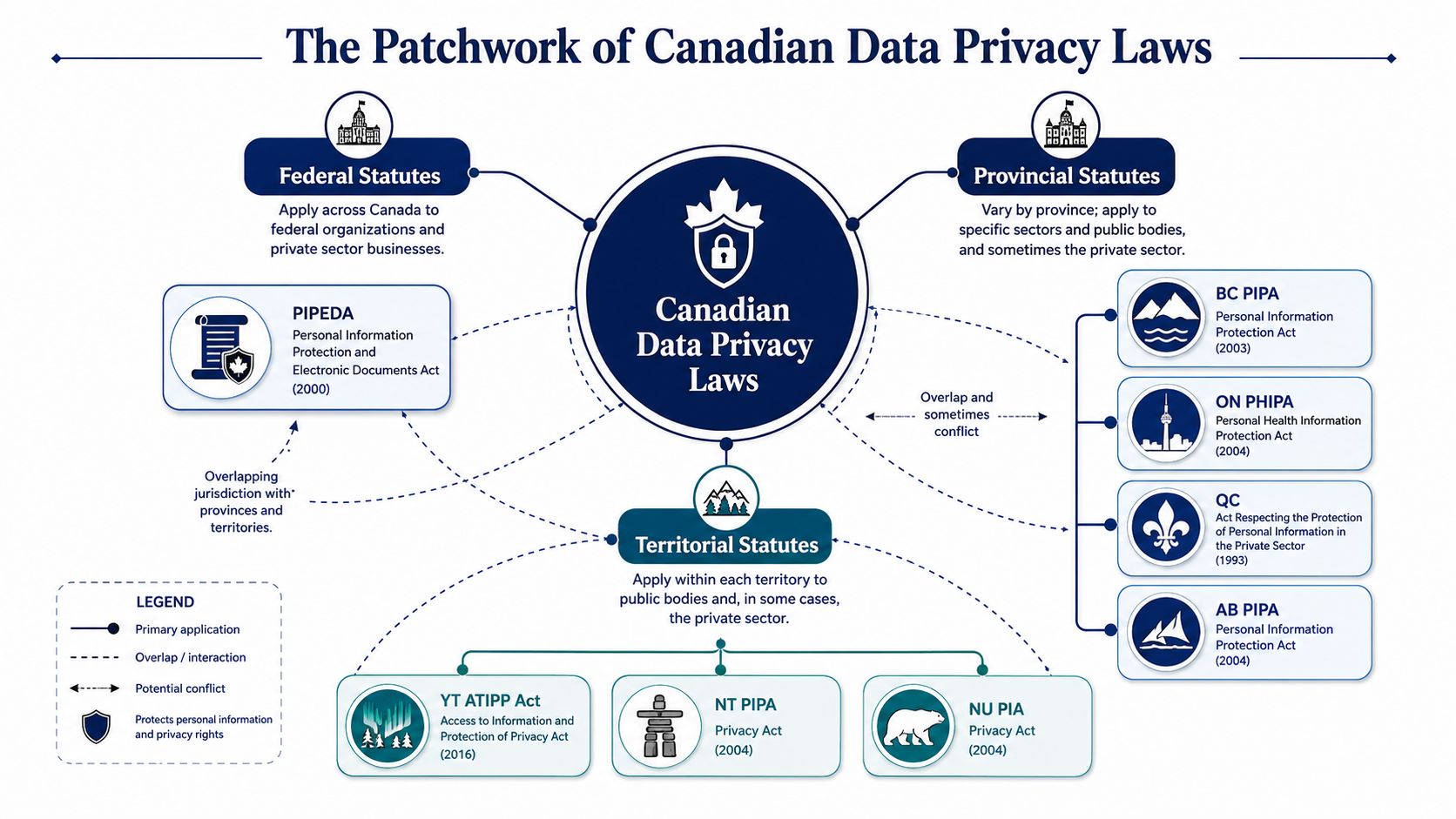
A 40-person Ontario clinic can follow local privacy habits and still run into trouble the moment a file crosses a border. The practice signs a cloud contract, the vendor replicates a patient record into Quebec for redundancy, and the data is now sitting in a different legal lane. That is where Canadian data privacy laws stop looking like one clean rulebook and start behaving like a patchwork of overlapping rules.
The federal baseline is PIPEDA, but Canada's privacy framework goes well beyond that single statute. The Office of the Privacy Commissioner describes a system made up of federal, provincial, and territorial privacy laws across private, public, and health sectors, with stricter provincial regimes in places like Quebec, Alberta, and British Columbia privacy laws in Canada. For an SMB, the key trigger is usually the data flow, not the location of the head office.
Privacy compliance works like road rules across several jurisdictions. A dataset can fall under one rule while it is collected, another while it is stored, and another again when a vendor or employee accesses it. A single privacy notice often does not cover a multi-province business cleanly, because the legal duty can shift with the record itself.
Practical rule: map where the data is collected, where it is stored, who can access it, and where it is replicated before deciding which law applies.
That is the operational line between a brochure-level policy and a program you can defend. For SMBs, the pressure points are cloud services, remote staff, and outsourced support all touching the same record. The law follows the record, not the org chart.
A business that stays inside one province still needs to confirm whether that province has substantially similar private-sector rules. If the data crosses a provincial border, or lands with a service provider that uses distributed infrastructure, PIPEDA can come back into play. That is why Canadian privacy governance starts with a data map, not a legal memo.
The first question is simple. Where does this data go? Once that is clear, the rest of the compliance work becomes much easier to set up.
PIPEDA is the federal anchor for private-sector privacy in Canada. It received royal assent in 2000 and took effect in 2004, which put Canada among the early movers on commercial privacy law. The Office of the Privacy Commissioner says businesses subject to PIPEDA must follow 10 fair information principles in Schedule 1, including identifying purposes, consent, limiting collection, safeguards, openness, individual access, and challenging compliance. The federal overview sets out the framework in plain terms, and the PIPEDA overview remains the cleanest starting point for owners who need the official baseline. For the actual operating principles, the federal commissioner also publishes the full list in its guidance on the fair information rules.
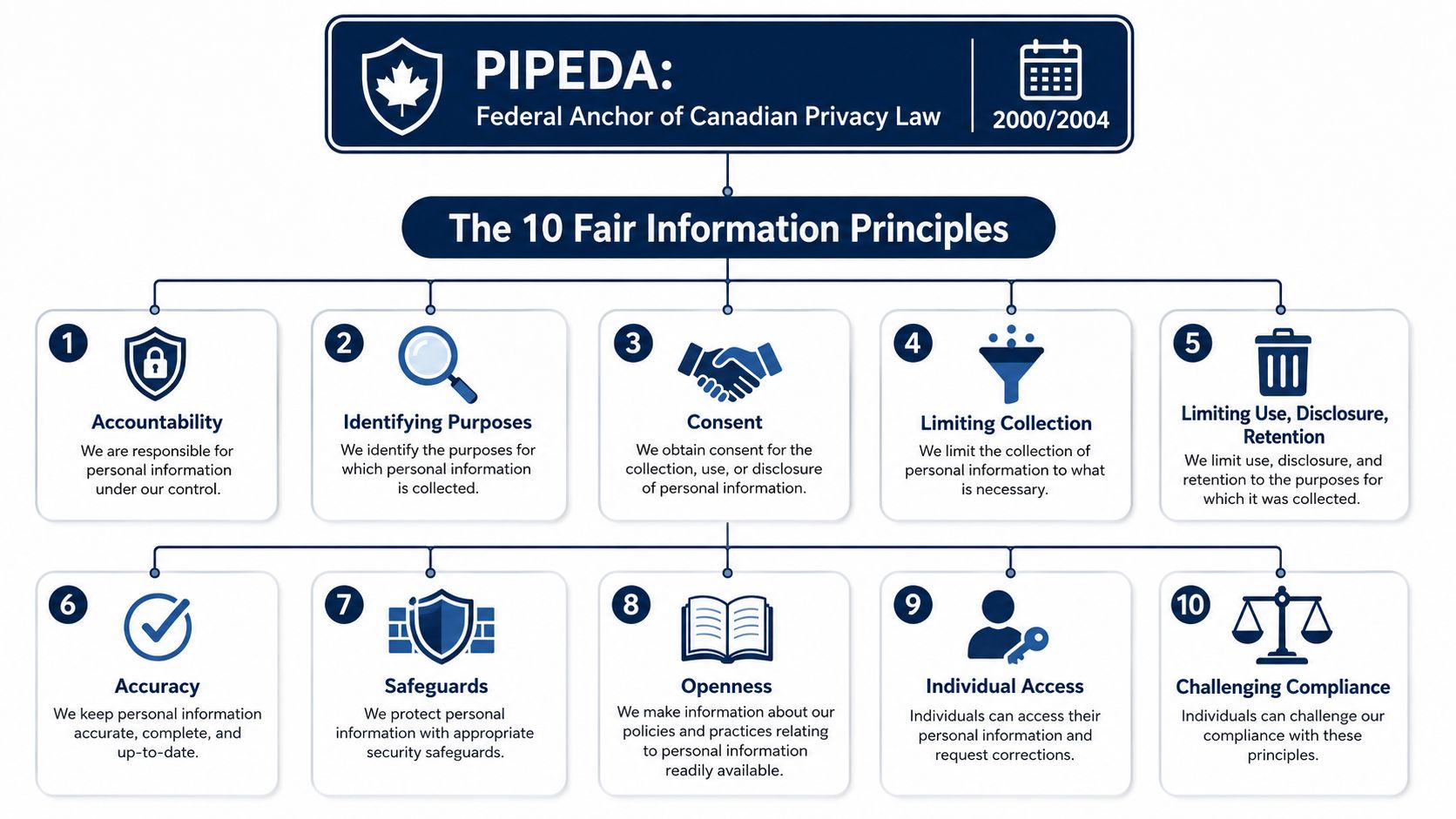
PIPEDA works best as an operations checklist that starts before data collection. Identify the purpose before you ask for the information, then keep collection limited to what you need. That separates a clean intake process from a privacy issue waiting to happen.
The principles only help if someone turns them into daily controls. A clinic, law firm, or other SMB does not need a legal binder sitting on a shelf, it needs rules staff can follow in the ticketing system, the front desk, and the cloud app.
A few practical controls line up well with the principles:
A useful support document is the data security and privacy guide, because the controls that support privacy also support security. That overlap matters in real life, since weak security usually becomes a privacy problem fast.
PIPEDA is not satisfied by a hidden clause and a tick box that nobody reads. The person has to understand what they are agreeing to, and the organisation has to show why the collection was necessary in the first place. For SMBs, that means consent language has to match the actual workflow.
A privacy policy that sounds good but doesn't match how staff handle data is worse than no policy at all.
Consent also gets messy in real workplaces. Employee files, client intake, marketing lists, and vendor portals do not always follow the same permission logic, so the controls need to distinguish between them instead of treating all personal information the same way. That is where a managed IT partner can help by tying forms, storage, access controls, and retention settings back to one privacy rule set.
Once a business crosses into Alberta, British Columbia, or Quebec, the compliance picture changes. These provinces have their own private-sector privacy laws deemed substantially similar to PIPEDA, so the provincial rule can replace the federal one for many intra-provincial activities. The practical result is that one privacy program needs regional branches, not just one national statement PIPEDA and provincial structure.
| Law | Jurisdiction | Key Stricter Obligations |
|---|---|---|
| Alberta PIPA | Alberta private sector | Includes employee information more directly than the federal baseline, which matters for workplaces that mix client and staff data. |
| British Columbia PIPA | British Columbia private sector | Requires organisations to state what data they collect and how and why they will use it, then stick to that purpose unless fresh consent is obtained. |
| Quebec Law 25 | Quebec private sector | Introduces privacy officer duties, privacy impact assessments, and stronger breach and governance expectations. |
| PIPEDA | Federal private sector across Canada | Serves as the baseline where a provincial law does not displace it, especially when data crosses provincial or national borders. |
Alberta and British Columbia are often the first places where a business realises employee data can't just be treated as a side issue. Alberta's regime is especially relevant where workplace records and client records sit in the same system. British Columbia puts extra emphasis on telling people what will happen to their information, then not drifting into new uses without a fresh basis.
Quebec is usually where governance becomes more formal. Policies, impact assessments, and breach handling need tighter internal ownership, because privacy can't live as an informal habit when a province expects disciplined process. For a firm with offices in Toronto, Calgary, and Montreal, that means the control set isn't “one policy, one notice, one vendor pack.”
The right way to manage this is a rules matrix by province, data type, and transfer path. That matrix should tell you which law applies to client data, employee data, health information, and vendor-hosted records. A broad privacy statement is fine as a front door, but it won't do the job internally.
A practical resource for firms building out Quebec-ready governance is this privacy impact assessment in Alberta article, because the same discipline of mapping risk and control applies when provincial rules get stricter.
A phishing email lands at a 25-person accounting firm, someone clicks, and an attacker gets into a client list. Under PIPEDA, that is the point where the firm has to assess whether the incident creates a real risk of significant harm, decide whether it meets the reporting threshold, and keep breach records for 24 months breach rules summary.
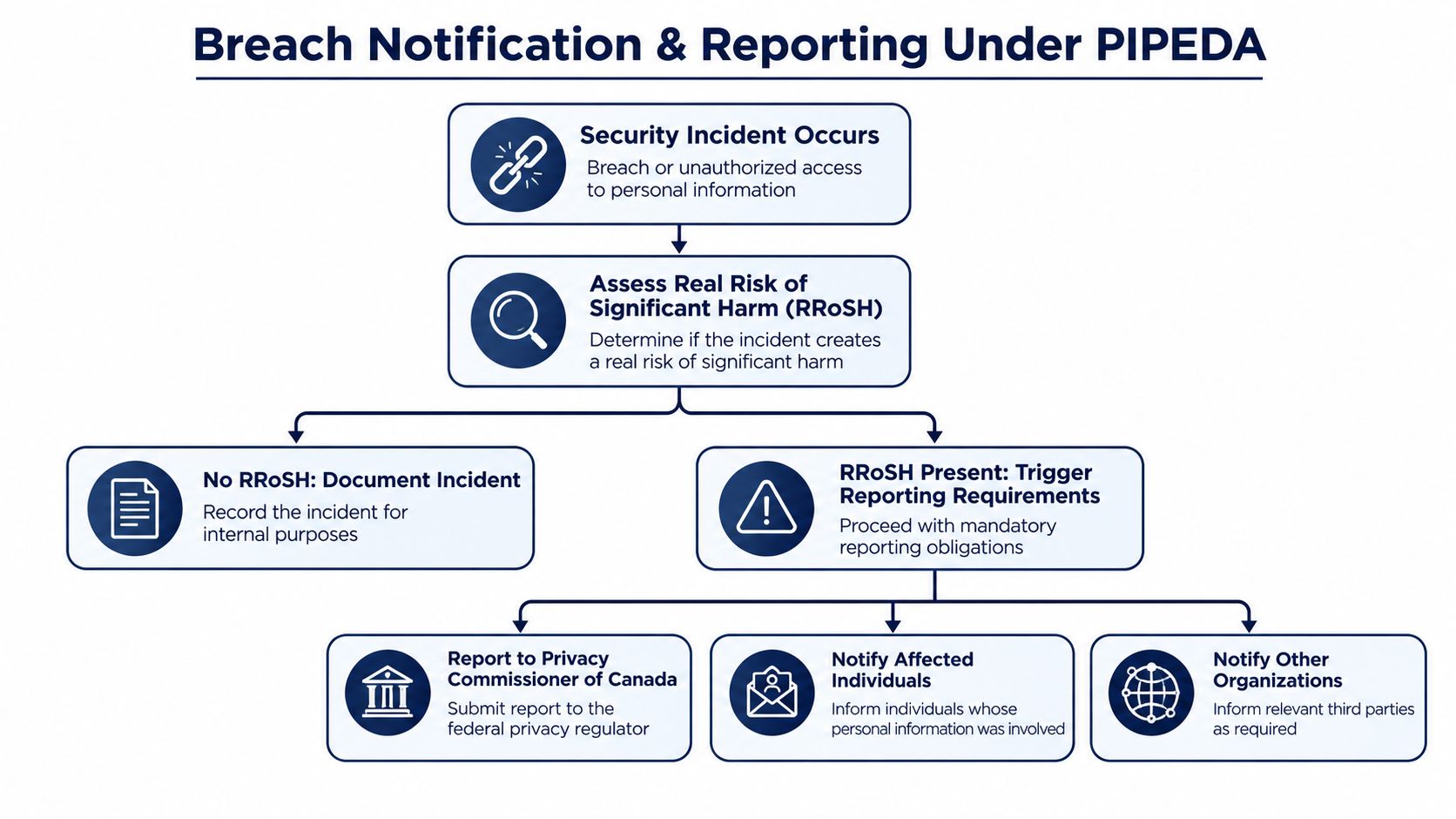
Containment comes first. Reset access, isolate the affected mailbox or endpoint, and preserve logs before they roll off. Then write down the facts that matter, who was affected, what data was involved, whether the attacker still has access, and whether the incident could create a real risk of significant harm.
If the threshold is met, the organisation needs to notify the Privacy Commissioner of Canada and the affected individuals as soon as feasible. It also has to keep the breach record even if the event turns out to be less serious than it first looked. That record becomes part of the compliance trail, which is what investigators and insurers often ask for after the fact.
A useful companion resource for response planning is Cloudvara security incident roadmap, because detection, containment, assessment, communications, and follow-up need to be handled in one sequence.
For the technical side, a threat detection and response process only helps if staff know what counts as a reportable event and who owns the decision. A clinic, law firm, or small agency does not need a sprawling playbook. It needs a short one that ties the incident path to the people who can act.
The OPC's 2024–2025 reporting shows how active the system is. It received 1,458 complaints under PIPEDA, a 32% increase from the prior fiscal year, and 686 breach reports linked to about 20 million affected Canadian accounts OPC annual report 2024–2025. That does not mean every business will face the same outcome, but it does show that privacy incidents move quickly from internal issue to formal process.
If staff do not know who to call, the clock starts running on confusion instead of containment.
The operational lesson is straightforward. Keep the response playbook short, tested, and owned by named people. In a breach, the fastest organisation is usually the one that already practised the sequence.
A defensible SMB program doesn't need a full legal department. It needs ownership, a data map, and a few technical habits that staff follow. If the privacy work lives only in a policy binder, the business is exposed the moment someone opens a cloud form, forwards a file, or sends a client list to a subcontractor.
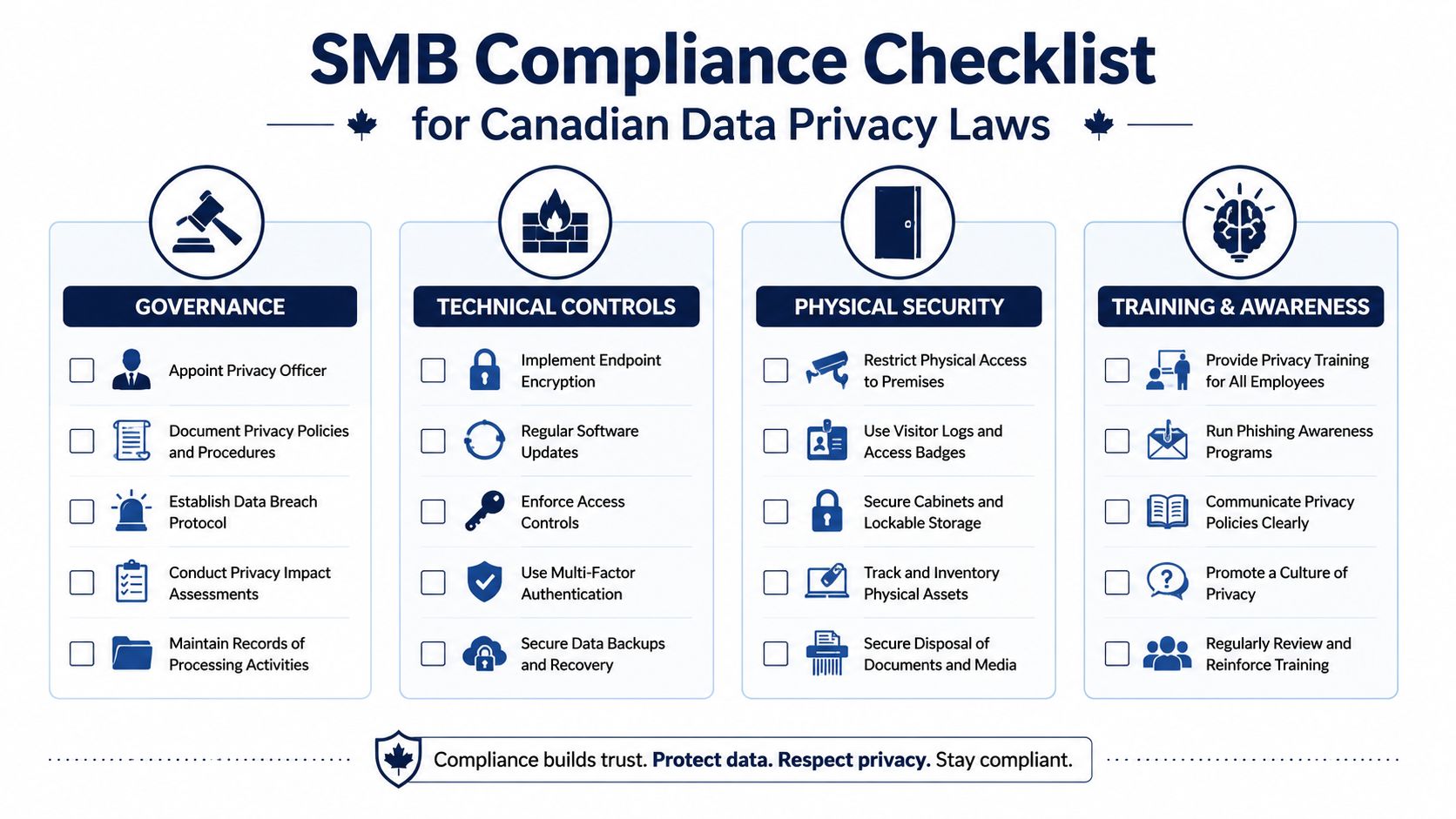
For law firms, a practical reference point is privacy policy for law firms, because legal practices need clear handling rules for client files, employee records, and matter-specific retention.
The internal discipline behind these controls is covered well in compliance training for employees, because training only helps when it's tied to real workflows.
A lot of privacy content stops after PIPEDA, Quebec, Alberta, and British Columbia. That leaves out the awkward cases that create real headaches for SMBs. McGill's privacy analysis says existing Canadian privacy laws and the current Bill C-27 model do not adequately cover political parties and many not-for-profits, and that current supports are not fully equipped for SMEs McGill privacy analysis.
Political parties and some not-for-profits often handle donor, member, and volunteer data, but they do not always fit neatly into the commercial-activity assumptions built into PIPEDA. That leaves organisations with weaker protection than business owners assume when they hear the phrase “Canadian privacy law.” The same problem shows up in mixed public-private workflows, where employee data can sit awkwardly between the Privacy Act and PIPEDA.
That matters for contractors, clinics, logistics firms, and professional services companies that support public-sector work on one side and private work on the other. If the same person, file, or device touches both environments, the compliance question is not just which province applies. It is which legal basis applies to which dataset.
Useful habit: classify data by type and legal context, not just by department name.
Canada's broader framework is fragmented across at least 29 privacy statutes, so edge cases do not get solved by one standard template privacy laws in Canada. A mature SMB program should tag records by whether they are client, employee, donor, vendor, or public-sector related. Then the business can tell which policy, retention rule, and access control fits.
The trap is assuming the presence of a privacy notice means the program is covered. It does not. Coverage depends on who collected the data, why it was collected, where it moves, and which legal regime sees the transaction.
A managed IT provider turns privacy requirements into working controls. In practice, that starts with endpoint protection, threat detection, and vulnerability assessments, because safeguards only matter if the environment is hardened before data starts moving around. Microsoft 365 hardening, backup and disaster recovery, and access control reviews then support the retention and incident-response obligations Canadian privacy laws expect.
A 60-person healthcare clinic in Mississauga needs that work to cover PHIPA-style handling and broader Canadian privacy obligations at the same time, especially where email, file sharing, and remote access all touch patient or staff records. The job usually runs in a sequence, assessment, data mapping, remediation, training, policy alignment, monitoring, and ongoing optimisation. That sequence gives the owner fewer privacy decisions to carry alone and makes the controls easier to audit later.
CloudOrbis Inc. is one Canada-based option that provides managed IT support, cybersecurity, cloud migration, backup and disaster recovery, and vCIO oversight for businesses that need privacy controls tied to day-to-day operations. A managed IT services partner for small business can turn those controls into routine work instead of one-off fixes. The value isn't a slogan. It is having one team that can line up technical controls with the privacy program the business runs.
A managed service partner should not replace legal advice, but it can make compliance real. The business gets controls, logs, and response habits that a lawyer can review, instead of vague assurances and a folder of PDFs.
Do cross-border transfers to US cloud providers need extra safeguards? Yes, they usually do. The practical move is to document where the data is stored, which vendors or subprocessors can access it, and what contractual safeguards are in place before the migration goes live. If the provider's infrastructure or support model changes, revisit the assessment and make sure the data map still matches reality.
**Under today's framework, the biggest risks are OPC findings, reputational damage, incident costs, and litigation exposure after a breach. Complaints and breach reporting can make those failures very visible, so the business needs controls it can defend, not just a policy on paper.
Where does Bill C-27 stand, and should SMBs wait? Don't wait. Build the controls now, because the basics of consent, access, vendor oversight, and incident response already matter under the current regime, and they will still matter if the law changes later. A future framework may tighten the rules, but it will not remove the need for a data map or a breach runbook.
How long does a defensible posture take? Most SMBs can move in phases. Governance and inventory work come first, vendor review and access cleanup follow, and training plus monitoring should keep running after that. The right goal is progress you can show, not a one-time project that disappears into a binder. The same approach also helps with edge cases that get overlooked, including employee records, not-for-profits, and political parties that have their own privacy obligations.
Does employee data fall under Canadian privacy laws? Yes, and it is often the first place where a gap shows up. HR files, payroll records, onboarding documents, and terminated-user mailboxes all need access limits, retention rules, and a clear owner. If a business treats employee data as separate from client data, the result is usually mixed permissions and records that stay live too long.
Do not-for-profits and political parties follow the same rules as other SMBs? Sometimes they do, sometimes they do not, and that is where the patchwork matters. A not-for-profit may fall under a provincial private-sector law or PIPEDA depending on the activity, while political parties can have separate obligations under election-related privacy rules. A managed IT partner should verify which bucket the organization sits in before setting retention, consent, and breach workflows.
What should an SMB ask a managed IT partner to show? Ask for access logs, backup testing records, endpoint hardening standards, and a written incident process. Ask how Microsoft 365 sharing is controlled, who reviews vendor risk, and what happens when staff leave or change roles. If the partner cannot show those controls in day-to-day use, the privacy program is probably weaker than it sounds.
Can one privacy program cover every province? Only if it is built to absorb provincial differences. Québec, Alberta, British Columbia, and some health or employment records have rules that can go beyond the federal baseline, so the safest setup is a central control set with province-specific exceptions where needed. That keeps the business from assuming one policy fits every file, every worker, and every location.
CloudOrbis Inc. helps Canadian SMBs turn privacy obligations into working IT controls, from threat detection and backup planning to Microsoft 365 hardening and policy support. If your team needs a practical way to line up systems, staff, and vendors with Canadian data privacy laws, visit CloudOrbis Inc. and book a privacy-readiness conversation.
September 26, 2026
On-Premise to Cloud Migration Checklist: 10 StepsUse this on-premise to cloud migration checklist to plan assessment, compliance, backups, sequencing, testing, cutover, and optimization for SMBs.
Read Full Post
September 25, 2026
Is VoIP Good for Small Business in Canada? a 2026 GuideIs VoIP good for small business in Canada? Explore costs, benefits, reliability, security, and migration tips for SMBs considering VoIP in 2026.
Read Full Post
September 24, 2026
Helpdesk vs Service Desk: Choosing the Right IT SupportHelpdesk vs service desk: understand the key differences and choose the right IT support model for your organization in 2026.
Read Full Post
