

September 25, 2026
Is VoIP Good for Small Business in Canada? a 2026 GuideIs VoIP good for small business in Canada? Explore costs, benefits, reliability, security, and migration tips for SMBs considering VoIP in 2026.
Read Full Post%20(1).webp)
Usman Malik
Chief Executive Officer
December 28, 2025
For many business leaders, IT support is an afterthought—something you only scramble for when a server gives up or a laptop goes dark. This reactive "break-fix" model, where you call for help after something breaks, might feel like you're saving money. In reality, it often leads to unpredictable bills and infuriating downtime that grinds your business to a halt.
Managed IT services for small business completely flips that script. It’s a shift to proactive technology management, all for a predictable, flat monthly fee.
Think of your IT partner like a dedicated property manager for your digital infrastructure. Instead of just showing up to fix a burst pipe (and the water damage that follows), they’re there every day, checking for small leaks, inspecting the foundation, and making sure every lock is secure. They prevent disasters before they can even start.
That’s the core idea behind managed IT services. It's about transforming your technology from a reactive headache into a strategic asset that actually helps you grow.
For many Canadian organizations, the daily grind involves juggling complex cloud tools, fending off a constant barrage of cyber threats, and struggling to find skilled tech talent. These challenges make a reactive IT model not just inefficient, but downright dangerous. Despite the rising risks, recent industry analysis shows an estimated 73% of Canadian SMBs still relied on break-fix support models in 2025.
A modern managed IT partnership is the clear solution to these headaches. By monitoring your systems 24/7, applying security patches the moment they're released, and constantly optimizing performance, a managed services provider (MSP) catches small hiccups before they snowball into business-disrupting emergencies.
This simple shift allows you to:
This strategic approach is one of the core benefits of managed IT services, ensuring your technology actively fuels your growth instead of holding it back.
The goal is simple: keep your business running smoothly and securely so you can focus on what you do best. A proactive IT strategy is the foundation for achieving that stability and enabling future growth.
To see the difference clearly, let’s look at how the two models stack up side-by-side.
The table below breaks down exactly why a proactive partnership is the smarter, more sustainable choice for any growing organization.
Seeing it laid out like this, the choice becomes pretty clear. One model leaves you waiting for the next disaster, while the other helps you build a more resilient and successful business.
When you partner with a provider for managed IT services for small business, you're getting far more than just on-call tech support. Think of it as your complete, outsourced IT department, giving you access to enterprise-level tools and expertise without the enterprise-level price tag.
A modern plan is built on proactive care, not just fixing things when they break. It’s about making sure every piece of your technology puzzle—from employee laptops to cloud servers—is constantly monitored, maintained, and optimized to keep your business running at its best.
This image really highlights the shift from the old, unpredictable IT model to a proactive, strategic one.
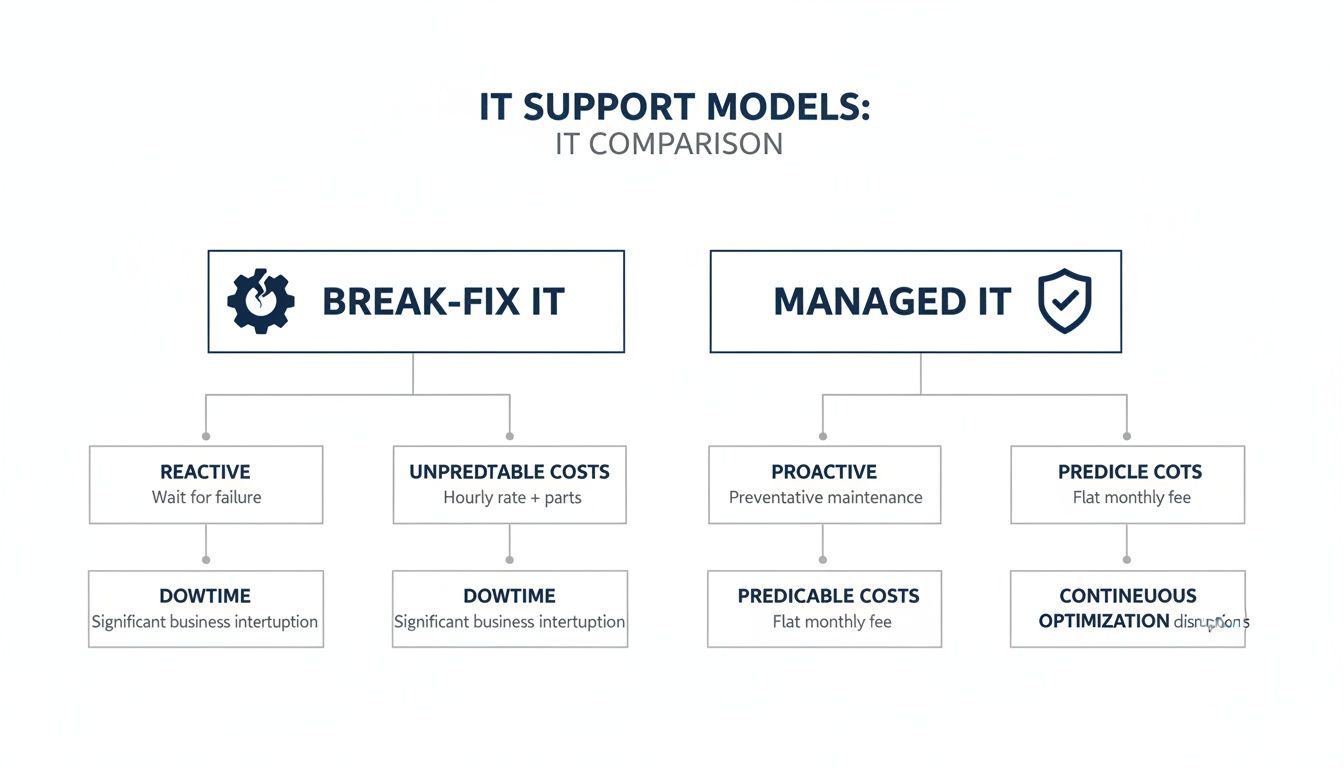
The difference is clear: managed services are all about preventing problems, while the break-fix model leaves you waiting for a disaster before you get help. Let’s break down the core components that make this proactive approach so effective.
Imagine your team having instant access to IT support anytime an issue pops up, whether it's a simple password reset or a critical software glitch. That’s the power of a 24/7/365 helpdesk. With a 100% Canada-based team, you get quick, effective support from technicians who understand the local business landscape and can ensure data residency and compliance needs are always met.
For example, if a logistics coordinator in Calgary hits a system error at 3 a.m., they can get immediate help to keep shipments on track. This prevents costly delays that would be inevitable with a standard 9-to-5 support model.
In today’s environment, a strong defence isn't optional. Managed cybersecurity is like having a digital bodyguard on duty around the clock, working to protect your sensitive data. It’s not just about installing antivirus software; it’s a deep, multi-layered strategy.
This typically includes:
To get a better sense of what a solid plan looks like, check out a practical guide to managed network security solutions, as this is a vital piece of the puzzle. This proactive stance is what prevents something like a ransomware attack from crippling a law firm by locking down all its critical case files.
The cloud is an incredible tool, but only if it’s managed the right way. A huge part of modern managed services is optimizing your cloud environment—whether it's Microsoft 365, Azure, or another platform—to ensure you’re getting the most out of your investment.
This isn’t just a trend; it's the future. By the end of 2025, estimates suggest that 85–90% of Canadian companies will be ‘cloud‑first’. On top of that, with 12.2% of businesses already using AI, having an expert partner to manage these advanced tools is becoming crucial for staying competitive.
What would happen if a fire, flood, or cyberattack wiped out your data tomorrow? A solid backup and disaster recovery (BDR) plan is your ultimate safety net. It’s more than just backing up files; it's about having a tested, reliable plan to get your entire operation back up and running fast.
For a healthcare clinic hit by ransomware, a compliant and encrypted backup solution means they can restore patient records and get back to providing care within hours instead of days, avoiding massive fines and reputational damage.
This service creates redundant copies of your data and maps out a clear recovery path, turning a potential catastrophe into a manageable hiccup. For a deeper look, check out our guide on how to strengthen your company's resilience with effective infrastructure managed services.
Finally, a truly modern plan offers high-level strategic advice from a virtual Chief Information Officer (vCIO). This expert acts as your technology advisor, helping you align your IT investments with your long-term business goals.
A vCIO helps you tackle the big questions:
This strategic oversight ensures your technology isn't just a cost centre—it becomes a powerful engine driving your business forward.
When you start looking at managed IT services for small business, the first question is always about cost. It’s tempting to put a monthly service fee side-by-side with an in-house salary, but that’s not really an apples-to-apples comparison. It misses the bigger picture.
The real value isn’t just about what you pay—it’s about the costly disasters you sidestep and the operational headaches you eliminate. The predictable monthly fee is a welcome change from the sudden, four or five-figure emergency bills that come with the old "break-fix" way of doing things.

Before you can budget, you need to know how these services are usually priced. While every provider has their own approach, most plans fit into a few main categories:
No matter the model, the goal is the same: to turn your unpredictable IT expenses into a stable, predictable operating cost you can actually budget for.
The real "aha!" moment comes when you look past the monthly fee and start calculating the return on investment (ROI). This means taking a hard look at all the hidden costs that come with reactive or outdated IT management. In fact, studies show that shifting to managed services can slash IT costs by up to 40% while boosting performance.
The ROI isn't just about direct savings; it's about avoiding risks and gaining a strategic edge. A single hour of downtime can cost a small business thousands of dollars in lost sales and productivity. A data breach? That’s even worse, often leading to financial and reputational damage that’s hard to come back from.
Think of it this way: a predictable monthly fee is your insurance against the catastrophic, unpredictable costs of technological failure. Proactive management turns IT from a volatile liability into a stable, strategic asset.
To figure out your potential ROI, you need to consider a few key things:
When you factor in these tangible benefits, the financial case for managed IT becomes crystal clear. You’re not just buying support; you’re investing in stability, security, and sustainable growth.
If your organization is in healthcare, finance, or law, you know that compliance isn't just a good idea—it’s the law. Navigating the web of regulations can be a massive headache, and a single misstep can have serious consequences. This is where a specialized managed IT services for small business partner becomes essential. They're not just a tech provider; they're your compliance guide.
Handling complex rules requires a deep understanding of both technology and the legal side of things. Your IT partner turns compliance from a major business risk into a process that is documented, managed, and always watched over. This gives you peace of mind, knowing your operations are built on a secure and compliant foundation.

For any Canadian business, data privacy is a top priority, governed by strict federal and provincial laws. The big one is the Personal Information Protection and Electronic Documents Act (PIPEDA), which sets the ground rules for how businesses handle personal information. A huge piece of this puzzle is data residency—making sure sensitive Canadian data stays right here in Canada.
This is why partnering with a 100% Canada-based managed services provider is so important. It guarantees your data, and the servers it lives on, are subject to Canadian privacy laws, not foreign ones. That simple choice eliminates a massive compliance headache and protects you from international data requests.
Let’s picture a healthcare clinic in Ontario. Every day, it handles a steady stream of highly sensitive Personal Health Information (PHI), which is protected by tough provincial privacy laws. It’s not enough to just store this data; the clinic has to prove it’s using the right technical safeguards to protect it.
A managed IT partner with healthcare experience would put a multi-layered plan in place:
By handing these technical controls over to an expert, the clinic doesn't just get stronger security. It also gets the documentation needed to prove it’s doing the right thing during a compliance audit. The MSP’s work becomes a clear record of the clinic's commitment to protecting patient privacy.
At the end of the day, a managed partner helps you meet regulatory standards by building compliance right into your daily IT operations. It stops being a one-off project and becomes a constant, proactive effort.
For businesses that want to get serious about their strategy, exploring specialized compliance solutions offers a clear path to find weak spots and put the right controls in place. This turns a daunting task into a real business advantage, building trust with clients who know their data is in good hands.
Picking a managed IT partner is a huge decision, and it goes way deeper than just comparing monthly fees. You’re not just buying a service; you’re handing over the keys to a critical part of your business. The right partner becomes a true asset that helps you grow, while the wrong one can bog you down with operational headaches and serious security risks.
The trick is to find a provider who does more than just fix things when they break. You need a team that understands your business goals, knows your industry inside and out, and has a clear, structured way of working with you. With the right criteria in mind, you can confidently find a partner who will help build a more secure, efficient, and resilient business.
Let's be honest—not all managed service providers are the same. A provider with real, hands-on experience in your industry, whether it's healthcare, manufacturing, or finance, already speaks your language. They understand your unique challenges and compliance needs from day one, so you don't have to waste time getting them up to speed.
When you're vetting a potential partner, ask them for:
Cybersecurity is easily one of the most critical parts of any managed IT partnership. Your provider’s security needs to be strong, proactive, and completely transparent. Don’t be shy about digging into the details of their security stack and asking for proof of their qualifications.
A top-tier provider should be able to walk you through their approach to threat detection, endpoint protection, and how they handle a security incident. Crucially, they must have a rock-solid understanding of Canadian data privacy laws like PIPEDA. This is why confirming they offer a 100% Canada-based helpdesk is a deal-breaker for keeping your data sovereign and compliant.
A real IT partner does more than just close helpdesk tickets. They provide the high-level strategic guidance you need to make smarter technology decisions. This is where the role of a virtual Chief Information Officer (vCIO) becomes incredibly valuable.
A vCIO helps align your technology roadmap with your long-term business goals, making sure every dollar you spend on IT delivers a measurable return. They help you shift from just maintaining systems to actively using technology to get ahead of the competition.
This kind of strategic oversight is the mark of a mature, experienced managed services provider. It shows they’re invested in your success, not just in keeping the lights on. As the Canadian managed services market continues to grow, providers offering this level of guidance are becoming essential. In fact, industry analysis projects a compound annual growth rate of approximately 14.2% for Canada’s managed services market between 2025 and 2030. This highlights just how strong the demand is for these advanced services among small businesses. You can read the full research on Canada's managed services market trends to see the full scope of this growth.
Choosing the right partner requires a thorough evaluation. This checklist will help you ask the right questions and compare providers effectively, ensuring you find a partner who is a great fit for your technical needs and your long-term business vision.
Use this checklist to evaluate and compare potential managed IT service providers to ensure you choose a partner that aligns with your business goals and technical needs.
After asking these questions, you should have a much clearer picture of which provider truly understands your needs and is equipped to help you succeed. Look for a partner who gives you confident, transparent answers and seems genuinely invested in your business's future.
Making the switch to a new IT provider can feel like a massive undertaking, but a professional partner will guide you through a clear, structured onboarding process. The goal here is to make the transition as seamless as possible, with almost zero disruption to your daily operations. Think of it less like plugging in new hardware and more like building a true partnership from day one.
The entire process is designed to be transparent and collaborative. It starts with your new provider getting to know your business inside and out and ends with your team feeling confident and fully supported by their new IT allies.
The first step is always a deep dive into your current IT environment. Your new managed services provider will conduct a thorough assessment to understand everything—your existing infrastructure, software, security protocols, and even your day-to-day operational workflows. This isn't just a technical audit; it's a strategic analysis meant to uncover pain points, security vulnerabilities, and opportunities for improvement you might not have even known existed.
This phase establishes a clear baseline. By mapping out your entire technology landscape, the provider can create a precise plan that tackles your immediate needs while aligning with your long-term business goals.
With a crystal-clear understanding of your environment, the next phase is to build your strategic IT roadmap. This isn't some vague document; it's a detailed plan outlining the specific solutions that will be implemented, the project timeline, and key milestones along the way.
This roadmap will cover everything, including:
A well-defined roadmap ensures everyone is on the same page. It transforms the onboarding process from a series of technical tasks into a strategic project with clear goals and measurable outcomes, giving you full visibility every step of the way.
Once the roadmap gets the green light, the implementation begins. A dedicated project manager will oversee the entire process, making sure every task is completed on schedule. Throughout this phase, communication is critical. Your provider will keep you updated on progress and work closely with your team to manage the transition smoothly.
A crucial part of this stage is employee training. Your new partner will make sure your staff knows exactly how to use any new systems and, just as importantly, how to get help when they need it. This includes learning how to use resources like the 24/7 IT helpdesk support for quick assistance. This hands-on training builds confidence and speeds up adoption, ensuring your business starts reaping the benefits right away.
Stepping into the world of managed IT services can feel like a big move, and it’s natural to have questions. To wrap things up, let's tackle some of the most common things we hear from business leaders who are thinking about making the switch to a proactive IT partner. Getting clear answers is the best way to feel confident you're making the right call for your company.
Not in the slightest. In fact, managed IT is built to be scalable, which is why smaller organizations often get the most value right away. You instantly gain access to enterprise-level security, tools, and expertise that would be cost-prohibitive to build from scratch.
A good provider will have plans that fit where you are right now—your size, your budget, and what you need to get done. This way, your IT can grow right alongside your business without you ever having to sink large amounts of capital into it upfront.
When you hire a single IT person, you’re getting just that: one person with one set of skills, available during their working hours. When you partner with a managed IT provider, you get an entire team of certified specialists at your disposal 24/7. This includes experts in cybersecurity, cloud computing, networking, and high-level strategy.
The team approach eliminates the "single point of failure" risk—what happens if your one person is on vacation, gets sick, or leaves? With a team, you have a deep bench of expertise ready to handle any challenge, ensuring you always have the right expert for whatever problem comes up.
Absolutely. This is what we call a co-managed IT model, and it's a popular and incredibly effective strategy. Your managed services provider (MSP) partners with your existing IT staff to create a powerhouse hybrid department.
Typically, the MSP handles the routine but critical tasks like 24/7 monitoring, security patching, and front-line helpdesk support. This frees up your in-house team to focus their energy on the big-picture projects that really drive the business forward and spark innovation.
Response times are clearly laid out in your Service Level Agreement (SLA)—no guesswork involved. Reputable providers offer transparent SLAs with guaranteed response and resolution times that are based on how urgent the issue is.
With modern tools like a one-click 'IT Button' on your desktop and a 24/7 helpdesk, you can expect an immediate acknowledgement that your request has been received. From there, a qualified technician gets to work right away to minimize downtime and keep your team productive.
Ready to stop worrying about IT and start focusing on growth? At CloudOrbis Inc., we provide proactive, secure, and strategic managed IT services that empower Canadian organizations to thrive. Let's build a technology foundation that works for you. Schedule a consultation today.
September 25, 2026
Is VoIP Good for Small Business in Canada? a 2026 GuideIs VoIP good for small business in Canada? Explore costs, benefits, reliability, security, and migration tips for SMBs considering VoIP in 2026.
Read Full Post
September 24, 2026
Helpdesk vs Service Desk: Choosing the Right IT SupportHelpdesk vs service desk: understand the key differences and choose the right IT support model for your organization in 2026.
Read Full Post
September 23, 2026
DDoS Protection for Canadian SMBs: What Works in 2026Learn what DDoS protection really does, the latest Canada-specific threats, and a practical playbook for small and mid-sized businesses
Read Full Post
