

September 24, 2026
Helpdesk vs Service Desk: Choosing the Right IT SupportHelpdesk vs service desk: understand the key differences and choose the right IT support model for your organization in 2026.
Read Full Post%20(1).webp)
Usman Malik
Chief Executive Officer
February 11, 2026
For any business in Edmonton, a disaster recovery plan is about much more than just IT—it’s the very foundation of your ability to stay in business. This isn't about recovering a single lost file; it's about ensuring your entire operation can survive a major disruption, whether that's a cyberattack, a severe snowstorm, or a supply chain failure.
Think of it less like a simple backup and more like a fire drill for your entire company.
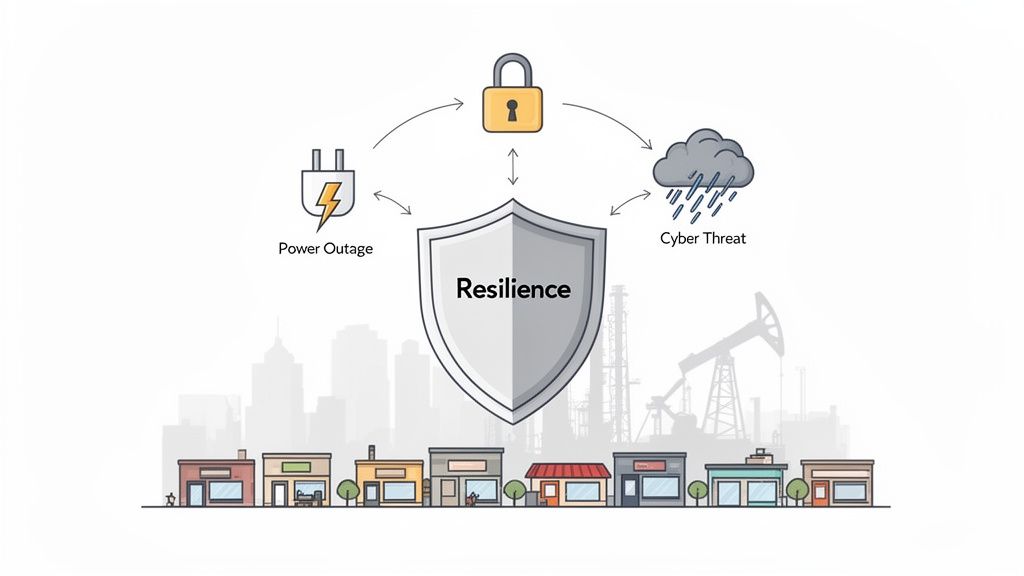
Many business leaders believe having a data backup is the same as having a disaster recovery plan. It’s a common but dangerous misconception. While related, they perform two completely different jobs. A backup is just a copy of your data. Disaster recovery is the entire strategy that gets your business back on its feet after a significant disruption.
Relying solely on basic backups leaves your business exposed to long, painful periods of downtime that can be financially devastating. For the industries that drive Edmonton's economy—like energy, healthcare, and manufacturing—every minute you're offline costs money, customer trust, and reputation.
When your systems are down, the financial damage extends far beyond lost sales. It creates a domino effect:
This is precisely why a proactive backup and disaster recovery Edmonton strategy isn't a cost—it's a critical investment in your company's survival. It's about shifting your mindset from just saving files to ensuring your whole organization can keep running, no matter what happens.
Edmonton’s business landscape is marked by a cautious optimism that can mask serious vulnerabilities. For example, the Edmonton Business Retention and Expansion Study found that while most businesses plan for growth, a staggering 72% expect to be negatively impacted by external forces. This level of uncertainty makes robust operational safeguards essential.
Worse, a recent cybersecurity survey revealed that three out of four organizations still lack a formal disaster recovery plan, leaving them dangerously unprepared.
A true disaster recovery strategy saves your business, not just your data. It’s the playbook that ensures you can get back to serving customers quickly, protecting your revenue and reputation when it matters most.
Modern threats, especially sophisticated cyberattacks, are designed to circumvent simple backup systems. To see how these attacks are specifically targeting local companies, read our guide on ransomware protection in Edmonton. A truly resilient plan must account for these advanced risks to ensure your recovery is both fast and secure.
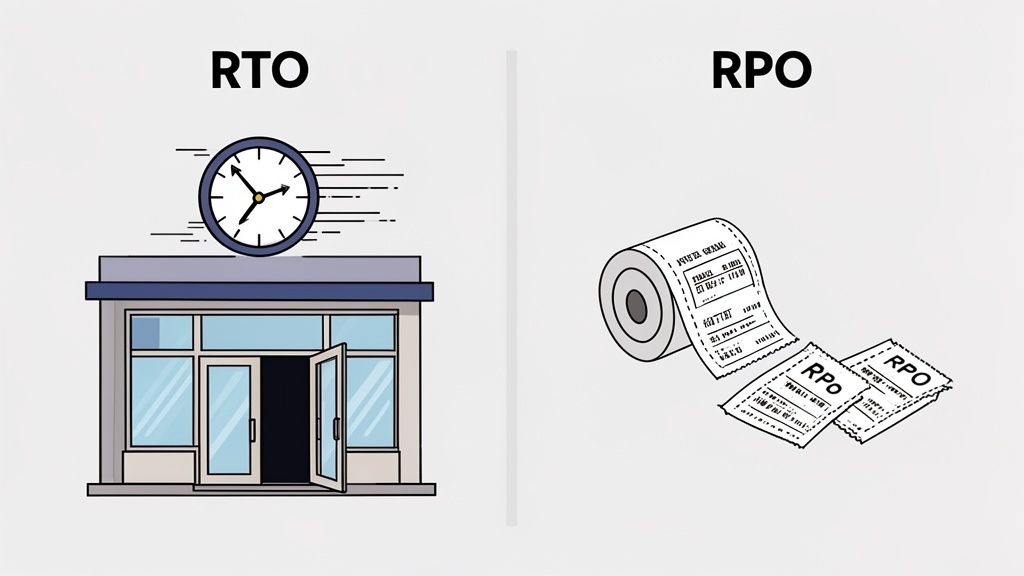
To build a powerful disaster recovery strategy, you first have to understand its core concepts. Two terms are at the heart of every plan: Recovery Time Objective (RTO) and Recovery Point Objective (RPO). These aren’t just technical acronyms; they are the key metrics that will define success or failure when a crisis hits your business.
Imagine your Edmonton business is a busy storefront. A sudden winter storm knocks out the power, and everything grinds to a halt. The first questions that come to mind are the real-world versions of RTO and RPO.
Understanding these concepts is the first step toward creating a plan that actually works. Without them, you’re operating blind, unable to measure whether your backups can truly save your business when it counts.
Your Recovery Time Objective (RTO) answers the first critical question: How long can our doors stay closed before we start losing customers for good?
RTO is all about the speed of your recovery. It’s the maximum acceptable amount of time your business can be offline before the consequences—lost revenue, reputational damage, operational chaos—become unbearable. A shorter RTO means you must get back up and running that much faster.
For an e-commerce site, the RTO might be just a few minutes. For a less critical internal system, it could be several hours or even a full day.
Your Recovery Point Objective (RPO) tackles the second key question: How much transaction data from the last hour are we willing to re-enter manually or lose forever?
RPO is focused on your tolerance for data loss. It measures the maximum amount of data, calculated in time, that you can afford to part with after a disaster. If your RPO is one hour, your backups must run at least every hour, guaranteeing you’ll never lose more than 60 minutes of work.
A financial firm processing transactions might have an RPO of mere seconds, while a marketing team’s project files might be fine with an RPO of 24 hours. As businesses get serious about continuity, using the right tools and software to simplify business continuity planning becomes essential.
To make this crystal clear, let's break down the differences side-by-side.
Understanding both is non-negotiable. One without the other provides an incomplete picture of what you need to protect your business.
The real danger for many businesses isn’t the lack of backups, but the mismatch between their recovery capabilities and their actual operational needs. Defining RTO and RPO closes this gap, turning a vague idea of "backup" into a precise business-saving strategy.
Defining these objectives is critical because it directly dictates the technology and processes you’ll need for your backup and disaster recovery Edmonton plan. Unfortunately, it's a step many businesses overlook.
A recent 60-day test of small business backup systems revealed a shocking 73% failure rate, where systems either failed completely or couldn't restore data in time. A primary cause? The absence of clear RTO and RPO metrics, which left these companies incredibly vulnerable.
Not all data is created equal, so your recovery plan shouldn't treat it that way. Different systems require different levels of protection, known as recovery tiers, based on their unique RTO and RPO.
Here's how it typically breaks down:
By categorizing your systems this way, you can build a cost-effective and practical strategy. You invest heavily in protecting what truly matters while using more standard solutions for less critical data. This tiered approach is a core part of building a resilient plan. For a deeper dive, check out our article on what is business continuity and see how it all connects.
A solid backup and disaster recovery plan for an Edmonton business must be built on a real understanding of the risks you’re actually facing. These aren't just abstract ideas; they’re local realities, shaped by everything from Alberta’s weather to the latest cyber threats. Ignoring these regional factors is like building a house without checking the foundation—sooner or later, you're going to have a problem.
The risks fall into two main categories: physical threats and cyber threats. Both can knock you offline and cause serious data loss, but you need a different strategy for each.
This breakdown shows the main threat categories facing Edmonton businesses today.
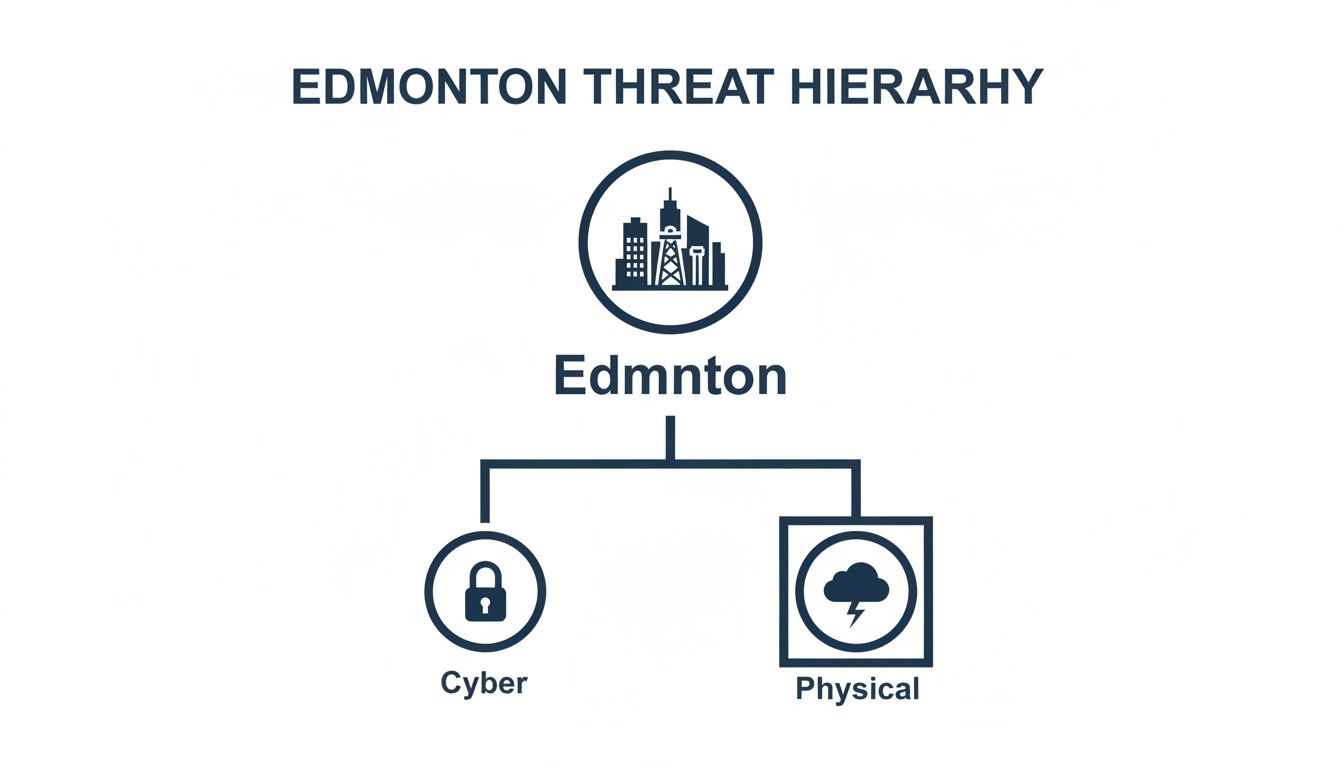
As you can see, the trouble comes from both the digital world and our physical environment. That means your BDR plan has to be ready to tackle both fronts head-on.
Alberta's climate presents unique physical challenges that can directly impact your on-site equipment. A generic BDR plan designed for a milder climate won’t be sufficient when you’re dealing with an Edmonton winter or a sudden summer hailstorm.
The key physical threats to consider include:
These physical risks highlight the vulnerability of keeping backups only on-site. A fire or flood doesn’t just stop your work for a day; it can wipe out both your primary data and your local backup copy, leaving you with nothing.
While you can see physical threats, the risks that hit most often—and hit the hardest financially—are digital. Cybercriminals are becoming more sophisticated, and Canadian businesses are a prime target. Ransomware, in particular, has become a major issue, crippling companies by locking up their files and demanding a large payout.
A successful ransomware attack is, by definition, a disaster. If your backups are connected to your network, they can be encrypted right along with your primary data, making your recovery plan useless when you need it most.
This is exactly why modern BDR strategies insist on air-gapped or immutable backups. These are copies of your data that are completely isolated from your main network and cannot be changed or deleted by an attacker. This guarantees you always have a clean, uninfected version of your data to restore from.
In addition to direct threats, your BDR plan must also meet legal and regulatory requirements. Here in Alberta, how you handle personal information is governed by strict privacy laws, and the penalties for non-compliance are steep.
Key regulations to be aware of are:
A proper disaster recovery plan is a huge part of meeting these compliance duties. It proves you’re being proactive about protecting sensitive data, which shields both your customers and your business from legal complications.
Choosing the right structure for your backup and disaster recovery (BDR) is one of the most important strategic decisions you'll make. This isn't just a technical choice; it directly shapes your budget, how quickly you can recover after an incident, and your company's overall resilience. Each approach strikes a different balance between control, cost, and protection.
Think of your data as your business's most valuable asset. How you protect it comes down to your specific needs and your risk tolerance. There are three main models: keeping it all in-house (on-premise), using a secure off-site service (cloud), or a hybrid approach that smartly combines the two.

Understanding the pros and cons of each will help you build the right framework for your backup and disaster recovery Edmonton strategy, ensuring your plan is a perfect match for your operational goals.
An on-premise BDR solution is like having a high-security safe in your office. You own the hardware, you manage the software, and you have complete physical control over your data backups. For a long time, this was the standard, especially for businesses needing fast local restores or those with strict data sovereignty rules.
However, this model comes with significant trade-offs. The initial capital investment for servers and storage can be substantial, and the ongoing maintenance demands dedicated IT expertise.
The biggest vulnerability of an on-premise-only approach is its exposure to localized disasters. A fire, flood, or major power outage in Edmonton could wipe out both your primary systems and your on-site backups simultaneously, leaving you with no path to recovery.
While it provides total control, the risks and costs associated with on-premise solutions have made them a less common choice for businesses aiming for true disaster resilience. For a deeper comparison of this traditional model against modern alternatives, see our guide on cloud computing vs on-premise infrastructure.
Think of a cloud-based BDR solution as storing your most valuable assets in a secure vault located somewhere else entirely. Your data is backed up to a secure, geographically distant data centre, completely isolating it from any local disasters that might affect your Edmonton office.
This model, often called Disaster Recovery as a Service (DRaaS), offers game-changing advantages:
Cloud solutions offer the ultimate peace of mind. You know a clean copy of your data is always available, no matter what happens at your physical location.
For most Edmonton businesses today, the hybrid model offers the ideal solution. It combines the speed of on-premise backups with the robust security of the cloud, giving you a powerful, multi-layered defence. It’s like having a local safe for quick access and a secure off-site vault for ultimate protection.
Here’s a simple breakdown of how it works:
This dual approach gives you the best of both worlds. You get the near-instant recovery of a local solution for everyday problems and the bulletproof security of an off-site cloud backup for worst-case scenarios. It’s the perfect balance of speed, security, and cost.
To make the decision easier, we've broken down the key differences between the three main BDR architectures. This table provides a side-by-side look to help you determine which model is the best fit for your business in Edmonton.
Ultimately, the hybrid approach is the clear winner for most organizations. It addresses the shortcomings of the other two models by offering a comprehensive solution that prepares you for anything, from a minor file loss to a major catastrophe.
Choosing a managed BDR partner is about much more than the technology they use. It's about trusting an expert team with the survival of your business. In Edmonton, you have options, but not all providers offer the same level of real-world protection or transparency. To see past the sales pitch, you need to ask the right questions and focus on what truly matters for your company’s ability to recover from any disruption.
The right partner becomes an extension of your team, bringing the expertise and infrastructure you need to stay in business, no matter what. The wrong one can leave you with a false sense of security and a failed recovery when you can least afford it.
When you’re meeting with a provider specializing in backup and disaster recovery in Edmonton, your questions need to force them to show proof, not just make promises. Vague answers are a major red flag.
Start with these critical questions:
These questions shift the conversation from a list of features to tangible, real-world outcomes—which is exactly where your focus should be.
A partner’s technical skill is critical, but their understanding of your business—and their local presence—is just as important. You need a team that is not only proficient with the technology but is also responsive and accessible when a crisis occurs.
Look for a provider with a proven track record. A key step in evaluating a managed BDR partner is to review their case studies to see how they've handled real-world situations for businesses like yours. This is where they demonstrate their ability to manage complex recovery scenarios.
A great BDR partner doesn’t just sell you a product; they provide a fully managed service. This includes proactive monitoring, regular testing, and a dedicated team that knows your environment inside and out, ensuring your plan actually works when disaster strikes.
And don't underestimate the value of local support. When your business is on the line, speaking with a support team that understands the Edmonton business landscape—and can provide on-site help if needed—offers priceless peace of mind. To learn more about the benefits of local IT support, check out our guide on choosing the right MSP in Edmonton.
Finally, a transparent pricing model is the hallmark of a partner you can trust. Some providers may try to attract you with a low initial cost, only to surprise you with hidden fees for data recovery, testing, or data overages.
Your agreement should be straightforward and all-inclusive. Here’s what to look for in a clear, value-driven service contract:
By prioritizing transparency, proven expertise, and robust security, you can confidently choose a backup and disaster recovery Edmonton partner who will act as a true ally in protecting your business’s future.
Knowing the theory is one thing, but putting it into action is what will actually protect your business. Building a complete backup and disaster recovery Edmonton plan can feel like a huge undertaking. The best way to tackle it is by breaking it down into smaller, manageable steps.
This checklist is your starting point. Think of it as the groundwork that will give you a crystal-clear picture of your unique risks and most urgent priorities. It turns a daunting project into a straightforward set of actions, giving you the momentum you need to build a truly resilient business.
First things first: you need to figure out what actually keeps your business running. Not all data and systems are created equal, and knowing which ones are indispensable is the foundation of any smart BDR strategy.
Take a moment to list the applications, data, and hardware that your business absolutely cannot operate without for more than a few hours.
Once you have this list, you can start focusing your BDR efforts where they’ll have the biggest impact. This ensures your most valuable assets get the highest level of protection.
To truly grasp the urgency of a BDR plan, you need to attach a real dollar figure to downtime. This isn’t just about the sales you might miss; it’s a full-picture calculation of what an outage would actually cost your organization.
Start with a simple question: what would one hour of downtime cost our business? Now, extend that to a full business day. Be sure to factor in everything.
The cost of downtime goes far beyond immediate lost revenue. It includes lost employee productivity, potential regulatory fines, damage to your brand’s reputation, and the long-term cost of winning back customer trust.
When you calculate this figure, it provides a powerful business case for investing in a proper recovery solution. It instantly reframes your BDR plan from a mere expense into essential insurance against a quantifiable financial disaster.
With a clear picture of what’s at stake, it’s time for an honest look at your current backup methods. Many businesses rely on outdated or incomplete solutions that create a dangerous false sense of security.
Ask yourself and your team these direct questions:
This honest evaluation will almost certainly reveal critical gaps that need immediate attention. Completing this checklist will arm you with the information you need for a much more productive conversation with a professional BDR provider.
Even with a solid plan taking shape, it's natural for business leaders in Edmonton to have a few lingering questions about backup and disaster recovery. Let's tackle some of the most common ones we hear, helping you clear up any final uncertainties and move forward with confidence.
Think of it this way: a simple backup is like having a spare tire in your car. It's a single, useful component that can solve one specific problem—a flat tire.
A complete backup and disaster recovery Edmonton plan, on the other hand, is like having a premium roadside assistance membership. It's the whole service. You get the spare tire, but you also get the expert who knows how to install it, a tow truck if the problem is bigger, and a clear plan to get you safely back on the road, no matter what went wrong. BDR is the entire strategy—the technology, the documented processes, and the expert support—that guarantees your whole business survives a major incident, not just a single lost file.
An untested backup creates a dangerous false sense of security. At an absolute minimum, your BDR provider should run automated, daily checks to confirm that your backups are completing successfully and are not corrupted.
But that's just the start. You should perform full-scale recovery tests at least once a quarter. This is where you actually "spin up" your critical systems in a safe, isolated environment to prove you can meet your RTO and RPO targets. Your provider should be able to provide documented proof that these tests were successful.
A backup strategy isn't finished until it's been tested. Regular, documented recovery drills are the only way to turn a theoretical plan into a proven, reliable safety net for your business.
While a cloud backup is absolutely critical for surviving a local disaster like a fire or flood, relying on it alone can present challenges. Trying to restore a large amount of data from the cloud can be very slow, especially if your internet connection isn't extremely fast. This can make it nearly impossible to meet an aggressive Recovery Time Objective (RTO).
This is precisely why a hybrid approach has become the gold standard for modern BDR. It combines a fast, on-site backup appliance for near-instant restores of individual files or servers with secure, off-site cloud replication for true disaster-level protection. You get the best of both worlds: incredible speed for day-to-day issues and bulletproof resilience for major catastrophes.
Ready to build a BDR plan that protects your business from any disruption? The experts at CloudOrbis Inc. can design a resilient and reliable strategy tailored to your Edmonton operations. Contact us today for a complimentary assessment.
September 24, 2026
Helpdesk vs Service Desk: Choosing the Right IT SupportHelpdesk vs service desk: understand the key differences and choose the right IT support model for your organization in 2026.
Read Full Post
September 23, 2026
DDoS Protection for Canadian SMBs: What Works in 2026Learn what DDoS protection really does, the latest Canada-specific threats, and a practical playbook for small and mid-sized businesses
Read Full Post
September 22, 2026
Security Audit Services Guide for SMBs in CanadaDiscover why security audit services are vital for Canadian SMBs. Explore typical scope, deliverables, timelines, and tips to choose the right provider.
Read Full Post
