

September 26, 2026
On-Premise to Cloud Migration Checklist: 10 StepsUse this on-premise to cloud migration checklist to plan assessment, compliance, backups, sequencing, testing, cutover, and optimization for SMBs.
Read Full Post%20(1).webp)
Usman Malik
Chief Executive Officer
December 29, 2025
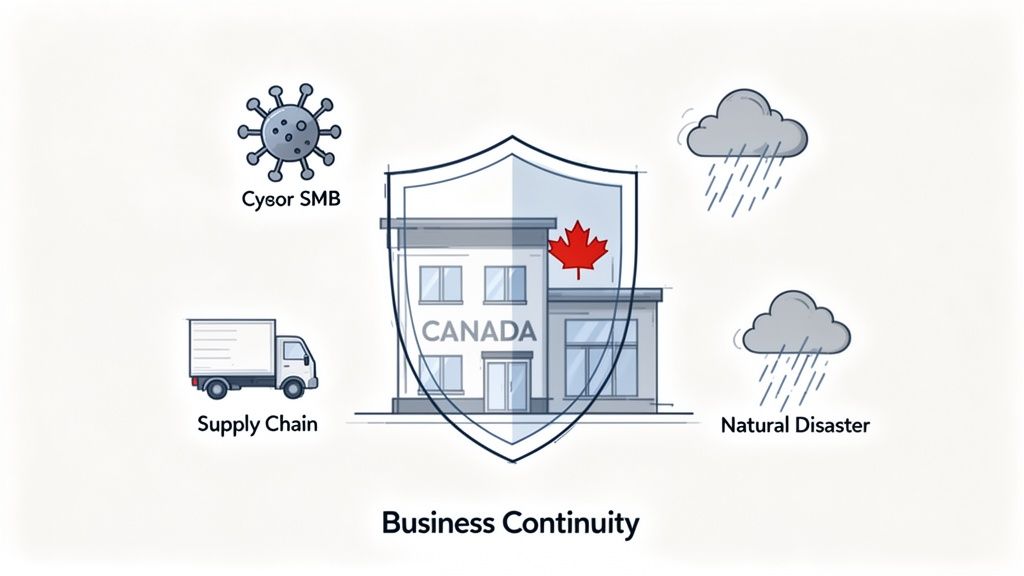
Business continuity is your organization’s strategic plan for staying operational through any disruption. It’s the framework that ensures you can keep serving clients and generating revenue during unexpected events like cyberattacks, supply chain failures, or natural disasters. Think of it as a proactive shield that protects your people, processes, and technology, safeguarding your operations and reputation when things go wrong.
It’s easy to confuse business continuity with having an emergency fire extinguisher on the wall. While that extinguisher is vital for reacting to a fire, business continuity is more like having a comprehensive fire-prevention system for the entire building. It’s the sprinklers, alarms, and pre-planned escape routes that work around the clock to minimize the chance and impact of a fire in the first place.
This is the key difference: business continuity isn't just about recovering after a disaster; it's about building resilience directly into your operations so you can withstand disruptions with as little downtime as possible.
For medium-sized Canadian businesses, especially those in critical sectors like manufacturing, healthcare, or legal services, a "wait and see" approach is a significant gamble. The biggest interruptions today often don't come from storms or floods—they come in digital form.
Cybersecurity incidents are one of the biggest threats to keeping a business running. Recent findings are stark, showing that over 85% of Canadian organizations were hit by successful cyberattacks in a single year. The average cost of a ransomware incident alone is nearly $2 million.
These attacks don't just steal data; they bring operations to a grinding halt for days or even weeks, causing financial and reputational damage that’s hard to come back from.
This is why a proactive mindset is so crucial. Every moment of downtime has a direct cost, translating to lost revenue, plummeting productivity, and eroding customer trust. A solid business continuity plan forces you to answer the tough questions before a crisis hits.
At its heart, business continuity planning helps you determine two key metrics that define your organization’s resilience:
Recovery Time Objective (RTO): This is the absolute maximum time your business can afford to be without a specific function or application. For example, your manufacturing plant's control system might have an RTO of just one hour, but a less critical internal reporting tool could likely wait 24 hours.
Recovery Point Objective (RPO): This metric defines the maximum amount of data you can stand to lose. If your RPO for customer orders is 15 minutes, your systems must be backed up at least that often to ensure you don’t lose more than a quarter-hour of transaction data if something goes wrong.
To get these core concepts down, here's a quick reference table.
This table breaks down the fundamental terms every business and IT leader should know to build a resilient operation.
Understanding these pillars is the first real step toward building a business that can weather any storm.
A business continuity plan is your organization’s commitment to its customers, employees, and stakeholders. It demonstrates that you are prepared to maintain service and protect valuable assets, no matter what challenges arise.
As we’ve all seen with recent global events, being technologically prepared for widespread disruption is no longer just a good idea—it's essential. Our guide on ensuring your business technology is ready for a pandemic offers deeper insights into this very challenge.
Ultimately, business continuity is about ensuring your organization not only survives but thrives, even in the face of adversity.
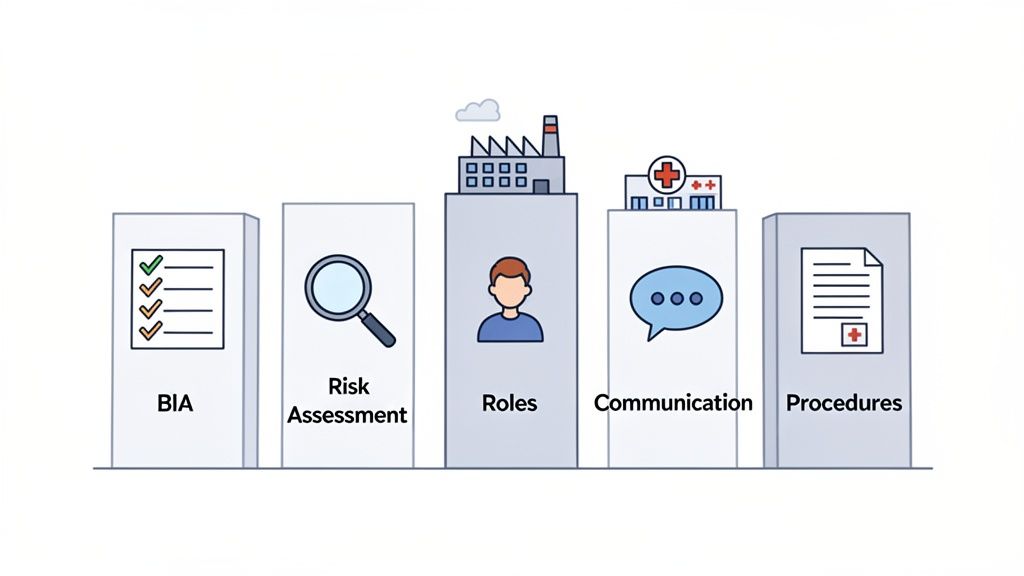
A solid Business Continuity Plan (BCP) is more than just a document you file away and forget. It's a living strategy built on critical pillars that work together to keep you operational. Understanding business continuity means breaking down these essential parts. Each one provides a clear piece of the roadmap for building real resilience.
Think of it like building a house. You wouldn't throw up walls without a solid foundation and a detailed blueprint. Every component of your BCP serves a specific purpose, ensuring the final structure is strong enough to handle any storm that comes your way.
The first, and arguably most important, step is the Business Impact Analysis (BIA). This is where you dig deep to identify which of your business functions are absolutely essential. It’s a discovery process that helps you understand the true, bottom-line consequences if any part of your organization goes down.
A BIA forces you to prioritize. For a manufacturing firm, the production line's control system is non-negotiable; it has to be restored almost instantly. For a law practice, uninterrupted access to client files and case management software is everything. By mapping out these critical functions, you create a clear pecking order for recovery.
This analysis gives you the hard data needed to set your Recovery Time Objectives (RTOs) and Recovery Point Objectives (RPOs) for each process. It answers the fundamental question: "What do we need back online first, and how quickly?"
Once you know what’s most important, the next step is figuring out what could go wrong. A Risk Assessment is your chance to systematically pinpoint potential threats to your business, then weigh their likelihood and potential impact.
These threats can come from anywhere:
By identifying these risks, you can develop targeted strategies to deal with them. For example, the risk of a server failure is best handled with redundant hardware and solid data backups. To protect your priceless data and ensure a quick recovery, setting up cloud backup for business continuity is a vital piece of the puzzle.
A plan is useless if nobody knows who’s supposed to do what when a crisis hits. A core part of any BCP is establishing crystal-clear roles, responsibilities, and a chain of command. This removes guesswork when a disruption happens.
Your BCP should name a specific crisis management team, outlining each person’s duties—from technical recovery to stakeholder communication. This clarity prevents panic and allows for a coordinated, effective response.
Just as important is your Crisis Communication Plan. How will you inform your employees, customers, and suppliers about what’s happening? The plan needs to include pre-approved message templates and designated channels to ensure information is timely, accurate, and consistent.
Finally, you must document your Emergency Procedures in a clear, easy-to-follow format. These are the step-by-step playbooks your team will use to execute the plan. They need to be straightforward enough for someone to understand even under immense pressure. Documenting everything—from how to failover to a backup system to the location of an alternate worksite—is what makes the entire process actionable.
It's a common mistake to use "business continuity" and "disaster recovery" as if they mean the same thing. While they're related, this mix-up can leave dangerous gaps in your company's ability to weather a storm. Getting the distinction right is the first step toward building a truly resilient organization.
The easiest way to think about it is with a health analogy. Business Continuity (BC) is your total wellness plan. It’s the proactive, day-in-day-out actions—your diet, exercise, and regular check-ups—all designed to keep you healthy and functioning at your peak.
Disaster Recovery (DR), on the other hand, is the emergency surgery you need after a bad accident. It’s a specific, reactive procedure focused on fixing a critical injury (like a server meltdown or a ransomware attack) so you can get back on your feet. It's absolutely vital, but it's only one piece of a much larger health picture.
The biggest difference comes down to scope. Business continuity is a big-picture, organization-wide strategy. It’s concerned with keeping every critical part of your business running through a disruption—that includes your people, your processes, and your technology. It answers the fundamental question: "How do we keep serving our customers and generating revenue when things go wrong?"
Disaster recovery is a much narrower slice of that pie, focused almost entirely on the IT department. Its job is to restore your tech infrastructure—servers, networks, applications, and data—after a crisis hits. While BC is strategic and proactive, DR is technical and reactive.
An organization can have a flawless disaster recovery plan for its data centre, but if there's no strategy for getting employees to a backup work location or keeping clients in the loop, the business will still grind to a halt. This is why a complete BC plan is non-negotiable.
A solid continuity plan always includes disaster recovery as a key component, but it doesn't stop there. It also covers crisis management, communications plans, and operational workarounds.
To sharpen the distinction, let's look at what each one measures. Business continuity works to maintain a minimum acceptable level of service across all essential business functions. You measure its success by how little the disruption affects the overall business.
In contrast, a disaster recovery plan is judged by technical metrics. How quickly can we get systems back online (Recovery Time Objective, or RTO)? How much data can we afford to lose (Recovery Point Objective, or RPO)? If you want to dive deeper into these metrics, check out our guide to building a resilient disaster recovery plan.
This table puts it all side-by-side to highlight their unique roles.
A side-by-side look at two related but distinct resilience strategies.
At the end of the day, disaster recovery is a critical tool in your toolbox, but business continuity is the entire workshop. A DR plan gets your servers running again, but a BC plan ensures your business survives.
The idea of creating a Business Continuity Plan (BCP) from scratch can feel like a huge undertaking. But when you break it down into clear, manageable steps, it’s a straightforward process. A well-thought-out plan is what separates an organization that stumbles in a crisis from one that stands strong. The goal isn't to create a dusty binder for a shelf, but a practical, living document your team can use when things go wrong.
Building this plan is not just an IT task; it needs input from across your entire organization to ensure every critical function is covered. From the initial analysis to the final rollout, each step builds on the last, creating a solid foundation for your company's resilience.
This flowchart shows the typical flow of business continuity, moving from proactive planning to reactive recovery during a disruption.
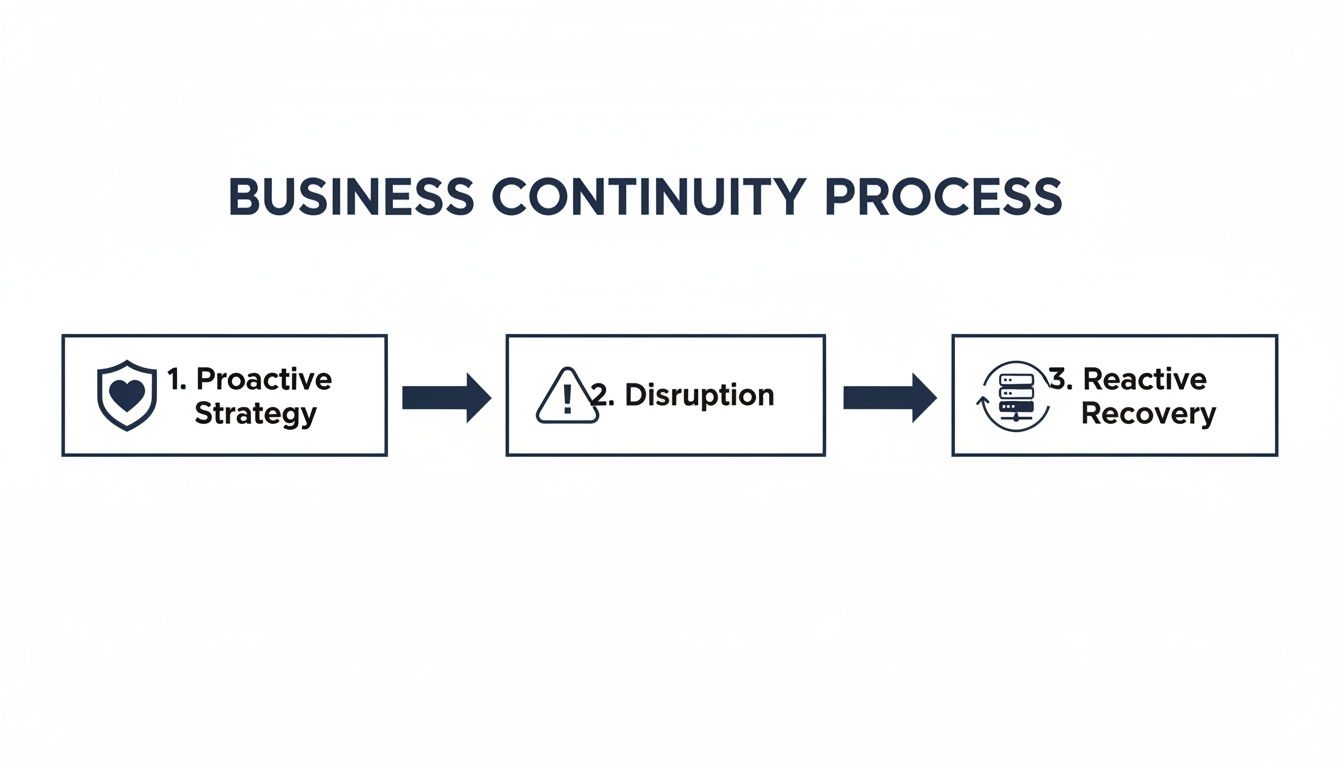
As you can see, a successful strategy involves both preparing for disruptions and having a swift, organized way to recover when they happen.
Your first move should be to put together a dedicated continuity team. This is the group that will steer the ship—developing, implementing, and maintaining the BCP. It’s absolutely critical that this team includes people from different departments. Think beyond IT to include operations, finance, HR, and communications.
A cross-functional team ensures all the crucial parts of your business are considered. For example, a law firm's team needs input from lawyers who understand client data confidentiality, while a manufacturer needs insights from the plant floor manager. This mix of expertise is what makes a plan work in the real world.
With your team in place, it’s time to conduct a Business Impact Analysis (BIA). As we touched on earlier, this process pinpoints your most critical business functions and spells out the financial and operational hit you’d take if they went down. The BIA is the bedrock of your plan, telling you exactly what to prioritize for recovery.
Right after the BIA, you will run a Risk Assessment to identify potential threats to those critical functions. These risks can be anything from server crashes and cyberattacks to physical threats like a fire or a major power outage. For each risk, you’ll evaluate its likelihood and potential impact, which helps you focus your resources where they’ll do the most good.
Now you can get to work building the plan itself. This document needs to be clear, concise, and easy for anyone to follow during a high-stress situation. Avoid technical jargon and focus on simple, actionable instructions.
Your documented plan should cover several key areas:
If you want some inspiration on what a finished document can look like, checking out some practical business continuity plan examples can help guide your structure.
A plan is only as good as the tools and training behind it. This is where you put the necessary IT controls and recovery solutions into place. This often means setting up robust cloud backup strategies, investing in redundant systems, and ensuring your team can work remotely without a hitch.
Once the technology is set, you have to train your staff. Everyone in your organization, from the executive team to front-line employees, should understand their role in the BCP. Run regular training sessions and drills so the plan feels familiar and everyone knows exactly what to do when a disruption hits. For a practical roadmap to implementing your own strategies, explore Your Guide to Business Continuity Planning Steps. This will help ensure your team is ready to act decisively.
Putting the finishing touches on your Business Continuity Plan (BCP) feels like a major accomplishment. And it is. But here’s the thing: it’s only the beginning. Without regular testing and ongoing maintenance, even the most carefully crafted plan can become irrelevant, failing you right when you need it most. Your BCP must be a living document, not a file you archive and forget.
This cycle of testing and updating is what transforms your plan from a theoretical exercise into a practical, reliable tool. It’s how you uncover hidden gaps, correct flawed assumptions, and ensure your team is truly ready to act. An untested plan isn't really a plan at all—it's a gamble.
With today’s rapidly shifting threats, this diligence is more critical than ever. It's surprising, but a recent analysis found that 60% of Canadian organizations test their business continuity plans just once a year, or even less. This leaves many medium-sized businesses exposed to evolving threats like sophisticated ransomware, power outages, and supply chain breakdowns. As you can discover in more detail from this strategic guide for Canadian leaders, many of these plans haven’t been updated since before the pandemic, leaving significant cyber risks completely unaddressed.
Testing isn't a one-size-fits-all deal. Different methods serve different purposes, from simple reviews to full-blown simulations. The key is to use a mix of approaches to check every part of your plan, from the technical systems to the human responses.
Here are a few common ways to put your plan through its paces:
A BCP that isn’t updated regularly suffers from what we call "plan rot"—the slow decay of a once-solid plan into something outdated and useless. To stop this from happening, you need to build a maintenance schedule directly into your continuity strategy.
Your business continuity plan should be a dynamic tool that evolves alongside your organization. Schedule formal reviews at least annually, or any time there is a significant change to your operations, technology, or key personnel.
This proactive approach ensures your plan always reflects the current reality of your business. Did you just implement a new CRM system? The plan needs to be updated with its recovery procedures. Changed your data backup strategy? That needs to be reflected in the BCP, too. For a deeper dive on that topic, our comprehensive data backup and recovery guide offers essential insights for modern businesses.
Ultimately, consistent testing and maintenance are what give your business continuity plan its real power. It’s what provides you the confidence that when a disruption hits, your team won’t be scrambling with an obsolete document—they’ll be executing a proven, up-to-date strategy to keep the business running.
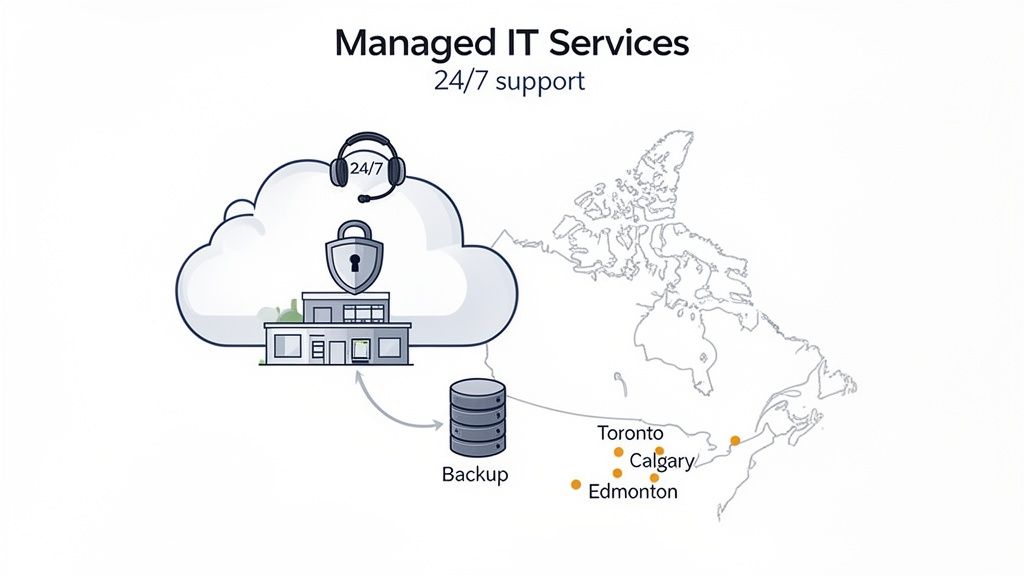
This is where a business continuity strategy stops being a document and becomes a real-world, operational shield. For many medium-sized organizations, having the in-house technical expertise and round-the-clock resources needed to execute a solid BCP is a huge challenge. Partnering with a managed IT services provider (MSP) bridges that gap, giving your plan the technological backbone it needs to work.
An expert MSP is essentially your dedicated continuity team, translating your strategic goals into technical action. From setting up resilient data backup and disaster recovery solutions to providing strategic guidance, they ensure your IT infrastructure isn't just running—it's fundamentally built to withstand disruption. This proactive approach transforms your plan from a reactive checklist into a system designed for uptime.
The best way to deal with a disruption is to prevent it from happening in the first place. Managed IT services bring advanced cybersecurity measures to the table that are often too complex or expensive for an in-house team to handle alone. This includes continuous threat monitoring, vulnerability assessments, and endpoint protection designed to neutralize threats before they can impact your operations.
This preventative layer is a core part of modern business continuity. It includes:
A partnership with an MSP means your business gets enterprise-grade resilience without the enterprise-level price tag. It frees you up to focus on growth, knowing your operations are protected by a dedicated team of experts.
When a crisis hits, every second counts. Having a 100% Canada-based, 24/7 helpdesk gives you immediate access to expert support right when you need it most. Whether it’s a server failure in Calgary or a network outage in Toronto, your team can get immediate help to start recovery procedures, reducing downtime and confusion.
For medium-sized organizations across Canada, this level of support is a game-changer. By exploring the benefits of managed IT services, you can see how this kind of partnership delivers the peace of mind needed to protect your operations and build a truly resilient organization.
When you start digging into business continuity, many practical questions come up. We hear them all the time from business and IT leaders trying to get it right. Let's tackle some of the most common ones to clarify things and help you move forward.
The short answer? More often than you think. For the big picture, a full-scale test—like a tabletop exercise where you walk through a scenario or a complete simulation—should happen at least once a year. This keeps the overall strategy sharp and ensures everyone knows their role when things go sideways.
But don't stop there. The technical components need more frequent attention. You should be testing your data backup restores quarterly, if not monthly, to be absolutely certain they work. Regular testing is what keeps your BCP from becoming a forgotten document on a shelf; it makes it a living, reliable tool.
By far, the most common mistake is treating the Business Continuity Plan as a one-and-done project. So many organizations pour time and energy into creating a plan, only to file it away and never look at it again. This "set it and forget it" mindset is a recipe for disaster.
A BCP must be a living document. Your technology, your team, your processes, and the threats you face are all constantly changing. Your plan needs to change with them through regular reviews, tests, and updates. An outdated plan is almost as bad as having no plan at all—it gives you a false sense of security while leaving the door wide open to risk.
The real value of a BCP isn't in writing it down once. It's in the continuous cycle of testing, learning, and improving. An agile, up-to-date plan is your strongest defence against disruption.
Absolutely. In fact, the better question is, "Can you afford not to have one?" Think about the real costs of being knocked offline for a few days or weeks—the lost sales, the angry customers, the damage to your reputation. Those costs almost always dwarf the investment in proactive planning.
Besides, a business continuity plan is completely scalable. For a medium-sized business, this isn't about a massive, bank-breaking overhaul. It starts with the fundamentals: determining which operations are absolutely mission-critical, setting up reliable cloud backups for your essential data, and creating a simple communication tree for your team and clients.
You don't have to boil the ocean. Focus on the areas with the highest impact first and build out from there. Even a basic, well-thought-out plan provides an incredible amount of resilience, making it one of the smartest investments you can make in your company’s future.
A robust business continuity plan is the foundation of a resilient modern business. At CloudOrbis Inc., we provide the managed IT services and strategic guidance to build, implement, and maintain a BCP that protects your operations and supports your growth.
September 26, 2026
On-Premise to Cloud Migration Checklist: 10 StepsUse this on-premise to cloud migration checklist to plan assessment, compliance, backups, sequencing, testing, cutover, and optimization for SMBs.
Read Full Post
September 25, 2026
Is VoIP Good for Small Business in Canada? a 2026 GuideIs VoIP good for small business in Canada? Explore costs, benefits, reliability, security, and migration tips for SMBs considering VoIP in 2026.
Read Full Post
September 24, 2026
Helpdesk vs Service Desk: Choosing the Right IT SupportHelpdesk vs service desk: understand the key differences and choose the right IT support model for your organization in 2026.
Read Full Post
