

September 23, 2026
DDoS Protection for Canadian SMBs: What Works in 2026Learn what DDoS protection really does, the latest Canada-specific threats, and a practical playbook for small and mid-sized businesses
Read Full Post%20(1).webp)
Usman Malik
Chief Executive Officer
September 24, 2026
Most advice on helpdesk vs service desk starts in the wrong place. It compares ticketing platforms, dashboards, asset views, and service-level features, as though a new tool will solve an organisation's support problems. It won't. The decision is what you're paying skilled people to do every day: close repetitive tickets, or prevent recurring incidents and manage IT as a business service.
That distinction matters in Canada, where Job Bank reports a national median wage of $31.47 per hour for help desk technicians, with provincial medians ranging from $26.00 in Nova Scotia to $34.18 in Yukon and $33.65 in British Columbia (Government of Canada Job Bank data). Labour capacity is expensive. Wasting it on avoidable password resets, printer restarts, and repeated Microsoft 365 fixes creates process debt that no ITSM licence can erase.
For leaders evaluating the benefits of managed IT services, the more useful question is simple: Do you need faster reactions, or a system that reduces the number and business impact of reactions? The answer should determine your support model.
A helpdesk and a service desk can both answer the phone, log a ticket, and restore a user's access. That surface similarity creates confusion, but it hides a major operational difference. The helpdesk usually optimises the individual interaction. The service desk manages the pattern behind those interactions.
A ticket that says “the VPN failed again” looks like an incident to a reactive team. A service-desk team asks whether the same user, device, configuration, or network path has caused similar incidents. It records the relationship, identifies the underlying problem, and routes a controlled change when the fix requires more than another workaround.
The practical distinction: a helpdesk spends its capacity responding to demand, while a service desk uses support data to reduce demand and control service delivery.
This is why the labour-economics angle matters more than the software comparison. A technician who repeatedly resolves the same issue is providing value in the moment, but the organisation continues paying for the same interruption. A service desk assigns ownership for problem management, knowledge, change, and service quality so that technical labour creates a lasting operational benefit.
Customer experience still matters. A support model should make users feel heard, informed, and able to get back to work, which is why guidance on what great customer service means in 2026 is useful beyond consumer contact centres. However, good communication can't compensate for weak ownership. A friendly technician who closes a recurring ticket without recording the cause leaves the business exposed to the next occurrence.
For a Canadian SMB, the choice becomes especially important when an internal generalist is already overloaded. That person may have enough technical skill to solve incidents, but not enough uninterrupted time to maintain a service catalogue, review recurring issues, document changes, and improve user workflows. The right external model should protect that capacity, not merely add another inbox.
The clearest distinction comes from scope. Canadian discussions commonly describe a helpdesk as a reactive, ticket-driven function focused on incident resolution, while a service desk acts as the broader single point of contact for users. The service desk covers incidents, problems, requests, and changes through an ITIL 4-informed operating model (Canadian helpdesk and service desk comparison).
A helpdesk receives a user's problem and works towards a practical resolution. Common examples include:
Its success measures tend to focus on first-contact resolution, response time, ticket volume, and closure speed. Those measures are useful when the organisation needs a fast response to straightforward incidents. They become limiting when the team closes tickets without learning from them.
A helpdesk can still be well organised. It can use a portal, remote support, escalation rules, and a knowledge base. The label alone doesn't determine quality. The important question is whether the team owns only the immediate fix or also the recurring cause and the service affected.
A service desk remains the user's front door, but it connects support activity to the wider IT environment. It manages incident management, problem management, service requests, change management, knowledge, service levels, and configuration information.
That broader remit changes the team's work. A request for a new employee is no longer an email that someone remembers to action. It becomes a repeatable workflow involving approval, equipment, identity, licensing, security, and onboarding. A recurring application failure becomes a problem record, not merely another incident number.
British Columbia's Service BC Help Desk illustrates the public-sector version of this broader access model. It offers defined support hours, toll-free access across Canada and the USA, and multiple contact methods, including telephone, video relay service, and TDD (Service BC Help Desk information). The example demonstrates how service boundaries, accessibility, and channels shape the support experience.
A helpdesk fixes the user's immediate problem. A service desk manages the service, the process, and the recurring risk behind it.
For a practical introduction to the narrower support function, see help desk support for IT environments. Then ask whether your organisation needs that function alone, or needs someone to govern the work surrounding it.
The wrong way to compare the models is to count features. A basic ticketing system can include fields called “problem” and “change” without giving anyone authority, time, or discipline to use them. Conversely, a modest platform can support a genuine service desk if the organisation has clear ownership and repeatable workflows.
| Dimension | Helpdesk | Service Desk |
|---|---|---|
| Scope | Individual incidents and straightforward requests | The full service catalogue, including incidents, problems, requests, and changes |
| KPIs | First-contact resolution, response time, ticket closure | SLA attainment, customer satisfaction, resolution performance, recurring-issue reduction, and service quality |
| Tooling | Ticketing, email, phone, and remote-control tools | ITSM platform, knowledge base, configuration information, change workflows, reporting, and service catalogue |
| Ownership | Primarily IT-owned, with limited business involvement | Shared ownership between IT and business stakeholders |
| Commercial model | Per-ticket, hourly, or break-fix billing | Per-user, per-device, or monthly managed-service retainer |
Scope determines what gets fixed. A helpdesk can restore a workstation while leaving the onboarding process, access policy, or application dependency untouched. A service desk treats those connected activities as part of the service and assigns them a defined path.
KPIs determine what gets rewarded. A team measured only on tickets closed has a reason to prioritise speed over prevention. A service desk adds measures that show whether users receive reliable service and whether the organisation is controlling recurring demand.
Tooling supports the operating model, but doesn't create it. Configuration information helps technicians understand which device, application, identity, and dependency are involved. Without reliable records, a service desk often becomes a glorified helpdesk, regardless of the licence displayed on the platform. Teams building a tiered support model can also review CloudOrbis support tier 1 services as a reference point for front-line responsibilities.
The ownership row is the one leaders often miss. A service desk needs business input on priorities, acceptable downtime, security requirements, and service expectations. IT can't define meaningful service levels in isolation. The finance, operations, legal, and executive teams all experience the consequences of support decisions.
Cost follows the commercial model, but it shouldn't lead the decision. A low per-ticket price can look attractive until the same recurring issue generates another ticket, another interruption, and another escalation. A monthly service-desk retainer costs more predictably, but its value depends on whether the provider performs process work rather than moving tickets between queues.
The right model changes with the work, not with the company's headcount alone. Three Canadian examples show why a small organisation can need structured service management, while another can sensibly stay with a lean helpdesk.
| SMB Scenario | Headcount & Region | Dominant Pressure | Right Model | Why It Wins |
|---|---|---|---|---|
| Dental clinic | 25 employees, Mississauga | Simple incidents and limited downtime | Lean helpdesk | Low process dependency keeps support practical and affordable |
| Food manufacturer | 60 employees, Mississauga | HACCP, BRC, traceability, and audit records | Service desk | Controlled changes and documented workflows support operational assurance |
| Law firm | 40 employees, Toronto | Compliance, mobility, and after-hours deadlines | Service desk, often co-managed | Ownership, secure access, and escalation matter more than ticket closure speed |
The dental clinic is the clearest case for restraint. If most requests involve a small set of predictable devices and applications, and the practice can tolerate occasional planned intervention, a lean helpdesk may be enough. Forcing a full service-desk process onto every minor request can add administration without reducing meaningful risk.
The food manufacturer has a different operating pattern. A change to production systems, user access, devices, or network services may affect traceability and audit evidence. The service desk provides a place to document the request, approval, implementation, and outcome. A break-fix queue may restore service quickly, but it won't reliably prove who changed what, why the change was approved, or whether the procedure was followed.
The Toronto law firm lives between those extremes. Lawyers and support staff may work remotely, travel between client sites, and face deadlines outside ordinary office hours. The firm needs more than a fast password reset. It needs controlled access, mobile support, escalation, and a clear record of incidents involving confidential information.
Canadian wage data sharpen the decision. With the national help desk technician median at $31.47 per hour (Job Bank wage data), leadership should ask whether that capacity is being used for repeatable service improvement or consumed by avoidable tickets.
The deciding signals are ticket predictability, compliance burden, and mobility intensity. Low scores across all three favour a helpdesk. High scores in any two usually justify service-desk discipline.
24/7 Canada-based support isn't automatically better because it operates around the clock. It becomes strategically useful when the provider combines availability with jurisdictional accountability, context, and a credible escalation path.
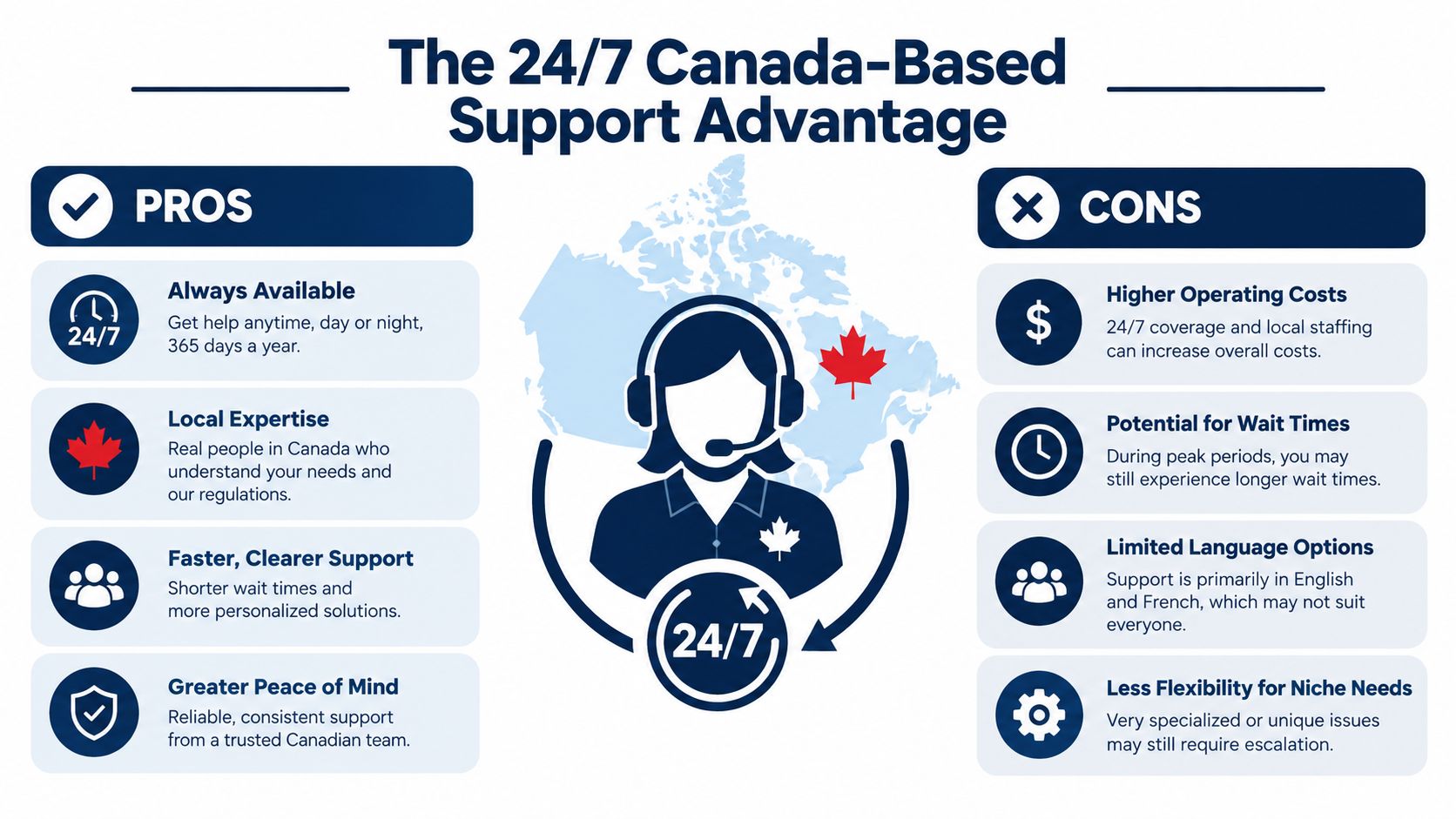
An incident that starts overnight can either be contained before staff arrive or become a morning outage. A Canadian Level 1 analyst who answers promptly can verify impact, apply an approved fix, notify the right owner, and escalate with useful context. A generic queue that accepts a ticket but leaves it waiting until another region opens has provided access, not necessarily support.
The distinction matters most for payroll, clinical systems, manufacturing operations, customer-facing applications, and remote workers. The provider must define what “24/7” means, including phone coverage, monitoring, triage, escalation, and communication. Tier 1 network support should be judged by those operating details rather than by the label alone.
Canadian organisations may need to consider PIPEDA, PHIPA, provincial health privacy requirements, contractual controls, and internal data-handling rules. The location and jurisdiction of support activity can therefore become a governance question, especially when technicians access or record information connected to users, devices, applications, or incidents.
A Canada-based queue can also reduce contextual friction. Staff familiar with Quebec French, bilingual provincial forms, Canadian banking workflows, and CRA-related processes are less likely to treat local requirements as unusual exceptions. That doesn't replace legal advice or formal compliance controls, but it can make day-to-day escalation more accurate.
A front-line analyst is useful only if the next layer responds. A mature 24/7 model passes the incident to a co-managed engineer, internal IT lead, security specialist, or application owner with the evidence already gathered. The handoff should preserve the timeline, affected service, actions taken, business impact, and current risk.
Pure 24/7 in-house coverage is uneconomic for many SMBs. That is why the practical answer is usually a co-managed arrangement, where the business keeps strategic control while an external Canadian service desk absorbs front-line and after-hours work.
For most growth-stage Canadian SMBs, co-managed IT is the more realistic path. It recognises that an internal IT lead often knows the business, vendors, applications, and risk tolerance better than an external provider, while also recognising that one or two people can't provide continuous front-line coverage and strategic improvement at the same time.
In a co-managed model, the internal IT lead or small team keeps ownership of the environment, roadmap, vendor relationships, and major decisions. A Canada-based service desk handles tier-1 tickets, after-hours coverage, routine workflows, documentation, and ITSM process execution. The internal team receives cleaner escalations instead of an unfiltered stream of user requests.
A fully managed service desk goes further. The MSP owns the operating stack and effectively provides the organisation's IT department. That can simplify accountability, particularly when there is no internal technical owner, but the client must accept less direct control over daily technical decisions.
The pricing context reinforces the distinction. Canadian co-managed service-desk coverage generally starts around CA$160 per user per month, while fully managed service-desk coverage starts around CA$180 per user per month. A CIS-aligned security tier is near CA$230, and a 50-seat firm would budget roughly CA$9,000 per month at the middle band, according to Canadian managed-service pricing guidance (Canadian service-desk pricing context).
Those figures are not interchangeable quotes. Scope, security requirements, licensing, device coverage, and escalation depth change the commercial outcome. They do show why leaders should compare operating responsibility, not just the monthly line item.
| Dimension | Co-Managed Service Desk | Fully Managed Service Desk |
|---|---|---|
| Strategic ownership | Internal IT retains roadmap and key decisions | MSP owns most IT operations and planning |
| Front-line coverage | External desk absorbs tier-1 and after-hours demand | MSP provides front-line through strategic coverage |
| Internal capability | Requires an accountable IT owner | Suitable when internal IT leadership is limited |
| Control | Shared control and defined escalation | More centralised provider control |
| Main failure mode | No internal owner sets priorities or resolves conflicts | Client expects deep control while outsourcing accountability |
The control question is more important than the cost question: Who should decide, who should execute, and who should be accountable when the service fails? A co-managed arrangement breaks down when no one inside the business owns direction. Fully managed breaks down when leaders outsource execution but still expect to direct every security and cloud decision.
Businesses considering that boundary can review co-managed IT services in Edmonton for a practical example of the model's positioning.
Treat this choice as a labour-economics decision, not a tooling purchase. Start with the workload. Review a representative sample of recent support requests and classify each as a one-off incident, recurring problem, service request, planned change, or compliance activity. Then identify who owns the outcome after the ticket closes. That process exposes the staff time and process debt each model must absorb.
Does the work stay reactive? A helpdesk fits simple, isolated, predictable requests. Recurring causes require problem management, documented fixes, and time for prevention.
How much process dependency exists? Onboarding, access reviews, device allocation, application changes, and vendor handoffs need repeatable workflows and accountable approvals. An inbox-based model shifts that work onto internal employees, often without tracking the labour involved.
What regulated information and audit obligations are involved? Clinics, law firms, manufacturers, and finance businesses may need traceability even when ticket volume remains modest. Audit evidence, approval records, and access history add work that a basic helpdesk may not cover.
What happens during an after-hours incident? If a one-hour outage affects production, patient care, client deadlines, or revenue-generating systems, define availability and escalation before selecting a provider.
Use the answers to choose among three practical paths.
| Business Profile | Recommended Model | Indicative Monthly Cost (CAD) | Key Trade-Off |
|---|---|---|---|
| Fewer than 20 endpoints, low process dependency, mostly break-fix work | Pure break-fix helpdesk | Per-ticket or break-fix pricing | Lower commitment, but limited prevention and predictability |
| Regulated or continuous operations with little internal IT leadership | Fully managed service desk | From CA$180 per user per month | Stronger operational coverage, with less direct control |
| Growth-stage SMB with one or two IT generalists | Co-managed service desk | From CA$160 per user per month | Shared accountability requires a clear internal owner |
These figures are planning references, not a universal rate card. Confirm endpoint coverage, response targets, escalation, security responsibilities, and project work before signing. A review of managed IT support services can help structure that provider discussion.
CloudOrbis offers a 24/7, Canada-based helpdesk alongside co-managed service-desk support. The practical next step is a no-obligation scoping call that maps ticket patterns, compliance exposure, escalation needs, and internal ownership. Choose a lean helpdesk, fully managed service desk, or hybrid model only after those responsibilities are explicit.
CloudOrbis Inc. helps Canadian SMBs move from break-fix support to structured, 24/7 Canada-based helpdesk and co-managed IT operations. Visit CloudOrbis Inc. to request a no-obligation conversation about the support model that fits your workload, risk, and internal team.
September 23, 2026
DDoS Protection for Canadian SMBs: What Works in 2026Learn what DDoS protection really does, the latest Canada-specific threats, and a practical playbook for small and mid-sized businesses
Read Full Post
September 22, 2026
Security Audit Services Guide for SMBs in CanadaDiscover why security audit services are vital for Canadian SMBs. Explore typical scope, deliverables, timelines, and tips to choose the right provider.
Read Full Post
September 21, 2026
Secure File Sharing Guide for Canadian BusinessesLearn secure file sharing essentials for Canadian SMBs — encryption, compliance, protocols and best practices to protect data and stay compliant.
Read Full Post
