Your Guide to a Help Desk for IT Support That Boosts Business
Discover how a modern help desk for it support can transform your business. Our guide covers service models, key features, and how to measure success in Canada.

Discover how a modern help desk for it support can transform your business. Our guide covers service models, key features, and how to measure success in Canada.
An IT help desk is the single point of contact for every technology issue your employees face. It is much more than a reactive “fix-it” crew, it’s the command centre that manages technical problems and user requests to keep your business running smoothly.
Think of your company’s technology like a complex city. Your servers are the power grid, your network is the road system, and your team members are the citizens trying to get their work done. In this scenario, the IT help desk is your central emergency service, traffic control, and information booth all rolled into one. It’s the organized system that prevents technological gridlock.
Without a structured help desk, IT support quickly devolves into chaos. One employee sends a desperate email about a critical software bug, another grabs the first IT person they see in the hallway, and a third just gives up, losing hours of valuable time. This ad-hoc approach is inefficient, frustrating, and creates significant untracked IT downtime that acts as a hidden threat to your productivity.
A professional IT help desk replaces that scramble with a streamlined process. It gives your team a single, reliable channel for all technical requests, making sure every issue is logged, prioritized, and sent to the right person for a speedy resolution.
This system does more than just fix broken things; it shifts your IT from a reactive fire-fighting squad into a proactive, strategic part of your business.
A help desk is the nervous system of your IT infrastructure. It not only responds to immediate pain points but also gathers crucial data that helps you anticipate and prevent future problems, boosting overall business health.
Understanding the scope of a dedicated support service is key to seeing the real value an IT help desk brings. It is all about creating a system that delivers concrete results across your entire organization.
Moving to a formal help desk system delivers immediate, measurable benefits. It empowers employees by giving them a clear path to get help, which directly cuts down on frustration and boosts morale. When your staff knows their tech problems will be handled promptly, they can focus on their jobs instead of wrestling with their tools.
The numbers back this up. Globally, IT ticket volumes have jumped by 16% since 2020. Yet, businesses that adopt a formal help desk see incredible improvements. A staggering 86% of IT teams report a boost in their effectiveness, and companies can achieve an overall productivity increase of up to 25% from faster issue resolution. This trend is also why 50% of IT organizations now outsource their help desk functions to specialized providers. Find out more about the Canadian IT services market.
Ultimately, a well-run help desk gives you several key advantages:
Deciding how to structure your IT support is one of the most critical decisions your business will make. Getting it right can accelerate growth. Getting it wrong can lead to operational drag, frustrated employees, and serious security risks.
Let’s explore the three main models for structuring your help desk for IT support so you can find the perfect fit for your company.
This decision tree cuts right to the heart of the matter: you can either stick with the chaos of ad-hoc support or implement a structured help desk that resolves issues efficiently.
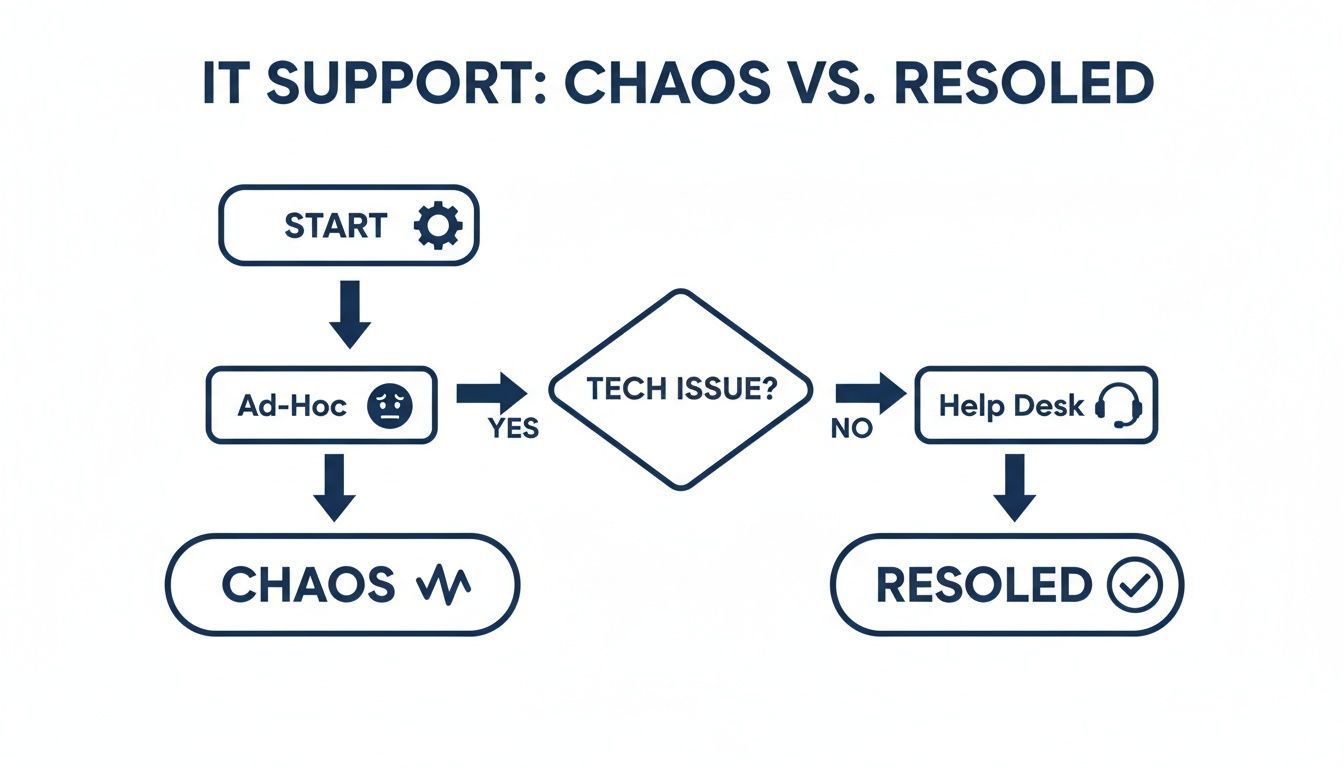
As you can see, a formal help desk process is the only way to achieve consistent, reliable outcomes. It turns tech headaches into a clear path toward resolution.
The in-house approach is what most people picture first: hiring your own full-time IT staff to manage everything. This model gives you the most direct control. Your team lives and breathes your company culture, understands your unique operational quirks, and is on-site for any hands-on problems.
But that control comes at a steep price. The real costs go far beyond salaries. You have to factor in recruitment, continuous training, benefits, and the expensive specialized tools they will need to do their jobs. For most medium-sized businesses, building an internal team with enough diverse expertise to cover everything from cloud applications to network security is a huge financial and logistical burden.
Outsourcing your help desk means partnering with a specialized Managed IT Services Provider (MSP). This move completely reframes your IT support, shifting it from a major capital expense to a predictable operational cost. Instead of hiring individuals, you get access to an entire team of certified experts for a flat monthly fee.
This approach offers powerful advantages:
More and more Canadian businesses are recognizing the value of external expertise. A Statistics Canada analysis found that 52.2% of businesses outsourced tasks last year. When it comes to IT support, adoption grows with company size, 29.3% of large firms outsource compared to just 8.0% of micro-businesses. This clearly shows that as IT complexity grows, so does the reliance on trusted partners.
What if you have a great IT person on staff, but they are completely swamped? The co-managed or hybrid model delivers the best of both worlds by combining the strengths of your internal team with the deep resources of an external partner.
The co-managed model is about strategic augmentation, not replacement. It allows your internal staff to offload the daily grind of user support and focus on high-value initiatives that drive the business forward.
In this setup, the external partner typically handles the frontline help desk, monitors systems 24/7, and manages routine maintenance. This frees your internal team to lead strategic projects like digital transformation, process optimization, and long-term IT planning. You can get a better sense of this partnership by understanding what to look for in an IT outsourcing company that can truly complement your team.
Many businesses also use an IT companies answering service to handle initial calls, ensuring every inquiry is answered professionally before being routed to the right help desk queue. This type of collaboration ensures your internal talent is used for its highest purpose, maximizing your return on investment.
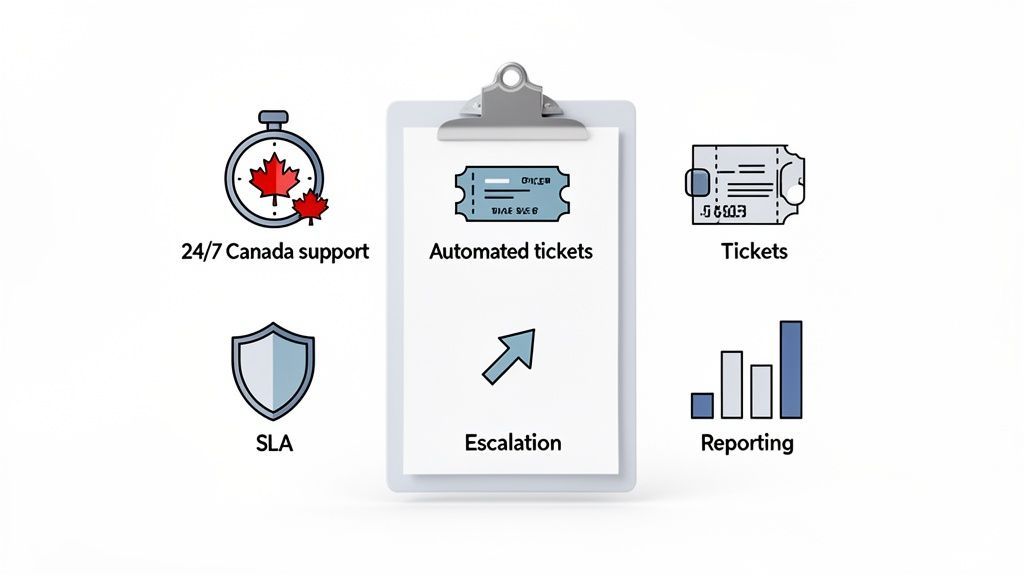
When you start looking at a help desk for IT support, it is easy to get lost in a long list of technical specifications. However, only a few core features are absolute must-haves for any Canadian business, especially if you are in a regulated industry. These are not just nice extras; they are the bedrock of a reliable and secure IT support system.
Choosing a partner without these foundational elements is like building a house on shaky ground. It might look fine at first, but it will not hold up when you need it most. Let's break down the non-negotiables you should be looking for.
Modern business does not end at 5 p.m., and neither do tech problems. A critical server can go down at 2 a.m., and an employee on a tight deadline might hit a software roadblock late on a Sunday. You need to know that help is available immediately.
That is why 24/7/365 support is non-negotiable. For Canadian businesses, it is just as important that this support is based right here in Canada. This ensures your sensitive business data stays within the country, helping you comply with data residency laws like PIPEDA. It also means you are getting help from professionals who understand the local business environment.
A great help desk brings order to the chaos of IT issues, and it all starts with a powerful ticketing system. Every single request, whether it comes in by email, phone, or a user portal, must be logged as a unique ticket. This creates an organized queue and a clear, auditable record of every problem from start to finish.
Workflow automation takes this a step further. It can intelligently route tickets to the right technician, prioritize urgent issues based on pre-set rules, and send automated updates so users are not left in the dark.
A ticketing system is your single source of truth for all IT issues. It eliminates the 'he said, she said' of informal support requests and provides the data needed to identify recurring problems and improve processes over time.
Without this structured system, requests inevitably fall through the cracks, response times drag on, and there is simply no way to measure performance or hold anyone accountable.
A Service Level Agreement (SLA) is your formal guarantee of service quality. Think of it as a contract that spells out the provider's responsibilities and sets clear, measurable targets for performance. For example, a solid SLA might guarantee a 15-minute response time for critical issues.
SLAs create accountability and transparency. They give you a clear benchmark to measure your provider's performance against, ensuring you are getting the level of service you are paying for. You should never partner with a provider that is hesitant to commit to a firm SLA.
What happens when a major incident strikes? You need a clear, transparent escalation procedure that outlines exactly who gets contacted and what steps are taken to resolve the crisis. This process ensures that your biggest problems get immediate attention from senior experts, not stuck in a queue.
Equally important is reporting. A good help desk partner will give you regular, easy-to-understand reports that show key metrics like:
These reports offer a clear window into your IT health and the effectiveness of your support. They also highlight opportunities for improvement, like pinpointing areas where extra employee training could cut down on common support requests. When you combine this data with proactive tools like remote monitoring and management, you can start preventing issues before they ever disrupt your business.
Picking an IT help desk provider is not just another item on your procurement list. Think of it as hiring a strategic partner who will become a seamless extension of your team. The right choice can fuel your growth and secure your operations, but the wrong one can become a source of endless frustration and risk. You need a solid framework to see past the flashy sales pitches and get to the heart of what they can actually do for you.
To find a provider that does more than just put out fires, you have to ask the right questions. A real partner takes the time to get to know your unique business challenges and is genuinely invested in your long-term success. The goal is to find a team that meshes with your company culture and truly feels like one of your own.
Not all IT support is created equal. The needs of a manufacturing firm are worlds apart from those of a healthcare clinic or a law office. Your first move should be to confirm that a potential partner has proven, hands-on experience in your specific industry. They need to speak your language and understand the unique operational pressures and regulatory hurdles you face every day.
Look for a team that holds relevant, up-to-date certifications. Credentials from names like CompTIA, Microsoft, and Cisco are good signs of a technically skilled team. But do not stop there. Ask them for concrete examples of how they have solved problems for businesses like yours.
A partner with deep industry experience will not just solve a tech issue; they will understand the business context behind it. They know why a particular system is critical during month-end for an accounting firm or why specific data security protocols are non-negotiable in healthcare.
This specialized knowledge is what separates the good from the great. A generic help desk for IT support can probably reset a password, but can they troubleshoot the proprietary software your business runs on? Can they give you strategic advice on tech that will actually give you a competitive edge? When you learn more about top IT support companies, you will find that industry specialization is a massive differentiator.
In today's world, security is not an optional extra, it must be baked into the very core of IT support. Your help desk partner will have significant access to your network and data, so their own security posture is something you must absolutely evaluate. You need to get into the details and ask tough questions about their internal security.
Start by digging into their approach to:
If your business is in a regulated industry, this scrutiny is even more critical. If you are in healthcare, for example, any potential partner must be able to show you their robust HIPAA compliance. Ask for proof, and be ready to go through their Business Associate Agreement (BAA) with a fine-toothed comb. Any hesitation or vague answers on compliance should be treated as a major red flag.
Your business is not going to stand still, and your IT support partner should not either. A good provider has the capacity and flexibility to scale right alongside you. Talk to them about their scalability, can they handle a jump in users as you hire more staff? Do they have the expertise to support new technologies you are planning to adopt down the road?
The Canadian IT services market shows just how important it is to find a forward-thinking partner. Projections show the market growing from USD 60.08 billion in 2026 to USD 128.46 billion by 2030. A big part of that growth is the IT consulting and vCIO segment, proving that businesses across Toronto, Calgary, and Edmonton need partners who can offer strategic guidance, not just reactive fixes. You can read more about the Canadian IT market growth to see the trend for yourself.
Finally, never underestimate the importance of cultural fit. You will be talking to this team every single day. Look for a partner whose communication style and service philosophy match your own. Reading client testimonials and checking references can give you invaluable insight into what it is actually like to work with them day-to-day.
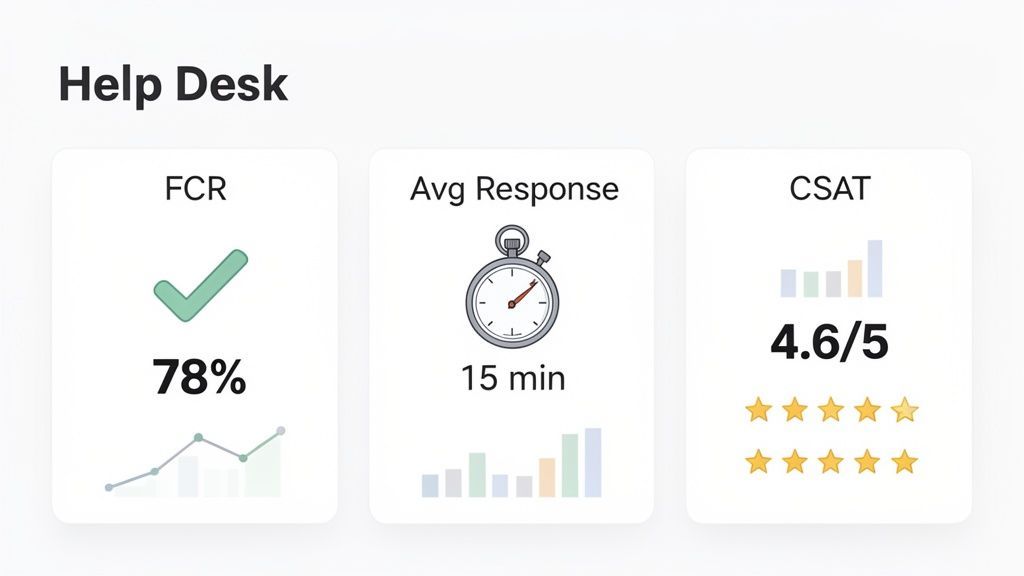
How do you know if your help desk for IT support is actually working? If you are not measuring performance, you are flying blind. Key performance indicators (KPIs) are what separate guesswork from a clear, data-backed picture of your IT support's true impact.
This is not about micromanaging your support team. It is about accountability and continuous improvement. The right metrics give you the proof you need to hold your provider to their promises, identify persistent technical problems, and make informed decisions that strengthen your entire business.
First-Contact Resolution (FCR) is simple: what percentage of support tickets get solved in the very first conversation? A high FCR is the hallmark of an efficient, knowledgeable team because it means your employees get back to work faster, without endless follow-ups.
Think about the last time you called a company for support and got bounced between three different departments. It is frustrating and a huge waste of time. A low FCR creates that same feeling inside your business, eroding trust in your IT support. A high FCR proves your provider has the skills to get it right the first time.
People often mix these two up, but they measure very different parts of the support journey. Average Response Time is how fast a technician acknowledges a new ticket and starts work. Average Resolution Time is the total time from the ticket’s creation to its final solution.
A quick response time tells your employees their issue has been seen and is a priority, which is crucial for building trust. The resolution time gives you the big picture, revealing how long it actually takes to get problems fixed. You need to track both to judge the overall speed and effectiveness of your IT support.
Top-tier help desks aim for response times under 15 minutes and an FCR of around 65% within their Service Level Agreements (SLAs). For voice support, where users expect immediate help, the bar is even higher, with elite teams hitting a 95% resolution rate on the initial call. These benchmarks are vital for managing thousands of tickets monthly while keeping technician workloads sustainable. You can discover more data on business operations from Statistics Canada.
Technical metrics only tell half the story; you also need to measure the human side of support. Customer Satisfaction (CSAT) scores do this perfectly. They are usually gathered with a quick, one-question survey after a ticket is closed, asking users to rate their experience.
CSAT is the ultimate test of your help desk's performance. It tells you not just if a problem was solved, but how the user felt about the entire process. High technical skill means little if your support team leaves employees feeling frustrated or unheard.
Tracking CSAT gives you direct insight into service quality from your team's point of view. It shines a light on top-performing technicians and pinpoints where communication or service might be falling short. A consistently high CSAT score is a powerful sign that your IT partner is adding real value and positively impacting your company culture.
Picking the right IT help desk is not just about finding a service provider. It is about finding a true partner who understands your business, your goals, and is genuinely committed to your security and growth. For Canadian SMBs, that partner is CloudOrbis.
We have designed our services from the ground up to tackle the specific hurdles you face, particularly if you operate in regulated sectors like healthcare or finance. Our approach is proactive, not reactive, with a 100% Canada-based managed help desk running 24/7/365. This means your operations are always protected, your data stays secure within our borders, and you get instant help from experts who know the local business environment.
We do not just sell services; we build a partnership founded on our proven 10-step engagement process. This structured framework guarantees a smooth and transparent move from your current IT situation to a fully managed, optimized one. It all starts with us taking the time to deeply understand your business, ensuring every solution we put in place aligns perfectly with your long-term vision.
Our process is thorough and clear:
The need for a proactive security partner has never been more urgent. In a single year, the Communications Security Establishment (CSE) Cyber Centre had to respond to 2,561 cyber incidents, with a staggering 1,406 of them hitting Canada’s critical infrastructure. Their pre-ransomware notifications to 336 organizations helped prevent millions in potential damages, a stark reminder of the constant threats Canadian businesses face. You can read more in the CSE Cyber Centre's annual report.
At CloudOrbis, we build security into every layer of our support. Our proactive monitoring and robust security protocols are designed to stop threats before they impact your business, giving you total peace of mind.
We deliver on the non-negotiables of a modern help desk by providing a robust ticketing system, clear SLAs, and unwavering support for compliance. Our team becomes your first line of defence, giving you the confidence to focus on growing your business.
Explore our comprehensive IT helpdesk support services to see how we empower businesses just like yours.
Ready to move from reactive fixes to a proactive partnership? Let’s start a conversation. Book a no-obligation consultation today.
Making the switch to a professional help desk can bring up a few last-minute questions. We get it. Here are some of the most common things business leaders ask when they’re thinking about a new help desk for IT support.
Every business is different, but a good provider has a well-defined process to get you up and running quickly. Typically, the entire onboarding, from the initial deep-dive to going live, takes just a few weeks.
The main goal is always a smooth, disruption-free transition. We make sure all your systems, users, and support protocols are perfectly configured from day one, so you see the benefits immediately.
Yes, but it is a change for the better. We replace the chaos of random emails and phone calls with one simple, central way to get help. This could be a dedicated user portal, a special email address that automatically creates a support ticket, or even a one-click “IT Button” right on their desktop.
This simple change means every single request is logged, tracked, and sent to the right technician instantly. It creates order and accountability, leading to faster, more reliable support and ensuring nothing critical ever falls through the cracks.
Absolutely, as long as you choose the right partner. A provider that specializes in regulated sectors like healthcare or finance builds their entire service around security and compliance from the ground up.
They use encrypted communication channels, enforce strict access controls, and will have no problem signing legal documents like a Business Associate Agreement (BAA) for PIPEDA compliance. Always ask a potential provider to show you their compliance credentials and security protocols before you sign anything. It is the only way to be sure your sensitive data is in safe hands.
Ready to transform your IT support from a cost centre into a strategic asset? Partner with CloudOrbis for proactive, 24/7 Canada-based managed IT services that give you total peace of mind. Book a no-obligation consultation today.
Book a 30-minute call with a senior engineer. No sales script, just straight answers about your environment.


