Top 10 API Security Best Practices for 2026
Protect your business with our top 10 API security best practices. Actionable advice for Canadian SMBs on authentication, encryption, and compliance.

Protect your business with our top 10 API security best practices. Actionable advice for Canadian SMBs on authentication, encryption, and compliance.
API attacks are now a standard part of how businesses get breached. For Canadian SMBs, especially clinics, professional firms, eCommerce companies, and other organisations handling regulated or sensitive data, an exposed API can lead to downtime, privacy incidents, client loss, and expensive cleanup.
APIs connect the systems your business depends on every day. Your client portal talks to your CRM. Your website exchanges data with Microsoft 365. Your clinic software connects to billing and third-party platforms. If those integrations are poorly controlled, attackers get a direct path into the business processes that generate revenue and store confidential information.
Canadian business owners should pay attention to where public-sector standards are heading. The Government of Canada's API standards set a clear expectation for secure, interoperable API design. That matters beyond government. In practice, private-sector organisations are being held to the same standard by clients, insurers, auditors, and regulators.
From a managed IT services perspective, we see the same pattern repeatedly. Companies invest in firewalls, endpoint protection, and Microsoft 365 security, then leave APIs with weak controls, poor visibility, and inconsistent ownership. That gap creates risk fast. A forgotten integration, a hardcoded secret, or a misconfigured endpoint can expose customer data long before anyone notices.
Good API security starts with governance and identity. You need a clear inventory of every API, a documented owner for each one, and access controls tied to business roles. If your team needs a stronger foundation for user access and policy design, start with a practical guide to identity and access management for growing businesses. For a common failure point, review this guide to remediating broken access control.
The priorities are straightforward. Control who gets in. Encrypt every connection. Inspect every request. Log what matters. Test regularly. The 10 practices below will help Canadian SMBs reduce breach risk, support PIPEDA and sector-specific compliance work, and protect the systems the business runs on.
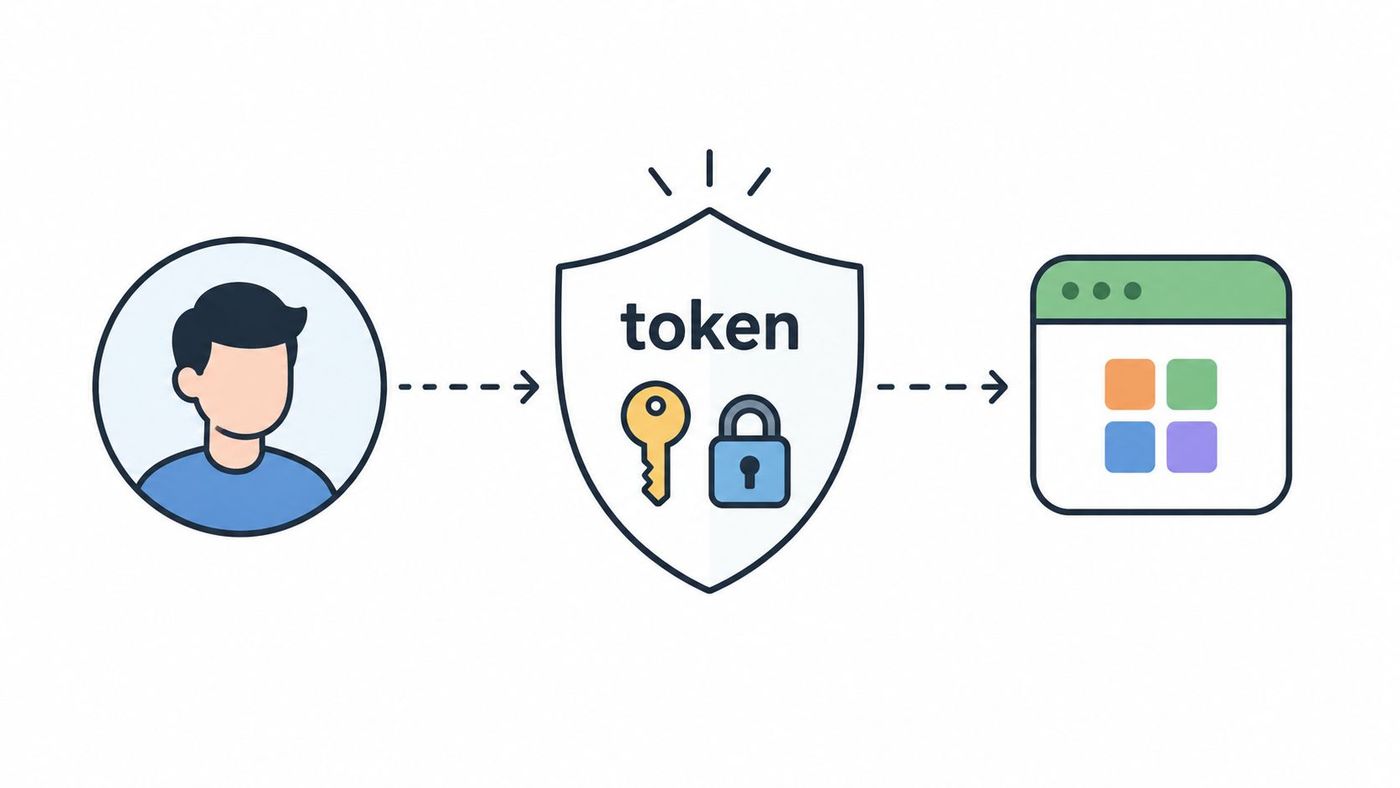
Stolen credentials remain one of the simplest ways into an API. If you run a Canadian SMB, especially in healthcare, legal, finance, or any business handling sensitive client data, weak authentication is a business risk, not just a technical gap. Use OAuth 2.0 and OpenID Connect for modern authentication. Then enforce authorization on every request at the endpoint, role, object, and tenant level.
Custom token schemes create avoidable risk. Standardize on proven identity flows, issue short-lived access tokens, rotate refresh tokens, and remove app credentials the moment an integration is no longer needed. A user or system being signed in is not enough. Each sensitive call must prove identity and permission for that exact action on that exact record.
A clinic integrating an electronic health record platform should grant each connected application the minimum access it needs. A law firm portal should keep junior staff and third-party tools far away from partner-level admin routes. A multi-tenant SaaS company must check tenant boundaries on every API request, not only in the front-end.
That is how you reduce exposure, contain mistakes, and support PIPEDA and sector-specific compliance reviews.
Use least privilege by default. Separate machine identities from user identities. Require multi-factor authentication for admin accounts, developer consoles, and any workflow that can create tokens, change scopes, or approve new integrations. If your team already uses Microsoft 365 or Entra ID, connect API access policies to the same provider and formal role design through a practical identity and access management strategy.
One more business point matters here. Strong identity controls protect far more than data. They protect uptime, client trust, cyber insurance readiness, and contract eligibility. Even public-facing trust signals matter, and secure web delivery can also improve SEO with HTTPS.
Data exposed in transit creates immediate business risk. For Canadian SMBs, one weak API connection can trigger client loss, downtime, insurance problems, and compliance scrutiny. Set a clear standard. Every API request must use HTTPS with TLS 1.2 or higher, including internal service-to-service traffic inside your cloud, office, and hybrid environments.
That rule matters most in organizations that move regulated or commercially sensitive data every day. A medical clinic syncing records with a booking platform, an accounting firm pushing payroll data to a client portal, or a manufacturer connecting ERP and warehouse systems all need encrypted API traffic at every hop.
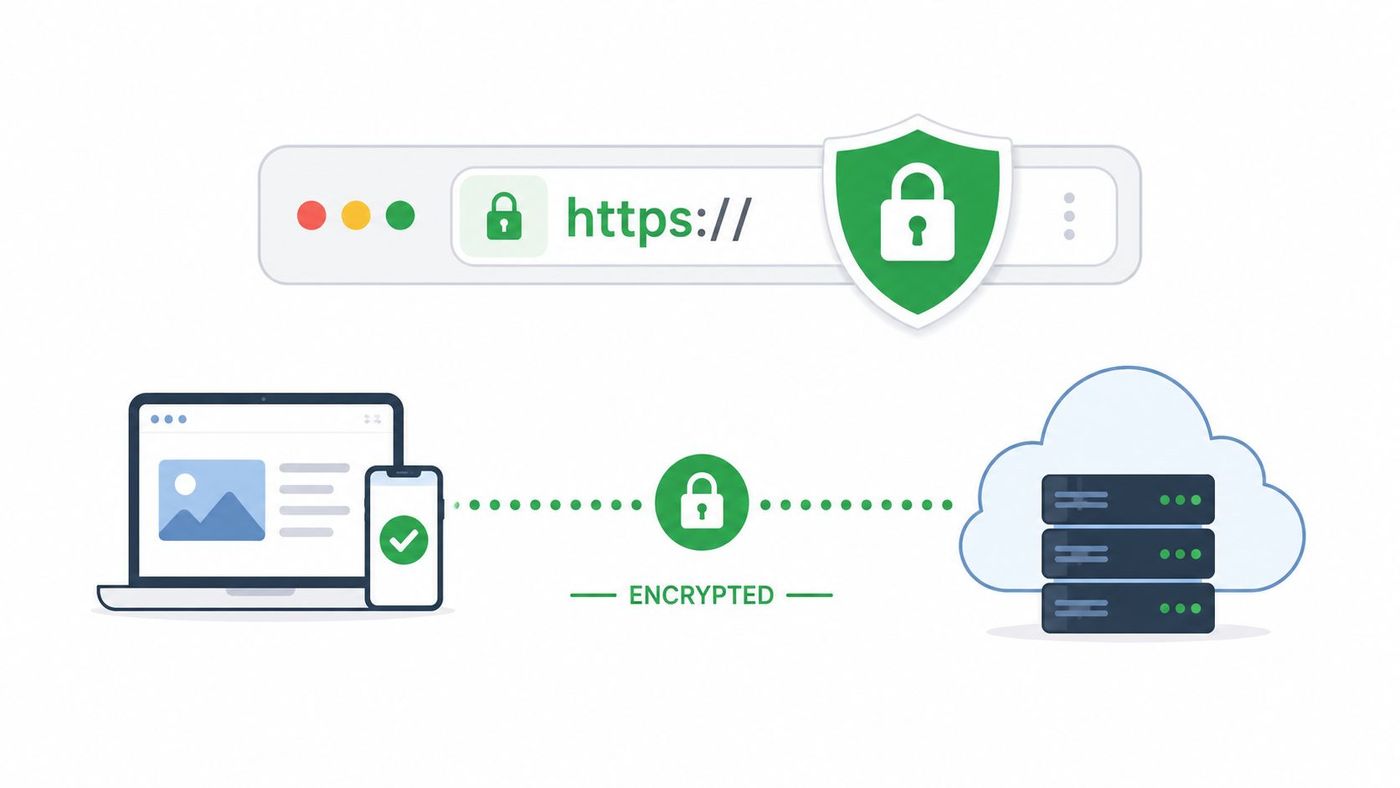
Public-facing APIs are only part of the job. Internal APIs deserve the same treatment because attackers target east-west traffic after they get a foothold. If your developers still allow HTTP on private subnets, fix that now. Disable outdated protocols, enforce modern cipher suites, and use certificates you can inventory, renew, and revoke without manual scrambling.
For higher-risk use cases, go beyond basic transport encryption. The OWASP API Security Top 10 recommends protecting APIs against common exposure paths and treating transport security as a baseline control, not the finish line. In practice, that means adding mutual TLS for trusted service connections, tightening certificate management, and applying message-level protections where business sensitivity or contractual obligations require it.
This is a practical compliance issue, not just a technical one. Canadian healthcare providers, legal firms, and other regulated businesses need to prove they protected data in transit with appropriate safeguards. If you cannot show consistent HTTPS enforcement across every endpoint, your API program is weaker than your policy says it is.
There is also a secondary upside for client-facing portals and web properties. Secure delivery can improve SEO with HTTPS. Security should drive the decision, but the visibility benefit is useful.
API abuse does not need to be complex to hurt your business. One noisy bot, one misconfigured integration, or one customer script stuck in a loop can slow core systems, interrupt client access, and drive up cloud and support costs fast.
For Canadian SMBs, rate limiting is an uptime control first and a security control second. It protects revenue, preserves staff productivity, and helps regulated organizations show they took reasonable steps to keep digital services available.
The OWASP API Security Top 10 treats unrestricted resource consumption as a common API weakness. Fix it at the gateway and enforce it in the application where needed, especially for endpoints tied to login, search, exports, and partner traffic.
Different endpoints need different rules. A login route should face tighter limits than a product catalog lookup. A report export should face tighter limits than a simple status check.
Set both steady-state and burst limits. That gives legitimate users room for short traffic spikes without giving attackers or broken automations free rein.
A manufacturing company syncing inventory between an ERP and a warehouse platform should cap burst traffic before one connector overloads the database. A healthcare clinic polling lab results through an integration should throttle requests during peak hours so patient portals and staff systems stay responsive.
Return HTTP 429 with a clear Retry-After value. Clients need a predictable response they can handle programmatically.
Do not stop at IP-based rules. Use API keys, user identity, client app, tenant, and endpoint sensitivity to shape limits that match how your business operates. That is the difference between a policy that protects service availability and one that just creates help desk tickets.
Bad input breaks more than code. It can corrupt records, trigger injection attacks, expose backend weaknesses, and create compliance problems your business then has to explain to customers, auditors, and regulators.
Treat every field as untrusted. Query strings, headers, JSON bodies, file uploads, IDs, and search inputs all need strict validation before your API processes them. For Canadian SMBs, especially clinics, professional firms, and other regulated organizations, this is basic risk control. One malformed request should never be able to poison a workflow, alter financial data, or push bad information into a patient or client record.
Front-end checks improve user experience. Server-side validation protects the business.
Your API should enforce schemas, data types, length limits, allowed formats, and allowed values on every request, even when traffic comes from your own app, your own portal, or a long-standing integration partner. If an endpoint accepts a date, require a date. If it accepts a number, reject strings. If it accepts a file, inspect type, size, and metadata before it reaches storage or downstream systems.
A few examples matter more than theory:
Use allowlists wherever possible. Use parameterized queries for anything touching a database. Use proven schema validation and sanitization libraries built into your framework instead of custom validators scattered across endpoints.
That approach reduces security risk and support costs at the same time. Your developers get predictable data. Your integrations fail in a controlled way. Your team spends less time cleaning up bad records and fewer hours tracing avoidable incidents across business systems.
Stolen or exposed credentials remain one of the fastest ways into an API environment. For Canadian SMBs, that risk carries real business consequences: downtime, client notification costs, regulatory scrutiny, and avoidable damage to trust.
Hardcoded API keys in source code, copied credentials in scripts, and long-lived tokens in forgotten integrations are still common. They should not exist in a business that takes security seriously. Store secrets in a dedicated vault. Rotate them on a defined schedule. Restrict who and what can access them. Every integration should have its own credential so you can limit impact and revoke access without breaking half your stack.
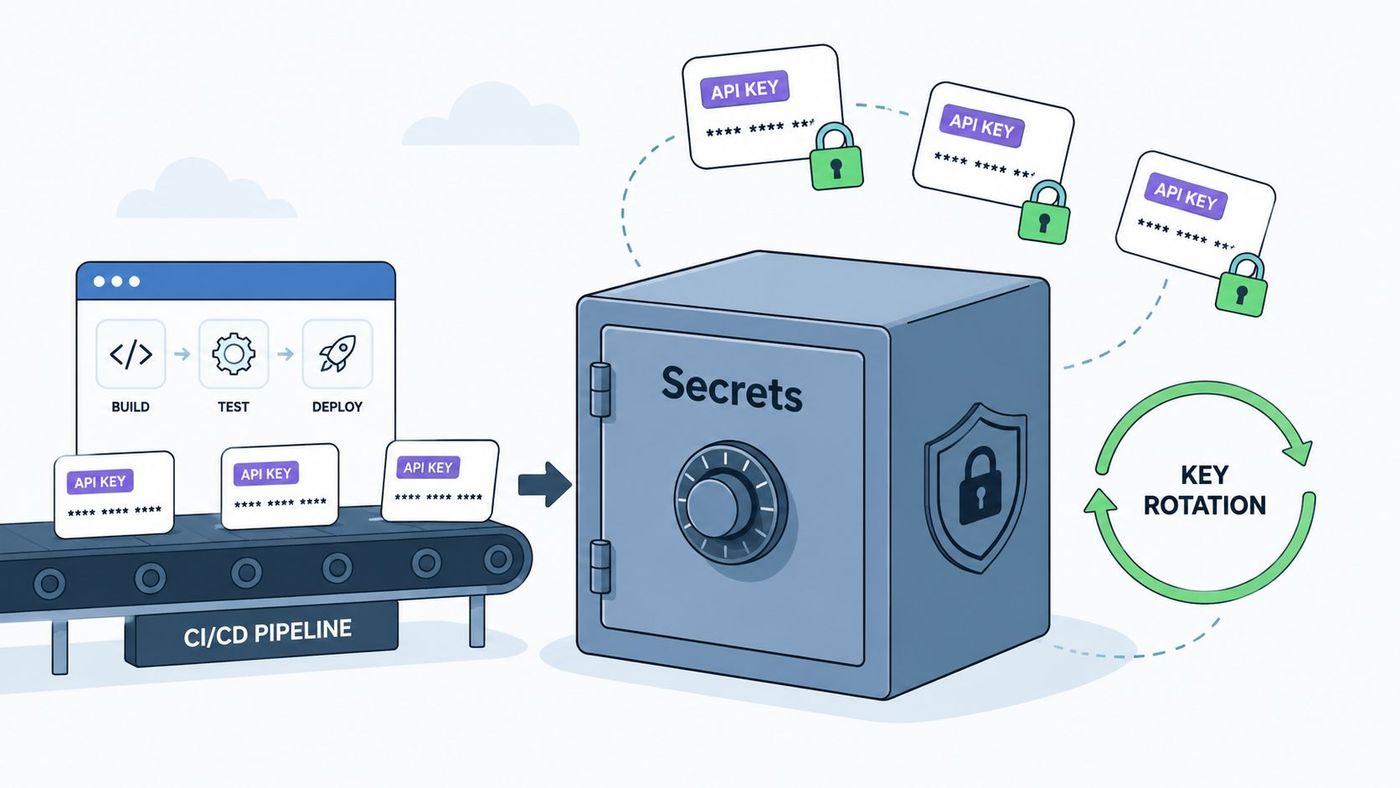
Use a proper secrets manager such as Azure Key Vault, AWS Secrets Manager, or HashiCorp Vault. Do not keep production credentials in spreadsheets, email threads, ticket comments, shared documents, or deployment notes. Separate secrets by environment so development, testing, and production stay isolated. Give each app, service, and third-party connection its own identity and secret.
Automation matters here. Rotation should be built into your operating process, not left to memory or a quarterly cleanup task. If your team still updates keys by hand, you are increasing the chance of outages and missed revocations. Microsoft outlines practical patterns for storing, controlling, and rotating application secrets in Azure Key Vault security guidance.
A mid-sized clinic using Azure, Microsoft 365, and custom integrations should centralize credentials in Azure Key Vault and enforce access through Entra ID and role-based controls. A manufacturer connecting ERP, shop-floor systems, and supplier portals should assign separate service accounts and rotate secrets tied to each workflow. In both cases, the goal is the same. Reduce blast radius, simplify revocation, and keep audit expectations manageable for PIPEDA and sector-specific obligations.
If a developer can read a production secret in plain text without approval, your process is broken.
Secrets management also works best when it connects to your audit process. Teams that pair vault controls with event logging and security monitoring for modern businesses can spot failed access attempts, unusual secret retrieval patterns, and stale credentials before they turn into incidents.
IBM's annual breach research consistently shows that organizations detect and contain incidents faster when they have mature logging and monitoring in place (Cost of a Data Breach Report). For Canadian SMBs, that speed affects more than cleanup costs. It affects client trust, downtime, audit pressure, and your ability to show regulators what happened.
API logs should answer four business questions fast. Who made the request? What data or function did they try to access? Did the system allow it? What needs immediate investigation?
Capture enough detail to reconstruct an incident without turning your logs into a privacy problem. That means recording security-relevant events while keeping secrets, passwords, tokens, and unnecessary personal data out of the record.
Focus on these areas:
Many SMBs fall short, collecting web server logs and calling it done. That does not give you enough detail to investigate abuse in a client portal, a healthcare integration, or an internal finance API.
A clinic handling patient data needs a clear record of which user or connected service accessed a scheduling or records endpoint. A manufacturer needs to trace which integration pushed a bad payload into ERP. A law firm needs evidence that access to matter-related data matched assigned roles. Logging should support operations, forensics, and compliance at the same time.
Monitoring matters just as much as collection. Set alerts for spikes in failed authentication, repeated access-denied events, unexpected traffic outside business hours, and unusual calls to sensitive endpoints. If your team is adopting a zero trust security model for business systems, those signals become far more useful because every request is evaluated in context, not assumed safe.
For a practical business view, CloudOrbis covers why event logging is a cybersecurity must-have for modern businesses.
A breached API is usually a design failure before it becomes an operations problem. If security gets bolted on after launch, Canadian SMBs pay for it twice. First in rework, then in downtime, client friction, audit pressure, and breach response.
Build security into the API from the first architecture decision. Treat every endpoint as exposed, every integration as a possible attack path, and every request as something that must earn access. That standard matters even more for organisations handling patient records, financial data, legal files, or sensitive client information.
Zero trust should shape the architecture, not sit beside it as a policy document. Internal APIs need authentication. Service accounts need limited permissions. Admin functions should be isolated from public-facing endpoints. Sensitive data flows should be separated from lower-risk services so one weak integration does not expose the rest of the business.
For Canadian organisations in healthcare and other regulated sectors, this approach supports both risk reduction and audit readiness. It gives your team cleaner access boundaries, better change control, and fewer expensive surprises when a partner integration or internal app behaves in ways you did not expect.
A practical design standard looks like this:
Architecture also needs to account for failure. Keys will get exposed. Developers will make mistakes. Third-party integrations will drift from their original scope. Good API design limits the blast radius and gives your team time to respond.
If you want to validate whether your current API design would hold up under real attack paths, start with API penetration testing services for business-critical applications. CloudOrbis also explains the operating model behind this approach in its overview of the zero trust security model.
Secure APIs don't stay secure by accident. Teams change code, add integrations, update libraries, and publish new endpoints. If security testing isn't built into that process, weaknesses reach production.
This is especially important for Canadian SMBs because cost and complexity often delay action. A 2025 study cited in a Canadian SMB-focused discussion found that 64% of Canadian small businesses delay API security testing due to perceived cost and complexity, yet 71% of API breaches in Canada stem from untested endpoints in production. That's a painful gap, and attackers know it.
Use a mix of automated and manual testing. Static analysis helps catch hardcoded secrets and insecure code patterns. Dynamic testing exposes runtime issues. Penetration testing reveals what scanners miss, especially around authentication, access control, and business logic.
Security testing belongs in CI/CD, not in a spreadsheet after deployment.
For regulated organisations, the Treasury Board also requires integration and automation of security testing to validate new API source code changes before deployment, alongside periodic audits of API access based on sensitivity and usage patterns. Private organisations should mirror that discipline even when the law doesn't spell it out word for word.
If you need an outside view, CloudOrbis outlines where penetration testing services fit into a practical security programme.
Attackers read docs too. If your API documentation exposes endpoint patterns, verbose error responses, integration flows, and retired routes, you are handing them a faster path to discovery.
For Canadian SMBs, this is not just a developer experience issue. It is a governance issue. If your team cannot clearly separate what staff, vendors, and the public should see, you increase the chance of exposing personal data flows, internal system details, or regulated workflows that should stay private. That risk rises in healthcare, legal, finance, and any business that shares data with external platforms.
Keep public documentation tightly scoped to what an external developer needs to integrate successfully. Put partner and internal documentation behind access controls. Review every example, schema, and error message before publication.
Use these rules:
A clinic that supports EHR integrations should document approved vendor workflows and authentication requirements. It should not publish internal endpoint names tied to patient intake, scheduling logic, or staff administration. A finance firm should provide field definitions and expected responses. It should not expose backend service relationships or failure conditions that reveal how fraud controls work.
Managed IT providers see this gap often. Teams lock down the API gateway, then leave Swagger files, Postman collections, and support docs exposed in public repositories or open portals. That is an easy fix with real business value. Restrict access, assign document owners, and review disclosure risk the same way you review endpoint changes. If your team needs a tighter process for identifying exposed technical details and responding quickly, build it into your threat detection and response plan.
A delayed breach response costs more than the breach itself. For Canadian SMBs, especially clinics, legal practices, and financial firms, slow decisions can trigger downtime, client loss, insurance disputes, and privacy reporting failures at the same time.
Treat API incident response as an operating requirement, not a policy document. Your team should know who makes decisions, what gets shut down first, how evidence is preserved, and when legal or privacy obligations are triggered. If those answers live in one manager's inbox or only inside your MSP's ticket notes, you do not have a response plan.
Build the plan around actions your team can execute under pressure:
The business goal is simple. Limit exposure, restore service safely, and document every decision.
A clinic should be able to contain a compromised patient booking API without disrupting every clinical system. A logistics company should be able to shut off a partner integration that starts sending hostile traffic while preserving shipment visibility. A law firm should know who approves client communications if confidential documents or matter data were exposed through an API.
Managed IT providers see the same weakness across growing businesses. Security controls exist, but no one has defined the first 60 minutes of response. Fix that now. Put the playbook in writing, map it to your vendors, and tie it to a tested threat detection and response process.
| Control / Practice | Implementation complexity | Resource requirements | Expected outcomes | Ideal use cases | Key advantages |
|---|---|---|---|---|---|
| Strong Authentication & Authorization (OAuth 2.0 / OpenID Connect) | High, protocol integration and token handling | Identity provider, token validation infra, MFA, dev expertise | Granular access control, reduced credential exposure, audit trails | Healthcare, finance, multi-tenant SaaS, third-party integrations | Industry-standard, RBAC/MFA support, scalable delegation |
| Enforce HTTPS and TLS 1.2+ Encryption | Low–Medium, config and certificate management | TLS certificates, CA trust, server config, automation for renewals | Encrypted transit, server authenticity, compliance alignment | All APIs, especially regulated industries (HIPAA, PCI-DSS, GDPR) | Prevents MITM, required for compliance, browser trust |
| API Rate Limiting and Throttling | Medium, design and distributed coordination | Rate-limiter service, monitoring, client retry logic | Protection from abuse and spikes, improved availability | Public/high-volume APIs, limited infra budgets, multi-tenant systems | Mitigates DoS, enforces fair use, supports monetization |
| Validate and Sanitize All API Inputs | Medium, requires security-aware dev work | Validation libraries/schemas, testing, input sanitizers | Prevents injection attacks, improves data integrity and stability | Any API accepting external input, DB-backed systems | Reduces OWASP risks, improves reliability and data quality |
| API Keys and Secrets Management | Medium–High, vault integration and rotation processes | Secrets manager (Vault/Cloud), CI/CD integration, IAM policies | Reduced secret leakage, rapid revocation, auditability | Multi-service cloud environments, CI/CD pipelines, IoT | Eliminates hardcoded secrets, enables rotation and audits |
| Comprehensive API Logging and Monitoring | Medium, scalable pipelines and alerting | Log aggregation, SIEM, storage, alerting, retention policy | Faster detection, forensic capability, compliance evidence | Regulated industries, distributed architectures, ops teams | Enables rapid incident response, performance insights, audits |
| Security-First Architecture (Zero Trust) | Very high, architectural and cultural change | Identity + device posture, microsegmentation, continuous monitoring | Minimized blast radius, strong internal and external protections | Remote-first orgs, cloud-native, high-risk/regulated sectors | Strong modern security posture, aligns with NIST zero trust |
| Regular Security Testing & Vulnerability Assessments | Medium, tooling and expert resources | Automated scanners, pen testers, SAST/DAST, CI/CD integration | Early vulnerability discovery, reduced remediation costs, compliance | Production APIs in regulated industries, CI/CD pipelines | Proactive detection, evidence for audits, improves code quality |
| Secure API Documentation & Info Disclosure Control | Low–Medium, access and content controls | Auth for docs, separate public/internal docs, scanning tools | Reduced reconnaissance by attackers, protected credentials | Partner integrations, sensitive/internal APIs, developer portals | Limits info leakage, protects keys, balances security and usability |
| Incident Response & Breach Notification Procedures | Medium–High, planning and team coordination | IR plan, detection integration, forensic tools, comms templates | Faster containment, regulatory-compliant notifications, lessons learned | Any org handling sensitive data (healthcare, finance, legal) | Limits damage/reputation loss, ensures compliance, improves readiness |
API security isn't a one-time hardening exercise. It's an operating discipline. Your team has to control access, encrypt traffic, validate data, protect secrets, monitor behaviour, test continuously, and respond quickly when something goes wrong.
For Canadian SMBs, the challenge isn't understanding that security matters. It's implementing all of it consistently while still running the business. Many mid-sized organisations have lean IT teams, growing cloud estates, third-party integrations, and rising compliance pressure. That's especially true in healthcare, finance, legal, logistics, and manufacturing, where APIs often carry sensitive or operationally critical data.
The most effective approach is layered. Put strong authentication in front of every important endpoint. Enforce TLS everywhere, including internal service traffic. Validate every payload before business logic touches it. Store secrets in a managed vault. Keep a current API inventory so shadow endpoints don't become silent liabilities. Then back all of that with logging, monitoring, regular testing, and a clear incident response process.
This also needs business ownership, not just technical ownership. Leadership should know which APIs expose customer data, which integrations are mission-critical, who approves access, and how incidents will be escalated. If those answers live only in a senior developer's head, your risk is already too high.
A good managed IT and cybersecurity partner helps close that gap. You get architecture guidance, implementation support, ongoing monitoring, and practical governance without forcing your internal team to build everything from scratch. For many Canadian SMBs, that's the fastest route to stronger protection and better compliance.
CloudOrbis works with organisations that need secure, compliant, and cost-effective IT operations. That includes healthcare providers protecting patient data, legal and finance firms managing confidential information, and operational businesses that can't afford downtime from a preventable API issue. We help clients take a practical approach to API security best practices, from identity controls and security testing to logging, threat response, and broader compliance-aligned IT strategy.
If your business relies on APIs, your digital front door is already open for business. Make sure it's locked down properly. CloudOrbis can help you assess where you're exposed, prioritise the right fixes, and build an API security programme that supports growth instead of slowing it down.
If your business needs practical help applying CloudOrbis Inc. expertise to API security, compliance, and managed IT, book a complimentary security assessment. We'll help you identify exposed endpoints, tighten controls, and build a resilient roadmap that fits your team, your budget, and your industry.
Book a 30-minute call with a senior engineer. No sales script, just straight answers about your environment.


