Information Governance: Business Value & Compliance
A practical guide to information governance for Canadian businesses. Secure data, ensure PIPEDA compliance, & drive business value.

A practical guide to information governance for Canadian businesses. Secure data, ensure PIPEDA compliance, & drive business value.
Your team is probably feeling the strain already. Customer files live in Microsoft 365, contracts sit in a shared drive, finance exports land in email, and someone still keeps critical documents on a local desktop “for convenience.” Everyone knows the information matters. Fewer people know which copy is current, who should have access, how long it should be kept, or what happens when a regulator asks questions.
That's where information governance stops being a policy document and starts becoming an operating discipline.
For Canadian businesses, especially in healthcare, legal, finance, logistics, and other regulated environments, information governance is how you turn scattered data into something usable, secure, and defensible. It isn't just records management. It's the set of rules, roles, technologies, and review habits that make sure the right people can find trusted information quickly, while sensitive data stays controlled and compliant.
A useful way to think about information governance is this: it's the library system for your business. Not the books themselves, but the catalogue, access rules, check-out controls, archive process, and audit trail that make the library usable.
Without that system, information piles up. Staff save duplicates. Sensitive files get overshared. Teams waste time confirming whether they're looking at the latest version. Leaders make decisions with incomplete context. In regulated sectors, that same disorder creates privacy and legal exposure.
At a practical level, information governance answers a short list of business questions:
That's why this work belongs to the business as much as IT. Technology enforces the controls, but leadership decides what matters, what's sensitive, and what risk is acceptable.
Statistics Canada made the same point in institutional terms. In its 2016 publication, it identified an adequate governance structure and an integrated metadatabase to centralize metadata as two mechanisms that “greatly facilitate users' accessibility to metadata” across Canadian federal data systems, and that model helped shape broader federal expectations for centralized oversight in information and data governance (Statistics Canada's chapter on management and access to metadata).
Most medium-sized businesses don't need a federal-scale program. They do need the same principle. Fragmented information creates fragmented accountability.
Practical rule: If nobody can explain a document's owner, sensitivity, retention rule, and approved access path, that document isn't governed.
A strong starting point is classification. If you need a plain-language legal overview of what is data classification, that resource is useful because it connects sensitivity levels to real handling decisions rather than abstract labels.
Good information governance gives leaders control without forcing the business to slow down. It creates a consistent way to label, protect, retrieve, retain, and dispose of information. That improves day-to-day efficiency, but it also supports privacy obligations, internal accountability, and cleaner decision-making.
Information governance earns budget when leaders stop seeing it as a compliance tax. It reduces operational friction, narrows exposure, and gives the business a cleaner foundation for growth.
The fastest way to lose momentum on a governance initiative is to frame it as a documentation project. It isn't. It's a business control system. When teams can trust their data, find it quickly, and prove who accessed it, work moves faster. When they can't, every process gets heavier. Contract review slows down. Incident response gets messy. Audits become expensive scavenger hunts.
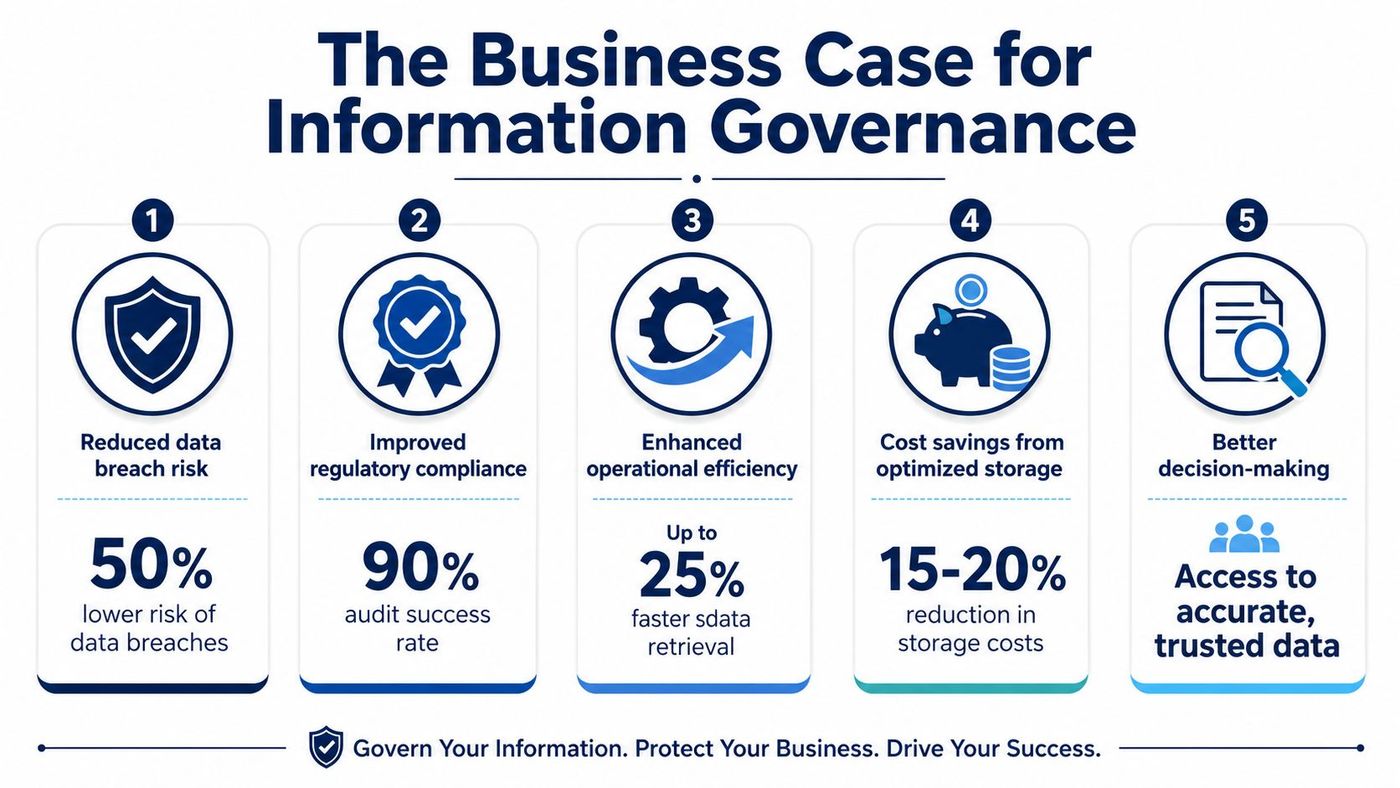
Privacy and security risks get executive attention because the consequences are visible. Under Canada's proposed CPPA, organizations could face penalties of up to $10 million or 3% of gross global annual revenue for contravening processing provisions or security safeguards, with enforcement handled by the Personal Information and Data Protection Tribunal (CPPA discussion in this Canadian data governance law overview).
That matters. But the day-to-day business case is often even stronger.
A governed environment helps teams:
Leaders often approve new tools before fixing information habits. That usually creates a more expensive version of the same problem. Migrating clutter into SharePoint, OneDrive, Teams, or a new line-of-business platform doesn't create order. It just relocates disorder.
A better sequence is to govern first, then optimize the platform around those rules. That's also how you get more value from infrastructure spend. If you're evaluating the financial side of IT decisions, this guide to cost-benefit analysis for business technology investments is a helpful companion because governance decisions should be tied to risk, productivity, and lifecycle cost, not just licensing.
Good information governance doesn't make the business bureaucratic. It removes the hidden bureaucracy created by bad information.
Clients and partners increasingly ask more informed questions about how vendors manage information. They want to know who has access, where data is stored, how incidents are handled, and whether retention practices are defined. Businesses that can answer clearly often move through diligence faster and with less internal scrambling.
That's the shift worth making. Compliance is the floor. Competitive advantage comes from using governance to improve reliability, responsiveness, and trust.
A workable framework doesn't need to be academic. It needs to be clear enough that your teams can follow it and your systems can enforce it.
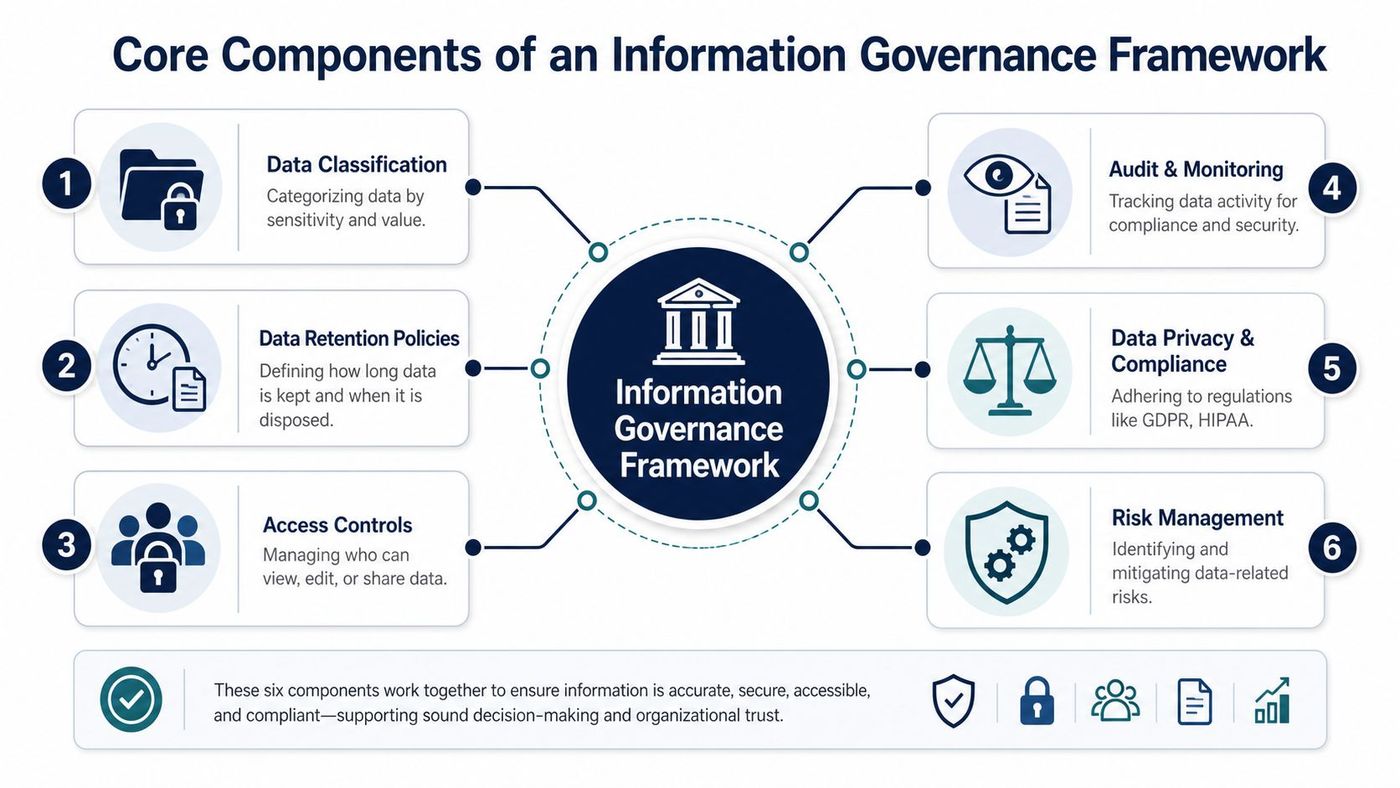
Policies are the operating rules. They define approved systems, record ownership, acceptable sharing methods, retention expectations, and escalation paths.
Bad policies are generic, overly legalistic, or disconnected from the tools staff use every day. Good policies are specific. They tell a clinic manager where patient-adjacent operational records belong. They tell finance which repository is the system of record. They tell HR what can't be sent by unsecured email.
If a policy can't be translated into a Microsoft 365 setting, a workflow rule, or an employee action, it's too vague.
Classification is how the business distinguishes ordinary information from material that needs tighter handling. Metadata is what makes that classification usable at scale.
In the Canadian federal context, digital systems are the preferred means for capturing information, and metadata fields must mark security classifications such as Protected A, B, or Confidential so retention and access protocols can be triggered automatically. The government also requires role-based access control so access to sensitive information is assigned by job function under a need-to-know principle (Government of Canada digital policies and standards).
For a medium-sized business, the lesson is straightforward. Don't rely on staff memory. Use labels, tags, sensitivity settings, and structured fields so systems can enforce the rules.
Retention schedules define how long information stays active, when it moves to archive, and when it should be securely disposed of. In this context, many businesses either keep everything forever or delete too aggressively. Both approaches create problems.
A practical retention model should reflect legal obligations, client commitments, operational value, and litigation risk. It should also be understandable by non-lawyers. If retention rules only live in a spreadsheet no one checks, they won't shape behaviour.
Operational test: Ask one department head how long their key records are kept and what triggers disposal. If they can't answer, your retention schedule exists on paper, not in practice.
Access management is where governance becomes visible to users. Staff don't need equal access to everything. They need the right access for their role, plus a clean process for exceptions.
A strong model usually includes:
This matters in environments like customer service and contact centres too, where recordings, transcripts, and client details can create compliance exposure. Teams that manage those workflows may benefit from a practical guide on contact center compliance because communications data often falls outside formal records thinking even though it carries real risk.
Governance fails unnoticed when nobody checks whether the rules are being followed. Audit logs, alerting, activity reviews, and data loss prevention controls help the business catch risky behaviour early. That can include unusual downloads, external sharing, mass deletions, or attempted transfers of sensitive files.
For many organizations, the framework becomes easier to manage when these components are viewed together:
| Component | Business purpose |
|---|---|
| Policy | Defines acceptable handling and accountability |
| Classification | Signals sensitivity and value |
| Retention | Limits clutter and supports defensible disposal |
| Access control | Restricts exposure |
| Audit and monitoring | Provides accountability and incident visibility |
| Lifecycle management | Governs creation through secure disposal |
If you're mapping these controls into broader security work, this article on data security and privacy for modern businesses is a useful adjacent read.
Most organizations stall because they try to solve everything at once. The better route is phased, visible progress. Start with the highest-value information, then build outward.
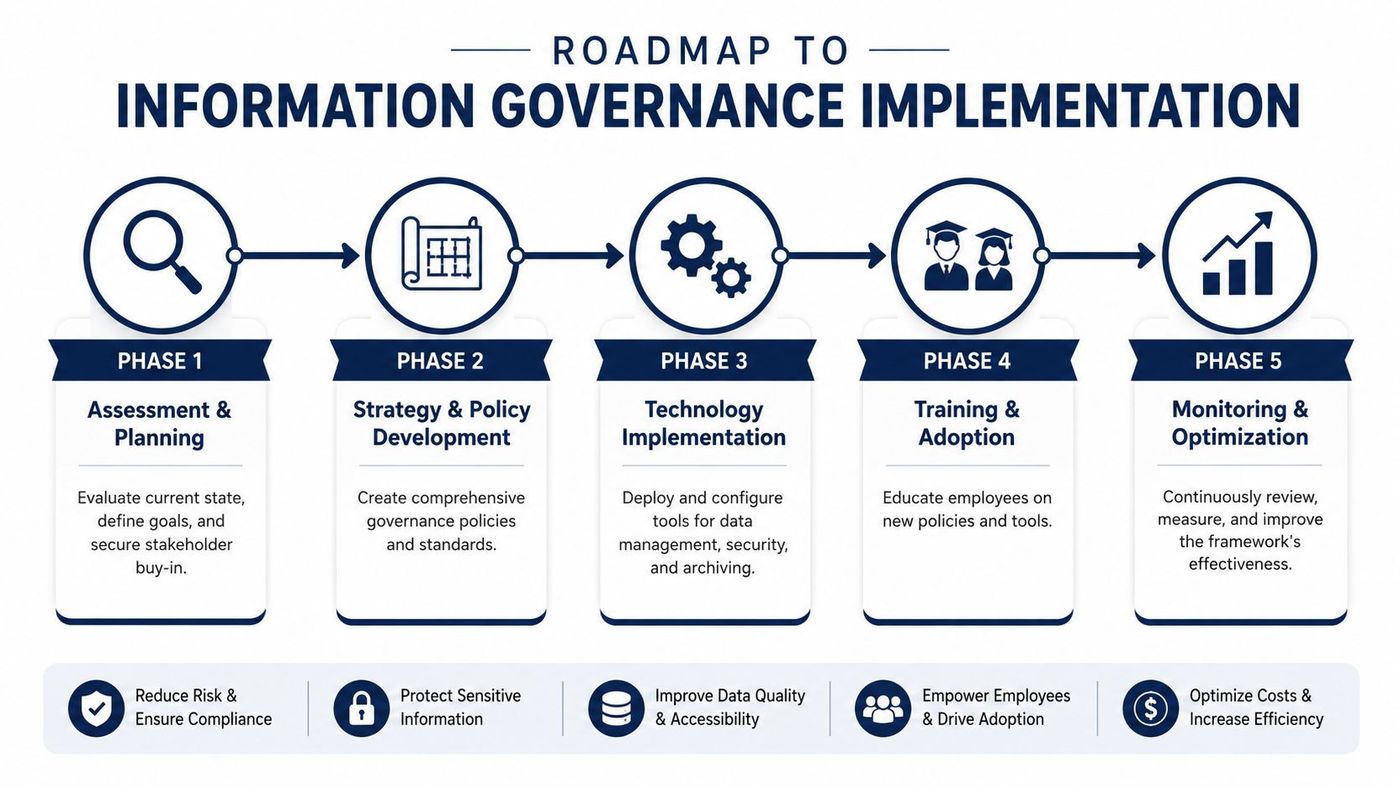
This can't sit with IT alone. You need representation from operations, privacy, legal or compliance, HR, and the business units that create the most sensitive or business-critical records.
The team's job is to make decisions on ownership, classification rules, approved systems, retention priorities, and escalation. One person should coordinate, but governance works best when accountability is shared and explicit.
Don't start with tooling. Start with visibility.
Map your major information categories, storage locations, access patterns, and obvious risks. Identify shadow systems, duplicate repositories, and high-sensitivity data stores first. In most businesses, the goal isn't a perfect inventory on day one. It's a credible picture of where risk and disorder are concentrated.
A structured assessment also makes policy decisions easier. If you're handling personal information in Alberta, the logic behind governance and assessment overlaps with the discipline used in a privacy impact assessment for Alberta organizations.
A practical rollout often looks like this:
Many organizations declare success when policies are approved and labels are published. That's too early. What matters is whether people changed how they store, share, retrieve, and dispose of information.
Track practical indicators such as:
A governance roadmap works when each phase reduces ambiguity for staff. If the rollout creates more confusion than clarity, the sequence is off.
The most common failure in information governance isn't technical. It's managerial. Businesses treat governance like a one-time setup task, then act surprised when the same issues return during audits, incidents, or leadership changes.
Canadian boards increasingly understand cyber risk, but oversight of privacy and governance maturity still lags. One Canadian legal analysis noted that 70% of boards recognize cyber risk as a top priority, while only 28% actively conduct quarterly reviews of privacy program implementation, monitoring, and enforcement. The same piece noted that 62% of mid-sized firms in Ontario lack a designated privacy officer or CEO-level accountability for data protection (BLG's checklist for boards and C-suite leaders).
That gap explains a lot. If the board asks about cyber posture but not information ownership, retention, access review, and privacy accountability, management gets a distorted signal. The result is often security tooling without governance discipline.
A mature program also needs preventive controls. If your environment still relies on users to notice risky movement of files, review your approach to data loss prevention in business environments. Governance needs enforcement, not just policy language.
“Set it and forget it” works for almost nothing in IT. It definitely doesn't work for information governance.
They review governance regularly. They tie ownership to named roles. They remove stale access. They update rules when systems or workflows change. They keep the conversation at the leadership level instead of burying it in a technical backlog.
Even when the strategy is sound, execution can be difficult. Medium-sized businesses often have lean internal teams, mixed legacy systems, and competing priorities. That makes governance hard to launch and even harder to sustain.

A capable managed IT partner brings structure in places where internal teams usually get stretched:
That matters because governance is both technical and operational. A policy may say “restrict access,” but someone still needs to map roles, update groups, document exceptions, monitor drift, and maintain the controls as the business changes.
The federal Guideline on Service and Digital requires government institutions to adopt a cloud first approach for information classified as Protected B or below, and to implement attribute-based access control so classified data is available on a need-to-know basis to authorized personnel (Guideline on Service and Digital).
Private-sector organizations aren't bound to copy government architecture wholesale, but the direction is instructive. Modern governance depends on well-configured cloud platforms, structured identity controls, and active administration. It doesn't depend on unmanaged file shares and tribal knowledge.
That's why operating support matters as much as initial design. Controls drift. Staff roles change. New repositories appear. Business units adopt new tools. Without continuous oversight, the framework weakens even if the original project was well executed.
If you're evaluating that operating model, this overview of managed IT service support for growing organizations helps clarify what ongoing partnership should include beyond basic help desk coverage.
Information governance is often introduced as a response to risk. The stronger reason to invest in it is control. When your business knows what information it holds, where it lives, who can use it, and how it moves through its lifecycle, work gets cleaner.
That control supports more than compliance. It improves responsiveness, strengthens trust, and gives leaders a better basis for decisions. It also reduces the drag that comes from duplicate files, unclear ownership, weak access discipline, and ad hoc retention.
The businesses that handle information well don't wait for an incident, audit, or client escalation to get serious. They build governance into daily operations and treat it as a permanent business capability.
The first step doesn't need to be dramatic. It needs to be honest. Assess where your information is, where your controls are weak, and which risks matter most right now. From there, the path becomes much easier to manage.
If your organization needs a practical way to turn information governance into stronger security, cleaner operations, and better PIPEDA readiness, CloudOrbis Inc. can help you start with a strategic assessment and build a roadmap that fits your systems, your risk profile, and your growth plans.
Book a 30-minute call with a senior engineer. No sales script, just straight answers about your environment.


