Managed Services Questionnaire: A Strategic Vendor Guide
Find the right IT partner with our strategic managed services questionnaire guide. Learn to customize, score, and evaluate vendors for your Canadian business.

Find the right IT partner with our strategic managed services questionnaire guide. Learn to customize, score, and evaluate vendors for your Canadian business.
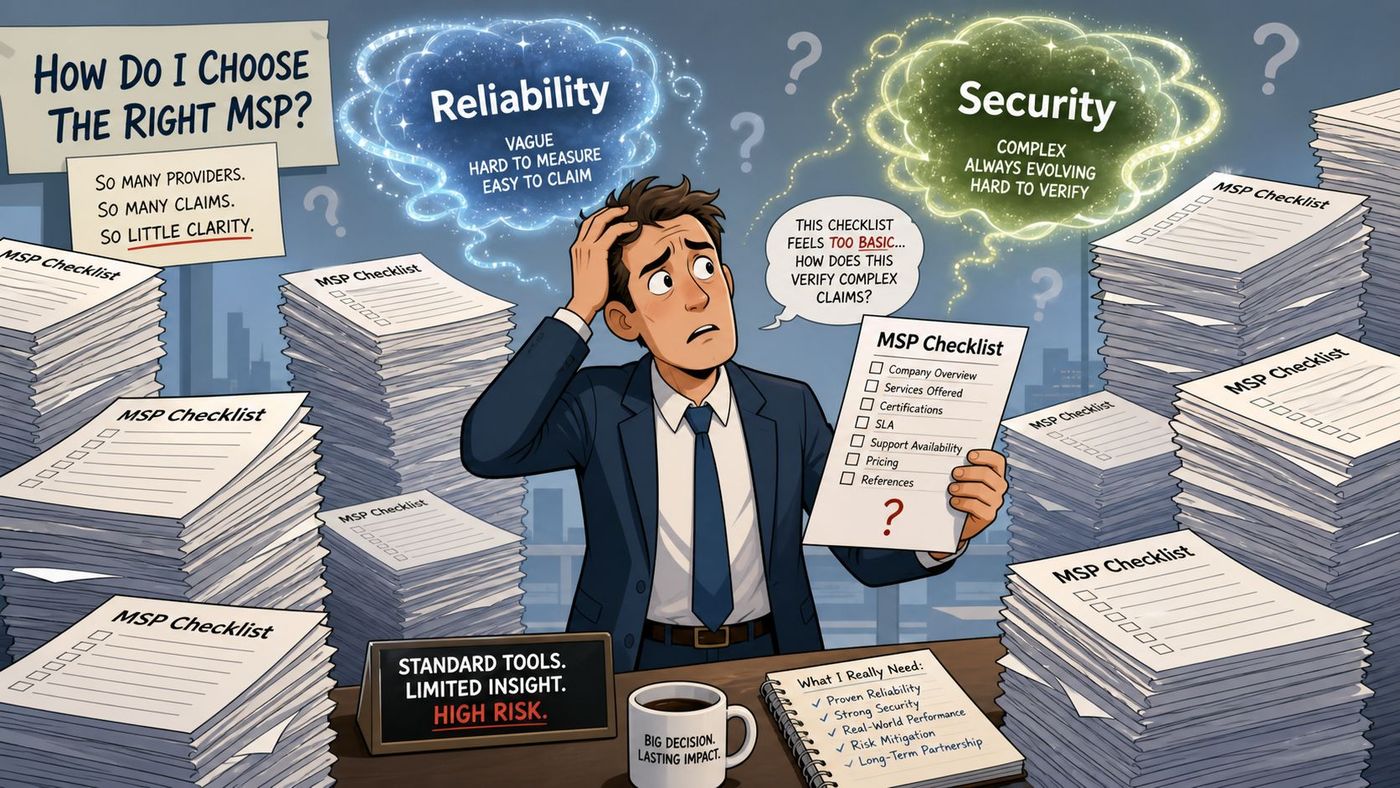
You're likely staring at a few proposals that all sound reassuringly similar. Every managed service provider says it's proactive. Every provider says security is built in. Every provider says support is responsive. Then actual pressure hits: you still have to choose one, defend that decision internally, and live with the consequences if the fit is wrong.
That's where a managed services questionnaire stops being paperwork and starts becoming a decision tool. A good one doesn't just collect answers. It exposes gaps, forces precision, and gives your leadership team a structured way to compare providers on the issues that affect uptime, compliance, cost control, and risk.
A generic MSP checklist usually fails for one reason. It treats vendor selection like a shopping exercise when it's really a risk-management decision.
Most business leaders don't struggle because they lack questions. They struggle because they get polished answers that are difficult to verify. “We offer strong security.” “We provide strategic guidance.” “We support regulated industries.” Those statements sound fine in a sales meeting. They're almost useless in procurement unless you can turn them into evidence, obligations, and measurable commitments.
The urgency is growing because the Canadian market is getting larger and more difficult to assess. The Canadian managed services market grew from USD 8,182.22 million in 2018 to USD 17,304.83 million in 2024, a 111.2% increase, according to Credence Research's Canada managed services market analysis. More providers, more specializations, and more bundled offerings mean buyers have more choice, but they also face more noise.
A copy-pasted list often overlooks the issues that create the biggest problems after contract signature:
A strong questionnaire shouldn't ask, “Do you provide security?” It should ask, “Show us how you govern access, document incidents, and validate controls.”
The better approach is to build a strategic managed services questionnaire with three purposes:
That changes the conversation. You stop rewarding the smoothest presenter and start rewarding the provider that can answer clearly, document its processes, and commit to outcomes in writing.
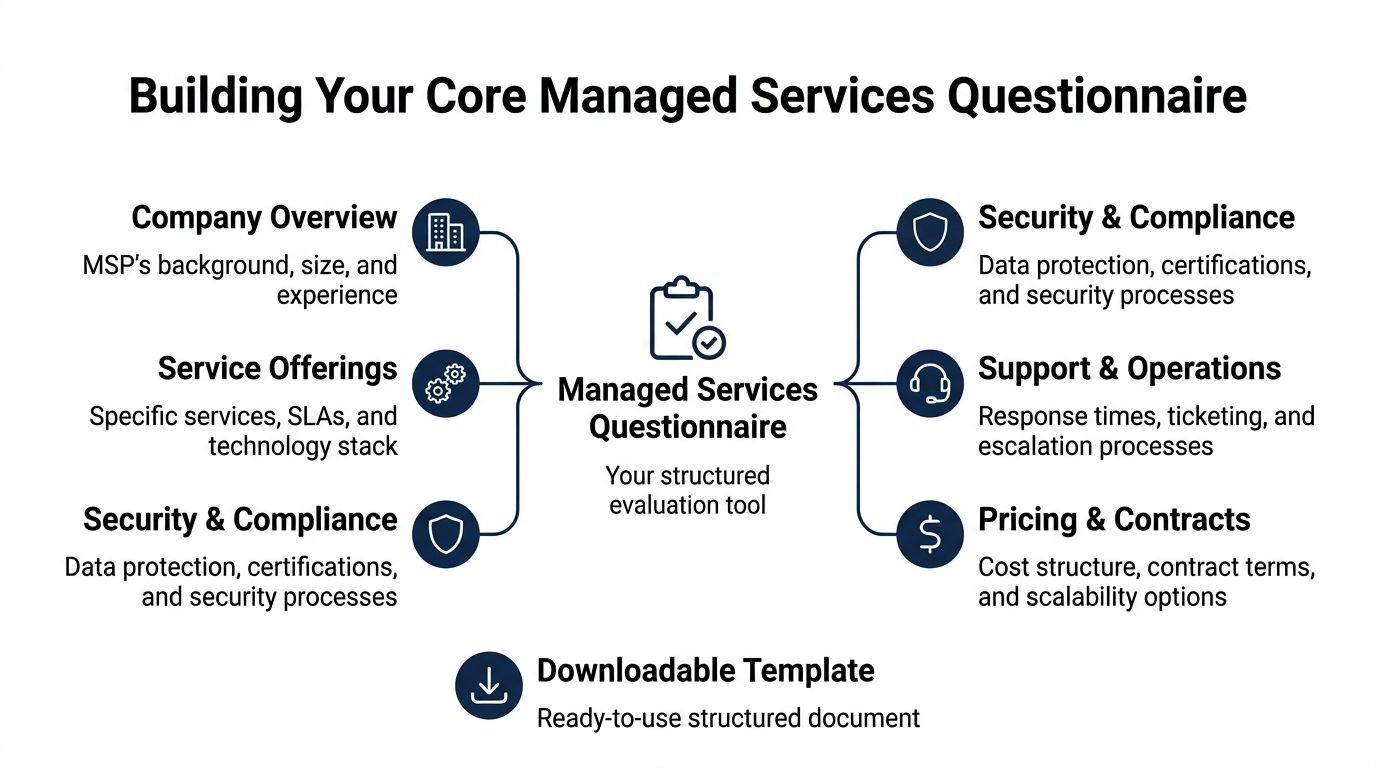
The easiest mistake is making the questionnaire too long, too vague, or too technical. If it feels like a legal interrogation, vendors will answer at a high level and your team won't get useful information back.
A better format is a structured document that a provider can complete in one sitting, with room for attachments where detail matters. To encourage completion, a managed services questionnaire should specify a 15–20 minute completion time and include inline instructions to clarify potentially vague items, such as defining the timeframe for security breaches as “within the last 24 months”, as noted by Contentsnare's managed services questionnaire template guidance.
If you need context on service scope before drafting your evaluation document, this overview of information technology managed services is a useful starting point.
Start with the environment itself. You need to know whether the provider can support your current stack and your likely direction over the next few years.
Ask questions such as:
A shallow answer usually lists products. A stronger answer explains ownership boundaries, support model, and what the MSP does when your environment contains legacy systems, custom line-of-business applications, or multiple sites.
Here, many provider comparisons become clearer. Technology matters, but service delivery discipline matters just as much.
Include prompts that force specifics:
| Area | Better question |
|---|---|
| Help desk | How are tickets triaged, escalated, and closed? |
| On-site support | When do you dispatch on-site resources, and who approves that step? |
| After-hours coverage | What does after-hours support include, and what is billable separately? |
| Reporting | What operational reports do clients receive each month? |
Practical rule: If an MSP can't explain how work moves from alert to resolution, you're buying promises, not process.
Some providers are competent operators but weak advisors. That may be acceptable if you only need narrow technical support. It's a problem if you need roadmap guidance, budgeting input, or help replacing outdated platforms.
Questions here should test whether the provider thinks beyond tickets:
This section often separates transactional vendors from long-term partners.
Commercial surprises damage trust faster than technical mistakes. Your managed services questionnaire should make the cost model visible before legal review starts.
Use direct wording:
The strongest answers are plain, itemised, and easy for a non-technical executive to understand. If pricing language is packed with caveats, expect friction later.
A solid core questionnaire gets you only part of the way. High-compliance sectors need industry-specific questions because the risks aren't the same.
The clinic worried about patient privacy, the manufacturer worried about plant uptime, and the law firm worried about document confidentiality are all buying managed services. They are not buying the same operating model.
Healthcare buyers should test whether the provider understands regulated workflows, not just generic IT support. Data handling, access controls, secure collaboration, and incident management all matter more when clinical systems and personal information are involved.
A critical requirement in Canada is data location. A managed services questionnaire for Canadian SMEs must verify data residency, as 78% of Canadian organizations face regulatory requirements for customer data to remain within national borders, according to F12's guide to choosing the right MSP for Canadian SMBs.
For healthcare organizations, ask:
If your organization operates in care delivery, outpatient services, or multi-location clinics, it also helps to review sector-specific expectations in health-care IT services.
Manufacturing and logistics environments are often less forgiving than office-only businesses. Downtime can affect plant output, shipping schedules, warehouse operations, handheld devices, and supplier coordination at the same time.
Your questionnaire should reflect that reality. Focus less on generic office support and more on resilience.
Use prompts like these:
A provider may be excellent in a professional services office and still struggle in a distribution centre or production floor. Your questions should make that visible.
In manufacturing, “we respond quickly” isn't enough. You need to know who takes control when an outage hits operations, suppliers, and customers at once.
These firms often need strong confidentiality controls, disciplined permissions, documented retention practices, and clear separation of client matters. The provider doesn't need to be your compliance officer, but it does need to operate in a way that supports your obligations.
Ask narrower questions:
These industries also benefit from probing how the MSP handles board-level reporting, legal hold considerations, and privileged account review. Those details reveal whether the provider understands your operating pressure or just your software stack.
Keep the structure consistent across industries, then swap in targeted questions under the same major headings. That gives you two advantages:
A questionnaire that is too generic creates false confidence. A questionnaire that is too bespoke becomes difficult to score. The middle ground works best: one common framework, with industry modules added where risk is concentrated.
Most MSPs know security sells. That's why weak security questions produce polished but low-value answers.
If you ask, “Do you take cybersecurity seriously?” every provider will say yes. If you ask, “What tools do you use?” you may get a product list that sounds impressive but tells you very little about governance, accountability, or control maturity.
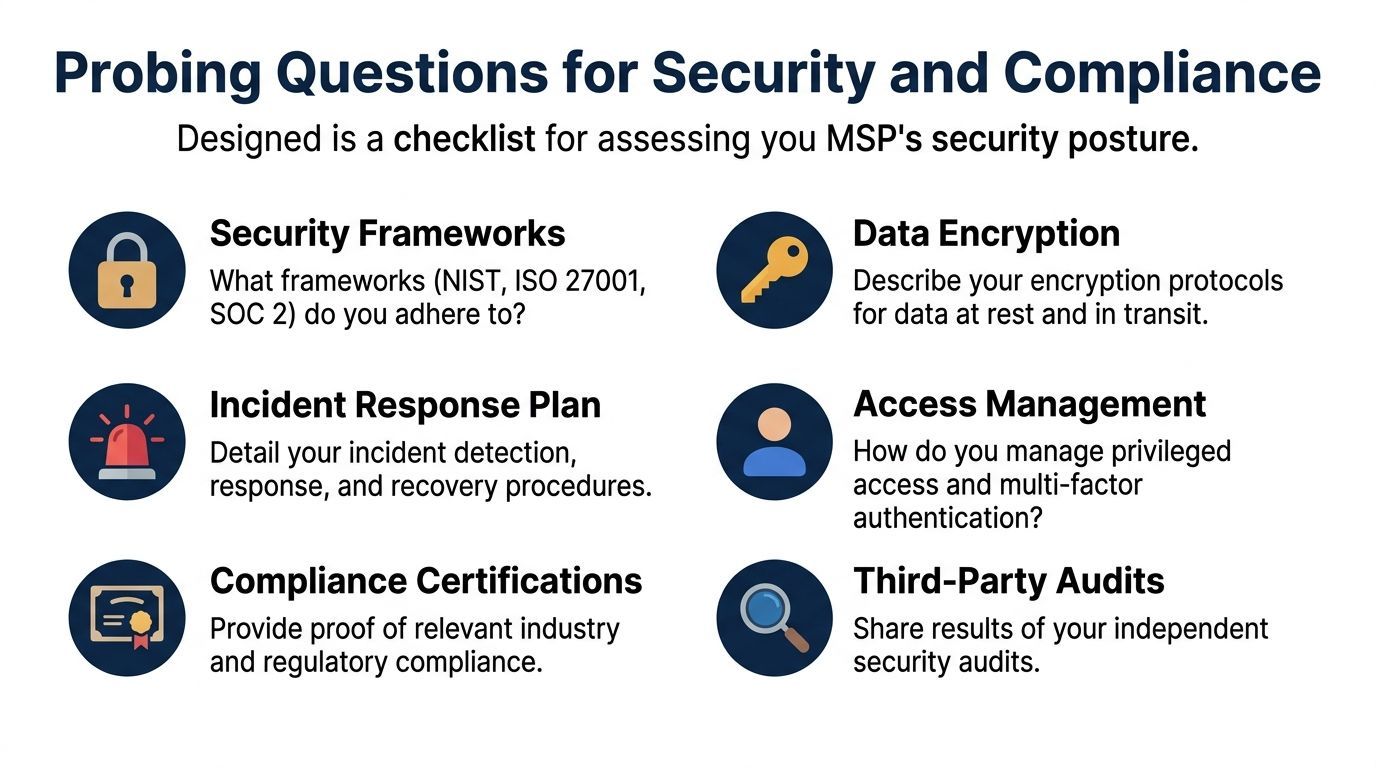
A better managed services questionnaire asks for proof, process, and scope. Canadian buyers should be particularly disciplined here. The Canadian Centre for Cyber Security guidance for consumers of managed services says businesses should ask whether a provider has been evaluated under its programs and, if not, request evidence of third-party evaluations against frameworks such as ISO 27001, ITSG-33, or NIST.
For organizations refining this part of the evaluation, this background on security managed services helps frame the difference between advertised protection and operational security practice.
Use questions that require evidence, not marketing language:
You should be cautious when an MSP does any of the following:
Security maturity shows up in routine discipline. Access reviews, documented procedures, and independent validation matter more than dramatic sales claims.
One more point often gets missed. You're not only assessing whether the provider can protect you. You're assessing whether the provider itself is a concentration of risk. An MSP with broad administrative access and weak internal governance can become your biggest exposure.
Once the questionnaires come back, many teams make a familiar mistake. They read the answers, discuss impressions, and choose the provider that feels strongest in the room. That approach is common. It's also hard to defend later.
A better method is to score responses against weighted criteria tied to business priorities. That turns subjective opinions into a structured evaluation record.
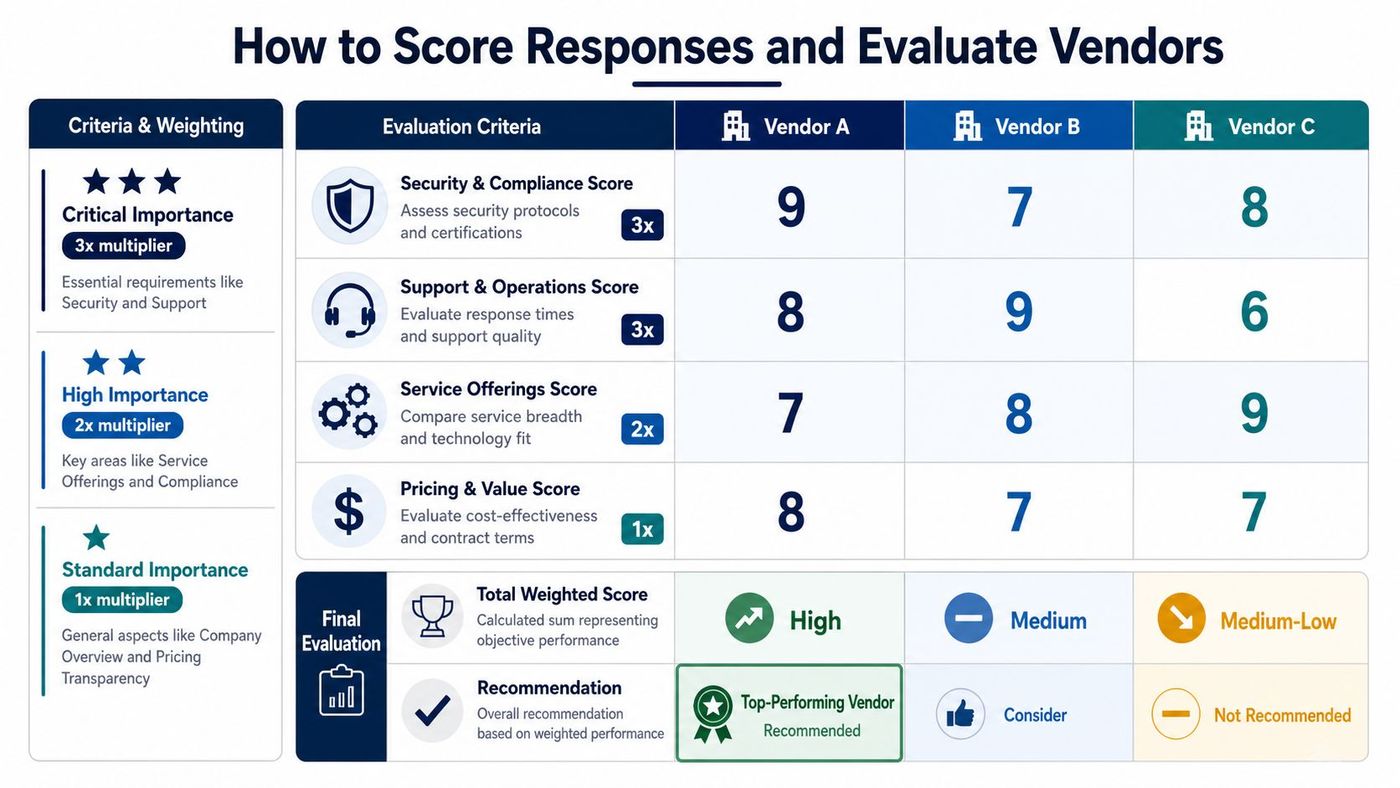
If your procurement process involves multiple suppliers and internal stakeholders, this guide on IT vendor management is a practical companion to the scoring model.
Not every answer should carry equal value. For a healthcare clinic, compliance and support continuity may outrank contract flexibility. For a manufacturer, incident response and site support may matter more than advisory services.
A simple model works well:
| Category | Priority | What to assess |
|---|---|---|
| Security and compliance | Critical | Evidence, frameworks, incident process, access control |
| Support and operations | Critical | Response commitments, escalation, reporting, coverage |
| Technical fit | High | Platform alignment, migration capability, monitoring scope |
| Strategic guidance | High | Planning, roadmap support, lifecycle advice |
| Pricing and contract terms | Standard | Transparency, exclusions, flexibility, exit support |
You don't need an elaborate procurement platform. A spreadsheet is usually enough if the criteria are clear and the scoring notes are disciplined.
Use a consistent rubric. For example:
That distinction matters most with service levels. Effective SLAs must include specific, numbers-based promises such as 99.9% uptime for essential systems, critical issue response times under 15 minutes, and defined penalties for non-compliance, as outlined in CloudOrbis's article on managed services companies and SLAs.
Compare the difference:
| SLA answer | Assessment |
|---|---|
| “We pride ourselves on fast response and excellent service.” | Weak. No measurable obligation. |
| “Critical incidents receive a response in under 15 minutes, covered by contract, with service credits for missed commitments.” | Strong. Specific and enforceable. |
There's a useful parallel outside IT. Reliability teams evaluating outside maintenance partners often focus on scope clarity, proof of process, and accountability before work starts. Those same principles apply here. Forge Reliability's guide to strategies for contractor quality is a helpful reference because it reinforces a broader truth: structured evaluation reduces operational surprises.
The best vendor selection process doesn't eliminate judgement. It gives judgement a framework.
By the end of scoring, you should be able to answer three questions clearly:
If you can't answer those questions from your scoring sheet, the questionnaire probably captured information but didn't create decision value.
The highest score doesn't always win automatically. You still need to read for warning signs.
Pay close attention when a provider avoids specifics, refuses to share sample reports, answers complex questions with jargon, or pushes every meaningful commitment into a future contract discussion. Those behaviours usually signal one of two things: immature operations or an unwillingness to be transparent.
A few red flags matter more than others:
The right decision is the one you can justify operationally, commercially, and from a risk perspective. If you want a useful benchmark for that partner profile, this article on signs of an MSP that has your business goals in sight is worth reviewing before final interviews.
A disciplined managed services questionnaire won't remove every uncertainty. It will do something better. It will make the trade-offs visible, force better conversations, and give your team a defensible path to the right provider.
If you're reviewing providers and want a partner that brings transparent process, strong security, and 24/7, 100% Canada-based support, talk to CloudOrbis Inc.. Their team helps Canadian organizations assess current gaps, modernize operations, and move forward with a structured engagement model that supports growth without compromising compliance or reliability.
Book a 30-minute call with a senior engineer. No sales script, just straight answers about your environment.


