
September 13, 2026
Third-Party Risk Management for Canadian SMBsMaster third-party risk management for your Canadian SMB. Learn OSFI compliance, vendor monitoring frameworks, and how to secure your supply chain.
Read Full Post%20(1).webp)
Usman Malik
Chief Executive Officer
December 9, 2025
Running your business while simultaneously acting as the on-call technician for every piece of technology is an exhausting, inefficient juggling act. This is where managed services companies come in, transforming your IT from a reactive, break-fix headache into a proactive, strategic partnership that drives your business forward.
This guide will walk you through what a managed services company does, the core services they provide, and how to choose the right partner for your medium-sized Canadian organization.
Think of the traditional IT support model as a fire department—you only call them when a blaze has already started. A managed services provider (MSP), on the other hand, is like having a fire inspector, an architect, and a security team all rolled into one. They don't just put out fires; they work around the clock to prevent them from ever happening.
This proactive approach is the fundamental difference. Instead of waiting for a server to crash or a security breach to occur, an MSP constantly monitors your systems. They handle maintenance, apply security patches, and optimize performance behind the scenes, meaning issues are often fixed long before your team even notices a problem.
The old "break-fix" method creates a painful cycle. An employee's computer breaks, productivity grinds to a halt, and you're stuck paying an hourly fee for an emergency repair. That model incentivizes downtime—the IT company only gets paid when your technology fails. Managed services companies flip this model on its head.
A partnership with an MSP aligns their success directly with yours. They operate on a predictable, subscription-based model, which means it’s in their best interest to keep your technology running smoothly and securely. Less downtime for you means better efficiency and profitability for them.
A true managed services partnership goes beyond simple maintenance. It’s about gaining a deep understanding of your business goals to ensure every technology investment delivers real, measurable value.
This strategic collaboration includes:
Ultimately, working with managed services companies lets you offload the entire complexity of IT management. This frees up your internal team to focus on their core responsibilities—serving your clients and growing the business—instead of being bogged down troubleshooting technical glitches. You can learn more about how a managed IT service can specifically benefit your operations in our detailed guide.
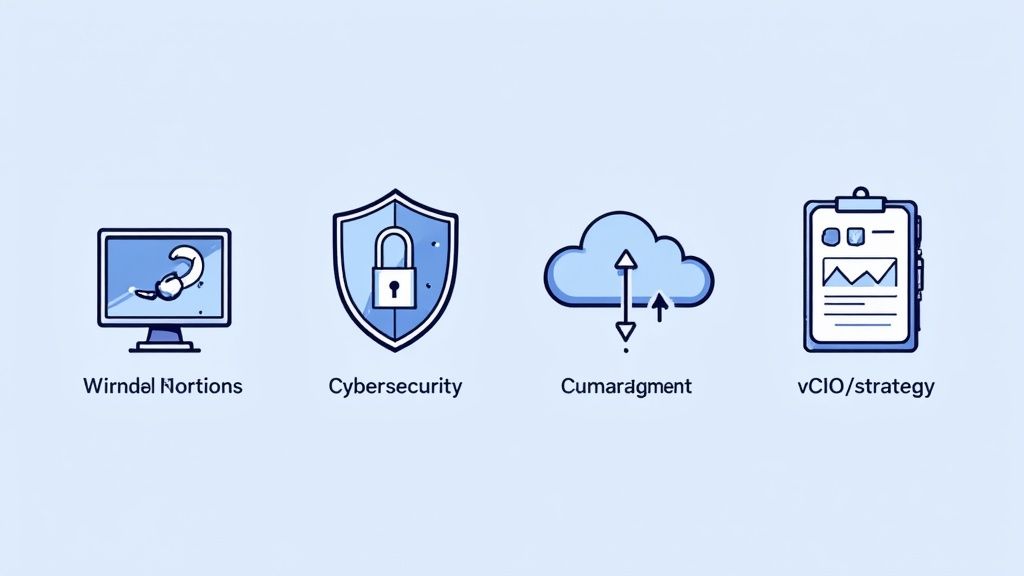
So, what exactly do you get when you bring a managed services company on board? While the specific menu can change from one provider to another, a core group of services forms the bedrock of a solid IT partnership. These aren't just about fixing things when they break; they’re designed to cover every corner of your tech environment, providing strategic value that helps your business grow.
Think of it like building a house. You need a solid foundation, sturdy walls, a secure roof, and a reliable electrical system. Each managed service acts as one of these crucial components, working together to create a dependable and secure structure for your business.
Let’s break down what those foundational services look like.
This is the service your team will interact with the most. It's the day-to-day support that keeps your operations running smoothly. But don't mistake it for a simple call centre. Modern managed support is about preventing problems before they start.
This includes 24/7/365 system monitoring, where a team of experts constantly watches your network for any signs of trouble. This allows them to spot and fix many issues—like a server about to run out of space or a failing network switch—long before they can cause frustrating downtime for your staff.
A responsive helpdesk also gives your employees a direct line to IT experts for any problem, big or small. No more lost productivity while someone tries to troubleshoot their own printer issues. This support also covers efficient deployment, from setting up new workstations to managing automated software installations across the entire company.
In an age of constant digital threats, skimping on cybersecurity is not an option. MSPs deliver enterprise-grade security that most medium-sized organizations could not afford or manage on their own. This is much more than just antivirus software; it’s a multi-layered defence strategy built to withstand modern attacks.
Key elements of a managed cybersecurity plan include:
A skilled MSP ensures your business is shielded from an ever-changing threat landscape, protecting your data, your reputation, and your bottom line.
The cloud offers incredible flexibility and power, but managing platforms like Microsoft Azure or Amazon Web Services (AWS) can get complicated and expensive fast. A managed services company brings the expertise needed to ensure you're getting the most out of your cloud investment.
This goes beyond just moving your data online. A true cloud partner helps you optimize your spending, secures your configurations against vulnerabilities, and manages performance so your applications run smoothly. They will design a cloud environment that fits your business, whether that's a public, private, or hybrid solution.
What would you do if a fire, flood, or a crippling cyberattack hit your office tomorrow? A Business Continuity and Disaster Recovery (BCDR) plan is your answer. It's your business's insurance policy against the unexpected, ensuring your operations can continue with minimal disruption.
An effective BCDR strategy, managed by an MSP, involves regular, automated backups of your critical data and systems. It also includes a clear, tested plan to restore operations quickly, ensuring that a catastrophe doesn't put you out of business.
This service offers incredible peace of mind, letting you know that your data is safe and your business is resilient enough to handle whatever comes its way. To see how this works, check out our guide on managed IT support services.
Finally, one of the most valuable services offered by today's managed services companies is the Virtual Chief Information Officer (vCIO). Think of it as having executive-level IT guidance and strategy without the hefty salary of a full-time C-suite executive.
Your vCIO works to deeply understand your long-term business goals and then builds a technology roadmap to help you get there. They provide crucial insights on budgeting, help you weigh the pros and cons of new technologies, and ensure your IT investments deliver a real return. In short, they help turn your technology from a cost centre into a strategic asset for growth.
To help you see how these pieces fit together, here’s a quick summary of how each service directly benefits your business.
Ultimately, these services work in concert to create a stable, secure, and forward-looking technology environment that empowers your business rather than holding it back.
It’s one thing to see a list of services a managed services company offers. It’s another to understand what those services do for your business on a day-to-day basis. The real value isn’t just about fixing computers; it’s about how that proactive support translates into measurable improvements that you can see on your balance sheet.
A strong MSP partnership gives you a strategic edge, impacting your budget, security, and the overall rhythm of your operations.
These benefits go far beyond "keeping the lights on." They create a stable, predictable foundation where your business can thrive. Let’s break down the three pillars of this value: predictable costs, stronger security, and a boost in productivity.
One of the first things you’ll notice when working with a managed services company is the shift from chaotic capital expenditures (CapEx) to a steady, predictable operating expense (OpEx). The old break-fix model is a financial rollercoaster. One month might be quiet, but the next could hit you with a server failure that costs thousands in emergency repairs and new hardware.
That’s a budgeting nightmare. An MSP works on a flat monthly subscription fee. This single fee covers everything from proactive maintenance and 24/7 monitoring to helpdesk support and strategic advice.
This predictability brings a few key advantages:
This financial stability lets you invest your capital into growing the business instead of hoarding it for the next inevitable IT meltdown.
For most medium-sized businesses, building an in-house cybersecurity team with the right expertise just isn't practical. The cyber threat landscape is a complex minefield, and the talent needed to navigate it is both hard to find and expensive. This is where an MSP delivers a massive security upgrade.
When you partner with an MSP, you instantly get access to a team of dedicated security professionals. Their entire job is to stay ahead of new threats and implement tough, multi-layered security strategies to keep your business safe.
By outsourcing security to a specialized provider, businesses gain a significant defensive advantage. With cybercrime damages projected to hit $10.5 trillion annually by 2025, enterprise-grade protection is no longer a luxury—it's a necessity.
This stronger security posture means you're far better protected against data breaches, ransomware attacks, and other cyber incidents that could cripple your reputation and your finances. You can explore the benefits of managed IT services in more detail to see how this all-around protection works.
Every minute your systems are down, your business is losing money. Unplanned downtime doesn't just halt productivity; it frustrates employees and can damage client relationships. A core mission of any managed services company is to maximize your uptime and keep your team working smoothly.
Through constant, proactive monitoring, MSPs can spot and fix potential problems long before they turn into full-blown disasters. A failing hard drive, a network slowdown, or an expiring security certificate can all be handled behind the scenes without your staff ever noticing a disruption.
For instance, a Canadian logistics company depends on its network to manage shipping routes and inventory. An unexpected server crash during its busiest season could cause catastrophic delays and financial losses. An MSP partner would have systems monitoring that server's health, applying patches proactively, and a tested disaster recovery plan ready to go. This forward-thinking approach transforms IT from a potential liability into a reliable engine for growth.
You wouldn't ask your family doctor to perform open-heart surgery. While they have excellent general medical knowledge, you need a specialist for something so critical. The same logic applies to your business's IT. A generic IT provider often lacks the deep, specific expertise required for industries with high stakes and complex regulations.
A one-size-fits-all strategy falls apart when you're dealing with strict compliance, unique security threats, and specialized operational workflows.
Choosing a managed services company that understands your industry is one of the smartest moves you can make. They already know your challenges, speak your language, and can build an IT environment that actively supports your business goals. They aren't just managing technology; they're protecting your entire operation from industry-specific risks.
For any Canadian healthcare organization—from a small clinic to a large care facility—data security isn't just a good idea, it's the law. You're handling massive amounts of Personal Health Information (PHI), which is protected by provincial regulations like Ontario's Personal Health Information Protection Act (PHIPA).
A general IT provider might not grasp the nuances of PHIPA, such as the rules around where data can be stored, the specific encryption needed for patient records, or how to secure communication channels. An MSP that specializes in healthcare builds compliance into the foundation of your IT.
This means they will handle critical details, such as:
Financial firms operate in a world where security and trust are everything. They're a prime target for sophisticated cybercriminals and must follow regulations like the Personal Information Protection and Electronic Documents Act (PIPEDA). A managed services company with a background in finance knows that a basic firewall is not enough.
A specialized financial IT strategy involves multi-layered security designed to protect sensitive client data, secure transactions, and ensure regulatory compliance. This focus is crucial for maintaining client trust and operational integrity in a sector built on confidentiality.
This involves implementing advanced threat detection, deploying powerful data encryption, and creating secure networks designed to fend off aggressive cyberattacks. The goal is simple: build a resilient IT infrastructure that protects your clients' assets and your firm’s reputation.
In manufacturing and construction, the game is all about uptime and reliability. These industries are now heavily reliant on Internet of Things (IoT) devices, from sensors on a factory floor to project management tools on a construction site. A network outage can grind a production line to a halt or cut off communication across a job site, leading to expensive delays and missed deadlines.
An MSP with experience in these fields understands how to build and maintain rugged, reliable networks that can handle complex supply chains and a host of connected devices. Their expertise turns your technology into a powerful asset that boosts productivity, rather than a fragile system that’s one step away from failure.
When you understand the unique IT demands of your field, you can find a partner who truly gets your day-to-day reality. For a closer look, you can explore our guide on IT solutions for specific Canadian industries.
Picking a partner to look after your critical IT infrastructure is one of the most important decisions you'll make. The right choice can fuel your growth and lock down your security, but the wrong one often leads to frustrating downtime, surprise costs, and major headaches. To find a partner who is genuinely invested in your success, you need a solid evaluation plan.
This isn't about lining up quotes on a spreadsheet. It’s about finding a provider whose technical skill, service delivery, and business values align with your own.
The Service Level Agreement (SLA) is the contract that defines your entire relationship with a managed services company. It's the single most important document you’ll review because it lays out clear, measurable promises for their performance. If the SLA is vague, that’s a major red flag.
When you're looking at an SLA, look for specific, numbers-based promises. Don't settle for generic statements like "fast response times."
Instead, you need to see clear metrics covering:
A strong SLA is detailed, transparent, and protects your business by making your provider accountable.
Managed services pricing can be tricky, and different models work better for different businesses. It’s vital to understand exactly how a potential partner bills for their services so you aren't hit with hidden costs later.
You'll usually encounter a few common pricing structures:
Always ask for a complete breakdown of what's included in any pricing model. Make sure you clarify costs for projects that fall outside the main agreement, like a major hardware refresh or an office move, to avoid financial surprises.
For any Canadian business, partnering with a local, Canadian-based managed services company is a massive strategic advantage. It’s not just about supporting the local economy; it’s about making sure your partner truly understands the Canadian business and regulatory environment.
A Canadian provider understands the finer points of data residency laws and compliance standards like PIPEDA and provincial-level privacy acts like PHIPA. This is especially important as the global IT market consolidates. For example, the Pacific region of the U.S. now accounts for 26.2% of the MSP workforce, driven by its massive tech sector. While this centralization has its benefits, a Canadian partner ensures your data governance is always aligned with local laws. You can learn more about the growth of the managed services market here.
This infographic offers a simple decision tree to help you think through the key questions based on your specific industry.
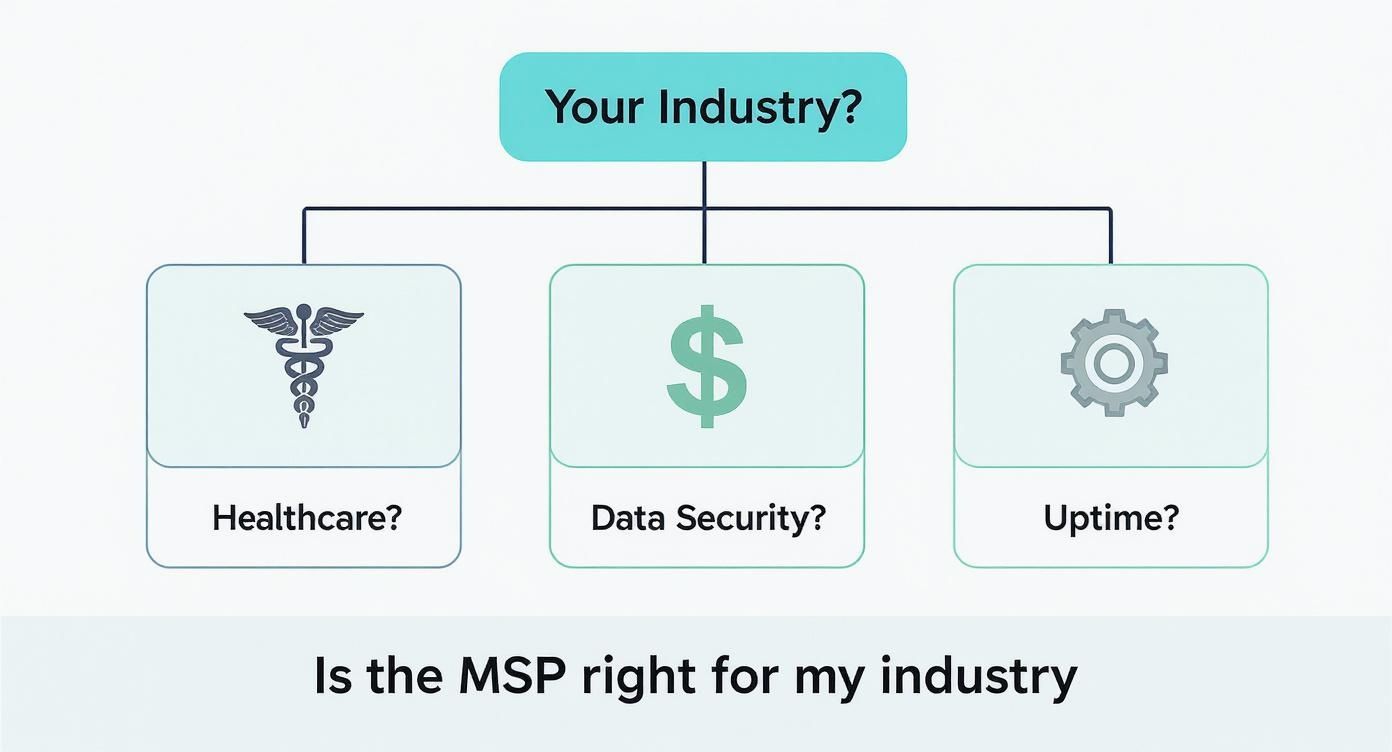
As the visual shows, it doesn’t matter if you're in healthcare, finance, or manufacturing—you have to address critical questions around compliance, data security, and operational uptime.
As you go through your evaluation process, keep your eyes peeled for warning signs that a provider might not be the right long-term fit. These red flags can point to a lack of transparency, poor service quality, or a sales-first culture that doesn’t put clients first.
Here’s a practical checklist to help you compare potential MSPs and spot any issues before you sign.
By using this checklist and staying alert for red flags, you can move beyond the sales pitch and find a partner who will genuinely help you achieve your goals for years to come. Choosing the right managed services company is a foundational step toward building a more resilient, secure, and efficient business.
Choosing the right managed services company is a strategic move that can shape the future of your business. A true partner does more than just fix tech problems—they ensure your technology actively helps you achieve your business goals.
At CloudOrbis, this philosophy is at the core of our work with every Canadian client.
We don't just offer IT support; we build strategic partnerships. Our approach is built on proactive strategy, robust cybersecurity, and smart cloud solutions that drive growth. Think of us less like an external helpdesk and more like an extension of your own team, fully invested in your success.
As a Canadian company, we live and breathe the local business environment. We understand the unique challenges and the specific regulatory hurdles you face.
The global market for managed services is huge, with major tech hubs around the world. For example, in 2025, California remains a hotspot for top-tier MSPs, with providers there being recognized globally for their work in cloud and cybersecurity. You can learn more about the top-performing managed service providers of 2025.
While global expertise is valuable, a local partner who understands Canadian compliance and business culture is essential. We combine world-class service with a personalized, local touch.
Our team is ready to help you turn your IT from a necessary expense into one of your most powerful assets. Take a look at our full suite of managed IT services and see how we can build a secure, efficient, and resilient technology foundation for your business.
Thinking about partnering with an IT company can bring up a lot of questions. Here are straightforward answers to the questions we hear most often from business leaders.
The difference comes down to being proactive versus reactive.
Traditional IT support is the "break-fix" model. Something breaks, you call for help, and wait for a fix. This often means unexpected downtime and surprise bills.
Managed services companies flip that script. We take a proactive approach, constantly monitoring your systems to catch and fix potential problems before they can disrupt your workday. Instead of being a reactive cost centre, your IT becomes a predictable, strategic part of your business.
The goal is to move from unpredictable repair bills to a stable, budget-friendly operating expense. Most managed services work on a subscription model, so you know exactly what you’re paying each month.
The most common setups are a flat monthly fee per user or per device. Some providers also offer tiered packages with different levels of service. The final cost depends on your company's size, the complexity of your IT setup, and the services you need. The idea is to give you one clear number that covers everything—maintenance, monitoring, and support—with no surprises.
Not at all. In fact, one of the biggest advantages for small businesses working with a managed services provider is gaining access to enterprise-level tools and expertise that would normally be out of budget.
A good MSP can build a service package that fits the needs of a small team perfectly. As your business grows, your services can scale right alongside you. You get the support you need at every stage without having to make huge upfront investments in technology or staff.
If you're with the right partner, it shouldn't be difficult. A professional managed services company will have a clear, well-practiced onboarding process designed to make the switch as smooth as possible.
It starts with a deep dive into your current setup, followed by a clear plan for the migration. The transition is handled carefully to ensure your team's workflow isn't disrupted. The goal is always a seamless handover, not a week of chaos.
Ready to turn your IT from a source of frustration into an engine for growth? The team at CloudOrbis is here to build a genuine partnership that aligns with your business goals. Get in touch with us today to schedule a consultation and see how a proactive IT strategy can make all the difference.
September 13, 2026
Third-Party Risk Management for Canadian SMBsMaster third-party risk management for your Canadian SMB. Learn OSFI compliance, vendor monitoring frameworks, and how to secure your supply chain.
Read Full Post
September 12, 2026
Managed Services Cost: A Practical Guide for Canadian SMBsUnderstand managed services cost for Canadian SMBs. Learn pricing models, industry factors, ROI, and how to choose the right provider for your business.
Read Full Post
September 11, 2026
Managed EDR Services: A Practical Guide for Canadian SMBsLearn how managed EDR services detect, contain, and respond to threats around the clock. A practical guide for Canadian SMBs evaluating providers, pricing
Read Full Post
