Elevate IT Efficiency with IT Support for Legal Firms
Boost cybersecurity, ensure compliance, and streamline workflows with it support for legal firms, discover the right partner today.

Boost cybersecurity, ensure compliance, and streamline workflows with it support for legal firms, discover the right partner today.
When it comes to IT, law firms operate in a completely different league. IT support for legal firms isn’t about simple tech fixes; it's a highly specialized service built to protect your firm's most sensitive digital assets, from client files to case strategy.
This kind of support goes far beyond the basics. It’s about building a digital fortress with robust cybersecurity, ensuring you meet strict regulatory obligations like PIPEDA, and guaranteeing the operational uptime that’s so vital for billable hours. Think of it as having a dedicated technology partner who genuinely understands the unique pressures and duties of the legal profession.
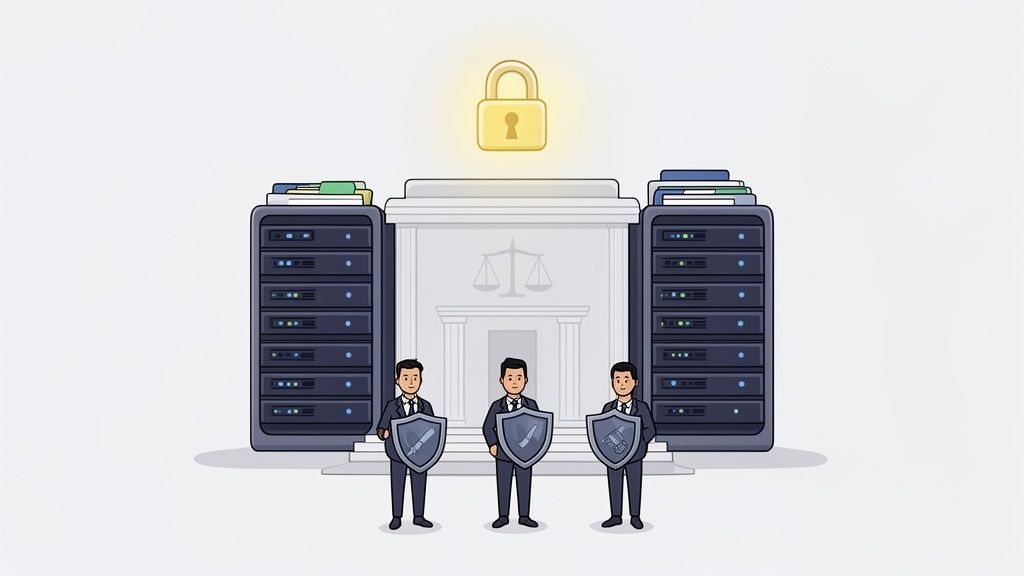
Picture your firm’s entire operation, every case file, client email, and billing record, as a secure digital courthouse. This courthouse needs more than a generic padlock. It demands a specialized security and operations team that understands the incredibly high stakes. Standard, one-size-fits-all IT solutions just don't cut it anymore, which is why specialized legal IT support is now a non-negotiable for any modern practice.
A specialist team focuses on three areas that generic providers often miss:
The need for robust IT support has never been more urgent for Canadian law firms, especially with cyber threats on the rise. With over 35,313 law firms operating across the country, many of which are small to mid-sized practices, the attack surface is massive. These firms are seen as lucrative targets for ransomware attacks that can shut down operations overnight.
Even more concerning, a 2023 report found that only 40% of Canadian law firms have cyber liability insurance, a significant drop from 46% the previous year. This trend points to a dangerous gap in preparedness, especially when it comes to protecting sensitive client data under PIPEDA.
The consequences of poor IT are serious, running from data breaches and client data loss to malpractice claims and irreversible reputational harm. But the conversation is changing. It's no longer just about avoiding risk.
Strategic technology is no longer just a defensive measure; it’s a competitive advantage. It allows lawyers to focus on what they do best, practising law, rather than managing technology.
A proactive IT strategy can turn technology from a source of frustration and cost into one of your firm’s most powerful assets. Find out more about how CloudOrbis provides tailored IT solutions for the legal industry that protect and empower your practice.
For any forward-thinking law firm, technology has moved far beyond being a simple background utility. It’s now the very foundation of your entire practice. Specialized IT support for legal firms is built on a few core pillars, with each one designed to hold up a critical business function. These aren't just technical add-ons; they are the essential services that guarantee your firm's security, efficiency, and growth.
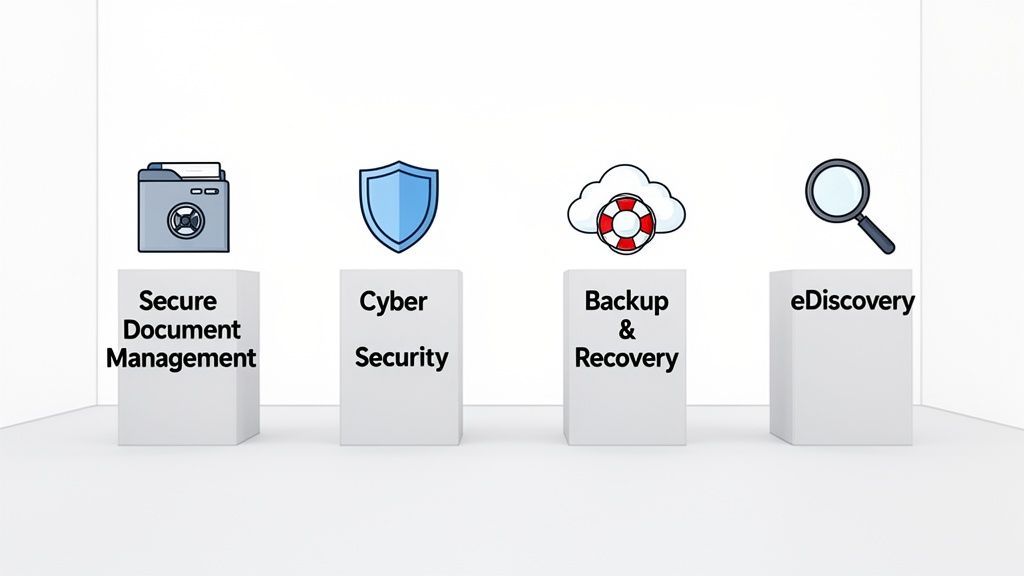
It helps to think of these services as interconnected supports holding up your digital practice. If one pillar is weak, the whole structure becomes vulnerable. A strong IT partner ensures each pillar is robust, secure, and perfectly aligned with your firm’s specific goals.
To help visualize how these IT services address specific operational headaches, here’s a breakdown of their direct impact on a legal practice.
| IT Service Pillar | Common Legal Challenge | How Managed IT Solves It | Direct Business Impact |
|---|---|---|---|
| Secure Document Management | Risk of data leaks and disorganized case files across multiple platforms. | Implements a centralized, access-controlled system with version tracking and compliance-ready storage. | Protects client confidentiality, streamlines collaboration, and creates a defensible audit trail. |
| Cybersecurity & Endpoint Protection | Lawyers working remotely on various devices create multiple entry points for cyberattacks. | Deploys 24/7 monitoring and threat protection on all devices (endpoints) to block malware and phishing attempts. | Prevents costly data breaches, safeguards the firm's reputation, and secures billable work from anywhere. |
| Data Backup & Disaster Recovery | A server crash or ransomware attack could wipe out years of critical client data and case files instantly. | Automates secure, encrypted backups and establishes a clear, tested plan to restore data and systems quickly. | Guarantees business continuity, minimizes non-billable downtime, and provides an essential safety net. |
| eDiscovery & Litigation Support | Manually sifting through massive volumes of digital evidence is slow, expensive, and prone to error. | Provides the tools and expertise to collect, process, and review vast datasets efficiently and accurately. | Accelerates the discovery process, lowers litigation costs, and strengthens the firm's position in court. |
As the table shows, each service pillar directly counters a significant risk or inefficiency common in the legal field, turning potential liabilities into operational strengths.
At its core, a law practice runs on documents. Think of a secure document management system as your firm’s perfect digital clerk and vault rolled into one, ensuring every file is kept confidential, version-controlled, and instantly available to authorized staff.
This is much more than just simple cloud storage. A proper system involves:
A robust document management system brings order to the chaos of multiple file versions and eliminates the massive security risks of using unsecured sharing methods. It effectively transforms your firm's intellectual property into a secure, organized, and easily searchable asset.
Consider this pillar your firm’s 24/7 digital security detail. It stands guard over every potential entry point into your network, from a partner’s laptop at their home office to a paralegal’s smartphone used on the go. With lawyers frequently working remotely, every device, or endpoint, becomes a potential vulnerability.
A single compromised device can be all it takes for a threat actor to access your entire firm’s network. Comprehensive endpoint protection is not a luxury; it's a necessity for modern legal practice.
This service actively defends against malware, ransomware, and sophisticated phishing attacks that target law firms. It also includes proactive, around-the-clock monitoring to detect and neutralize threats before they can escalate into a full-blown data breach. For any law firm where client confidentiality is the currency of your reputation, this constant vigilance is non-negotiable.
A catastrophic data loss, whether from a hardware failure, cyberattack, or even a simple office fire, can bring a law firm to a grinding halt. This pillar acts as your ultimate insurance policy, ensuring your practice can recover quickly with minimal disruption to operations and, most importantly, to billable hours.
It's a straightforward two-part strategy:
Without a solid backup and recovery plan, you risk losing irreplaceable client information, facing severe regulatory penalties, and suffering irreparable damage to your firm's hard-won reputation. When facing downtime, immediate access to an expert is critical, which is why having responsive support is a key component. Learn more about how CloudOrbis provides a dedicated IT helpdesk support team that understands legal urgency.
In today’s legal world, the vast majority of evidence is digital. This pillar functions like a high-tech paralegal, capable of sifting through immense volumes of electronically stored information (ESI) with a speed and precision that would be impossible to achieve manually.
Research shows just how fast the legal profession is adopting technology for these key tasks. For example, 77% of legal professionals now use AI-powered tools for document review, and 74% use them for legal research. These trends underscore the growing need for specialized IT support in litigation. An IT partner can help you manage the platforms and processes for:
This kind of support doesn’t just speed up the discovery process; it also dramatically reduces the risk of human error, giving your firm a clear competitive advantage in any litigation.
For any law firm, the duty to protect client information goes far beyond locked filing cabinets and hushed conversations. It’s an ethical and legal mandate that now lives entirely in the digital world, creating a high-stakes environment of compliance rules and ever-present cyber threats. The right IT strategy can turn that anxiety into confidence.
This isn’t about memorizing dense legal texts. Think of regulations like Canada's Personal Information Protection and Electronic Documents Act (PIPEDA) as the modern rulebook for upholding "digital client privilege." It sets the standard for how you must collect, use, and protect the sensitive personal information your clients have entrusted to you. Failing to comply isn't just about fines; it’s a direct risk to your professional standing and the trust you've built with your clients.
A good IT partner acts as a translator, turning those legal requirements into concrete technical controls and ensuring your firm's digital practices are always defensible.
Cybercriminals see law firms as treasure troves of valuable information, client secrets, financial data, M&A details, making you a prime target. Understanding the specific attacks they use is the first step in building a solid defence. Proactive IT support for legal firms is all about anticipating these scenarios and putting countermeasures in place before they can do any real damage.
Here are the most common attacks your firm is up against:
These threats aren't just abstract risks; they are daily realities. A single employee clicking the wrong link can compromise your entire firm, leading to devastating financial loss, regulatory penalties, and a ruined reputation.
A reactive approach to cybersecurity, waiting for something to break before you fix it, is a recipe for disaster. A modern legal IT partner helps shift the conversation from fear to empowerment by building a proactive, multi-layered defence system. The entire strategy is focused on stopping attacks before they can ever succeed.
Rather than simply reacting to breaches, a proactive IT strategy creates a resilient digital environment where threats are identified and neutralized before they can impact your firm. This allows you to focus on practising law, confident that your data is secure.
Key defensive measures include:
Legal firms also have to navigate data privacy regulations that extend beyond Canada, such as GDPR. For a deeper dive, you can explore this helpful GDPR compliance checklist to ensure your firm is ticking all the right boxes. By combining robust technical controls with ongoing education and a clear understanding of your duties, you can confidently meet your ethical obligations.
To learn more about how CloudOrbis helps firms align their technology with regulatory demands, explore our compliance solutions.
For any law firm, the thought of switching IT providers can bring on a wave of anxiety. Will our systems go down? Will we lose access to critical client files? The fear of disrupting billable hours is enough to make any managing partner pause.
But a professional transition to specialized IT support for legal firms isn't about flipping a switch and hoping for the best. It’s a meticulously planned process, carefully orchestrated to have zero impact on your day-to-day operations. Think of it less like a sudden, jarring overhaul and more like an after-hours renovation that leaves your firm more secure and efficient without interrupting a single moment of your workday.
The journey always begins with a thorough health check of your firm's current technology. This is far more than a quick glance at your servers. A senior consultant, often acting as your virtual Chief Information Officer (vCIO), will lead a deep dive into every aspect of your IT. They will analyze your network, your cybersecurity defences, your practice management software, and your compliance protocols.
The goal here is to build a complete picture of your technological strengths and, more importantly, your vulnerabilities. This allows your IT partner to craft a precise, customized implementation plan that addresses your firm’s unique needs and anticipates any potential roadblocks. It's like having a detailed architectural blueprint before the first nail is hammered.
With a solid plan in hand, the actual work of implementing new systems and migrating your data is scheduled when it will have the least impact, usually evenings or a weekend. This is where an experienced IT partner really shows their value. The entire operation is managed with precision to ensure there is absolutely no downtime during business hours.
A seamless migration is the hallmark of a professional IT provider. The objective is to have your team leave the office on a Friday and return on Monday to a fully functional, upgraded environment, often without even noticing a change occurred beyond improved performance.
This phase involves the careful transfer of all your data, from case files and emails to financial records, into the new, secure environment. It’s a critical process where expertise is non-negotiable to maintain data integrity and security. You can get a more detailed look at how this is done without business interruption in our guide to effective cloud migration services.
The following graphic shows how a proactive cyber defence strategy works, moving from identifying threats to putting robust protections in place and ensuring compliance.
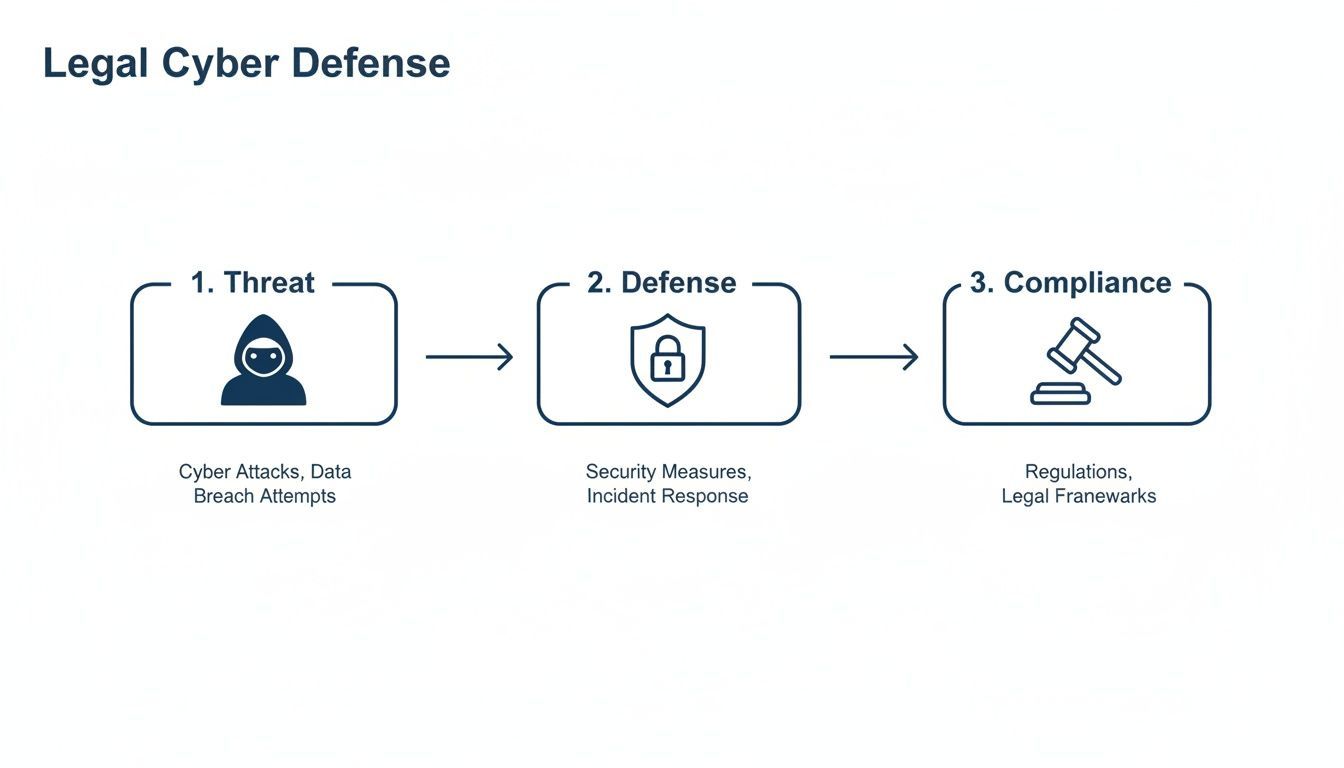
This highlights that effective security isn’t a one-time fix but a continuous cycle of threat identification, defence implementation, and compliance management.
Technology is only useful if your team knows how to use it confidently and securely. Once the migration is complete, the focus shifts to empowering your people. A good IT partner provides clear, practical training on any new systems, such as the advanced security features in Microsoft 365 for secure collaboration. This turns technology into an asset, not an obstacle.
The adoption of legal tech in Canada is on the rise, with some platforms now holding a dominant 38.5% market share. Yet, a surprising 22.3% of solo practitioners still use no dedicated software at all, which often leads to operational decline. This data underscores the urgent need for modernization. CloudOrbis helps firms bridge this gap by optimizing tools like Microsoft 365 for the secure, seamless collaboration every modern law firm needs.
The transition isn't over when the new system goes live. The final, and arguably most important, phase is continuous, proactive management. This is what truly separates managed services from a simple break-fix model.
Your IT partner should be actively managing your systems 24/7, applying security patches, monitoring for threats, and fine-tuning performance. This proactive stance ensures potential problems are found and fixed long before they can ever impact your firm’s productivity, truly protecting your billable hours.
Selecting the right technology partner is one of the most critical decisions your law firm will ever make. Get it right, and you gain a strategic asset that tightens security and boosts efficiency. A poor choice, on the other hand, can lead to constant frustration, crippling downtime, and serious data risks.
The real challenge is telling a true legal IT specialist apart from a generic provider who doesn’t understand the unique pressures of your profession. A great partner delivers more than just technical fixes; they provide peace of mind.
They get that for a law firm, every minute of downtime means lost billable hours. They understand that protecting client confidentiality isn't just a goal, it's a non-negotiable ethical duty. This means their services are built from the ground up around the specific demands of legal work, not just general business needs.
The single most important factor is proven experience within the legal field. A generic IT provider might be able to fix a printer, but do they understand the software and compliance rules that govern your practice? A specialist in IT support for legal firms will already be deeply familiar with your world.
When you're vetting a potential partner, don't be shy. Ask direct questions:
If a provider can’t answer these questions with confidence, it's a major red flag. Their lack of familiarity is likely to cause costly errors and introduce major inefficiencies down the line.
Choosing a partner without deep legal sector experience is like hiring a general contractor to perform delicate surgery. They might understand the basic tools, but they lack the specialized knowledge required to guarantee a successful outcome.
The difference between a standard IT provider and a true managed services partner comes down to their core philosophy. A reactive provider works on a "break-fix" model, they wait for something to go wrong, then they step in to fix it. This approach is fundamentally at odds with the needs of a modern law firm.
A proactive partner, by contrast, works tirelessly to prevent problems from ever happening in the first place.
This proactive stance is what keeps your practice productive and secure. It transforms IT from a source of unexpected emergencies into a reliable, stable foundation for your firm. When you are looking for an IT outsourcing company, this is a key differentiator to consider. At CloudOrbis, for example, we prioritize this proactive model to keep your operations running smoothly.
Choosing the right type of provider is essential. This table breaks down the key differences to help you evaluate your options.
| Evaluation Criteria | Standard IT Provider | Specialized Legal IT Partner (e.g., CloudOrbis) | Why It Matters for Your Firm |
|---|---|---|---|
| Industry Knowledge | General business IT experience; may have worked with a few law firms. | Deep expertise in legal software, workflows, and Law Society rules. | A specialist understands your practice's unique challenges without needing a crash course. |
| Support Model | Reactive "break-fix": Solves problems after they occur. | Proactive monitoring: Prevents issues before they cause downtime. | Proactive support minimizes lost billable hours and protects your reputation. |
| Compliance Focus | Basic understanding of data privacy; may not know legal-specific rules. | Expert guidance on PIPEDA, data residency, and legal compliance obligations. | Ensures you meet strict ethical and regulatory duties for client data protection. |
| Security Approach | General cybersecurity measures. | Advanced security tailored for legal risks (e.g., secure document sharing). | Protects highly sensitive client information against targeted threats. |
| Software Expertise | Familiar with standard office software (Microsoft 365, etc.). | Experts in Clio, PC Law, CosmoLex, and eDiscovery tools. | Ensures the core software your firm relies on runs flawlessly and efficiently. |
| Data Location | Data centres and support teams may be located globally. | 100% Canada-based infrastructure and support teams. | Guarantees data sovereignty and compliance with Canadian privacy laws. |
As you review potential partners, use this checklist to gauge whether they're truly equipped to support a modern law firm or just offering a generic service. The right choice is a partner who scores high on the "Specialized" column.
For Canadian law firms, data sovereignty isn't just a best practice, it's a critical compliance requirement. When your client data is handled by support teams located outside of Canada, you risk running afoul of privacy laws and losing control over your most sensitive information.
Insisting on a provider with 100% Canada-based support gives you two massive advantages:
Don't be afraid to ask a potential vendor where their helpdesk and data centres are physically located. The answer will tell you a lot about their commitment to protecting your firm and its clients.
For too long, many law firms have treated information technology as a simple line item on the budget, a necessary cost to be managed, but not a source of value. This perspective is quickly becoming a major liability. The most successful modern practices are completely changing that conversation, transforming their IT support for legal firms from a cost centre into a real engine for growth.
This shift begins when technology is woven directly into your firm's core business goals. It's no longer just about keeping the computers running. It's about using technology to close matters faster, build stronger cases, and attract the best legal minds in the industry. When your IT partner truly understands your practice, they can deliver solutions that have a direct, positive impact on your bottom line.
The impact of this strategic approach isn't just theory; you can see it in the day-to-day operations of firms that get it right. These aren't far-fetched scenarios, they show how the right technology creates tangible value and a clear return on investment.
Think about these common examples:
In every one of these cases, technology stops being a background utility. It becomes a direct contributor to the firm's success, boosting efficiency, elevating the client experience, and creating a genuine competitive advantage.
The key takeaway is that by 2026, the firms that lead the pack won't just be those with exceptional legal minds. They will be the ones that pair their legal expertise with a superior, forward-thinking technology strategy.
Ultimately, seeing IT as a strategic investment opens up a new world of possibilities for your firm. It allows you to operate with greater efficiency, deliver a higher level of client service, and build a more resilient and profitable practice for the long term.
The right technology partner doesn’t just fix your IT problems, they help you achieve your most ambitious business goals. Is your firm ready to turn its technology into a true profit driver? It all starts with a conversation.
When it comes to specialized IT, we find that lawyers and managing partners often have similar questions. Making an informed decision is critical, so we've put together clear, straightforward answers to some of the most common inquiries we hear about IT support for legal firms.
Without a doubt. It’s a common misconception that cybercriminals only go after the big players. In reality, they often see small and boutique firms as softer targets, assuming they have weaker security in place.
Specialized IT support effectively closes that gap. It gives your firm access to the kind of enterprise-grade security that protects sensitive client data from increasingly sophisticated attacks. On top of that, compliance obligations under regulations like PIPEDA apply to every firm, regardless of size. A specialist partner ensures you meet these legal duties while providing technology that grows with your firm, instead of holding it back.
While major threats like ransomware get all the headlines, the most frequent and damaging risk is much simpler: human error. This usually happens through a phishing attack, where a single click on a malicious link in a cleverly disguised email is all it takes to compromise your network and expose confidential client files.
This is exactly why a strong security strategy has to combine advanced technical defences with continuous employee training. Technology can only do so much; your team is your first and most crucial line of defence against these threats.
A comprehensive approach prepares your staff to spot and sidestep these targeted attacks. This is fundamental to protecting the firm from expensive data breaches and the reputational fallout that follows.
If you're working with a competent IT partner who has experience in the legal field, the answer is a firm no. Any professional provider understands that for a law firm, every minute of downtime is a direct hit to your billable hours and client service.
The entire migration process is planned down to the last detail. It's almost always executed during off-hours, like over a weekend or overnight, to ensure zero disruption to your firm’s daily operations. The goal is a completely seamless transition. Your team should be able to leave the office one day and return the next to a more secure and efficient system, without ever losing a moment of productivity.
A managed IT partner who specializes in the legal sector is your key to meeting PIPEDA obligations. They do this by putting in place and managing the specific technical controls required to protect personal information under Canadian law.
This isn't just a vague promise; it involves concrete actions:
Is your firm ready to transform its technology from a liability into a strategic asset? CloudOrbis Inc. provides proactive, Canada-based IT support that secures your data, ensures compliance, and drives profitability. Schedule your free consultation today to discover how we can help your practice thrive.
Book a 30-minute call with a senior engineer. No sales script, just straight answers about your environment.


