A Guide to Cloud Computing for Service Providers in Canada
Master cloud computing for service providers. Learn proven strategies to build, secure, and scale cloud offerings for SMBs in Canada's evolving market.

Master cloud computing for service providers. Learn proven strategies to build, secure, and scale cloud offerings for SMBs in Canada's evolving market.
For service providers in Canada, the game has changed. Simply offering transactional IT support isn't enough anymore. The real opportunity now is to become a strategic partner in your client's success, and cloud computing is the key. It's what drives modern business agility, security, and growth. For providers who can build and manage cloud environments effectively, the opportunity is massive. Making this pivot isn't just an option, it's essential for staying relevant.
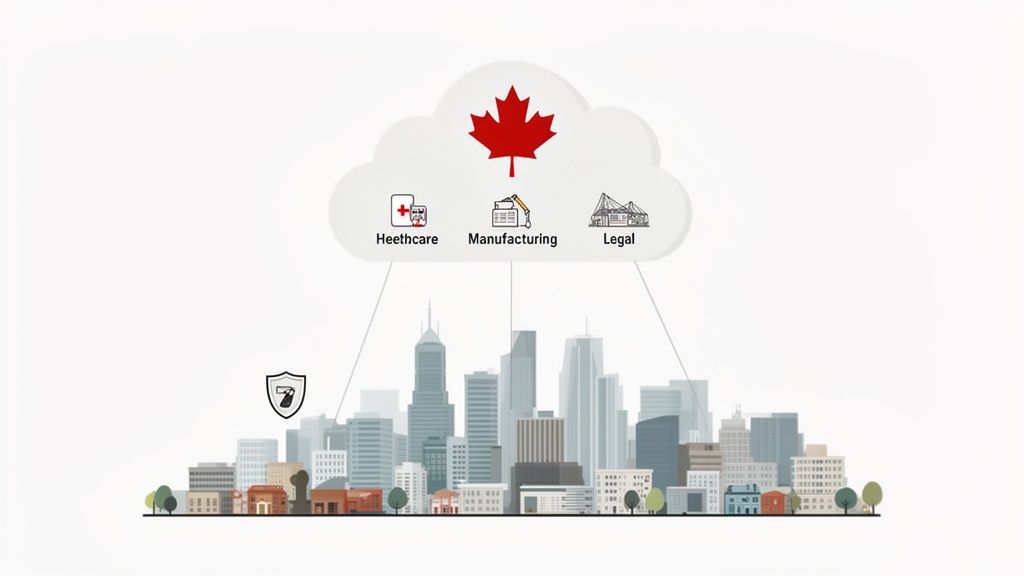
The Canadian business landscape is undergoing a major shift, with cloud adoption at its centre. If you're a service provider, the first step to capitalizing on this is understanding the drivers behind it. This isn't just about new technology; it’s about solving the real business pressures Canadian companies face every day.
The demand is undeniable. The Canadian cloud computing market is set for explosive growth. One analysis projects the market, valued at USD 47,889.7 million in 2024, will soar to USD 152,299.2 million by 2030. This is fuelled by a staggering compound annual growth rate (CAGR) of 20.5% from 2025 to 2030.
Several factors are pushing small and medium-sized businesses (SMBs) across Canada to the cloud. As a provider, your ability to speak directly to these needs is what will set you apart.
The normalization of remote and hybrid work has made cloud infrastructure a necessity. Businesses need to give their teams secure, reliable access to data and applications, whether they’re in downtown Toronto, a satellite office in Calgary, or working from home. On-premise servers simply can't deliver that level of flexibility without adding complexity and cost.
The real opportunity lies in moving beyond being a simple vendor to becoming a strategic partner. Businesses aren't just buying cloud storage; they are buying outcomes like enhanced security, operational efficiency, and the ability to scale on demand.
On top of everything else, Canada's stringent data sovereignty laws add another layer of complexity. Regulations like the Personal Information Protection and Electronic Documents Act (PIPEDA) mean organizations must be diligent about where their data is stored and how it’s protected.
This is especially critical for businesses in highly regulated sectors:
These organizations are actively looking for expert partners who understand the Canadian legal framework. They need providers who can build and manage cloud solutions that are compliant, secure, and high-performing. To dig deeper into these foundational advantages, take a look at our guide on the benefits of cloud computing services. This is exactly where a knowledgeable service provider proves their immense value.
Building a cloud practice that stands out doesn't happen by accident. It starts with a clear blueprint for your offerings, and that process begins long before you touch any technology. The first, most critical step is a deep-dive assessment of your client's business.
Forget the standard IT audit. Your real job is to uncover their core business goals, operational headaches, budget realities, and long-term vision. Is it a logistics company that gets swamped during seasonal rushes? Or maybe a law firm that needs iron-clad security for client data while letting its team collaborate from anywhere? Each one needs a completely different playbook.
A high-value portfolio isn’t about offering every cloud service under the sun. It’s about curating the right set of solutions that solve real-world business problems for your target clients, showing them tangible value that goes way beyond the tech itself.
This client-first mindset is more important than ever as cloud computing reshapes major Canadian industries. The market is set to explode from USD 16.7 billion in 2025 to USD 54.0 billion by 2034, growing at a 13.95% compound annual growth rate (CAGR). You can dig into the specifics of the Canadian cloud computing market's trajectory to see how this growth is driven by very specific needs in different sectors.
Once you have a firm grip on what the business actually needs, you can start architecting the right solution. This is where mastering the three core cloud service models, Infrastructure as a Service (IaaS), Platform as a Service (PaaS), and Software as a Service (SaaS), really pays off. Knowing which one to recommend is what separates a mere technician from a true strategic partner.
Your role is to translate these technical models into tangible business outcomes. For a growing manufacturing company, the raw computing power and flexibility of IaaS might be perfect for running their custom ERP software. On the other hand, a marketing agency trying to launch a new web app for a client would benefit more from a PaaS environment, letting them build and deploy without getting bogged down in server management.
Meanwhile, SaaS continues to be the go-to for many businesses. It offers turnkey applications for everything from accounting to CRM. For a finance or legal firm, a secure, compliant SaaS solution like a specialized version of Microsoft 365 is often the perfect answer for secure file sharing and collaboration.
To build a portfolio that truly resonates, you need to connect each service model to specific industry problems. This shows clients you understand their world and helps them see the direct benefits.
Thinking about which model fits best can be tricky. This table breaks down how to match client needs to the right service, with real-world examples to guide your thinking.
Choosing the Right Cloud Service Model for Your Clients
| Service Model | Best For | Client Example (Industry) | Key Provider Responsibility |
|---|---|---|---|
| IaaS | Businesses needing maximum control and scalability for custom applications or variable workloads. | A logistics company that experiences high traffic during peak shipping seasons and requires scalable server resources. | Managing the underlying infrastructure, including virtual machines, storage, and networking, while ensuring high availability. |
| PaaS | Development teams that want to build, test, and deploy applications quickly without managing infrastructure. | A software startup developing a new mobile app that needs a streamlined and cost-effective development environment. | Providing and maintaining the platform, including operating systems, development tools, and database management systems. |
| SaaS | Organizations looking for ready-to-use software for specific business functions with minimal IT overhead. | A healthcare clinic that needs a secure, PIPEDA-compliant email and collaboration tool like a specialized version of Microsoft 365. | Ensuring the software is up-to-date, secure, and accessible, and providing user support and training. |
By building a flexible portfolio around these models, you can effectively serve a wide range of clients. You can see how these services come together in our detailed guide to managed cloud computing.
Ultimately, when you position your services as solutions to specific business challenges, you build a practice that delivers real, measurable value.
For many Canadian SMBs, the biggest roadblocks to cloud adoption aren't about technology or price, they're about security and compliance. As a service provider, your ability to navigate this tricky territory isn't just a nice-to-have; it's the very foundation of the trust you build with clients. Moving to the cloud securely involves far more than just a firewall. It requires a security-first mindset that’s baked into every service you offer.
This is especially true for businesses in regulated fields like healthcare or finance, where even a minor compliance slip-up can lead to devastating consequences. Your job is to take their valid concerns and turn them into a rock-solid security posture that gives them total peace of mind.
A modern security strategy is all about being proactive, not just reacting to problems. Think of it as creating layers of defence that work in concert to protect client data and infrastructure from every possible angle. It all starts with a few foundational practices that should be non-negotiable for any cloud environment you manage.
To really get a handle on where the weaknesses are before they can be exploited, a thorough cloud security assessment is an essential first step. It gives you a clear map of the terrain.
These are the key pillars of that foundation:
By making these practices a core part of your offering, you deliver a much stronger security promise. You can dig deeper into building these layers in our guide on data security management.
For Canadian organizations, one of the biggest issues is data sovereignty. This is the legal requirement that certain data, particularly personal information, must physically stay within Canada's borders. It's a massive deal for healthcare clinics, law firms, and government-related entities governed by laws like PIPEDA and provincial privacy acts.
This concern has sparked a significant trend toward sovereign cloud solutions. In fact, service providers in Canada are seeing a boom in sovereign cloud adoption as a direct answer to these regulations. The market, which was valued at USD 6,439.0 million in 2024, is projected to explode to USD 43,873.0 million by 2033. That’s a staggering compound annual growth rate (CAGR) of 24% from 2025 to 2033, all driven by the need to solve data residency challenges.
A provider's ability to guarantee that all client data, from primary storage to backups and disaster recovery sites, is hosted exclusively on Canadian soil is a powerful differentiator that directly addresses a key client anxiety.
Let's walk through a real-world scenario. A mid-sized healthcare clinic wants to modernize its operations by moving its patient records and admin systems to the cloud. They need to be compliant with Canadian privacy laws like PIPEDA.
As their service provider, your job is to build an environment that’s both fully compliant and completely secure. Here’s what that looks like in practice:
By taking these concrete, demonstrable steps, you transform a web of complex regulations into a tangible, secure solution. This is the kind of practical expertise clients are really looking for when they evaluate a partner for cloud computing for service providers.
A great cloud strategy means nothing if the migration goes sideways. As a service provider, this is where you prove your worth. Getting the migration right isn’t just about moving data, it's a delicate dance of technical skill, clear communication, and making sure the client's business doesn't miss a beat.
A smooth transition is all about breaking the project into small, manageable wins. You move methodically from planning and testing through to the final cutover and ongoing support. To pull this off, you need to be familiar with established data migration best practices. These aren't just suggestions; they are the framework for keeping data safe and minimizing risk.
The initial planning is where most migrations are won or lost. This is your chance to map out every single dependency, spot potential roadblocks, and set a timeline that’s actually achievable. A classic mistake is to underestimate how complex a legacy app is or how much data needs to be moved. That’s a fast track to blown deadlines and an unhappy client.
Trying to move everything at once in a "big bang" migration is a recipe for disaster. It's almost always too risky. A phased approach is the smarter play. You can migrate systems in logical groups, test everything thoroughly, and fix problems without taking the entire company offline.
We typically structure a rollout around these key stages:
Technology is only half the job. The real success of a migration often comes down to how well you handle the people involved. Change makes employees nervous, and it’s your responsibility as the service provider to be their guide.
The client’s experience during migration and onboarding sets the tone for the entire relationship. Proactive communication, solid training, and responsive support aren't nice-to-haves, they're fundamental to a successful project.
Managing expectations begins with being upfront and honest. Be transparent about the timeline, what could go wrong, and what they should expect at every step. Sending regular updates, even if it's just to say "all is on track," gives them confidence that you're in control. For businesses in Alberta, local factors can add another layer of complexity. We've written about this in our guide to cloud migration in Alberta.
Good employee training is also a must. For instance, moving a company to Microsoft 365 is about much more than technology; it’s about changing how people work together. You need to provide hands-on training sessions, create simple guides, and perhaps offer post-launch "office hours" for users to drop in with questions.
The security process underpinning a safe migration always comes down to a few core ideas: identity, detection, and assessment.
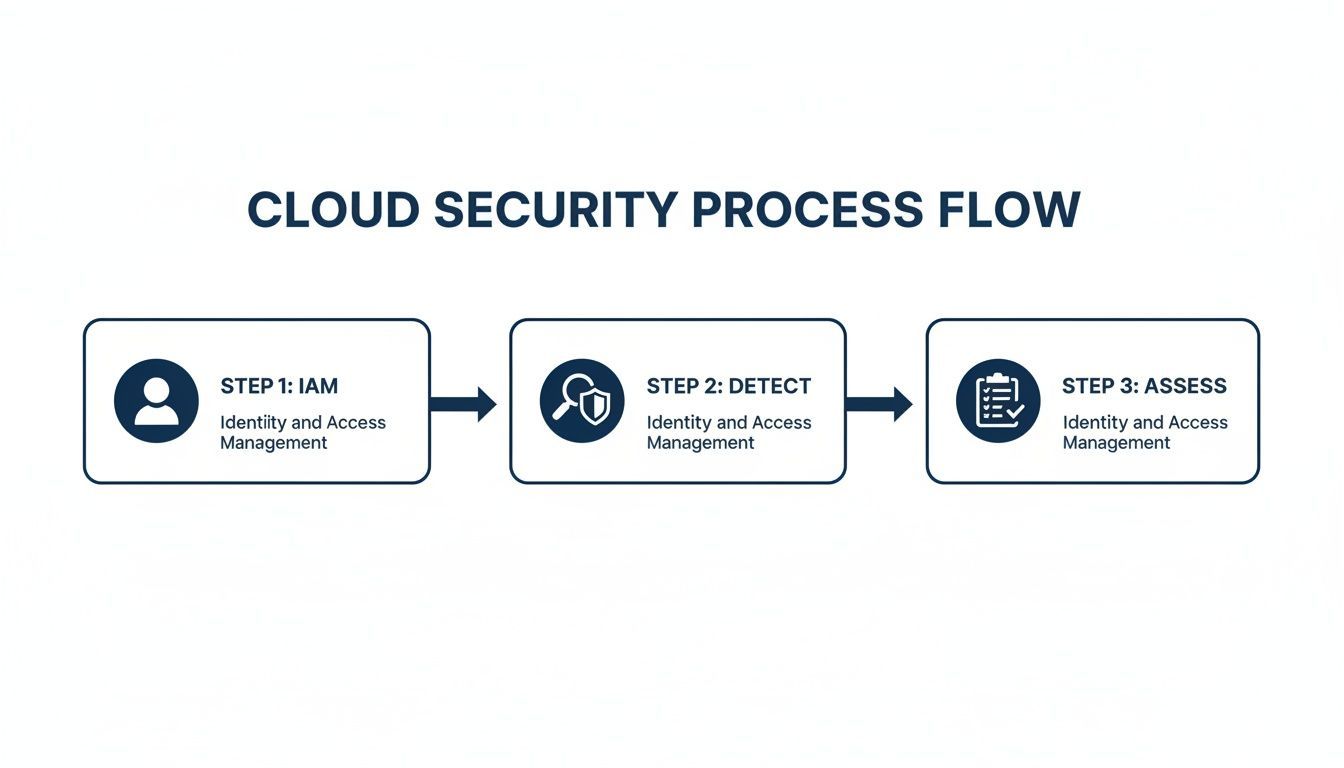
This flow shows it simply: a secure migration starts with controlling who has access (IAM), then constantly watching for threats (Detect), and finally, regularly checking your security posture (Assess).
Let's look at a real-world example. A mid-sized manufacturer in Ontario was struggling. Their on-premise servers running a critical ERP system were old and failing, causing frequent downtime. Their remote sales team couldn't work effectively.
Our first move was to migrate their email and files to Microsoft 365. This was a quick win that gave them immediate value and built trust.
Next up was the ERP system. A simple "lift and shift" was too risky. Instead, we worked with them to deploy a modern, cloud-native version of the ERP on a private cloud. We hosted it in a Canadian data centre to ensure top performance and data sovereignty. Meanwhile, their public website and sales portal went to a public cloud to handle traffic spikes.
This phased, hybrid approach meant their 24/7 manufacturing floor never stopped. We held weekly check-ins with management and ran specific training for office staff and the sales team. The result? A smooth transition, better security, improved remote access, and a happy client ready for growth. That’s the hallmark of excellent cloud computing for service providers.
A successful cloud migration is really just the starting line. The true test of a service provider's worth, what really builds trust and long-term partnerships, is everything that comes after.
To stand out, you have to move beyond the old, reactive "break-fix" model. It’s about delivering a proactive, strategic service that keeps a client’s business humming along securely, day in and day out. Your goal is a service so seamless that clients forget about their IT infrastructure entirely. This is what separates the best from the rest in the world of cloud computing for service providers.
Top-tier service isn't measured by how fast you fix things. It's measured by preventing problems from ever happening. That’s the core of proactive monitoring.
Modern tools offer deep visibility across the entire cloud environment, tracking everything from app performance and resource use to network latency and security threats. You can spot the warning signs long before they become emergencies.
For instance, if a virtual machine’s memory usage is slowly creeping up, it’s a clear signal that it will eventually crash. Proactive monitoring lets you step in during off-hours to add more memory or investigate the cause. You avoid downtime completely, and the client's business is never impacted. This approach turns you from a simple repair crew into a trusted strategic partner.
For any business, data is its most critical asset. A rock-solid backup and disaster recovery (DR) plan isn't a "nice-to-have", it's non-negotiable. Your job as a provider is to build and manage a strategy that guarantees business continuity, whether it’s a simple file deletion or a full-scale data centre outage.
A proper DR plan has a few key ingredients:
A well-architected disaster recovery plan is your client's ultimate insurance policy. It's the tangible proof that you have prepared for the worst, giving them peace of mind that their business can survive a major incident.
Service Level Agreements (SLAs) are the foundation of your managed services relationship. They are the formal contract that defines your commitments on metrics like uptime guarantees, support response times, and resolution targets.
But the best SLAs are more than just legal documents; they’re tools for managing expectations and building trust. Resist the urge to promise flashy numbers you can't consistently hit. It's far better to promise 99.9% uptime and consistently deliver 99.95% than to promise 99.99% and fall short.
Transparency is everything. Write your SLAs in plain English, clearly outlining what’s covered, what the client should expect, and how you’ll report on performance. This clarity prevents misunderstandings and shows you're committed to accountability. To see how these pieces fit into a wider strategy, check out our detailed look at managed IT services.
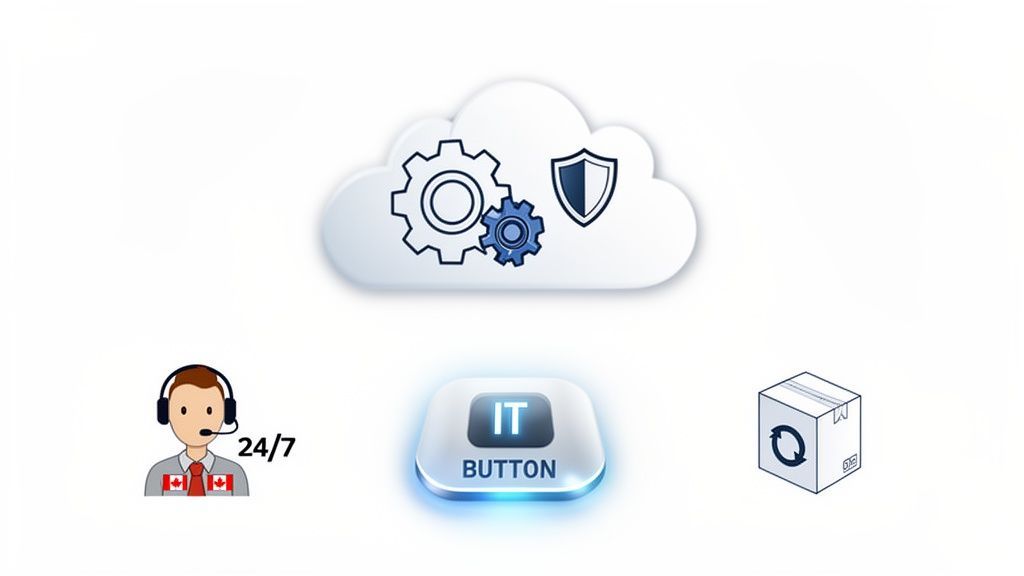
When a client needs help, the experience has to be seamless. This is where offering a 24/7, 100% Canada-based helpdesk becomes a massive competitive advantage. Business leaders gain incredible peace of mind knowing they can reach a knowledgeable technician who understands their specific setup, anytime.
Beyond just phone and email, you can use innovative tools to elevate the client experience. Think about something as simple as a one-click "IT Button" on their desktop. It can instantly generate a support ticket pre-filled with all the necessary system info. This cuts out the frustration of explaining the problem and gets your team the data they need to start working on a fix right away.
By combining proactive monitoring, resilient DR, clear SLAs, and frictionless support, you create a managed service that delivers undeniable value and builds lasting client loyalty.
Once you’ve nailed the technical side of delivering cloud solutions, the real business challenge begins: how do you package and price your services to actually make money and grow? This is where your technical expertise has to translate into tangible business value. In a crowded Canadian market, your pricing can't just cover your costs, it has to show clients you're a strategic partner, not just another vendor.
SMB leaders don't care about buying gigabytes of RAM or CPU cycles. They’re looking to buy outcomes. They want better security, predictable IT spending, and the freedom to focus on running their business, not their servers. Your job is to package your services as a complete solution that delivers exactly that.
One of the most effective ways to sell your services is by ditching the complicated, line-item menu. A tiered pricing model is much simpler for clients to understand and gives you a clear path for upselling as their needs grow.
Think about structuring your offerings into three clear tiers:
This kind of tiered structure makes your value crystal clear and helps you appeal to a much wider range of clients without confusing them.
Your pricing shouldn’t just be about the technology you provide. It should articulate the value of the peace of mind, security, and growth you enable, positioning your services as a strategic investment rather than a cost centre.
Within those tiers, how you charge matters. A per-user, per-month model has become popular for a reason, it’s predictable for the client and it scales beautifully. As your client’s business adds new employees, your revenue grows right alongside them. It directly aligns your success with theirs.
Another powerful, though more advanced, strategy is value-based pricing. Instead of starting with your costs, you anchor your price to the real-world value you’re delivering. For instance, if your disaster recovery solution can save a manufacturing client from an estimated $100,000 in losses during a single day of downtime, that service is worth far more than the sum of its technical parts. This model takes a deeper understanding of your client's business, but it's incredibly powerful for communicating your strategic importance and justifying a premium price.
As you build out your cloud practice, you're going to run into some tough questions. It's only natural. We see service providers wrestling with the same set of challenges time and again, whether they're just starting out or trying to scale.
Let's cut through the noise and get straight to the practical answers for the questions we hear most often.
This is the big one, isn't it? The thought of going up against giants like AWS or Azure can feel daunting. But here's the thing: you don't compete by trying to match their scale. You win by delivering what they can't.
While hyperscalers offer the raw, commoditized infrastructure, your real value is in your expertise and your relationship with the client. Your fight isn’t on price or size; it’s on service.
Focus on the gaps they leave wide open for a savvy Canadian provider:
Sooner or later, your clients will be using services from multiple cloud platforms. It might be intentional, or it might happen by accident through shadow IT. Don't fight it, manage it. This is a massive opportunity to prove your value.
Your role is to bring order to the chaos. A smart multi-cloud strategy means creating a single pane of glass for management and security, giving you and your client clear visibility across all environments.
Your goal is to be the single point of contact for your client’s entire cloud ecosystem. When you manage the complexity for them, you become an indispensable partner, not just another vendor.
This means deploying tools that can monitor performance, enforce security policies, and manage costs across different platforms. You become the central hub that makes a tangled, complex setup feel simple and secure. This orchestration is a powerful differentiator.
At CloudOrbis, we specialize in helping businesses navigate these exact challenges. We provide the strategic partnership and technical expertise needed to build a secure, efficient, and growth-oriented IT foundation, so you can focus on what you do best.
Ready to gain total confidence in your IT infrastructure? Contact CloudOrbis today for a free consultation.
Book a 30-minute call with a senior engineer. No sales script, just straight answers about your environment.


