Unlock Growth: DBA as a Service for Canadian SMBs
Discover DBA as a Service for Canadian SMBs. Cut costs, boost security, and ensure compliance in healthcare & manufacturing. Modern database management.

Discover DBA as a Service for Canadian SMBs. Cut costs, boost security, and ensure compliance in healthcare & manufacturing. Modern database management.
Your database probably isn’t the part of your business you think about every morning. Until it slows down your CRM, breaks reporting before payroll, or raises ugly questions in a compliance review.
That’s the trap many Canadian SMBs fall into. The database sits underneath Microsoft Dynamics 365, accounting platforms, line-of-business apps, client portals, and internal reporting. It’s critical, but it rarely gets proper attention until something goes wrong. Then your office manager, IT generalist, or outsourced support provider is scrambling to fix a problem they were never set up to own.
That’s why dba as a service matters. It turns database administration from a reactive chore into a managed business function. It gives you access to database expertise, monitoring, maintenance, recovery planning, and security discipline without forcing you to build that capability in-house.
At 3:10 p.m., orders start lagging, staff blame the application, and your IT generalist restarts a service to buy time. The screen speeds up, but the underlying issue persists. That pattern is common in Canadian SMBs that depend on databases for ERP, reporting, scheduling, billing, or client records but do not have clear database ownership.
The actual burden is not one outage. It is the steady accumulation of risk no one is managing properly. Backups run, but no one checks whether they can be restored. Jobs fail, but no one reviews the alerts. Changes get made, but no one keeps a clean record of what changed, why it changed, and whether it affected performance or security.
For regulated businesses, that gap gets expensive fast. A clinic has to protect patient data. A law firm has to control access to sensitive files and matter information. A manufacturer may need better traceability, retention, and system reliability to satisfy customer, insurer, or contractual requirements. If an auditor, cyber insurer, or major client asks for evidence of control, "our IT person handles it" is not a defensible answer.
Bad database management also distorts spending. Owners approve more server capacity when the underlying issue is poor indexing, bad queries, failed maintenance jobs, or neglected patching. They postpone upgrades because no one wants to touch an unstable system. They keep one overextended employee as the single point of failure because replacing that informal knowledge feels harder than fixing the root problem.
Analysts at Market Research Future report that the global Cloud Database as a Service market was valued at USD 22.15 billion in 2024 and is projected to reach USD 61.45 billion by 2035, growing at a 9.72% CAGR. That growth reflects a practical decision. Businesses want database expertise without building a full internal team.
The shift also fits the broader move toward proactive IT support for businesses. Smart SMBs are buying accountability, oversight, and repeatable processes instead of waiting for the next slowdown, failed backup, or security exception.
If you already see the value of managed IT services for small business, apply the same standard to your database environment. For a regulated Canadian SMB, dba as a service is a way to reduce operational risk, tighten security discipline, and stop routine database issues from turning into compliance problems.
Think of your business like a delivery company with a fleet of vehicles. Those vehicles generate revenue only when they’re running properly. You can hire one mechanic, hope they know every engine type, and accept delays when they’re unavailable. Or you can use a specialist service centre with a full team, proper tools, scheduled maintenance, emergency support, and clear accountability.
DBA as a service is that service centre for your data engine.
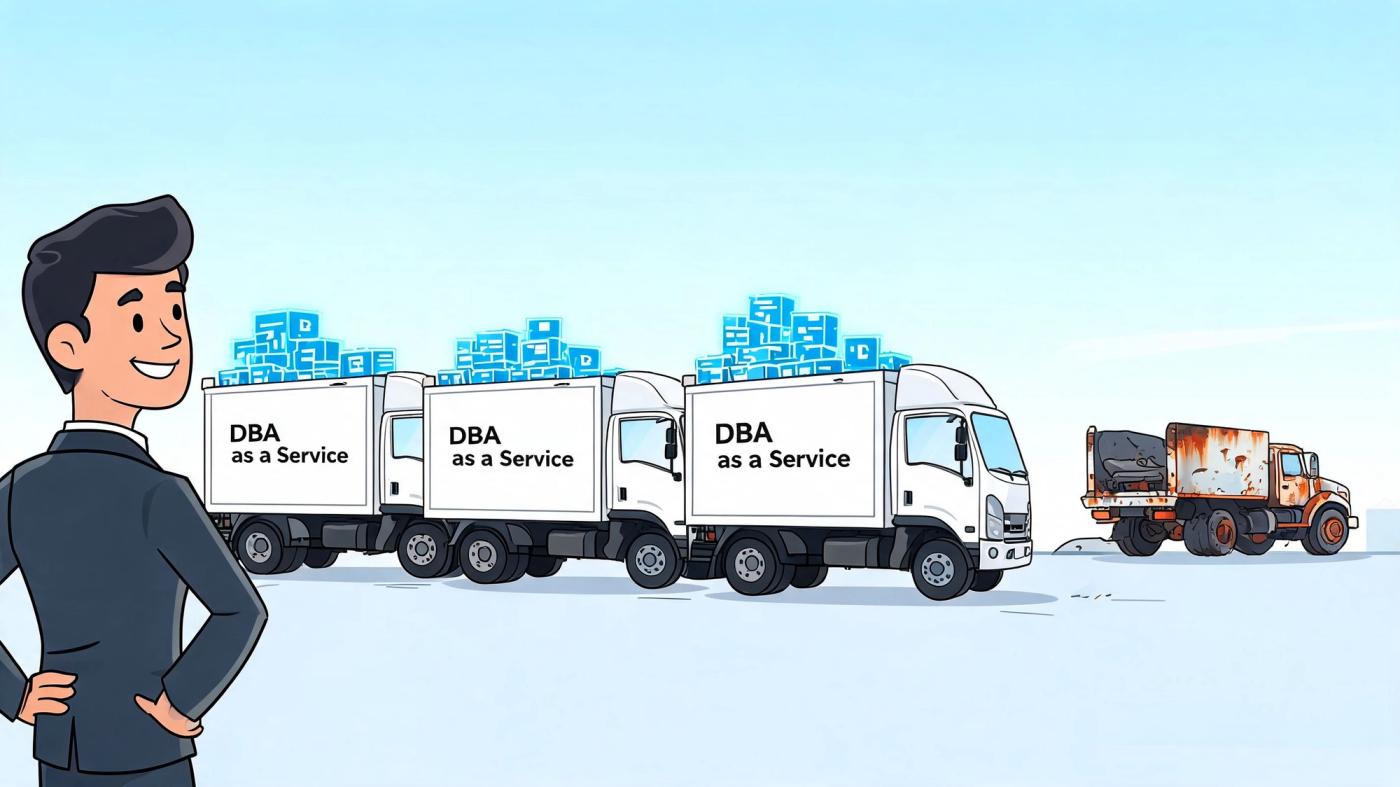
A lot of business owners assume this is just software with a new label. It isn’t. Tools matter, but tools alone don’t tune queries, investigate failed backups, review capacity trends, or decide whether a patch should be applied now or delayed for a maintenance window.
You’re buying a service outcome. That usually includes specialist oversight for platforms such as Microsoft SQL Server, PostgreSQL, MySQL, Oracle, or cloud-managed database platforms running in Azure or AWS.
A good way to think about it is this:
Many SMBs don’t have a formal DBA. They have an accidental DBA. It might be the sysadmin. It might be the application consultant. It might be the owner of the ERP system. That setup works until the database needs deeper tuning, structured maintenance, or urgent recovery action.
That’s where the managed service model is stronger. It’s built around prevention, not heroics. If you want a useful primer on how managed providers approach prevention, this overview of proactive IT support for businesses from F1Group is worth reading because it captures the shift from break-fix support to continuous operational care.
Practical rule: If your database health depends on one person remembering to check it, you don’t have a database strategy.
SMBs need expert outcomes without enterprise overhead. That’s exactly where dba as a service fits. It gives you experienced coverage, repeatable maintenance, and faster incident handling while letting your internal team focus on business systems, user support, and planning.
If you’ve already moved parts of your environment toward a managed IT service model, dba as a service is a logical next step for the applications and records you can’t afford to leave unmanaged.
If your ERP slows down at month-end, your staff do not care whether the cause is a bad query, disk pressure, or a failed maintenance job. They care that invoicing is delayed, reporting is unreliable, and customers are waiting. That is the full scope of dba as a service. It covers the technical work that keeps core business systems available, recoverable, secure, and fast enough to support daily operations.
For regulated Canadian SMBs, that scope needs to go beyond generic server care. You need disciplined database operations that stand up to audit questions, security reviews, and shared responsibility with your internal IT team or outside MSP.
Routine maintenance stops small database issues from turning into service tickets and lost hours. A DBA service should handle health checks, failed job reviews, database consistency checks, storage growth, index and statistics maintenance where it makes sense, and scheduled reviews of system behaviour.
Neglect shows up slowly, then all at once.
A database rarely fails because of one dramatic event. More often, it degrades through missed jobs, unchecked growth, stale statistics, and poor housekeeping until users start complaining that the system has become unreliable.
Performance tuning is not about chasing abstract metrics. It is about fixing the specific database problems that slow down payroll, reporting, inventory, client portals, and line-of-business applications.
A capable DBA team examines query patterns, indexing, blocking, deadlocks, memory pressure, and configuration issues. They also identify cases where the application itself is creating unnecessary load. That matters because many SMBs waste money scaling infrastructure before anyone confirms the database is tuned properly.
The better approach is simple. Fix the database first. Buy more infrastructure only when demand justifies it.
Backups are a control, not a checkbox. A DBA service should define backup schedules, monitor job success, test restores, document recovery steps, and match retention to your business needs and record-keeping obligations.
This is a major issue in Canadian SMBs with regulated data. A backup job that completes successfully is not proof that your business can recover on time. If your team has never tested how long it takes to restore a production database, you do not know your recovery position.
For firms in healthcare, legal, financial services, and other compliance-sensitive sectors, recovery planning also needs to account for where backups are stored, who can access them, how long they are retained, and how recovery evidence is documented.
Database security starts with control over access, configuration, and change. Your provider should handle patch planning, hardening, privileged access review, service account review, encryption support, and least-privilege practices.
That work needs to fit the rest of your environment. If your systems run in Azure or AWS, your DBA provider should work as part of your broader managed cloud computing approach for business systems, with clear responsibility across infrastructure, identity, backups, and database administration.
For Canadian SMBs, this is also where co-managed service matters. Your internal IT team may own endpoints, identity, or vendor relationships. The DBA team should own the database controls, patch coordination, and operational discipline that your broader IT team usually does not have time or depth to manage.
Good monitoring catches database trouble before users become your alerting system. It should track failed jobs, query slowdowns, storage pressure, blocking, replication issues, backup status, and unusual behaviour that suggests risk.
Here is the practical difference:
| Area | Reactive setup | Managed DBA setup |
|---|---|---|
| Failures | Users report them first | Alerts flag issues early |
| Capacity | Reviewed only when full | Tracked continuously |
| Slowdowns | Treated as one-off complaints | Investigated as patterns |
| Recovery risk | Assumed to be covered | Tested and documented |
This discipline matters more in co-managed environments, where one team handles infrastructure and another handles the application. Without clear monitoring and ownership, database issues sit in a grey area while the business waits.
During a database incident, speed matters. So does judgment. You need people who can assess the problem, contain the damage, communicate clearly, and restore service without creating a second outage through guesswork.
That is especially important for regulated businesses. If a practice management database, accounting platform, or document system goes down, the problem is not limited to IT. It can affect service delivery, records access, client commitments, and audit exposure within hours.
The exact scope depends on your environment, but a serious provider should support the database platforms and operating model your business uses, including:
Good dba as a service protects more than the database engine. It protects the business process, the compliance position, and the people who depend on the system working every day.
A database problem rarely stays contained. It turns into delayed invoices, missed client updates, reporting disputes, and staff time wasted on manual workarounds. For a regulated Canadian SMB, it also creates risk around records handling, service continuity, and audit readiness.
That is why dba as a service should be judged as an operating decision first and a cost decision second. Lower spend matters. Stable operations, cleaner reporting, and fewer preventable incidents matter more.
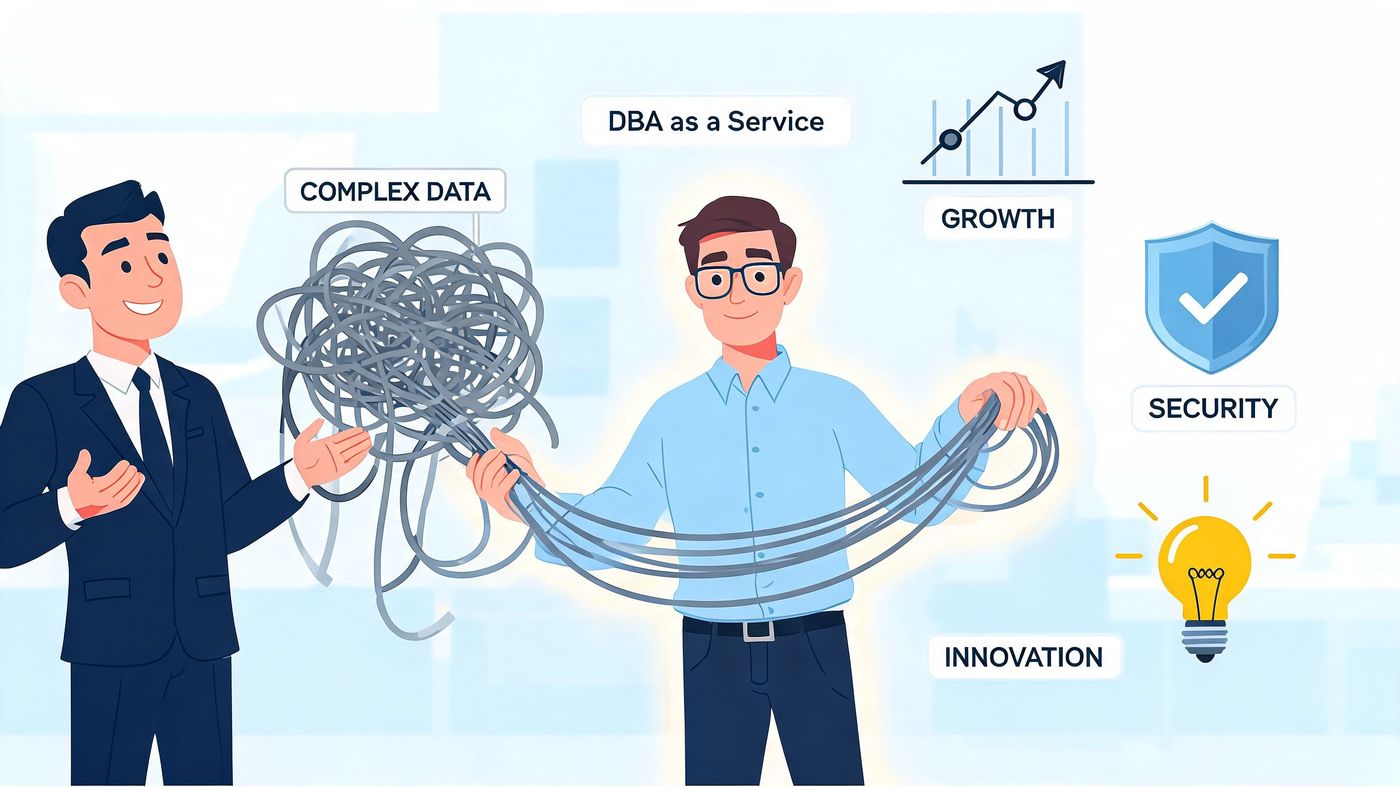
If the database slows down or fails, the business feels it immediately. Orders do not process properly. Staff stop trusting dashboards. Customer-facing systems look unreliable. In regulated sectors, a short outage can also disrupt access to records your team depends on to serve clients properly.
Good DBA coverage reduces those interruptions by keeping performance, maintenance, and recovery under control. That stability protects revenue, but it also protects confidence. Your staff trust the system. Your clients get a consistent experience. Your leadership team spends less time managing operational noise.
Many SMBs hit the same wall. The business grows, reporting gets heavier, transaction volume climbs, and one internal IT generalist gets stuck carrying database work that needs specialist judgment.
A managed DBA model gives you access to that judgment without forcing a full-time hire before the workload justifies it. You get capacity planning, performance tuning, change review, and architecture input as the business expands. That matters in co-managed environments where your internal team owns the application or vendor relationship and the service provider handles database operations.
It is a practical way to scale. You add expertise as needed instead of hiring in panic after performance problems start affecting the business.
Your IT staff should be working on projects that improve the business. Security controls. Microsoft 365 governance. Device standards. User support. Process improvement.
They should not spend their week chasing failed jobs, checking backups by hand, or guessing why a maintenance plan did not run.
The return is straightforward:
That shift is especially useful if you are already trying to improve your broader data security management practices. A database specialist should reduce risk, not compete with your internal team for attention.
Poor database management shows up in reporting long before someone labels it a database issue. Numbers do not reconcile. Scheduled reports fail. Dashboards lag behind reality. Finance and operations start questioning whether the data is current or complete.
That slows decisions down. It also creates a bad habit of exporting data into spreadsheets and rebuilding reports manually, which introduces more errors and more security exposure.
Well-managed databases produce more dependable business information. That helps leaders make decisions faster and with more confidence. For Canadian SMBs in healthcare, legal, finance, and other regulated fields, that is not a technical luxury. It is part of running a controlled, accountable operation.
Generic advice on database management falls apart quickly in regulated Canadian environments. A clinic in Ontario, a law firm in Toronto, or a finance company in Calgary doesn’t just need a fast database. It needs a database environment that stands up to privacy expectations, audit scrutiny, and residency questions.
That’s where many generic providers miss the mark. For Canadian organizations, compliance is a top cloud barrier, with 68% citing it as a major concern, and many generic providers fail to address specific PIPEDA and healthcare data residency requirements according to Trilio’s overview of database as a service challenges.
If you handle personal, financial, legal, or health information, your database partner should be ready to answer detailed questions. Not marketing questions. Operational ones.
Ask for clarity on:
A provider built for a broad global audience may offer strong technology but weak accountability for Canadian regulatory realities. That becomes a problem when your business needs local support processes, clearer residency options, and practical alignment with laws such as PIPEDA.
Healthcare adds even more pressure. Clinics need dependable access to records, controlled permissions, and disciplined change management. Legal and finance firms need stronger assurance around confidentiality, retention, and evidence of control.
If you’re evaluating providers, your checklist should extend beyond uptime language. It should include how the provider supports your broader data security management strategy, especially across cloud platforms, endpoints, identity, and compliance documentation.
If a provider can’t explain your compliance posture in plain English, they probably can’t support it properly either.
Don’t ask, “Are you secure?”
Ask, “How do you help us prove control over sensitive data in a Canadian regulatory context?”
That question forces a more honest answer. It separates vendors who sell generic cloud convenience from partners who understand accountability, residency, audit trails, and regulated operations.
Not every business should choose the same support model. That’s good news, because the best dba as a service arrangement usually depends on your internal team, your application environment, and how much control you want to retain.
This is the lightest-touch option. Think of a cloud platform handling the basics of infrastructure and some database operations. It can work for straightforward workloads, but it often leaves gaps around optimisation, business-specific recovery planning, and application-aware support.
For simple environments, that may be enough. For regulated or operationally critical systems, it usually isn’t.
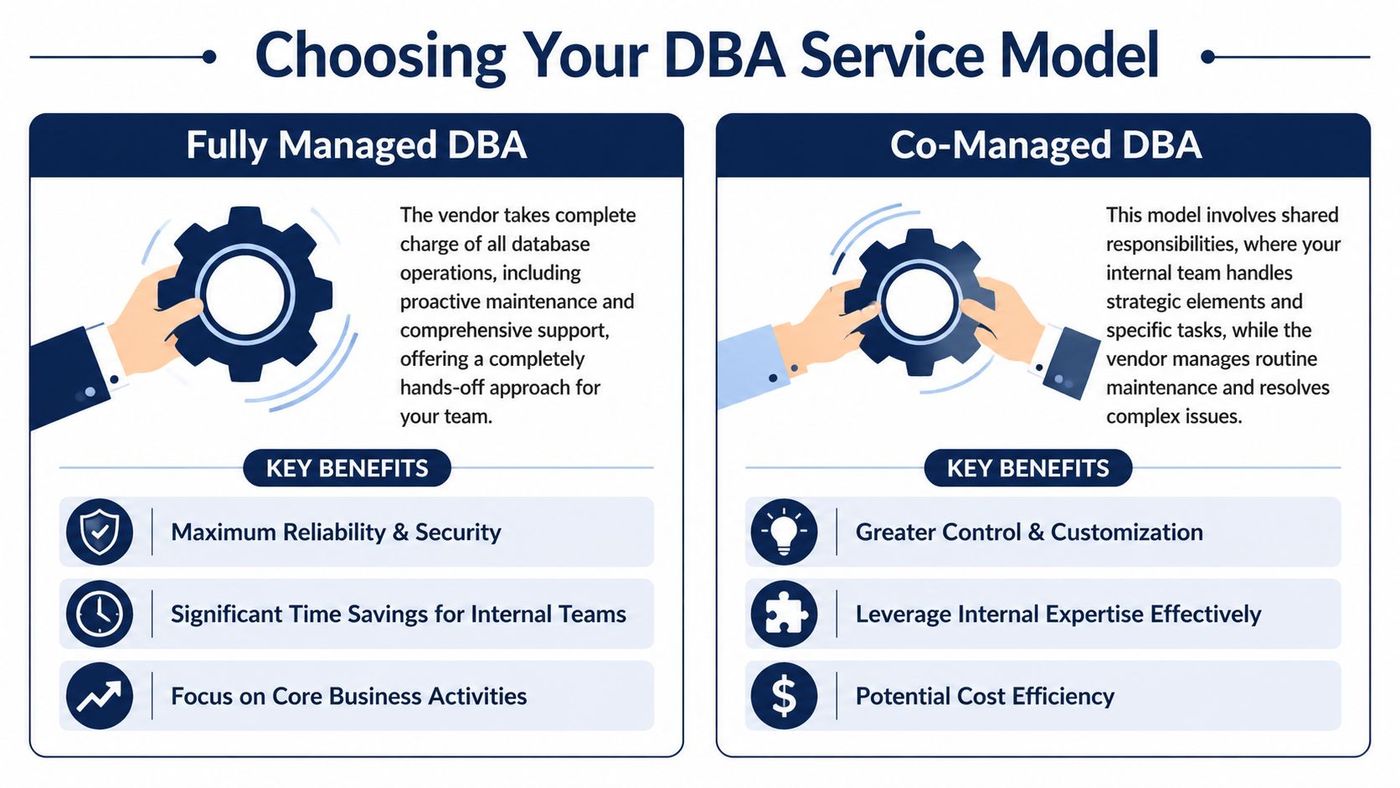
This model is best when your team wants to hand off database responsibility almost completely. The provider runs maintenance, monitoring, backups, tuning, patching, and incident response.
It works well when you have little internal database skill or you want clean accountability. The trade-off is that your internal team may have less day-to-day involvement in technical decisions.
This is the model I recommend most often for Canadian SMBs with an internal IT lead, application owner, or infrastructure team. Your people keep strategic input and business context. The provider handles specialist database operations, continuous oversight, and escalation support.
That matters because many businesses don’t want full outsourcing. They want help where the risk is highest.
A useful parallel appears in hiring strategy. This comparison of tech hiring models from Wonderment Apps is worth reading because it shows why managed services and team extension solve different problems. Database support often needs a managed operating model, not just extra hands.
Co-managed models are rising 35% annually in major Canadian hubs like Toronto and Calgary, and that hybrid approach is especially important in sectors such as oil and gas where full outsourcing may not meet nuanced high-availability and disaster recovery needs, according to the University of San Diego’s explainer on DBaaS.
That tracks with what I see in the field. Manufacturing, logistics, healthcare, and resource-sector organisations often need both things at once. They need external specialists for depth and internal staff for context.
| Model | Best for | Limitation |
|---|---|---|
| Vendor-managed | Simple cloud workloads | Limited business-specific support |
| Fully managed | Minimal internal IT capacity | Less shared control |
| Co-managed | SMBs with internal IT or app owners | Requires clear role definition |
Shared ownership works well when responsibilities are explicit. It fails when everyone assumes someone else is handling the risk.
Most SMB owners overestimate the disruption and underestimate the value of getting this right. A solid dba as a service transition is usually straightforward when the provider follows a disciplined process.
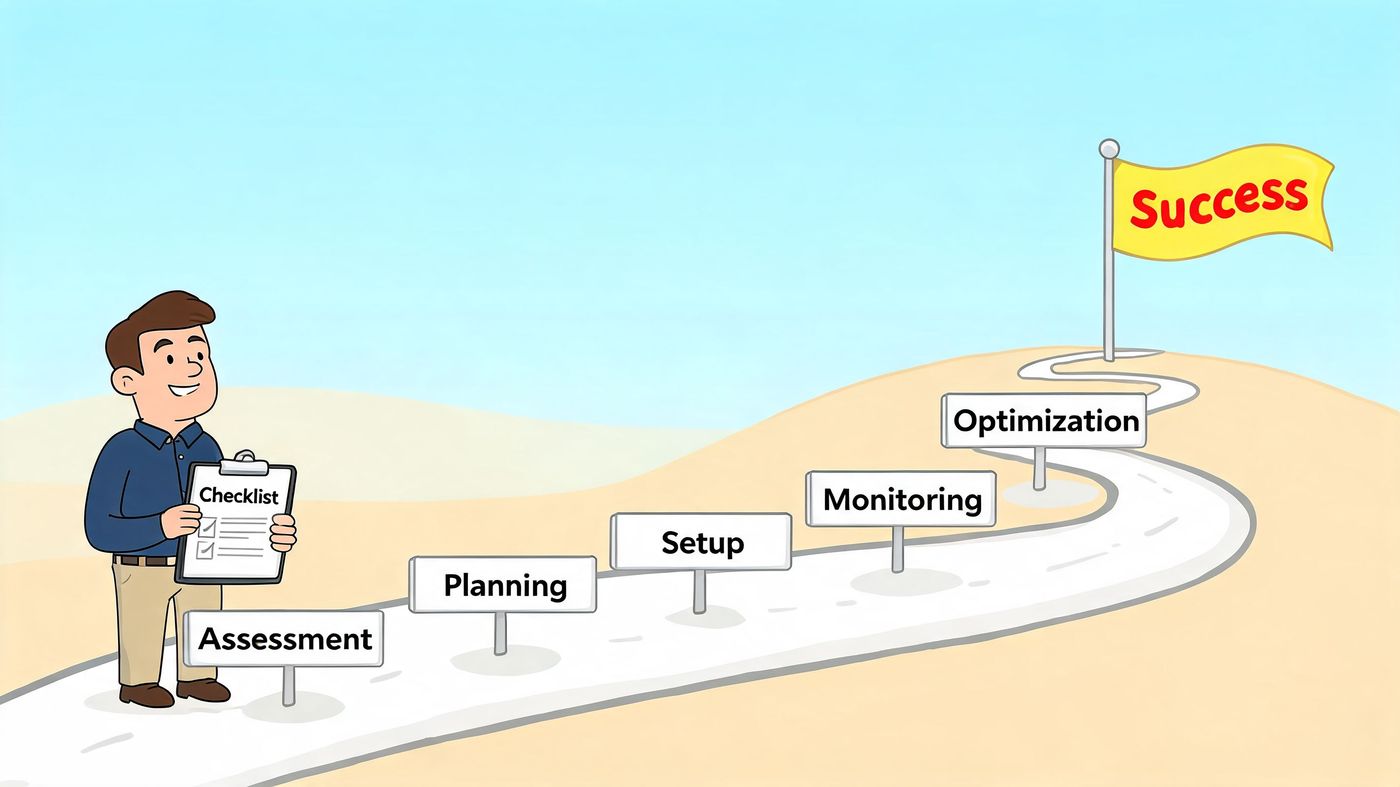
A sensible rollout usually follows these stages:
If you’re evaluating broader sourcing alongside database support, this guide to IT outsourcing company options can help frame where database administration fits within the larger support strategy.
Don’t choose a provider because their sales deck sounds polished. Choose them because they can answer hard operational questions.
Use this checklist.
A healthcare clinic should prioritise continuity of access to records and audit readiness.
A law firm should prioritise controlled access, evidence of administrative changes, and confidence in data recovery.
A manufacturing company should prioritise predictable performance, scalable support, and disciplined handling of operational databases tied to production or logistics.
If you’re comparing external partners more broadly, this roundup of top Web3 and AI outsourcing companies can be a useful contrast point. Not because every provider on that list is relevant to database administration, but because it highlights how specialised outsourcing has become. Database support should be evaluated with that same level of precision.
Selection advice: If a vendor talks mostly about tools and barely talks about process, accountability, and recovery, keep looking.
Your database is too important to leave half-managed. If it supports billing, operations, records, reporting, or client service, it deserves specialist oversight.
This highlights the strong case for dba as a service. You reduce avoidable cost, improve resilience, tighten security, and give your internal team room to focus on work that moves the business forward. For regulated Canadian SMBs, the value is even clearer because the right service model also supports compliance, residency concerns, and operational accountability.
If your business is still relying on a generalist, a software tool, or a hope-and-pray backup routine, it’s time to fix that.
CloudOrbis Inc. helps Canadian SMBs build secure, reliable, and compliant IT environments with practical support that fits real-world operations. If you want a clear view of whether dba as a service makes sense for your organisation, contact CloudOrbis Inc. for a complimentary IT assessment.
Book a 30-minute call with a senior engineer. No sales script, just straight answers about your environment.


