What Is IT Vendor Management? a Guide for Canadian SMBs
Learn what is IT vendor management, its lifecycle, benefits, and risks. Our guide for Canadian SMBs covers best practices for security and compliance.

Learn what is IT vendor management, its lifecycle, benefits, and risks. Our guide for Canadian SMBs covers best practices for security and compliance.
You know the situation. One team signs up for Microsoft 365 add-ons. Another brings in a VoIP provider. Finance approves a backup tool. Operations orders hardware from a separate supplier. Then renewal notices start arriving, support quality varies, and nobody is fully sure which vendor has access to what.
That's where many small and mid-sized businesses land. They don't have one giant IT problem. They have a growing pile of small vendor decisions that now affect security, cost, uptime, and compliance.
When business owners ask, what is IT vendor management, they're often expecting a procurement definition. What they need is a control system. It's the discipline of choosing technology vendors carefully, setting clear expectations, tracking results, and knowing how to exit safely when a provider no longer fits.
A lot of IT environments become messy in a very ordinary way. The company grows. Staff add software to solve immediate problems. A managed service gets layered on top of cloud tools, telecom services, cybersecurity products, printers, laptops, line-of-business apps, and consultants. Each choice makes sense on its own. Together, they create confusion.

The warning signs are familiar:
This isn't just untidy administration. It affects resilience and profitability. In Canada, procurement is economically significant. Statistics Canada reported that Canadian businesses spent about C$1.2 trillion on goods and services purchases in 2022, which is why even small improvements in supplier selection, contract controls, and performance monitoring can matter at scale, as noted in Ramp's discussion of vendor management best practices.
Most leaders notice vendor problems long before they use the term vendor management. They feel it when a critical tool goes down and support bounces them between providers. They feel it when finance asks why two platforms do nearly the same job. They feel it when legal or compliance asks who approved a vendor handling sensitive data.
Good vendor management turns a stack of separate supplier relationships into one organised operating model.
That's the fundamental shift. IT vendor management is not paperwork for its own sake. It gives your business a way to control third-party technology relationships across onboarding, contract terms, service expectations, security checks, performance review, and exit planning.
If you've ever felt that your providers are managing you more than you're managing them, that's the point where structure starts paying off. Businesses that want stronger outcomes from outside partners often start by improving how they evaluate and govern them. This is closely related to getting more value from your providers, a theme explored in how to get more out of your IT provider.
Think of your IT vendors like subcontractors building a commercial space. One handles electrical work, one installs security systems, one supplies the HVAC controls, and one manages networking. If nobody coordinates them, each may do acceptable work individually while the whole project still ends up late, over budget, or unsafe.
That coordination role is the heart of IT vendor management.
A lot of people reduce vendor management to purchasing. That's too narrow. Buying software or hardware is only the opening move. The harder part is making sure the vendor continues to deliver what your business needs after the contract is signed.
That includes questions such as:
| Business question | Why it matters |
|---|---|
| Does the vendor support a critical business process? | Failure can disrupt operations |
| Who owns the relationship internally? | Accountability prevents drift |
| What service level was promised? | Expectations need to be measurable |
| What data does the vendor handle? | Security and privacy obligations follow |
| How do we leave if needed? | Exit planning reduces lock-in |
A useful way to define IT vendor management is this: it's the practice of making outside technology providers work in line with your business goals, risk tolerance, and operating standards.
For organisations in regulated sectors, vendor management works as a third-party risk management layer. It involves identifying, assessing, monitoring, and mitigating vendor risks through a structured lifecycle, which is especially important in healthcare and finance, according to Ncontracts' overview of vendor management.
That matters beyond regulated industries too. A payroll software company, cloud backup provider, managed security service, Microsoft partner, and internet carrier can all affect your operations directly. If they miss deadlines, mishandle data, or fail to deliver support, your business takes the impact.
Practical rule: If a vendor can interrupt your operations, access your systems, or influence compliance, that vendor needs active management.
At its best, vendor management helps leaders do four things well:
This is also why vendor management overlaps with IT asset management practices. You can't govern your vendors properly if you don't know which tools, licences, devices, and services they support.
Most confusion about vendor management comes from treating it as a one-time event. It isn't. It's a lifecycle.
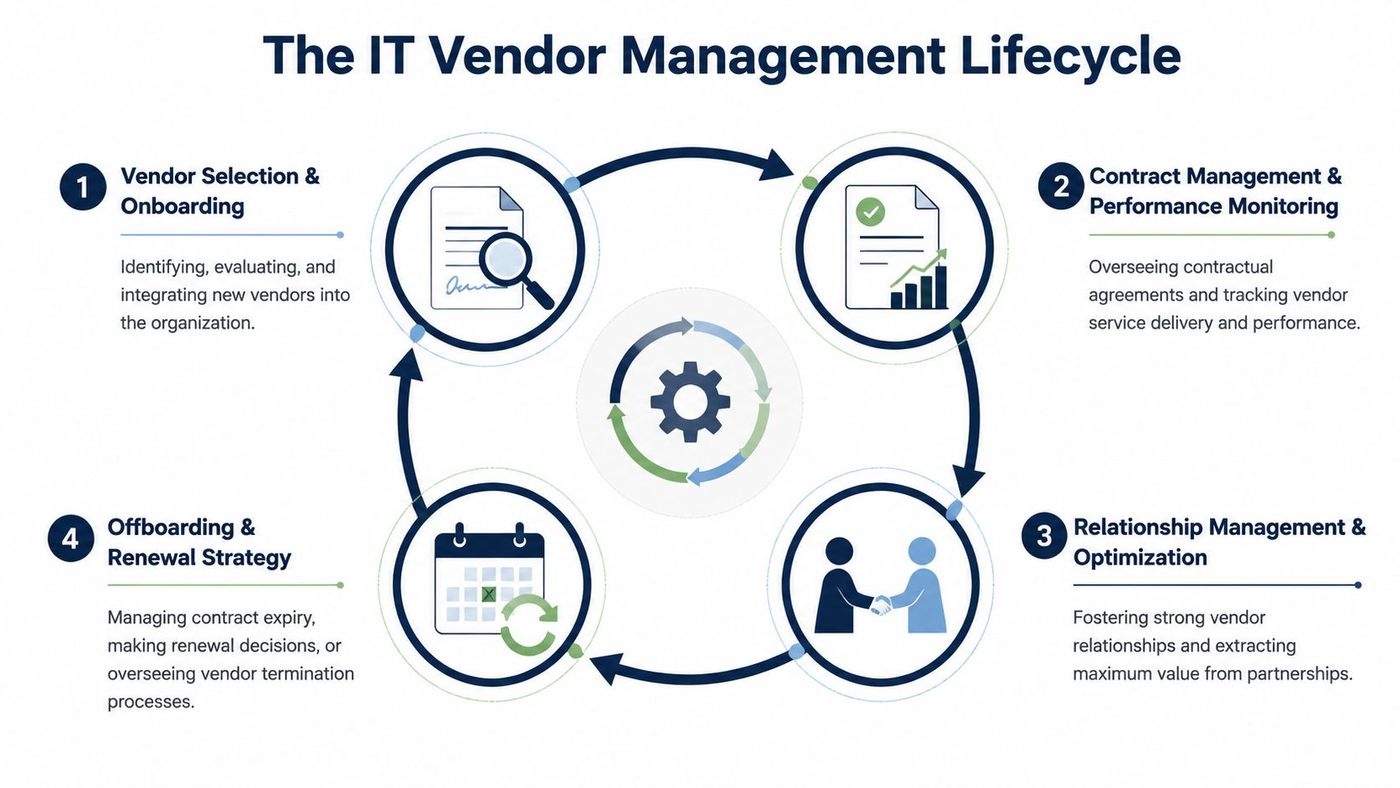
A simple way to manage it is to divide the work into four stages.
This stage starts before any contract exists. The aim isn't just to find a capable provider. It's to find a provider that fits your business, your risk profile, and your operating model.
A common mistake is choosing a vendor mainly because the demo looked polished or the price seemed attractive. That often leads to bigger problems later, especially with hidden support limits, weak onboarding, or unclear security controls.
During selection, teams should examine:
For an SMB, this doesn't need to become a large procurement exercise. It does need a repeatable checklist.
Once you choose a vendor, the contract should define more than price. It should spell out deliverables, roles, service expectations, milestones, data obligations, and review mechanisms.
Many businesses tend to be vague. They say they expect “good support” or “strong security,” but those ideas only become enforceable when translated into concrete terms.
A solid onboarding process usually covers:
A contract should help you manage the relationship on an ordinary Tuesday, not just argue about it during a dispute.
Businesses that rely on external help for infrastructure, cloud projects, or support often discover that onboarding quality predicts long-term performance. That's one reason many organisations look closely at how an IT outsourcing company structures handoff, accountability, and communication.
At this juncture, vendor management either becomes real or fades into a filing cabinet.
Once services are live, someone needs to track whether the vendor is doing what was promised. That can include uptime discussions, ticket responsiveness, delivery timing, quality issues, security reviews, and budget alignment. Common KPIs in vendor management literature include on-time delivery, quality defect rates, responsiveness, and adherence to budget targets.
You don't need a huge governance programme to do this well. You do need rhythm.
A practical review cycle often includes:
| Review area | What to look for |
|---|---|
| Service performance | Are agreed expectations being met consistently? |
| Risk changes | Has the vendor changed tools, staff access, or subcontractors? |
| Contract fit | Does the current agreement still match the business need? |
| User feedback | Are internal teams satisfied with support and delivery? |
Monitoring also now includes cyber risk. Supply-chain compromise and ransomware are major concerns in the current threat environment, which is why vendor review can't stop at pricing or procurement paperwork.
This is the stage many companies neglect until they're forced into it.
A frequently underexplored angle in vendor management is exit and offboarding. Recent Canadian guidance, including OSFI's third-party risk expectations, puts weight on exit planning, data return or destruction, and access removal, making offboarding a core lifecycle activity rather than an afterthought, as highlighted in ServiceNow's explanation of vendor management.
When a vendor relationship ends, your business should know:
This is also where concentration risk matters. If one vendor handles too much of your environment, leaving becomes harder, slower, and more expensive. Offboarding isn't just a technical task. It's proof that your business kept enough control to move when it needs to.
The strongest case for vendor management is that it improves outcomes while reducing unpleasant surprises. But it only works when leaders look at both sides. There are benefits to building discipline here, and there are serious risks when companies leave vendor relationships unmanaged.
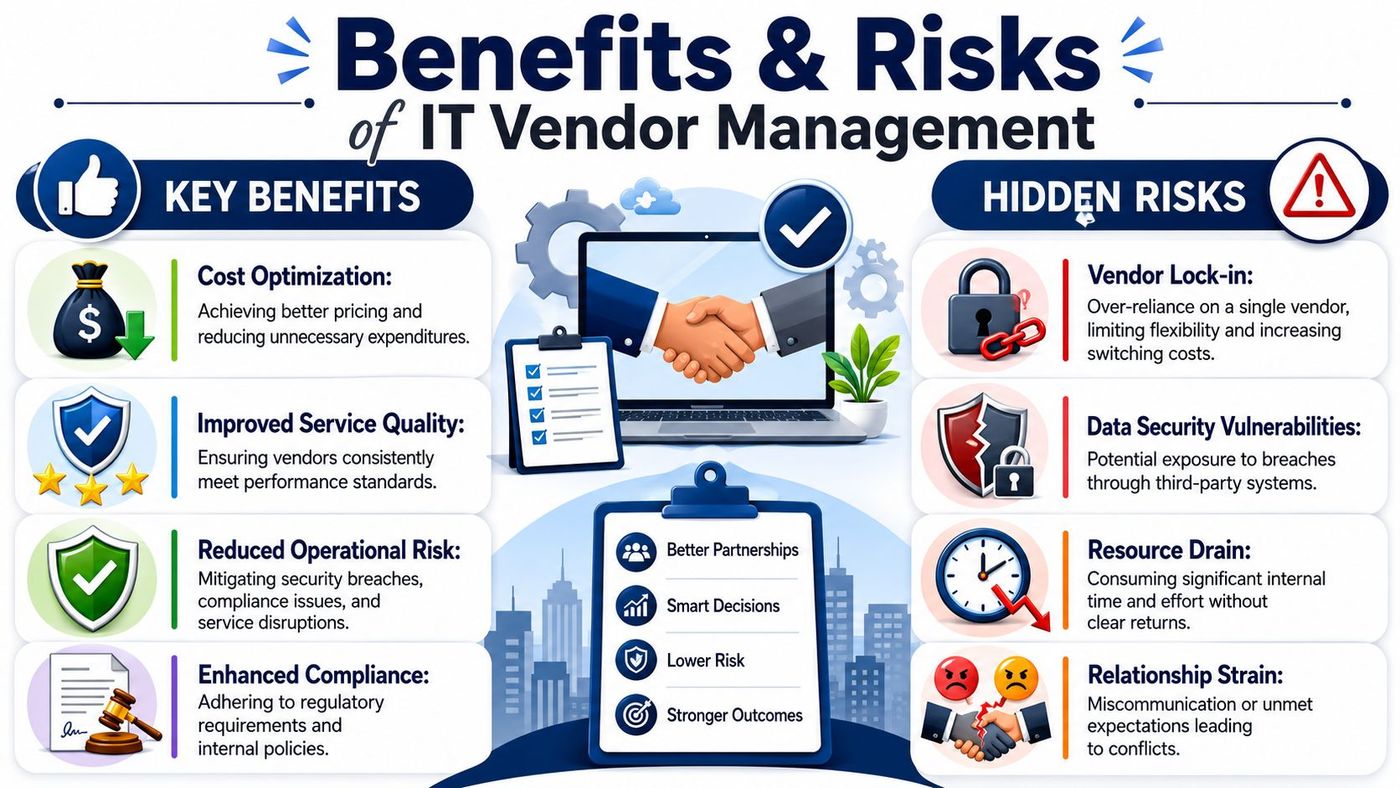
A mature approach often produces practical gains that business owners can feel quickly.
There's also a strategic benefit. Well-managed vendors can contribute expertise, implementation support, and product guidance that internal teams may not have in-house.
The Canadian Centre for Cyber Security's National Cyber Threat Assessment 2023–2024 identified supply-chain compromise as a major threat, reinforcing why vendor oversight must include security reviews and continuous monitoring, not just price negotiation, as summarised in JPMorgan's vendor management guide.
That warning matters because vendor risk often hides in ordinary operations. The provider that stores your documents, supports your endpoints, or connects into your cloud environment can become part of your exposure.
Poor vendor management rarely fails all at once. It leaks value quietly, then creates a crisis suddenly.
Three hidden risks deserve special attention:
A tool becomes firmly embedded. Data exports are awkward. Integrations are proprietary. Your staff know only one platform. By the time service quality slips, switching feels too costly or disruptive.
A vendor may process employee, customer, financial, or health data. If oversight is weak, your company may discover too late that controls, permissions, or incident handling weren't strong enough.
Without structure, internal teams spend too much time chasing invoices, finding contract terms, clarifying support responsibilities, and sorting out ownership disputes. That's management overhead with very little upside.
For organisations building a stronger risk management framework, vendor governance belongs near the centre. Third parties are not outside the operating model. They're part of it.
The basics of vendor management still matter. Clear contracts, service reviews, and ownership discipline are timeless. What's changed is the environment around those basics. Vendors now update features constantly, bundle AI into existing products, and move customer data across more complex cloud ecosystems.
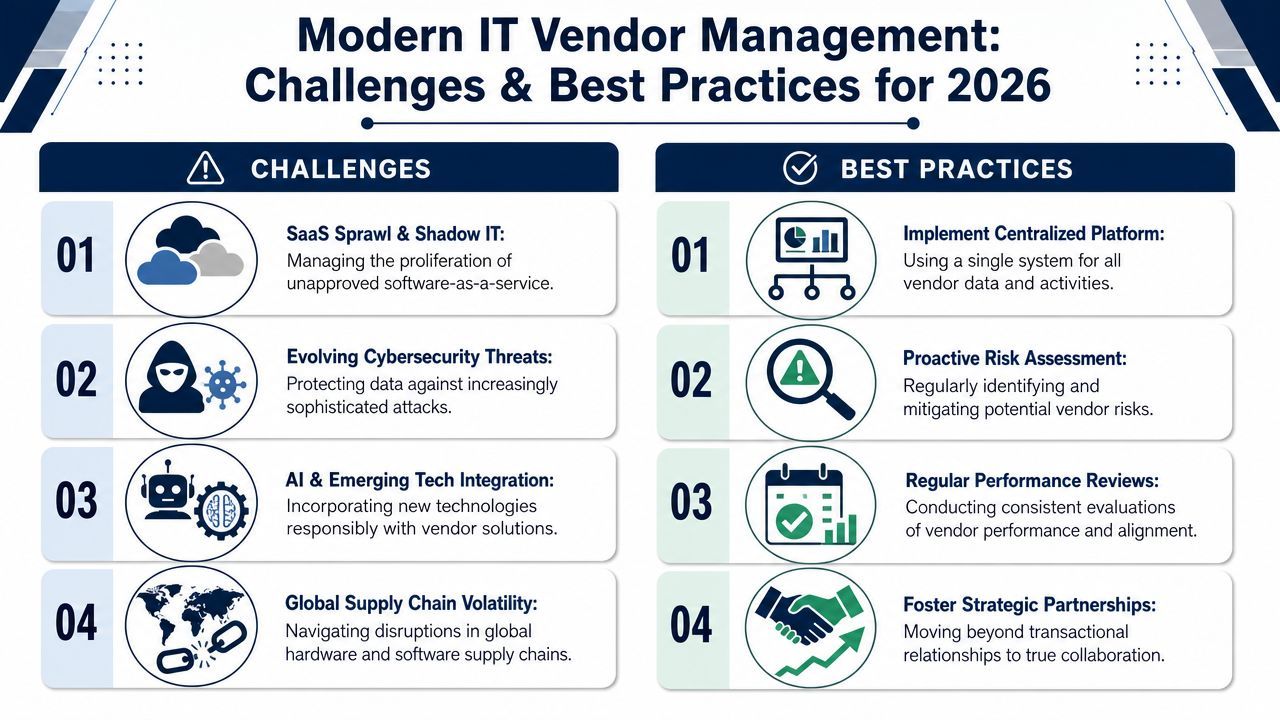
A key challenge is governing vendors that use AI, especially for organisations working with tools such as Microsoft 365 and Copilot. Canadian privacy regulators have issued AI-related guidance, which pushes organisations to ask for more transparency and control from third parties handling their data, as discussed in Taulia's overview of vendor management.
That creates a new kind of management problem. A vendor may sell one product, but the product's data flows, embedded AI features, and processing behaviours may change over time. If your business only checks the vendor at the start of the relationship, you can miss meaningful changes later.
Many guides on what is IT vendor management fall short. They explain onboarding and contract terms, but not how to govern services that evolve continuously.
For 2026 planning, five habits matter more than ever.
Create one record of all IT vendors, contracts, renewal dates, owners, connected systems, and data access levels. If that information lives across inboxes and spreadsheets, oversight will stay patchy.
Not every supplier needs the same depth of governance. Focus your strongest controls on vendors that support essential operations, handle sensitive information, or have privileged access.
Your agreements should consistently address service expectations, security responsibilities, data handling, change notification, and exit terms. Standardisation reduces ambiguity and speeds review.
Use regular check-ins, not just renewal-season scrambles. Review service quality, support experience, access rights, and any changes in product scope or risk.
Maintain current contacts, data export options, access revocation procedures, and replacement paths. If a vendor relationship deteriorates, you don't want your first offboarding discussion to happen during an outage or dispute.
The modern test of vendor management is simple. Can your business explain who each critical vendor is, what they touch, how they're measured, and how you would replace them?
The businesses that answer yes usually don't have perfect systems. They have clear ownership, repeatable processes, and the discipline to keep vendor oversight current.
If your vendor environment feels bigger than it should, start smaller than you think. You don't need a complex governance programme on day one. You need visibility, priorities, and follow-through.
First, create a full list of your IT vendors. Include software subscriptions, internet providers, managed services, telecom, hardware suppliers, cloud platforms, cybersecurity tools, backup vendors, consultants, and any third party with system access or data exposure.
Second, identify which of those vendors are most critical. A useful filter is simple: which ones would disrupt operations, create security concerns, or trigger customer impact if they failed tomorrow?
Third, review the contracts for those critical vendors. Look for renewal terms, exit clauses, support scope, ownership of licences and data, and any gaps around access removal or service accountability.
A short starter checklist helps:
Many SMBs understand the need for vendor management but struggle with execution. The work crosses IT, finance, operations, compliance, and leadership. Contracts need review. Security questions need technical judgement. Renewals need planning. Offboarding needs discipline.
That's where a managed partner can help bring order without adding internal administrative burden. External IT leadership can support vendor evaluation, technical due diligence, contract review, service monitoring, and structured lifecycle management across your stack. For businesses looking to stabilise and simplify this work, managed IT services can provide the operational support and strategic oversight needed to keep vendors aligned with business goals.
A healthy vendor management practice doesn't mean you control every detail personally. It means your business is no longer guessing.
You know which vendors are critical. You know what they've promised. You know how they're performing. You know what risks they create. And if needed, you know how to leave.
That's the core answer to what is IT vendor management. It's not a procurement form or a spreadsheet exercise. It's a practical way to protect your business, improve the value of every external technology relationship, and keep control as your environment grows.
If your business needs help bringing structure to vendor oversight, CloudOrbis Inc. can help you assess your current IT suppliers, reduce risk, improve service accountability, and build a more resilient vendor management approach for your organisation.
Book a 30-minute call with a senior engineer. No sales script, just straight answers about your environment.


