Risk Management Framework for Canadian SMBs: Guide 2026
Build a robust risk management framework for your Canadian SMB. Get a practical roadmap for key components, NIST vs. ISO, and healthcare applications.

Build a robust risk management framework for your Canadian SMB. Get a practical roadmap for key components, NIST vs. ISO, and healthcare applications.
Most mid-sized businesses don't set out to run on guesswork. It happens gradually. A clinic adds a new cloud app because staff need it fast. A manufacturer gives a long-time employee broad access because “they've always handled it.” A finance team assumes backups are covered because someone once said they were. Then a ransomware event, a vendor outage, or a privacy complaint exposes the underlying problem. Nobody had a shared way to decide what mattered most, who owned the risk, or what the response should be.
That's where a risk management framework stops being theory and starts being useful. It gives leadership a repeatable way to identify risk, decide what's acceptable, and invest in the controls that effectively protect operations. For Canadian SMBs, that matters well beyond IT. It touches privacy, service continuity, cyber insurance, vendor management, and board-level accountability.
If you're already reviewing coverage, this is also where risk work and insurability meet. A lot of policy questions get easier to answer when your controls, owners, and recovery plans are documented in a structured way. CloudOrbis covered that overlap in its guide to cyber insurance for Canadian SMBs.
A business owner usually feels the gap before they can name it.
You know the feeling. One manager worries about phishing. Another worries about a supplier delay. HR is concerned about a key person leaving. Operations wants better backup internet. Finance wants to know whether a new system is worth the spend. All of them are talking about risk, but they're not using the same language or the same decision model.
That's why businesses drift into reactive mode. They respond to the loudest issue, the most recent incident, or the vendor with the best sales pitch. What they don't have is a structured way to separate a nuisance from a business-stopping event.
In practice, it usually shows up in a few familiar patterns:
A business doesn't need a perfect framework. It needs one that people will actually use when time, money, and attention are limited.
For Canadian organizations, the pressure is practical. Privacy obligations, customer expectations, insurer questions, and cross-border work all demand clearer governance. In healthcare, legal, finance, and public-facing services, the cost of confusion is more than downtime. It can become a trust problem very quickly.
A useful risk management framework acts like a decision system. It helps leadership answer questions such as:
Without that structure, risk stays informal. Informal risk management works right up until it doesn't.
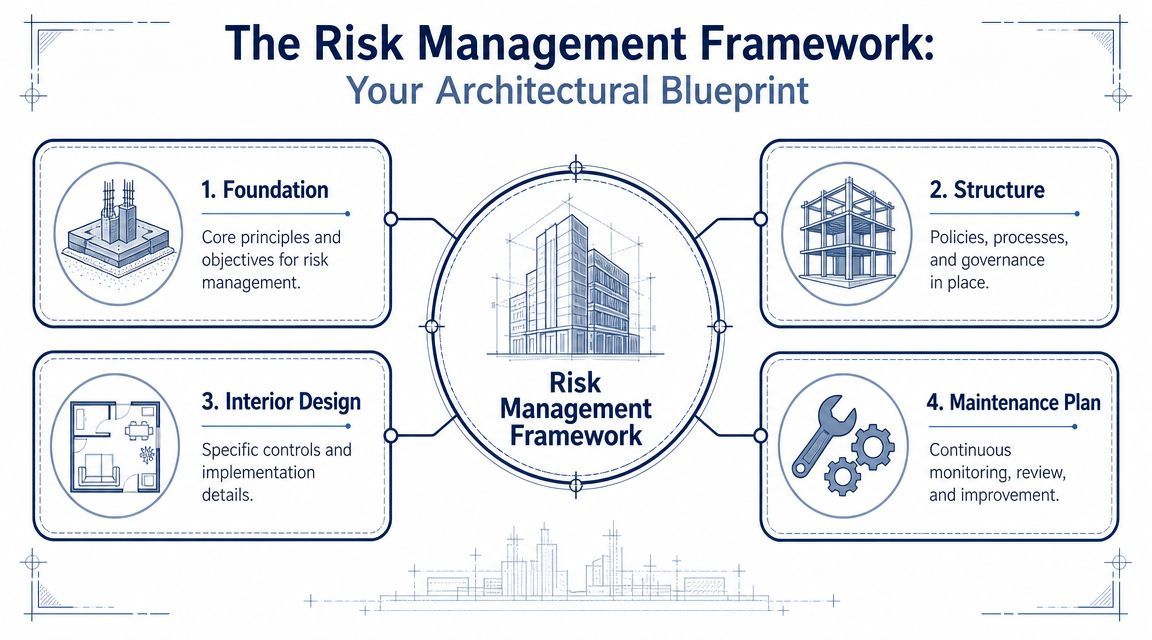
A risk management framework is the blueprint for how your business handles uncertainty. Not just cyber threats. All the issues that can interrupt service, damage trust, create compliance exposure, or force expensive last-minute decisions.
If you think of your business like a building, the framework is the architectural plan. It shows what needs to be reinforced, who signs off on changes, and how the building is maintained over time.
One of the most important shifts in modern risk practice came from the U.S. National Institute of Standards and Technology. The NIST Risk Management Framework, formalized through NIST SP 800-37 Revision 2 in 2018, uses a continuous lifecycle of Prepare, Categorize, Select, Implement, Assess, Authorize, and Monitor. NIST's own overview shows how ongoing monitoring is built into the model instead of treated as a one-time review in its Risk Management Framework project overview.
That matters for Canadian SMBs because many organizations already use NIST-aligned controls as a practical baseline, especially when they handle regulated data or support cross-border clients.
A good framework doesn't say, “We assessed risk last year.” It says:
The framework only works when it ties business objectives to real controls. That means linking executive priorities to operational reality.
For example:
If you need a starting point for that work, CloudOrbis outlines a practical service approach in its cybersecurity risk management services.
Practical rule: If your framework can't help a department head make a better decision this month, it's too abstract.
A framework fails when it becomes a paperwork exercise. Common signs include copied templates, generic heat maps, and a risk register nobody updates. Businesses also get stuck when they treat risk as an IT-only issue. In reality, finance approves spend, operations owns downtime impact, HR influences insider risk, and leadership sets the tolerance for disruption.
The blueprint has to reflect how the business actually runs. Otherwise, staff will route around it.
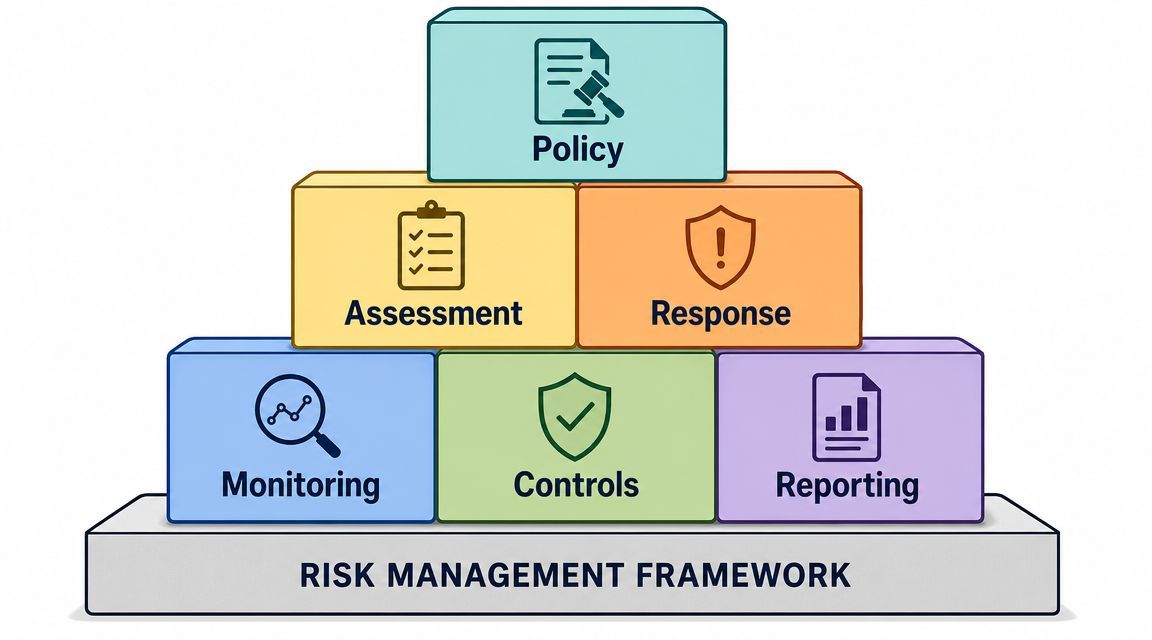
Once the blueprint is clear, you need the parts that hold it together. These aren't academic artefacts. They're the tools leadership and operations teams use to make consistent decisions.
Most SMBs skip this because it sounds too corporate. That's a mistake.
A risk appetite statement is leadership's position on what level of disruption, exposure, or delay the business is willing to tolerate in pursuit of its goals. You don't need pages of legal wording. You need a usable statement.
A clinic's appetite for downtime affecting patient records should be low. A manufacturer may accept some risk in a pilot system but not in production scheduling. A professional services firm may tolerate minor inconvenience in internal reporting tools but not in client file access.
When teams don't define appetite, every issue turns into an argument.
A risk register is your working list of meaningful risks. It should be simple enough to update and specific enough to support action.
At minimum, include:
Many SMBs often overcomplicate the process. If your register needs specialist software before anyone can use it, you've probably made it too heavy for the current stage.
Risk scoring should help teams compare priorities. It shouldn't create false precision.
Use practical criteria. Ask what happens if a system is unavailable, if data is exposed, if staff can't work, or if a workaround exists. In healthcare and other public-facing services, that still isn't enough. Recent North American guidance stresses that a modern framework must consider sector-specific harms, stakeholder engagement, and downstream consequences, not only probability and impact. That's especially relevant when a control decision affects patients, workers, or communities, as outlined in the DOE Risk Mitigation Approach Guidebook for States.
That changes the conversation. A delayed payroll batch is serious. A delayed access to patient information may also create safety and trust consequences that a simple score won't capture.
The strongest control set won't help if ownership is vague.
Here's the minimum governance model I've seen work in mid-sized environments:
| Building block | What it should answer |
|---|---|
| Risk appetite | What are we willing to accept? |
| Risk register | What are our real risks right now? |
| Control library | What safeguards do we rely on? |
| Ownership model | Who decides and who escalates? |
| Review cadence | When do we reassess? |
| Reporting | What does leadership need to see? |
A few practical rules keep governance from drifting:
If you're tightening the control side of the framework, CloudOrbis has a useful overview of data security management that fits well with this operating model.
Most SMBs don't need to evaluate every framework on the market. They need a sensible starting point that matches their business, regulator expectations, and internal maturity. In practice, the conversation often comes down to NIST RMF versus ISO 31000.
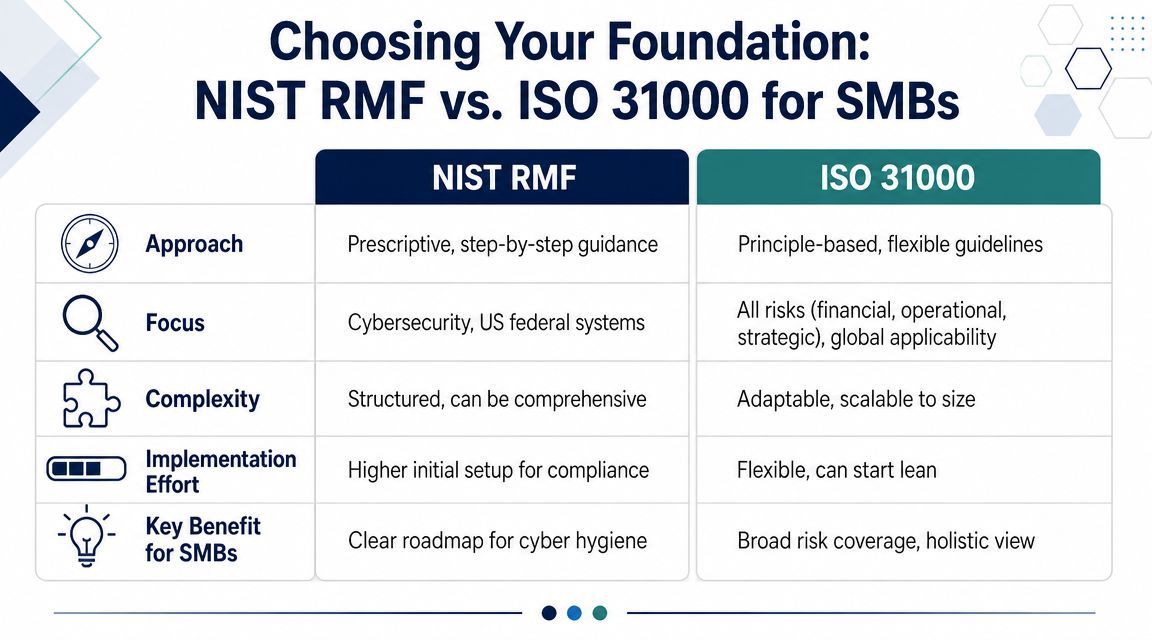
NIST RMF is often the better fit when the business needs tighter cybersecurity governance, clearer control evidence, or alignment with U.S. expectations. That's one reason it shows up frequently in Canadian organizations serving regulated sectors or cross-border clients.
The practical benefit is structure. The model gives leaders a way to connect system impact, control selection, assessment results, authorization decisions, and monitoring into one lifecycle. For SMBs that struggle with “why are we spending on this control?”, that evidence trail matters.
ISO 31000 is less prescriptive and more principle-driven. That makes it useful when leadership wants risk management integrated across operations, finance, procurement, HR, and strategy, not only cyber controls.
In a mid-sized business, that flexibility can be an advantage. You can start lean, adapt the language to your culture, and avoid importing enterprise bureaucracy that nobody will maintain.
If NIST helps you build disciplined control decisions, ISO 31000 helps you make risk part of everyday management.
| Criterion | NIST Risk Management Framework (RMF) | ISO 31000 |
|---|---|---|
| Approach | Prescriptive, structured lifecycle | Principle-based, flexible guidance |
| Best fit | Cyber governance, regulated data, cross-border expectations | Enterprise-wide risk integration |
| Strength | Clear evidence model for controls and monitoring | Broad applicability across business functions |
| Trade-off | Can feel heavier if scoped too widely too early | Can stay too high-level if teams avoid specifics |
| Good SMB use case | Clinic group, legal firm, finance team, manufacturer with strong cyber dependency | Multi-site SMB wanting one shared risk language across departments |
Use these decision cues:
That blended model is often the most realistic option. Many SMBs need enterprise-wide risk language, but they also need a concrete method for selecting, assessing, and monitoring controls.
If your broader compliance path includes attestations and audits, a useful companion read is this ISO 27001 and SOC 2 roadmap, which helps frame where a risk management framework fits relative to formal assurance work.
Businesses often pick based on branding instead of operating reality. They choose the framework that sounds more recognised, then discover it doesn't match how decisions are made internally.
A better question is simpler: which framework will your managers use when approving vendors, prioritising projects, assigning budget, and reviewing incidents?
If the answer is “none of them unless we simplify it,” start smaller. Scope one business unit, one system set, or one regulated workflow first.
Most SMBs don't fail because they chose the wrong framework. They fail because they launched too big, assigned vague ownership, and treated the work like a one-time compliance project.
A practical rollout is smaller and stricter. It should change decisions in IT, operations, finance, and leadership. Recent practitioner guidance makes the point clearly: effective risk management has to be embedded by design into core processes, supported by data, technology, and the right roles. It has to become a living operating model, not a standalone policy exercise, as discussed in GARP's piece on rethinking risk management strategy.
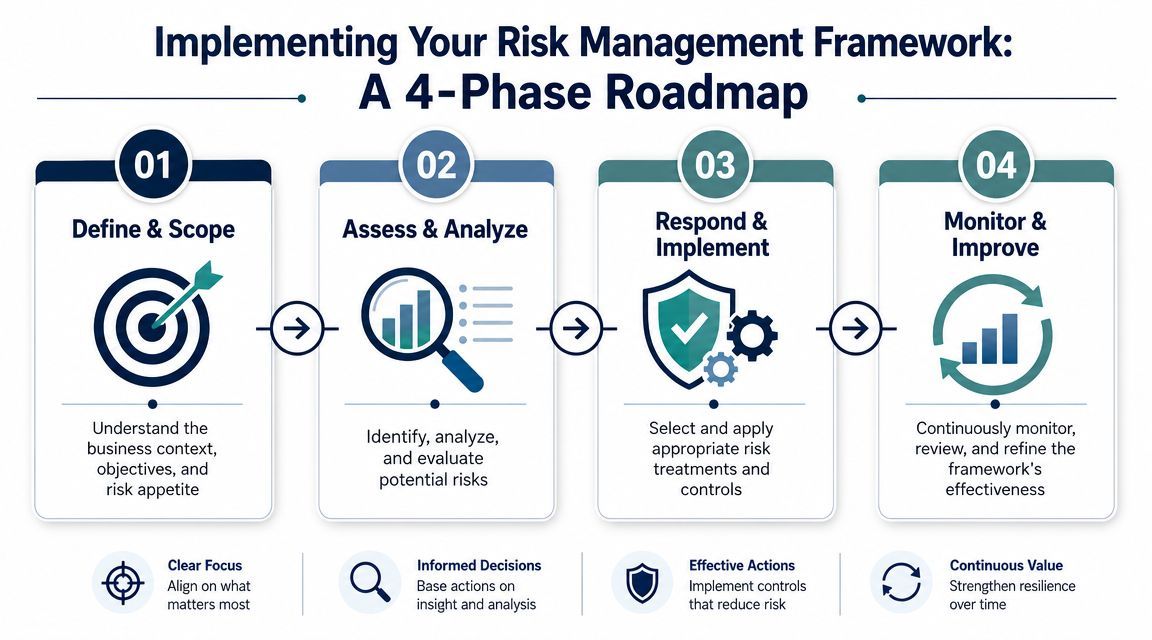
Start with boundaries. Which business processes matter most? Which systems support them? Which data types create legal, operational, or patient-care consequences if mishandled?
For a mid-sized healthcare provider, I'd usually start with scheduling, EMR access, file storage, email, endpoint security, and vendor access. For manufacturing, I'd focus on ERP, production planning, plant connectivity, file shares, and remote access.
Keep phase one grounded in decisions:
If this phase turns into endless workshops, stop and tighten the scope.
Teams build the working view of risk. Run short workshops with people who know the environment, not just managers. Include IT, operations, privacy, finance, and frontline users where the workflow matters.
Look for failures from multiple angles:
Ask, “What would stop us from delivering service?” before you ask, “What security tools do we need?”
Document the impact in business language. Not “server issue.” Say “staff lose access to patient schedules” or “shipping cannot release orders.”
Not every risk deserves the same answer. Some should be mitigated. Some should be transferred through contracts or insurance. Some should be accepted because the cost of treatment outweighs the benefit. A few should be avoided entirely.
This is the phase where controls become concrete:
If you need operational help putting those controls under active oversight, a managed approach such as security managed services can support monitoring, remediation workflows, and ongoing review. CloudOrbis is one provider in that space for Canadian SMBs.
At this juncture, frameworks either mature or fade away.
Monitoring doesn't have to mean a large governance office. It means the business checks whether controls still match reality. New software, acquisitions, clinic expansions, staffing changes, and vendor turnover all create drift.
Use a short recurring review that answers:
You'll know the framework is working when managers start using it without being pushed. Procurement asks about vendor risk before signing. IT flags control gaps in project planning. Leadership approves spend based on business impact instead of fear. Department heads know what gets escalated and what stays local.
That's the point. A risk management framework should change behaviour, not just documentation.
Healthcare organisations don't need a separate universe for compliance and risk. They need one operating model that makes both clearer.
For Canadian providers, that often means aligning privacy, service continuity, and security controls with healthcare-specific obligations while also dealing with cross-border requirements. If you support U.S.-connected workflows, HIPAA language may show up in vendor contracts, hosting discussions, or patient data handling expectations. The framework gives you a way to organise that work instead of chasing it requirement by requirement.
The cleanest approach is to treat compliance requirements as risk categories and control obligations inside the framework.
A practical mapping looks like this:
That approach keeps compliance from becoming a parallel project. It also gives leadership evidence for why specific investments are necessary.
Healthcare risk scoring needs a sharper lens than generic office environments. A failed control can affect patient access, staff workflow, privacy, and service trust at the same time. That's why healthcare teams should evaluate not only whether a safeguard exists, but whether it reduces actual harm in the care environment.
This also matters when using data for analytics, testing, or secondary workflows. If your team is handling data sets beyond direct care operations, this overview of technical PHI de-identification methods is a useful technical companion for deciding when identifiers should be removed or transformed.
In healthcare, a control that looks acceptable on paper can still fail if it slows care, confuses staff, or creates unsafe workarounds.
Clinics and healthcare groups don't have endless governance capacity. Keep the framework usable:
For organisations building that structure in a regulated care setting, CloudOrbis outlines its healthcare IT context in health care services.
A workable risk management framework gives a mid-sized business something far more useful than a compliance checklist. It gives leaders a way to make better decisions under pressure.
The shift is practical. You move from scattered concerns to defined ownership. From generic policies to controls tied to business impact. From annual review theatre to an operating model that keeps pace with change.
That model also needs measurement. If you're refining review cycles or proving whether process changes are improving performance, this guide to metrics for operational improvement is a helpful reference for building cleaner follow-through.
The important part is to start with a realistic scope and keep the framework alive. One critical workflow. One business unit. One set of systems. Done properly, that's enough to create momentum and give leadership better visibility into where risk is acceptable, where it isn't, and what action comes next.
CloudOrbis Inc. helps Canadian SMBs turn risk management into a practical operating model across security, compliance, cloud, and day-to-day IT governance. If you need a clear starting point for a risk assessment, control review, or healthcare-focused compliance roadmap, talk to CloudOrbis Inc..
Book a 30-minute call with a senior engineer. No sales script, just straight answers about your environment.


