Digital Transformation Strategy: SMB Success in 2026
Discover a step-by-step digital transformation strategy for SMBs in 2026. Align goals, pick cloud, manage change, & measure ROI.

Discover a step-by-step digital transformation strategy for SMBs in 2026. Align goals, pick cloud, manage change, & measure ROI.
Your server room is noisy, the finance team is still chasing approvals in spreadsheets, and someone on the leadership team keeps asking why “the digital project” hasn't paid back yet. Meanwhile, your staff are doing their best with legacy systems that slow them down, and every new compliance question feels like one more thing to verify before lunch. That's the point where a digital transformation strategy stops being a buzzword and starts being a management decision.
The Canadian market makes that decision harder to ignore. The Canada digital transformation market was US$12.96 billion in 2024 and is projected to reach US$74 billion by 2025, growing at a 25% CAGR according to a U.S. government commercial guide on Canadian market conditions (Trade.gov commercial guide on Canada's digital economy). At that pace, delay isn't neutral. It affects competitiveness, service quality, and how quickly a business can modernize without breaking operations.
A useful starting point is to separate hype from execution. If you want a concise primer before you map the work, CloudOrbis has a straightforward overview in its digital transformation explainer, and broader strategy framing from 2026 business transformation strategies can help leaders compare options without getting lost in vendor language. A key question is simple, though. What should you change first, what can wait, and what needs governance before anyone touches a platform?
A lot of Canadian SMBs do not set out to start a transformation program. It begins after a near-miss security incident, a competitor launches a faster online service, or staff spend another week re-entering the same data into two systems that do not talk to each other. By the time that happens, the business is already carrying process debt, and the lack of a formal plan starts to show up in service delays, support issues, and avoidable risk.
A digital transformation strategy gives leadership a way to decide what gets fixed first, what can wait, and what should never be handed to software without governance. That matters in Canadian firms that handle sensitive records, work under privacy obligations, or serve regulated industries where access controls and retention rules are not optional. In practice, the strategy has to connect the business reason for change to the people, systems, and controls that will carry it.
A useful starting point is a clear definition of what transformation means before anyone buys tools. CloudOrbis' digital transformation explainer is a concise reference for that foundation, and broader framing from 2026 business transformation strategies can help leaders compare approaches without getting trapped in vendor language. The core of the work is deciding whether the business is trying to remove friction, improve service, tighten governance, or prepare for growth that the current setup cannot support.
For Canadian SMBs, the hardest part is usually not the technology itself. It is the readiness gap around ownership, process discipline, and decision-making. I have seen teams with decent tools still struggle because nobody is accountable for data quality, no one has mapped the approval path, and compliance checks are handled ad hoc. When those gaps are ignored, the project looks active on paper while the organization keeps operating the old way beneath it.
The businesses that move well are the ones that treat modernisation as an operating decision, not an IT purchase. They use urgency from a security scare, a lost deal, or a competitor's new service launch to force a candid review of how work gets done. That is where a strategy earns its place, because it turns scattered pressure into a controlled plan the business can support.
A good transformation plan begins with a blunt question. Are you trying to grow revenue, reduce operational drag, meet compliance obligations, or all three? If the answer isn't clear, vendors will happily define the project for you, and that usually leads to overbuying, under-adoption, and more complexity than the business can support.
Canadian adoption data shows why this discovery work can't be skipped. 96% of Canadian SMEs use at least one digital technology, up from 91% in 2021, and three in ten Canadian businesses are using generative AI (BDC research on SMEs and AI). That tells leaders two things at once. Digital tools are already mainstream, and a key difference now is how well those tools are aligned to process, governance, and people.
A practical capacity review should cover the basics without turning into a six-month audit. List the current systems, who owns them, where the data lives, what breaks most often, and which compliance controls are missing or inconsistent. If a clinic, law firm, or financial services practice is handling regulated information, the gap analysis has to include privacy obligations and access controls, not just hardware age.
Practical rule: if you can't explain the business result in one sentence, the scope is too broad.
Not every Canadian industry is starting from the same place. Statistics Canada found that digital intensity improved continuously from 2000 to 2015, with stronger performance in information services, broadcasting and telecommunications, professional services, machinery and computer-related products, and transportation equipment manufacturing, while agriculture, mining, construction, and many manufacturing and transportation industries lagged behind (Statistics Canada on digital intensity by industry). That matters because your maturity target should be realistic for your sector, not copied from a tech firm in Toronto.
A simple internal scorecard works better than a glossy maturity model. Rate each area as stable, exposed, or blocking progress.
That assessment gives you a shortlist of objectives with real constraints attached. It also stops transformation from becoming a vague modernization slogan.
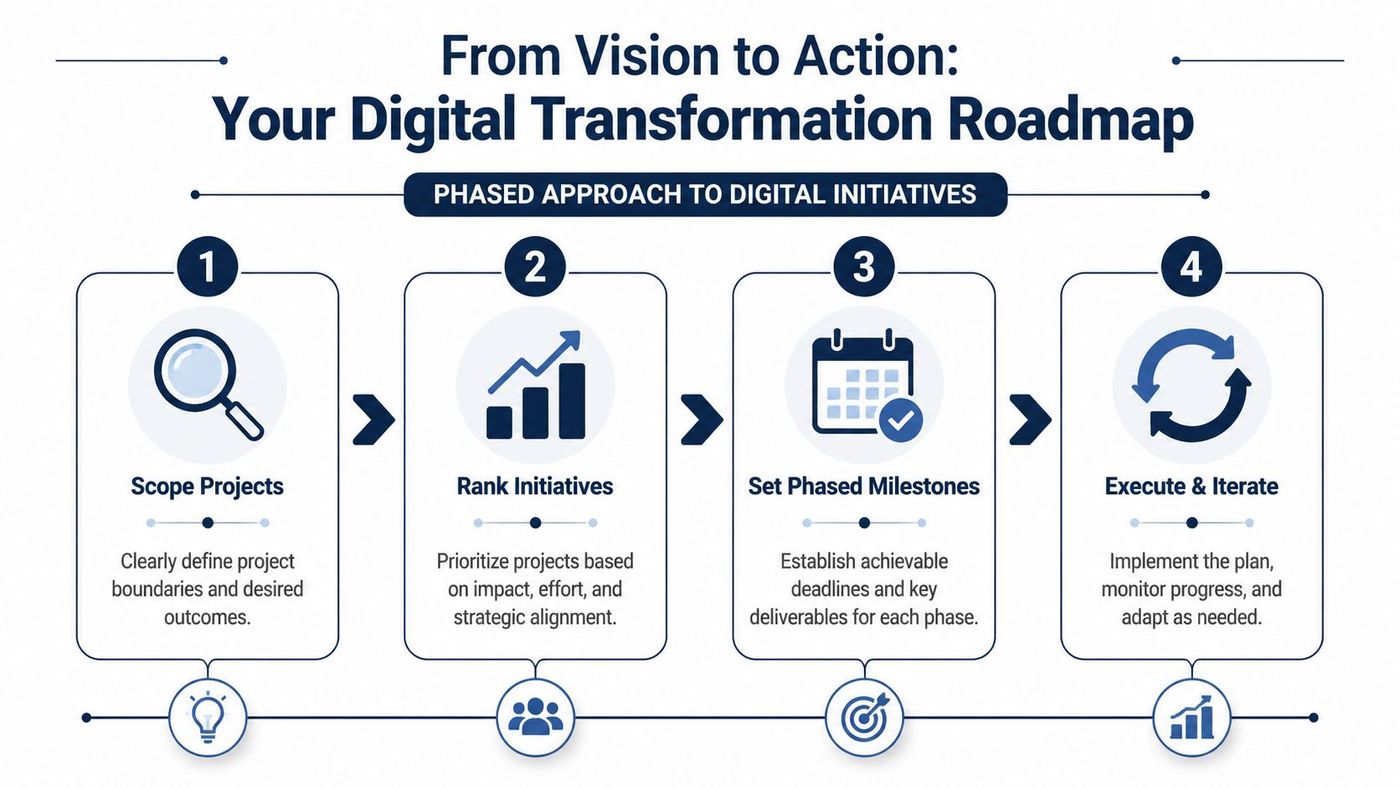
A roadmap only helps if it forces trade-offs. Too many SMBs build lists of desirable projects, then discover they've created a wish list instead of a sequence. The better method is to narrow the scope, rank the work, and tie each initiative to a milestone that leadership can approve.
Canadian public-sector guidance points in the right direction by recommending an actionable roadmap that covers use cases, technology, people, and clear accountability with operational or financial metrics (Canadian market guidance on digital transformation roadmaps). That structure works just as well in the private sector. The roadmap should answer who owns the work, what success looks like, and when the business will decide to continue, adjust, or stop.
The strongest plans use phased sequencing. Security controls often need to move early because they reduce risk across later projects. Data cleanup and process standardisation usually need to happen before a migration. Training and communications should begin before rollout, not after users complain that the new system feels unfamiliar.
A useful timeline includes checkpoints that force action. After discovery, ask whether the use case still supports the original business goal. Before implementation, confirm that the team has the skills, vendor support, and budget to proceed. After launch, review whether adoption and operational results justify expansion.
CloudOrbis's digital transformation roadmap approach is a good example of how to keep the work practical. The point isn't to create a perfect plan on paper. It's to define a sequence that survives contact with real staffing limits, vendor lead times, and changing regulatory pressure.
I've seen better results when leaders treat the roadmap as a living operating document rather than a one-time presentation. That mindset keeps momentum alive because the plan can absorb reality without losing direction. It also makes it easier to defend the budget when priorities shift, because the business can point to the decision criteria instead of improvising a new explanation every quarter.
Cloud decisions look technical on the surface, but they're really about control. Public cloud gives flexibility and speed, private cloud can provide tighter governance, and hybrid models often fit SMBs that need to modernise without moving everything at once. The wrong choice is usually the one made for price alone, because cost savings disappear quickly if the environment can't support compliance, integration, or recovery.
For regulated Canadian SMBs, the cloud conversation should include how data is handled, who can access it, and how controls are documented. A managed hosting model may reduce internal workload, while a co-managed model can preserve internal oversight and give the business more direct visibility into security and change management. The right answer depends on the team's capacity, the sensitivity of the data, and how much operational responsibility leadership wants to keep in-house.
Public cloud is often the fastest path for elastic workloads and collaboration tools. Private cloud can make sense when governance, customisation, or tighter segregation matters more than speed. Hybrid cloud is often the pragmatic middle ground for SMBs that need to keep some systems local while moving others to modern services.
The compliance layer should sit on top of that decision, not inside it. Policies need to define access, retention, encryption, logging, and incident response in language the business can enforce. Security controls also need to be visible to non-technical leaders, because accountability fails when only the MSP or IT manager understands what's protected and what isn't.
Most compliance failures start with unclear ownership, not bad software.
CloudOrbis's cloud security posture management guidance fits this stage because it treats security as something you configure, monitor, and review, not something you assume a platform will handle automatically. That matters in Canadian environments where privacy expectations and audit readiness are part of the operating model.
The safest migration path is usually incremental. Move one workload, validate the control set, document the result, then expand. That approach takes longer than a rushed “lift and shift”, but it gives the business evidence that the environment is secure enough to support the next step.
Technology rollouts fail when leaders assume adoption will happen on its own. Employees rarely resist change because they dislike progress. They resist because the work arrives without context, the training is too generic, or the new process adds friction before they can see any benefit. That's why change management has to sit beside the technical work from day one.
Canadian policy sources have been clear that a nationally consistent digital skills strategy is still needed, and that workforce readiness is uneven across geography and firm size (Toronto Metropolitan University report on Canada's digital economy). For SMBs, that means training can't be treated as a generic lunch-and-learn. It has to be role-based, relevant, and timed to the actual rollout schedule.
Stakeholder mapping should start with the people who will use the system, support the system, and approve exceptions when the system doesn't fit. Then communicate what's changing, why it matters, and what stays the same. Keep the messages short, repeat them often, and make sure managers know how to answer the awkward questions before staff ask them.
CloudOrbis's change management process guide is a useful fit here because it reinforces the practical side of adoption, not just the communications side. In real deployments, co-managed support can take pressure off internal staff while they learn the new tools, which gives the business a safer transition without abandoning internal accountability.
The best training sessions I've seen are hands-on and close to the go-live date. People remember what they need when they can practice it in the workflow they'll be using. If leadership wants adoption, it has to fund the human side of transformation with the same seriousness it gives the software licence.
A digital transformation strategy fails when nobody tracks the business case after launch. Leaders approve a project, the team delivers it, and then everyone hopes value will appear on its own. That's not management, it's optimism with a budget.
Generative AI adds a concrete reason to measure outcomes carefully. CFIB estimates that generative AI could raise Canada's GDP by 0.84%, equal to about CAD 12.8 billion annually, if gains are reinvested toward productive work (CFIB analysis of SMEs and digital transformation). That doesn't mean every SMB will capture the same result. It does mean leaders should track whether saved time turns into better service, faster billing, cleaner compliance, or more capacity for growth.
A workable budget should include software licensing, managed services, internal labour, training, and contingency for change. But the more important part is the measurement model. Choose metrics that leadership can verify without needing a technical translation.
Keep the dashboard small. If the reporting pack gets too complicated, no one uses it.
Good ROI tracking usually starts with three questions. What cost did we avoid by reducing manual effort or downtime? What productivity improved because the team spent less time chasing work? What compliance burden got lighter because controls became easier to prove?
CloudOrbis's cloud cost management resource is relevant here because optimization isn't a one-time exercise. Quarterly reviews, user feedback, and minor adjustments keep the environment aligned with the business instead of drifting back into sprawl. That's where many SMBs lose value, not in the initial buy, but in the lack of follow-through.
A strong optimisation habit is simple. Review usage, compare it to the original objective, and cut anything that isn't supporting the outcome. Then reinvest the savings in training, security, or the next highest-priority change. That's how transformation becomes a capability, not a project.
The hardest part of digital transformation isn't choosing technology. It's deciding what your business can realistically absorb, govern, and sustain. The Canadian market is moving fast, the adoption baseline is already high, and the governance gaps are what usually slow teams down. If you wait for the perfect time, you'll usually end up modernising under pressure instead of on your own terms.
CloudOrbis works through a structured 10-step engagement model that covers assessment, strategy, implementation, training, and ongoing optimisation, which is the right shape for SMBs that need control as well as progress. If your team is still stuck between legacy systems and a half-finished plan, the next step is to get the roadmap out of theory and into action.
A CTA for CloudOrbis Inc..
Book a 30-minute call with a senior engineer. No sales script, just straight answers about your environment.


