

September 21, 2026
Secure File Sharing Guide for Canadian BusinessesLearn secure file sharing essentials for Canadian SMBs — encryption, compliance, protocols and best practices to protect data and stay compliant.
Read Full Post%20(1).webp)
Usman Malik
Chief Executive Officer
June 23, 2026
Your cloud bill lands. It's higher than forecast, nobody can explain the jump cleanly, and your finance lead gets one answer from Azure, another from AWS, and a shrug from operations.
That's not a cloud problem. It's a management problem.
For a mid-sized Canadian business, cloud spend can either become a disciplined operating lever or a slow leak across every department. The difference comes down to visibility, ownership, and a willingness to treat cloud costs like any other material business expense. If you wouldn't accept an unexplained increase in payroll, fleet costs, or rent, you shouldn't accept it in your cloud environment either.
Most business owners don't object to paying for cloud. They object to paying for cloud they can't justify.
That frustration usually starts the same way. You approve a migration or expand Microsoft 365, Azure, AWS, or a mix of hosted services. Teams move faster. New workloads launch quickly. Then the monthly bill starts drifting upward and the invoice becomes harder to decode. By the time someone investigates, you're paying for stale test environments, overbuilt virtual machines, duplicate storage, and services that nobody clearly owns.
That's why cloud cost management matters. It isn't a finance-only exercise and it isn't a technical clean-up project. It's the ongoing discipline of monitoring, measuring, and controlling cloud spend so it stays aligned with business value. Core practices include right-sizing instances, removing idle resources, and using commitment-based pricing to lower bills without hurting performance, as outlined in this overview of cloud cost management practices.
A healthy cloud environment doesn't mean the bill is low. It means the bill is understandable.
You should be able to answer basic questions quickly:
If your team can't answer those questions within a reasonable review cycle, you don't have cloud cost management. You have cloud consumption.
Practical rule: Don't start by asking how to cut the bill. Start by asking which parts of the bill are necessary, attributable, and governed.
There's a useful parallel in SaaS licence management. In both cases, the waste rarely comes from a single catastrophic mistake. It comes from small, repeated decisions made without ownership, review, or retirement rules.
Treat cloud spend as an operating system for growth, not just an expense line.
That means setting policy before teams provision resources, reviewing costs with the same discipline you apply to margins, and making engineering decisions visible in financial terms. Businesses that do this don't just spend less. They forecast better, scale with fewer surprises, and make stronger decisions about expansion, compliance, and pricing.
Cloud invoices confuse leaders because they bundle very different cost types into one number. That single monthly total hides the underlying drivers.
Here's the visual breakdown that organizations need before they can control anything:
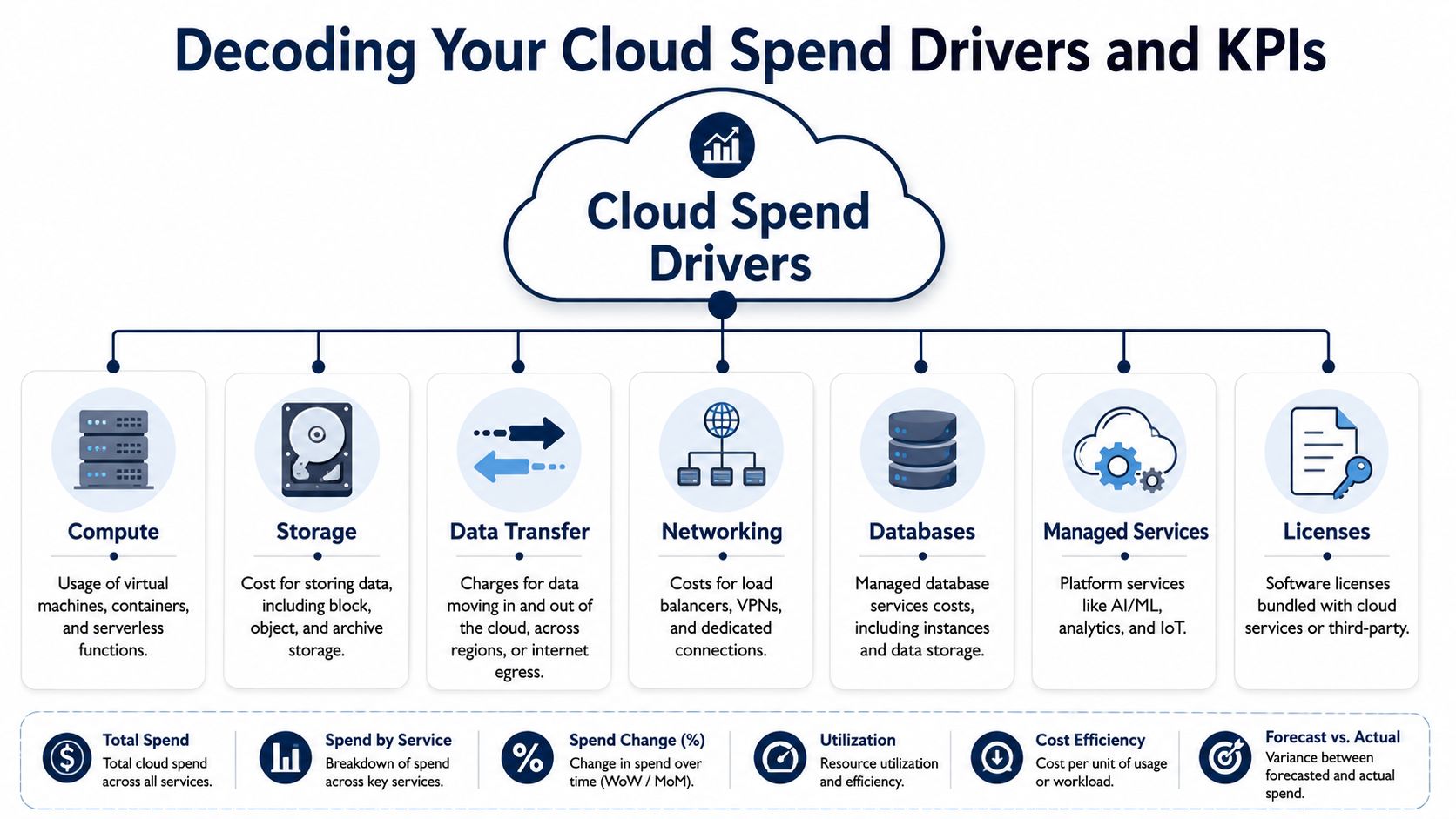
Think of cloud spend as a commercial building.
Compute is the floor space you rent for active work. Virtual machines, containers, and serverless workloads all sit here. If they're oversized or left running when nobody needs them, costs climb fast.
Storage is your warehouse. It feels cheap until old backups, duplicate files, snapshots, and archive data pile up.
Data transfer is shipping. Many businesses ignore it until traffic between regions, zones, offices, and cloud services turns into a meaningful charge.
Networking, databases, managed services, and licences are the specialised systems in the building. They often support the business well, but they're easy to overlook because each line item looks modest in isolation.
A lot of Canadian mid-sized firms still can't tie cloud spend back to business activity. A 2022 survey found that 68% of mid-sized businesses couldn't reliably attribute cloud expenses to specific business units or projects because of inconsistent tagging, and those firms estimated 23 to 30% of their monthly cloud bill came from idle or over-sized resources. That's the core business case for disciplined cloud cost management, not just technical housekeeping.
When tagging is inconsistent, finance sees a bill but not accountability. Operations sees resources but not business context. Leadership sees spend but not return.
A strong analytics and reporting approach closes that gap. Without it, your team is reviewing noise, not information.
Stop managing to total spend alone. Use a tighter scorecard.
| KPI | What it tells you | Why it matters |
|---|---|---|
| Unallocated spend | Spend with no clear owner, project, or department | Exposes governance gaps immediately |
| Cost per user | Cloud cost divided by active users or staff supported | Helps leadership judge operating efficiency |
| Cost per transaction | Cost to process an order, claim, case, or workload event | Connects infrastructure to margin |
| Environment split | Production versus dev, test, and sandbox spend | Flags non-production sprawl |
| Commitment coverage | Which stable workloads should use reserved pricing | Reduces avoidable on-demand spend |
| Variance to forecast | Actual bill versus expected bill | Reveals whether controls are working |
The best KPI is the one a business leader can act on. “Cost per claim,” “cost per shipment,” or “cost per location” beats a generic infrastructure chart every time.
Use plain language. Ask direct questions.
If your provider or internal team can't answer those cleanly, the first job isn't optimization. It's basic cost intelligence.
Cloud cost management fails when it sits with one team.
If finance owns it alone, you get reports without action. If engineering owns it alone, you get technical fixes without budget discipline. The answer is FinOps. In practical terms, that means finance, IT, operations, and business leaders sharing responsibility for cloud decisions.
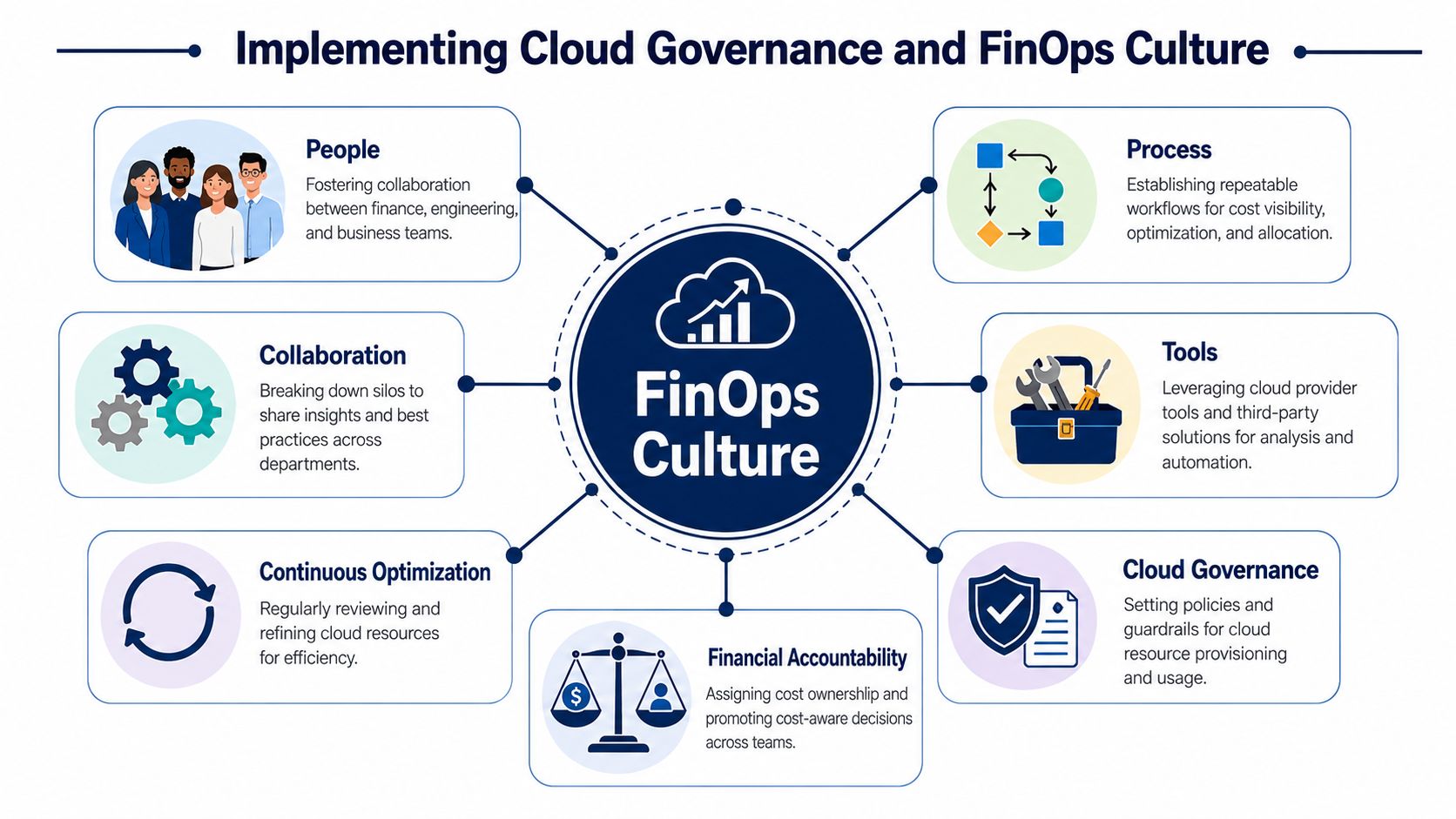
Canadian firms that formalised cloud cost management disciplines such as monthly reviews, tagging standards, and chargeback or showback models achieved an average 27% reduction in unallocated cloud spend within 12 months and improved committed-use pricing take-up by 22 to 29%. Those results make the case for governance better than any slide deck.
A workable FinOps model follows three simple motions.
Build a common view of spend first. Pull billing, tag, account, and workload data into one reporting layer. Finance needs allocation. IT needs utilisation context. Department leaders need to see what they consume.
This phase also forces naming discipline. If one team tags “Prod” and another tags “Production,” your reporting is already compromised.
Once the data is trustworthy, take action. That includes right-sizing compute, deleting waste, shifting steady workloads to commitment-based pricing, and cleaning up storage patterns.
This phase should produce decisions, not just dashboards. Every review should end with assigned actions, owners, and dates.
Embed the discipline into normal management. Monthly reviews, budget thresholds, provisioning rules, and exception approvals all belong here. FinOps isn't a special project. It's recurring operational governance.
A mature cloud practice doesn't rely on heroic clean-ups every quarter. It uses policy, ownership, and routine review to stop waste from accumulating in the first place.
Many mid-sized firms overcomplicate governance documents and underdeliver on actual control. Keep it practical.
Don't frame FinOps as a cost-cutting campaign. Teams resist that because they assume cost control means slower delivery.
Frame it properly. The point is to make trade-offs visible. Some workloads deserve premium spend because they support revenue, compliance, or customer experience. Others don't. Governance helps you tell the difference.
Governance gives you control. Tactics produce the savings.
Here are the moves that change the bill:
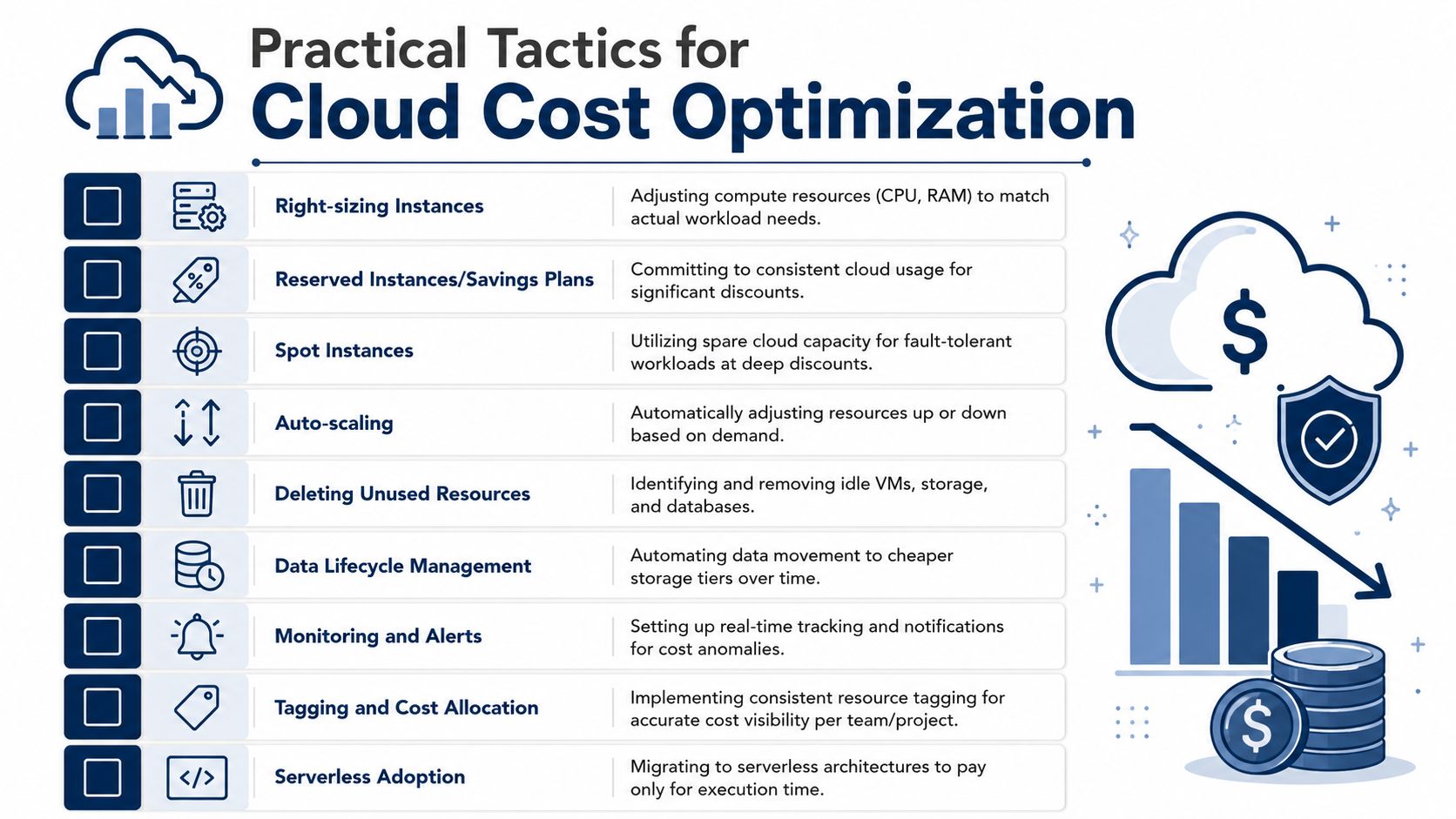
Right-sizing should be first because there's no point locking in discounts on waste.
If a VM runs at low utilisation for long periods, scale it down or move the workload to a better-fit service model. The same logic applies to storage. Old snapshots, over-retained backups, and premium tiers used for cold data are common and expensive habits.
This is also where architecture matters. Some applications belong on virtual machines. Others are better candidates for containers, scheduled jobs, or serverless architecture, especially when demand is uneven.
Canadian enterprises should target 90 to 95% cost allocation coverage through strict tagging, and organisations below 80% coverage typically experience 30 to 50% larger month-over-month variance in cloud spend, according to CloudBolt's guidance on strategic cloud cost metrics. That matters even more in healthcare and finance, where auditability and attribution aren't optional.
Don't rely on reminders. Enforce mandatory tags before resources are provisioned. Required fields should include owner, environment, application, and cost centre. If the tags aren't there, the resource shouldn't launch.
Teams waste money because cloud makes it easy to forget what's running.
Start with a short list:
If a resource exists without an owner, a purpose, and a retirement rule, it's a candidate for waste.
Reserved instances, savings plans, and similar commitment models work well for stable workloads. They work badly when businesses buy them too early, too broadly, or without confidence in baseline demand.
Start with your most predictable production services. Leave volatile workloads on flexible pricing until you understand their patterns. Commitment pricing should follow analysis, not sales pressure.
Good cloud cost management overlaps with broader infrastructure efficiency. If you want a useful external perspective on that broader problem, this piece on optimizing IT costs for modern infrastructure is worth reading because it connects cloud decisions to the wider cost stack.
The practical test is simple. Every optimization tactic should answer one of three questions:
| Tactic | Financial effect | Operational effect |
|---|---|---|
| Right-sizing | Lowers recurring spend | Keeps performance aligned to real demand |
| Tagging enforcement | Improves allocation and forecasting | Creates accountability |
| Auto-shutdown | Removes avoidable non-production waste | Reduces manual clean-up |
| Commitment pricing | Lowers cost on stable usage | Increases planning discipline |
| Lifecycle management | Reduces storage bloat | Prevents silent accumulation |
Most mid-sized businesses stall because they try to fix everything at once. That's unnecessary. A phased roadmap works better because each stage creates the conditions for the next.
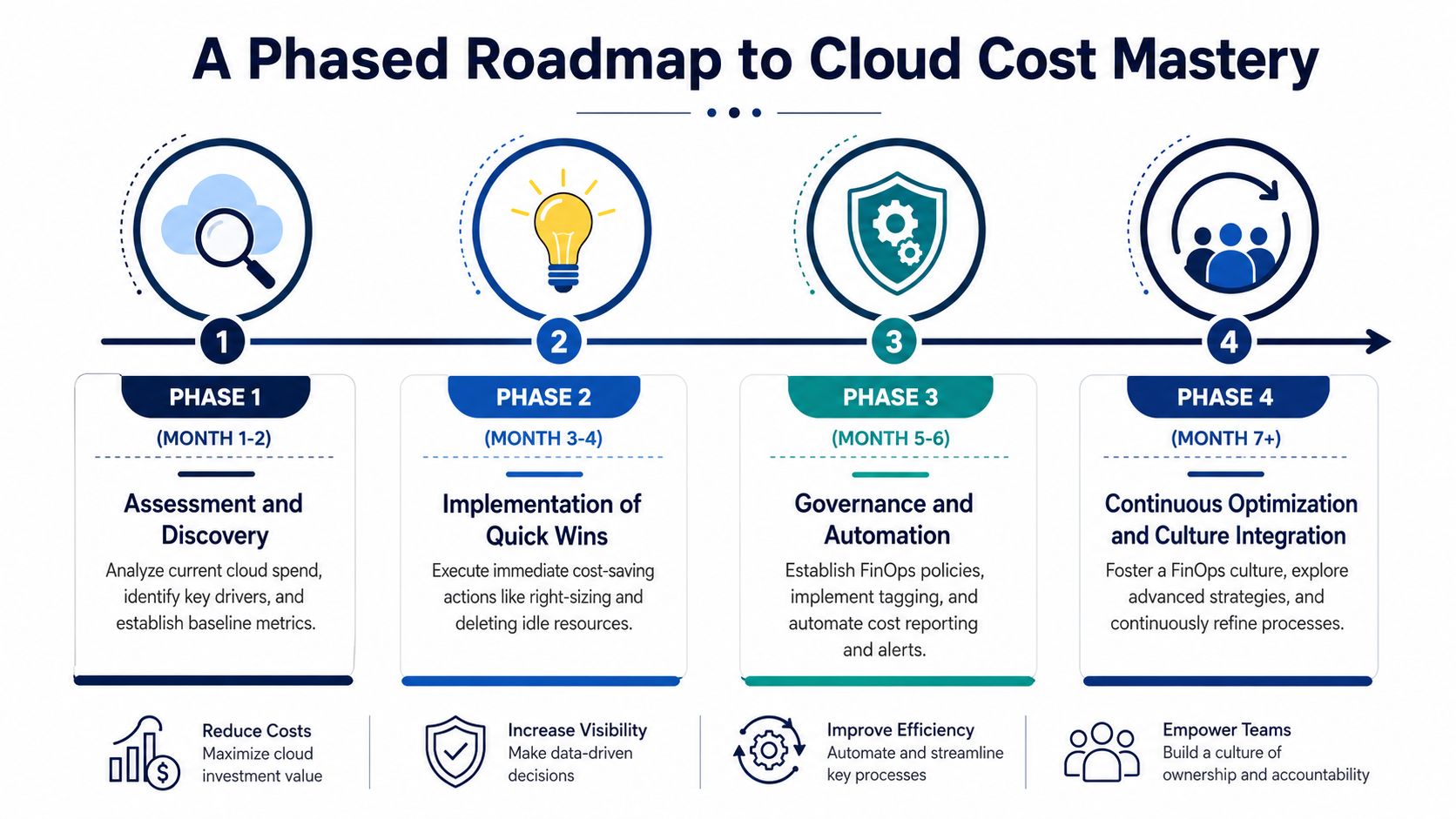
Start by collecting the facts. Pull billing data from every cloud platform and map current spend by service, workload, environment, and owner wherever possible.
You're looking for concentration and ambiguity. Which services drive most of the bill. Which costs have no owner. Which environments are growing without review. This stage also establishes your baseline KPIs so later decisions can be measured against something real.
This is the origin of momentum.
Clean up obvious waste, remove idle assets, shut down unnecessary non-production resources, and create a minimum tagging standard. You don't need perfect maturity to make immediate improvements. You need discipline and follow-through.
A simple operating checklist helps:
Once visibility and hygiene are in place, move into the deeper work. Review architecture. Identify stable workloads that justify commitment pricing. Evaluate whether data storage classes, database models, and inter-region traffic patterns still make sense.
This stage is also where finance should be fully involved. Contracting, forecasting, and budget planning all improve when engineering decisions are translated into operating impact.
Mature cloud management isn't one brilliant negotiation with a hyperscaler. It's dozens of smaller decisions made correctly and repeatedly.
The final stage is operational maturity. Embed cost controls into provisioning workflows and CI/CD processes. Use policy to prevent untagged resources, enforce environment standards, and trigger alerts when usage shifts unexpectedly.
At this point, cloud cost management stops being reactive. Teams provision within rules, finance gets cleaner forecasts, and leadership spends less time being surprised by invoices.
Generic cloud advice misses Canadian reality.
In Canada, cloud decisions often carry compliance, location, and accounting implications that change the economics. If you're in healthcare, legal, finance, or any business handling sensitive data, the cheapest region on paper may not be a viable option at all.
Many guides ignore the cost impact of Canadian data residency and privacy rules such as PIPEDA and provincial health data requirements. Storing sensitive data within Canada can restrict the use of lower-cost global regions and increase data transfer costs. That creates a regulatory premium that needs to be built into strategy and budgeting.
This affects more than hosting location. It also affects backup design, disaster recovery planning, cross-region replication, and multi-cloud architecture. A workload that looks efficient in a global pricing model may become more expensive once Canadian residency rules and traffic patterns are applied.
For organisations comparing providers, this overview of cloud computing providers in Canada is a useful starting point because provider choice in Canada is often tied to compliance posture, not just raw price.
Technical optimisation isn't the whole story. Canadian businesses should also ask how cloud decisions interact with accounting treatment and tax incentives such as SR&ED.
A more expensive architecture may still produce a better effective outcome if it supports eligible development work, compliance requirements, or capital planning in a way your finance team can justify. That's why cloud cost management should include finance leadership early, not after technical decisions are already locked in.
Use a short decision lens:
If you need a broader benchmark for how local providers package support around these realities, this guide to Canadian managed IT services for small businesses gives a useful market view.
Don't copy a U.S. or global playbook and assume it fits.
Canadian businesses often need a hybrid answer that balances residency, security, supportability, and cost. The cheapest design is not always the smartest design. The best design is the one that remains compliant, supportable, and financially defensible over time.
Some businesses should run cloud cost management in-house. Many shouldn't.
If your environment is simple, your internal team is disciplined, and finance and operations already work closely with IT, you may be able to manage this internally. But once your cloud estate spans multiple platforms, regulated data, after-hours operations, and recurring invoice surprises, the workload gets heavier than most mid-sized teams can absorb.
You should consider a partner if any of these are true:
At that stage, cloud cost management isn't a side task. It's a specialised operational function.
A good managed provider doesn't just send reports. They create management discipline.
That includes continuous monitoring, cost attribution, anomaly review, tagging enforcement, rightsizing recommendations, commitment planning, and governance routines that your internal team can stick to. They should also understand the realities of managed cloud computing services, including how cost control interacts with performance, security, and resilience.
The right partner gives you leverage. Your team stays focused on the business while someone else does the hard, recurring work of cloud hygiene, governance, and optimisation.
If your internal team spends too much time deciphering bills, chasing owners, and reacting to overruns, that's already a cost. It just doesn't show up cleanly on one invoice.
A partner makes sense when the value of better forecasting, stronger controls, lower waste, and less internal distraction outweighs the cost of outside support. For many mid-sized Canadian firms, that point arrives sooner than they expect.
If your cloud bill feels harder to explain every month, it's time to bring structure to it. CloudOrbis Inc. helps Canadian businesses build practical cloud governance, improve cost visibility, and keep cloud spend aligned with compliance, performance, and growth.
September 21, 2026
Secure File Sharing Guide for Canadian BusinessesLearn secure file sharing essentials for Canadian SMBs — encryption, compliance, protocols and best practices to protect data and stay compliant.
Read Full Post
September 20, 2026
Disaster Recovery Plan Business Continuity for SMBsBuild a disaster recovery plan business continuity strategy tailored for Canadian SMBs. Covers risk assessment, RTO/RPO, backup, testing, and ownership.
Read Full Post
September 19, 2026
Database Migration Services Explained for Canadian SMBsLearn how database migration services move data to the cloud securely with minimal downtime. Types, risks, costs and a Canadian provider checklist.
Read Full Post
