

September 20, 2026
Disaster Recovery Plan Business Continuity for SMBsBuild a disaster recovery plan business continuity strategy tailored for Canadian SMBs. Covers risk assessment, RTO/RPO, backup, testing, and ownership.
Read Full Post%20(1).webp)
Usman Malik
Chief Executive Officer
August 6, 2026

MSPS in Canadian IT usually means Managed Service Providers, a third-party company that remotely manages your IT infrastructure and end-user systems under a service-level agreement. If you've been wondering why the same acronym seems to mean different things in different places, that confusion is exactly why this guide matters.
What do you want when you search for msps full form, a telecom definition, a healthcare staffing term, or a real IT partner for your business? The answer depends on context, and for most Canadian business owners the useful meaning is the IT one, because it affects support, security, uptime, and compliance.
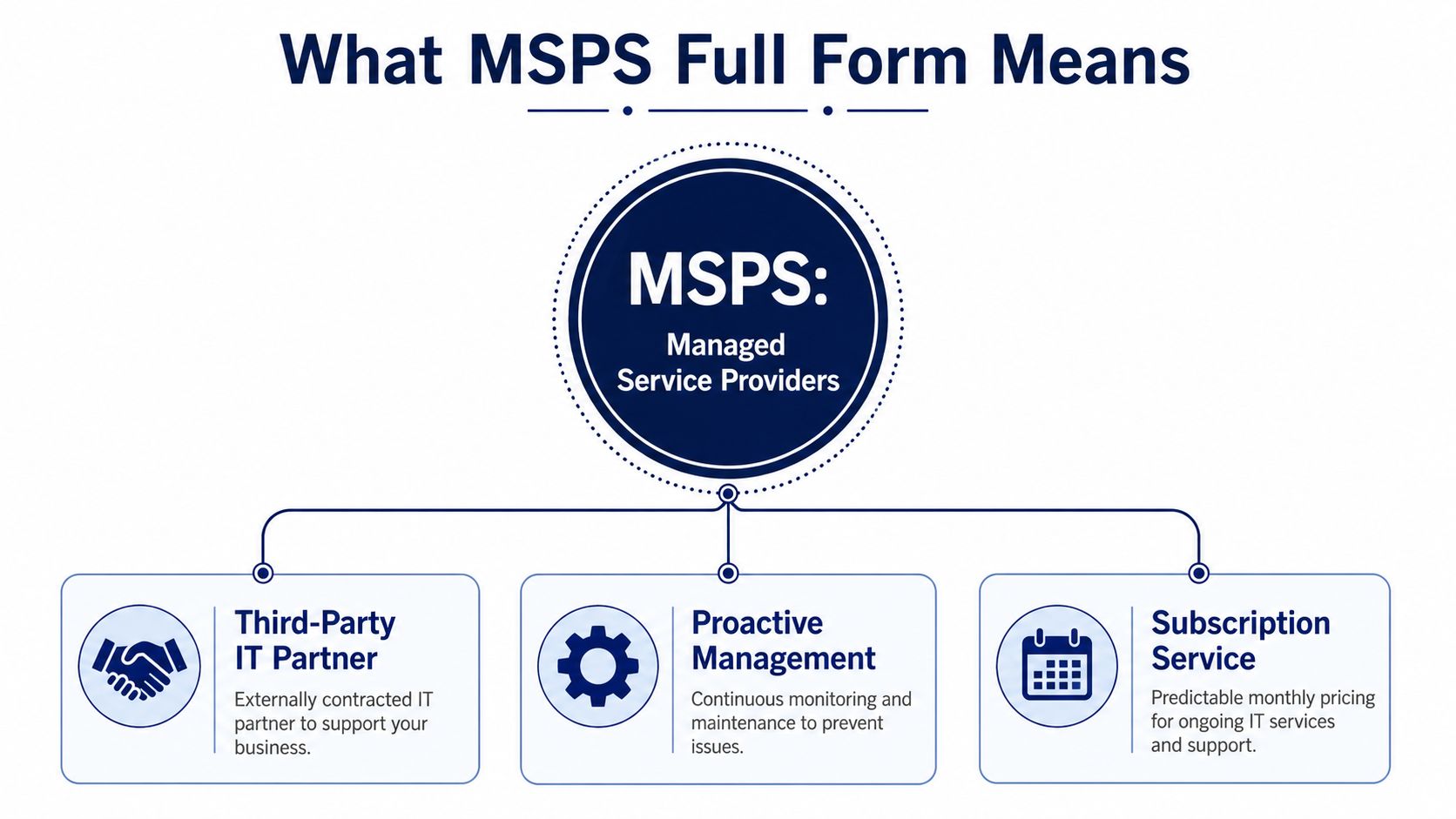
In Canadian business and IT settings, MSPS most commonly points to Managed Service Providers, often shortened to MSP in industry use. The practical meaning is simple, a third-party provider takes ongoing responsibility for your IT environment, rather than showing up only when something breaks. That model is built around a contract and a service level agreement (SLA), not a one-off fix.
That distinction matters because the MSP relationship is meant to be proactive. Sources such as TechTarget's MSP definition and SAP's overview of the model describe ongoing monitoring, maintenance, and administration as the core of the arrangement, which is why MSPs are usually tied to recurring service plans rather than break-fix work. For Canadian SMBs, that structure is attractive because it supports predictable IT spending and continuous support without forcing a business to build a full internal team.
Practical rule: If a provider only appears after an outage, you're dealing with support. If they monitor, maintain, and manage your environment under contract, you're looking at an MSP relationship.
The phrase also matters for companies like CloudOrbis Inc., because its service model lines up with the MSP framework, proactive support, cloud management, cybersecurity, and compliance-oriented IT operations for growing businesses. That's why the acronym is more than a glossary answer. It points to a delivery model that shapes how Canadian firms run network management, application support, infrastructure maintenance, and baseline security.
The acronym isn't owned by one industry, and that's where search confusion starts. In IT, MSPS usually means managed service providers. In telecom and RF engineering, it can mean Mega-Samples Per Second, a sampling-rate metric used to describe how quickly an analog signal is converted to digital data, as explained in Analog Devices' MSPS glossary entry.
| Full Form | Industry | Recognition Signal |
|---|---|---|
| Managed Service Providers | IT and business services | Remote management of IT systems, SLAs, helpdesk, cybersecurity |
| Mega-Samples Per Second | Telecom and RF engineering | ADCs, digitizers, bandwidth, sampling rates |
| Michigan or Minnesota Society of Professional Surveyors | Professional associations | Surveying, regional membership, licensure context |
| Workforce or staffing MSP use | Healthcare and contingent labour contexts | Vendor management, staffing programmes, workforce coordination |
Acronym ambiguity is especially common in Canada because readers often search with a business intent but may land on unrelated professional or technical meanings. AcronymFinder's MSPS listing shows how regional associations and other sector-specific uses sit alongside the IT definition, which is why context is the first thing to check. If the page is about IT support, cloud, or cybersecurity, you're almost certainly in MSP territory.
The healthcare staffing use adds another layer of confusion. In some organisations, MSP refers to workforce management or contingent labour programmes, so the same letters can signal a staffing process instead of an IT provider. That's why a Canadian reader should ask one quick question before going deeper, is this page about systems, signals, or staffing?
A good way to understand an MSP is to consider it a utility-style relationship for your IT environment. You're not buying a single repair visit, you're paying for someone to keep systems running, watch for problems, and respond before users feel the impact. SAP describes the MSP model as a contract-based arrangement with defined service levels, and ACU-Acuative frames it as ongoing monitoring and maintenance rather than reactive support, which is the operational difference.
An MSP usually covers the day-to-day jobs that internal teams rarely have time to own fully. That can include 24/7 helpdesk support, network and infrastructure monitoring, patch and update management, endpoint protection, cloud and Microsoft 365 administration, data backup, disaster recovery, and strategic vCIO guidance. A useful external reference is Premier Broadband's managed network services guide, which helps readers see how managed services map to real network operations.
The point of managed services isn't just faster ticket handling. It's keeping problems small enough that staff barely notice them.
For a Canadian SMB, that usually translates into fewer interruptions, more predictable costs, and access to senior expertise without hiring multiple specialists. A law firm may need secure collaboration and document access. A manufacturer may care more about uptime, device management, and plant connectivity. The MSP model can support both, but the service mix should match the business.
You can also compare it with the kind of managed IT coverage CloudOrbis describes in its own managed IT service overview. The shared pattern is clear, MSPs work best when they are responsible for prevention, not just recovery. That proactive posture is what separates a service partner from an emergency contractor.
The right MSP model depends on how much IT capacity you already have in-house. Fully managed means the provider takes on the entire IT operation. Co-managed means your internal team keeps ownership of core responsibilities while the MSP fills gaps, extends coverage, or handles specialised work.
If you have no internal IT staff, fully managed support is the cleaner fit. The MSP becomes the operational backbone, handling monitoring, support, maintenance, and escalation. That structure suits smaller firms that want one accountable partner and don't want to coordinate between multiple vendors and contractors.
If you already have a capable IT person or team, co-managed support can be a better fit. The MSP can provide after-hours coverage, advanced security, cloud expertise, project support, or overflow help when internal staff are overloaded. CloudOrbis' co-managed IT services in Edmonton is a useful example of how that type of partnership can be framed for growing organisations.
A simple way to decide is to look at four things.
A 15-person clinic often has no spare IT capacity, so fully managed support fits the operating reality. A 40-person Toronto law firm with one internal administrator may prefer co-managed support so the internal person keeps control while the MSP handles monitoring, patching, and escalation. That's not about size alone, it's about how much risk you can absorb internally.
An MSP handles broad IT operations. An MSSP, or managed security service provider, is built around security operations, threat detection, and incident response. CrowdStrike's MSP versus MSSP explanation makes the core split clear, general IT management on one side, dedicated security focus on the other.
The family doctor can handle many everyday issues. The cardiologist is the specialist you call when the risk is sharper and the expertise has to be deeper. That analogy fits the MSP versus MSSP choice well. An MSP can include baseline security, but an MSSP is designed to watch for threats, investigate alerts, and respond to incidents as a core function.
For many Canadian SMBs, the trigger isn't abstract. It's repeated phishing exposure, customer data risk, cyber insurance questions, audit pressure, or the fact that nobody in the company is dedicated to security full time. CloudOrbis' MSSP security services overview is relevant here because it reflects the kind of security depth that sits beyond basic IT upkeep.
If your business is asking who watches the logs, who investigates the alerts, and who owns the response plan, you're already in MSSP territory.
The practical decision is often this, do you need managed IT with baseline security, or do you need a security-first layer on top of it? If your MSP can handle patching, endpoint protection, and backup, that may be enough for now. If your risk profile keeps rising, an MSSP relationship, or an MSP that partners tightly with security specialists, becomes the more defensible choice.
Compliance changes what an MSP has to deliver, not just how it talks about service. In Canada, privacy and data-handling duties affect healthcare, legal, finance, and any business that stores sensitive operational records. A capable MSP should not only advise on controls, it should help implement them in daily operations.
Healthcare clinics need documented access controls, encryption, secure backups, and clear breach workflows, especially when patient data moves across systems or borders. For that reason, CloudOrbis' healthcare IT compliance article is relevant for readers in clinical settings. Legal and accounting firms need strong identity management, audit logs, and disciplined retention practices because client confidentiality depends on traceable access.
Financial services usually need a tighter standard around monitoring, policy enforcement, and incident response. Manufacturing and construction firms may not be driven by patient or client privacy in the same way, but they still handle operational data, supplier information, and business-critical systems that need formal risk assessment. PIPEDA, Quebec's Law 25, and HIPAA-style expectations for cross-border healthcare data all push the same message, controls have to be documented and maintained.
A workable MSP should be able to show how it supports:
The right question for a buying team is not, “Do you understand compliance?” It's, “Will you own the operational controls that prove compliance is being maintained?” That's the standard that separates a vendor from a real managed-services partner.
Start with the service scope. If a provider can't explain its monitoring, support, cloud, backup, and security stack in plain language, that's a warning sign. You also want a clear SLA, transparent escalation paths, and support coverage that matches your business hours, especially if your team works across time zones or needs after-hours help.
Look for these indicators when you compare providers.
CloudOrbis is relevant for Canadian SMBs because it offers a 24/7, 100% Canada-based helpdesk, sector coverage across healthcare, manufacturing, legal, finance, and construction, and a 10-step engagement model that covers assessment, strategy, implementation, training, and ongoing optimisation. Its mix of cloud, cybersecurity, and vCIO services fits the evaluation criteria above, and its managed services questionnaire can help frame the right discovery questions.
Avoid vague contracts, offshore helpdesks with no clear escalation path, and one-size-fits-all promises. Good MSPs reduce confusion before the sale, not after it.
For Canadian business readers, MSPS usually means Managed Service Providers, a contract-based model for ongoing IT support, monitoring, and maintenance. The decision is whether you need fully managed or co-managed support, whether security has reached MSSP territory, and whether your provider can meet the compliance demands of your sector without hand-waving.
If you want fewer outages, clearer accountability, and a managed-services relationship that supports growth instead of just closing tickets, the next step is to assess your current environment. The right MSP should make your IT more predictable, more secure, and easier to scale.
CloudOrbis Inc. helps Canadian SMBs with managed IT services, cybersecurity, cloud support, backup, and vCIO guidance under a proactive service model. If you're reviewing your current MSP fit or deciding whether you need co-managed support, visit CloudOrbis Inc. to explore an approach for your business.
September 20, 2026
Disaster Recovery Plan Business Continuity for SMBsBuild a disaster recovery plan business continuity strategy tailored for Canadian SMBs. Covers risk assessment, RTO/RPO, backup, testing, and ownership.
Read Full Post
September 19, 2026
Database Migration Services Explained for Canadian SMBsLearn how database migration services move data to the cloud securely with minimal downtime. Types, risks, costs and a Canadian provider checklist.
Read Full Post
September 18, 2026
Business VoIP Telephone Systems Explained for SMBsLearn how business VoIP telephone systems work, what they cost and how to choose a secure, resilient option for your Canadian SMB.
Read Full Post
