SaaS License Management: A Guide for Canadian Businesses
A practical guide to SaaS license management for Canadian businesses. Learn to control costs, reduce security risks, and optimize software spend. Start today.

A practical guide to SaaS license management for Canadian businesses. Learn to control costs, reduce security risks, and optimize software spend. Start today.

Your finance lead sees one invoice. Your department heads see their own tools. Your IT team sees only the applications they approve. That's how a medium-sized company ends up paying for overlapping SaaS products, carrying licences for former staff, and getting blindsided by renewals no one planned for.
Most leaders don't notice the problem until software spend starts feeling unpredictable. By then, the issue isn't just cost. It's access control, privacy exposure, procurement drift, and wasted admin time. Good SaaS license management fixes all of that by turning a messy stack of subscriptions into something the business can effectively govern.
A growing business rarely creates SaaS sprawl on purpose. It happens because each team solves a real problem. Sales adds a proposal tool. HR buys an onboarding platform. Operations signs up for workflow software. Marketing starts using another collaboration app because it's faster than waiting for approval. Each decision makes sense in isolation. Together, they create a stack no one fully owns.

That's why SaaS license management isn't an IT housekeeping task. It's a business control. It answers basic leadership questions. What are we paying for? Who has access? Which contracts renew when? Which applications hold sensitive data? Which tools can we remove without interrupting operations?
The obvious waste is paying for software no one uses. The less obvious cost is fragmentation.
A scattered SaaS environment creates problems like these:
SaaS sprawl doesn't start as overspending. It starts as decentralised decision-making.
This isn't a niche operational concern. It's part of a broader software governance shift. MarketsandMarkets projects the SaaS management market to grow from USD 4.58 billion in 2025 to USD 9.37 billion by 2030, with a 15.4% CAGR, and says North America holds 32.3% of the market in 2025. For Canadian organisations, that matters because most buy into the same North American vendors, billing models, and renewal patterns.
The practical implication is simple. As your SaaS stack grows, informal oversight stops working. A spreadsheet may be enough when you have a handful of subscriptions. It breaks down once licences, contract dates, user entitlements, and security obligations spread across the company. That's where broader IT asset management practices start to matter.
Strong SaaS license management gives leadership three things:
| Business need | What management provides |
|---|---|
| Cost control | Visibility into spend, usage, and overlap |
| Risk reduction | Fast revocation, better access hygiene, cleaner audits |
| Operational efficiency | Fewer manual checks, fewer renewal surprises, clearer ownership |
If you're running a Canadian business with regulated data, remote staff, or multiple locations, this discipline stops being optional early. The larger your stack becomes, the more expensive unmanaged convenience gets.
Most companies don't need a perfect system on day one. They need a repeatable one. The cleanest way to think about SaaS license management is as a lifecycle that starts before purchase and doesn't end until access is fully removed.

Start by building a single list of every SaaS application the business uses. Include owner, department, contract term, renewal date, licence type, user assignments, and the data each app touches. Finance records, procurement files, SSO logs, and expense claims all help fill gaps.
This step sounds basic, but it's where most organisations realise they don't have one source of truth.
A useful inventory should answer:
Once the inventory exists, assess value instead of just counting seats. Some apps are critical but underused because staff need training. Others are over-licensed because everyone got the highest tier by default. Some can be replaced because another approved platform already covers the same need.
That evaluation should tie back to business outcomes, not just software activity. If a tool supports a revenue process, legal workflow, or patient communication path, the right question isn't whether it's popular. It's whether it's necessary and correctly sized.
Practical rule: Don't optimise blind. Review user role, business dependency, and actual usage before removing or downgrading anything.
Renewals are where unmanaged SaaS turns into avoidable cost. If no one reviews usage, contract language, and alternatives before the vendor's deadline, the company usually overpays or stays locked into poor-fit terms.
Good renewal management means:
This is also where better IT vendor management discipline pays off. Vendor decisions shouldn't sit in inboxes and calendar reminders. They need process.
Every company needs clear rules for how SaaS enters the business. Without them, shadow purchasing and inconsistent approvals become normal.
A workable policy should define:
Policy doesn't need to be bureaucratic. It needs to prevent ad hoc buying and unclear ownership.
The last stage is the one companies skip most often. Offboarding must trigger licence reclamation, access removal, and record updates across all relevant apps. If that process depends on someone remembering each application manually, accounts will be missed.
Then review the whole framework on a regular basis. New tools enter. Teams change. Vendors alter packaging. Governance has to adapt with the business or it becomes shelfware itself.
Most CEOs care about SaaS license management for one reason first. Spend. That's fair. The quickest way to get executive support is to show that software cost control doesn't require cutting useful tools. It requires managing entitlements with evidence.
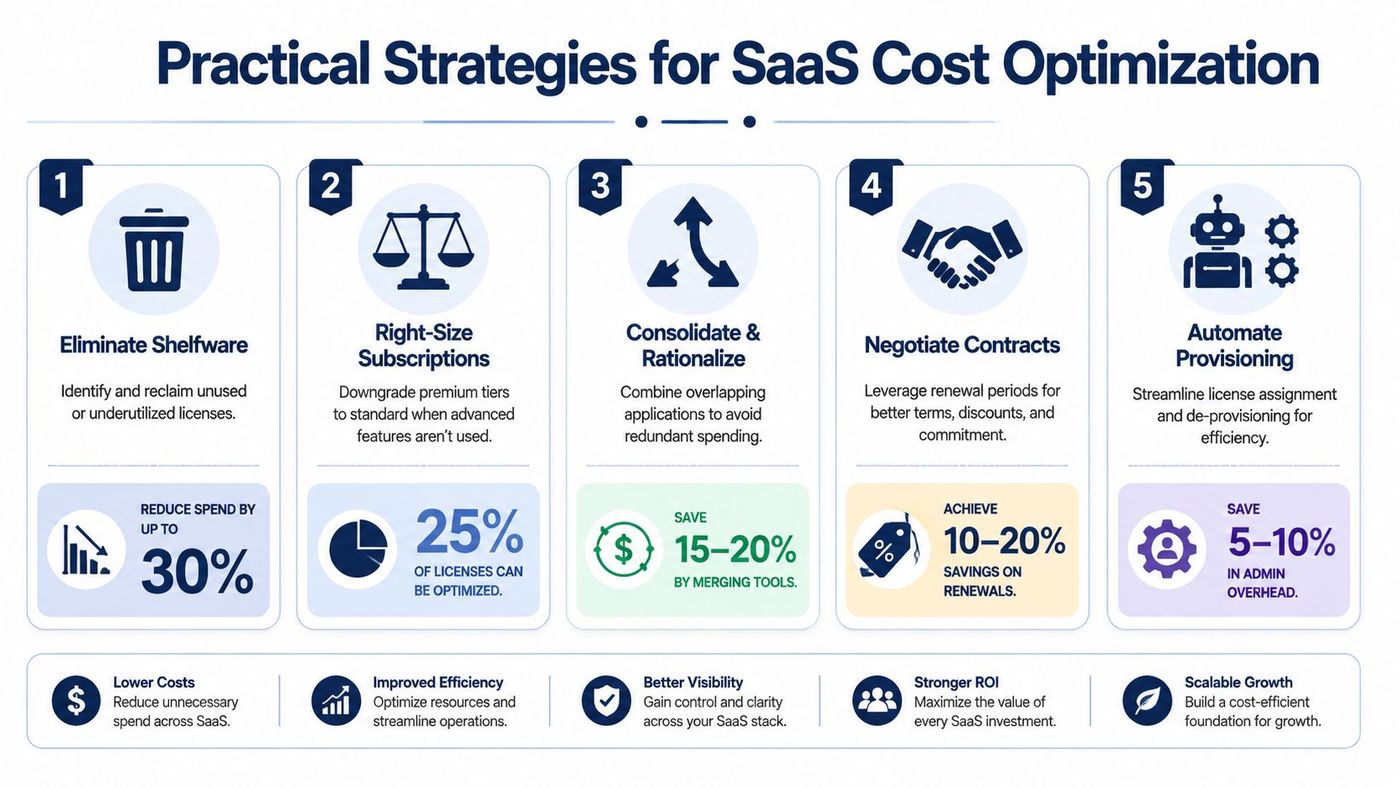
The scale of waste is large enough to justify a formal process. Zylo's 2026 index reports that only 54% of SaaS licences are used in the average enterprise, creating about $19.8 million in wasted annual spend, and notes that proactive organisations review usage 90–120 days before renewal. Even if your organisation is much smaller, the pattern still matters. Waste usually hides in inactive seats, over-tiered users, overlapping tools, and late renewals.
The fastest savings usually come from reclaiming and rightsizing. Not from renegotiating every vendor at once.
Here are the most practical cost controls:
A common mistake is treating any login as proof of value. It isn't. Someone can sign in once a week and still not justify an advanced licence. Better decisions come from feature-level telemetry. That means understanding whether users rely on premium workflows, storage-heavy functions, API usage, or advanced reporting, not just whether they opened the app.
This is especially relevant for large platforms with layered plans. If you're reviewing Microsoft environments, this Microsoft 365 licensing playbook is a useful example of how to think through entitlement matching rather than defaulting everyone into the same package. It pairs well with a disciplined review of your own Microsoft enterprise licensing approach.
The best optimisation decisions are the ones users barely notice because you matched the licence to actual work.
Cost programmes fail when they become blunt cuts.
A poor approach looks like this:
| Weak approach | Better approach |
|---|---|
| Cancel quickly based on low login counts | Review role, feature use, and business dependency |
| Push everyone to the cheapest tier | Match licence level to work performed |
| Negotiate after renewal notice arrives | Start early and use current usage evidence |
| Let each department manage its own contracts | Centralise visibility, then involve departments in decisions |
The point isn't to reduce software at all costs. It's to stop paying premium rates for low-value allocation and duplicate capability.
SaaS licence waste gets attention because it shows up on invoices. Security gaps are worse because they stay invisible until something goes wrong. An unmanaged application stack almost always includes accounts that should have been removed, apps that were never properly reviewed, and unclear ownership for data held outside core systems.
For Canadian businesses, that creates more than operational friction. It creates compliance exposure.
Every SaaS account is an access path. If a former employee keeps access to a file-sharing platform, CRM, e-signature tool, or project workspace, that's not just an admin oversight. It's a potential data exposure. The same applies when contractors, temporary staff, or role-changed employees retain permissions they no longer need.
Strong SaaS license management reduces that risk by tying each entitlement to a named user, an owner, and a business purpose. It also makes offboarding enforceable instead of aspirational.
The basics matter most:
For organisations in healthcare, finance, legal, and other regulated sectors, licence governance supports privacy obligations as much as cost management. Vertice notes that for Canadian businesses, especially in healthcare and finance, SaaS license management is a key control for privacy and data residency expectations under frameworks like PIPEDA, and that a centralised inventory with automated offboarding helps reduce audit risk and prevent orphaned accounts.
That matters because licence decisions affect where data goes, who can access it, and how quickly access can be revoked. In a Canadian context, those aren't side issues. They're operational requirements.
If your leadership team is reviewing broader data security management practices, SaaS governance belongs in the same conversation. Software purchasing, identity control, privacy handling, and offboarding all connect.
An app with no owner is a security problem, even if the invoice is small.
Executives don't need to manage every SaaS setting themselves. They do need a clear operating model. A defensible programme usually includes contract records, user-to-licence mapping, approved procurement paths, and documented removal procedures.
If your team is building internal controls, outside references on vendor-side data protection measures can help frame the kinds of safeguards worth asking about during software review. The key is to connect those controls back to your own inventory and user lifecycle, not treat security questionnaires as a standalone exercise.
When licence management is mature, compliance gets easier because evidence is easier to produce. You know what you own, who uses it, and how access changes are handled. That's the difference between hoping your environment is under control and being able to prove it.
Every company starts somewhere. The mistake is assuming the same method still works after the SaaS environment becomes more complex. Tool choice should reflect scale, risk, and internal capacity.
Spreadsheets are common for a reason. They're easy to start, familiar, and cheap. For a very small environment, they can be enough.
But they fail in predictable ways. They depend on manual updates. They don't discover unapproved apps. They don't show real usage. They don't automate offboarding. And they rarely survive staff turnover with clean data.
Manual tracking works when the software estate is simple and changes rarely. Most medium-sized businesses aren't in that position for long.
A SaaS management platform gives you stronger discovery, usage insight, contract visibility, and workflow support, enabling teams to establish a practical control loop. Find the apps. Understand usage. Reclaim waste. Review renewals. Report on risk.
The most useful capability here isn't just inventory. It's depth of usage data. BetterCloud's guidance highlights feature-level telemetry, not just login counts, as the strongest control for rightsizing, and points to automated reclamation rules after 30, 60, or 90 days of inactivity as a core function of advanced tools.
That distinction matters. If a tool only tells you that a user logged in, you still don't know whether they need the premium tier. If it shows feature adoption, API usage, storage consumption, or AI-related activity, you can make cleaner licence decisions.
Some organisations have the tools but not the time. Others have the data but no one driving the process. That's where a managed model becomes attractive.
A managed service is usually the best fit when:
A good partner should help with process, not just tooling. That includes inventory design, policy support, renewal discipline, access governance, and reporting that leadership can use. If your organisation is already evaluating broader managed IT services in Canada, SaaS governance should sit inside that conversation rather than beside it.
Use this lens when comparing options:
| Selection factor | Manual tracking | Dedicated platform | Managed service |
|---|---|---|---|
| Discovery capability | Low | Stronger | Strongest when paired with process |
| Usage analytics | Limited | Strong | Strong with interpretation |
| Automation | Minimal | Moderate to strong | Strong, depending on scope |
| Internal effort required | High | Medium | Lower |
| Suitability for regulated firms | Weak | Better | Best when governance is included |
The right answer isn't always the most advanced tool. It's the model your team will maintain.
Most companies delay SaaS license management because it looks larger than it is. It becomes manageable once you break it into phases. The first goal isn't perfection. It's control.

Start with inventory. Pull software records from finance, procurement, IT, and department leads. Identify contract owners, renewal dates, and where sensitive data may sit. Don't wait for a perfect data set before beginning. A workable list beats an incomplete assumption that everything is already known.
Then name the stakeholders. SaaS license management usually touches finance, IT, operations, HR, and department managers. Without clear ownership, the programme becomes another shared responsibility that no one drives.
Once you can see the stack, clean up the obvious waste. Remove unused accounts for former staff. Review dormant subscriptions. Check for duplicate applications across departments. Look for users sitting on premium plans without a business reason.
This phase matters because early wins create confidence. Leadership support grows when the business sees practical improvements, not just another governance initiative.
Start where the evidence is clear. Inactive licences, duplicate apps, and unmanaged renewals are usually the fastest wins.
After the first round of clean-up, put rules around how software enters and exits the business. Define approval paths, privacy review expectations, renewal ownership, and offboarding requirements. Keep the policy short enough that managers will follow it.
At this stage, governance should connect to existing business processes. Procurement, onboarding, offboarding, and role changes all need SaaS touchpoints. If those workflows stay disconnected, drift returns quickly.
Once policy exists, bring in the right level of tooling. That may mean better licence reporting, SSO integration, automated reclamation rules, or a managed service to run the operational cadence. The point isn't automation for its own sake. The point is reducing manual effort on repeatable tasks while improving consistency.
A practical reporting rhythm should show leadership:
SaaS governance is never done because the business keeps changing. New hires arrive. Teams adopt new tools. Vendors change packaging. Contract terms shift. What worked last year may be overbuilt now.
Keep the programme alive with a regular review cycle. That review should include finance, IT, and business owners. Done well, SaaS license management becomes part of normal operating discipline rather than a clean-up project that has to be restarted every year.
The payoff is straightforward. You spend less on waste, reduce access risk, and gain control over a part of the business that often grows faster than anyone realises.
If your organisation needs a practical way to get control of software spend, user access, renewals, and compliance, CloudOrbis Inc. can help you build and manage a SaaS license management programme that fits your environment. From assessment and policy design to ongoing optimisation and support, their team helps Canadian businesses turn SaaS sprawl into a governed, efficient, and secure operating model.
Book a 30-minute call with a senior engineer. No sales script, just straight answers about your environment.


