Top 7 Cloud Computing Providers in Canada for Medium-Sized Businesses
Discover the top 7 cloud computing providers Canada has to offer. Compare AWS, Azure, GCP, and local experts to find the right fit for your business.

Discover the top 7 cloud computing providers Canada has to offer. Compare AWS, Azure, GCP, and local experts to find the right fit for your business.
Choosing the right cloud partner is one of the most critical infrastructure decisions a Canadian business will make this decade. It’s not just about storage or servers anymore; it’s about securing a foundation for growth, security, and operational resilience. However, the market for cloud computing providers in Canada is crowded and complex. From global giants with data centres on Canadian soil to sovereign cloud specialists and hands-on managed partners, the options can feel overwhelming.
This guide is for business and IT leaders in medium-sized organizations who need clarity. We will provide a practical, in-depth roundup to help you cut through the marketing noise, understand the key trade-offs, and make a decision that aligns with your specific operational, compliance, and budgetary needs. You will gain a clear understanding of the distinct advantages offered by public cloud hyperscalers, Canadian-focused hosting partners, and managed service providers like CloudOrbis.
Inside, you will find detailed profiles for each provider, complete with direct links and insights into their ideal use cases. We will explore the major players, demystify Canadian data residency requirements like PIPEDA and PHIPA, and offer a straightforward framework for selecting the provider that will truly empower your business. We skip the generic advice to give you actionable information, helping you compare how each platform solves core business problems, from securing sensitive data for healthcare clinics and law firms to providing scalable infrastructure for manufacturing and logistics companies. This article provides the information needed to move from evaluation to confident decision-making.
For medium-sized organizations in Canada seeking a partner to manage their entire IT environment, CloudOrbis Inc. presents a compelling, hands-on alternative to the do-it-yourself model of public cloud. Positioned as a managed IT and cloud services provider rather than a direct infrastructure vendor, CloudOrbis focuses on packaging enterprise-grade security, support, and strategy into a predictable, monthly service. This approach is particularly well-suited for organizations in regulated sectors like healthcare, finance, legal, and manufacturing that require robust compliance, security, and uptime but lack the in-house resources to manage it all.
Unlike hyperscale cloud computing providers in Canada, who provide the raw tools, CloudOrbis delivers a fully managed outcome. This distinction is critical for business leaders who want the benefits of the cloud (scalability, security, remote access) without the complexity of architecting, migrating, and securing the environment themselves. With a local presence in Oakville, Calgary, and Edmonton, they offer a blend of national reach and local accountability.
CloudOrbis organizes its offerings around a few core pillars designed for business growth and operational stability. Its strength lies in integrating these services into a single, cohesive strategy.
CloudOrbis is an excellent fit for Canadian medium-sized businesses that view technology as a strategic asset but prefer to outsource its day-to-day management. Their industry-specific knowledge makes them a strong contender for:
The primary drawback is the lack of public pricing; costs are provided via a custom quote following a consultation. While this allows for tailored solutions, it makes direct, initial cost comparison difficult. Additionally, large multinational enterprises may find their Canada-centric focus and support model less suitable for global operations.
Website: https://cloudorbis.com
Amazon Web Services (AWS) is a dominant force among cloud computing providers in Canada, offering an exceptionally deep portfolio of services from its in-country data centres. With two distinct Canadian regions, Canada (Central) in Montréal and the newer Canada (West) in Calgary, AWS provides a robust foundation for businesses that require their data to remain within national borders for compliance with regulations like PIPEDA.
Each region is built with multiple Availability Zones (AZs), which are isolated data centres within a geographic area. This design is a core part of the platform's value, allowing businesses to build highly available and fault-tolerant applications that can withstand single data centre failures. For a company in the manufacturing or logistics sector, this means you can run critical production systems across two AZs in the Calgary region, ensuring operational continuity even if one location experiences an issue.
What sets AWS apart is the sheer breadth and maturity of its service catalogue. Beyond foundational services like EC2 (virtual servers) and S3 (object storage), AWS offers specialized tools for nearly any business need.
The platform's extensive partner network in Canada means finding local experts for support, migration, and management is straightforward. For instance, businesses planning a move to the cloud can find a partner to guide them through a detailed assessment, a key step in any successful cloud migration in Alberta.
AWS operates on a pay-as-you-go pricing model, which offers flexibility but also requires careful management to prevent unexpected costs. The complexity of its pricing, with variables for data transfer, API requests, and storage tiers, can be a significant hurdle for medium-sized organizations. Using tools like AWS Cost Explorer and setting up budgets is essential.
Key Insight: While the base services are priced competitively, be mindful of additional costs. AWS Support plans, which provide technical assistance, are sold separately and are a necessary consideration for any business running production workloads.
Pros:
Cons:
Website: https://aws.amazon.com
Microsoft Azure is a major player among cloud computing providers in Canada, especially for organizations already invested in the Microsoft ecosystem. With data centre regions in Canada Central (Toronto) and Canada East (Quebec City), Azure delivers on the critical requirement for in-country data residency, helping businesses meet their compliance obligations under PIPEDA and other Canadian regulations.
A key differentiator for Azure is its in-country region pairing. The Toronto and Quebec City regions are linked, allowing businesses to replicate data and services between them for disaster recovery. This setup ensures that even in the event of a major regional outage, your data and applications remain protected and accessible, all within Canadian borders. For a law firm handling sensitive client information, this provides an extra layer of business continuity without compromising data sovereignty.
Azure’s strength lies in its deep, native integration with widely used Microsoft products like Microsoft 365, Dynamics 365, and Active Directory. This creates a familiar and cohesive environment for IT teams accustomed to managing Microsoft software, simplifying administration and identity management.
The platform's extensive compliance documentation and clear guidance on Canadian data residency make it a strong choice for regulated sectors. Businesses planning their journey to the cloud can find detailed resources, including guides for a successful Azure migration in Calgary.
Azure uses a flexible, pay-as-you-go pricing model similar to other major providers. While this avoids large upfront capital expenditures, it necessitates diligent cost management to prevent budget surprises. Tools like Azure Cost Management and Billing are essential for monitoring spending and optimizing workloads. It is also important to verify service availability and feature parity, as newer services may not be available in all regions simultaneously.
Key Insight: The true value of Azure often shines for businesses standardizing on the Microsoft stack. The integrated identity, security, and management tools can significantly reduce administrative overhead and complexity.
Pros:
Cons:
Website: https://azure.microsoft.com
Google Cloud Platform (GCP) stands as a strong competitor among cloud computing providers in Canada, known for its powerful data analytics, machine learning capabilities, and modern application development tools. With two in-country regions, Montréal (northamerica-northeast1) and Toronto (northamerica-northeast2), GCP enables businesses to meet data residency requirements under regulations like PIPEDA while building performant, low-latency services for Canadian users.
This dual-region strategy allows for robust disaster recovery and high-availability architectures entirely within Canada. A financial services firm in Ontario could, for example, run its primary operations in the Toronto region and have a live backup in Montréal, ensuring business continuity without data ever leaving the country. GCP also provides helpful tools like its Region Picker, which allows organizations to weigh factors like price, latency, and even carbon footprint when deciding where to deploy resources.
GCP's key differentiator is its strength in data, AI, and containerization. While it offers a full suite of core services like Compute Engine (virtual machines) and Cloud Storage, its specialized tools are where many businesses find unique value.
GCP maintains a transparent product-by-region matrix, making it easy for businesses to confirm that the specific services they need are available in one or both Canadian regions. This clarity is a major benefit when planning a deployment that must adhere to strict compliance rules.
Google Cloud employs a pay-as-you-go model similar to its competitors, with discounts for sustained and committed use. Its pricing is often seen as competitive, especially for its data and networking services. The platform provides detailed pricing calculators to help businesses estimate their monthly spend accurately.
Key Insight: While GCP is expanding its Canadian footprint, always verify that niche or newer services are available in the Montréal or Toronto regions before committing to an architecture. The rollout of services can be staggered across different geographic locations.
For businesses looking to implement these advanced tools, working with a partner that understands the Canadian cloud market can simplify the process. A managed services provider can offer tailored cloud solutions in Calgary and other major hubs, ensuring your GCP environment is optimized for cost, performance, and security.
Pros:
Cons:
Website: https://cloud.google.com
OVHcloud, a global player with European roots, has established a significant footprint among cloud computing providers in Canada. It carves out a niche by focusing on price predictability, data sovereignty, and sustainability. With a major data centre campus on the South Shore of Montréal and a newer facility in the Toronto area, OVHcloud provides Canadian businesses with multiple in-country options to keep their data securely within national borders.
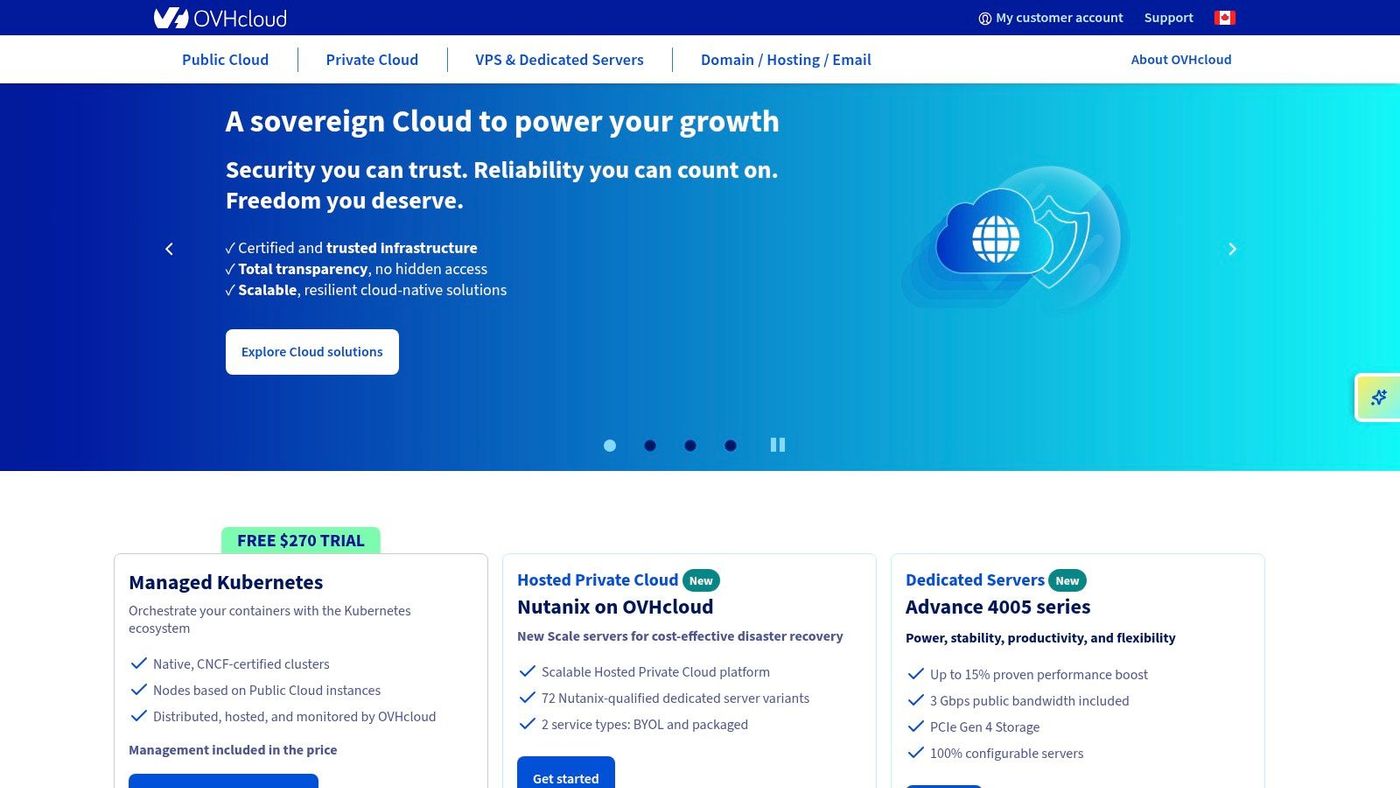
This multi-site presence is a key advantage for companies designing disaster recovery and business continuity plans. A legal firm in Toronto, for example, could run its primary operations from the local data centre while replicating critical case files and client data to the Montréal facility. This setup provides geographic redundancy, a core requirement for maintaining operational resilience against regional disruptions like power outages or network failures.
OVHcloud differentiates itself with a straightforward and cost-effective approach to cloud infrastructure, making it an attractive option for businesses sensitive to budget fluctuations. Its catalogue is focused on core infrastructure services that provide a solid foundation for many common business workloads.
For companies whose primary need is reliable server capacity, OVHcloud's offerings present a strong value proposition. A business looking to migrate from on-premises servers can find a direct and affordable path by exploring its IaaS solutions. For more information, you can learn about how infrastructure as a service is ideal for businesses needing a server.
One of OVHcloud’s most compelling features is its transparent and predictable pricing model. Unlike the complex, variable costs of hyperscalers, OVHcloud often provides clear, flat-rate monthly pricing for its virtual private servers (VPS) and dedicated servers, with generous or unmetered bandwidth allowances. This makes it easier for medium-sized businesses to forecast their IT spending without fearing surprise data transfer fees.
Key Insight: OVHcloud’s model is built for cost predictability. The price you see on their Canadian website (in CAD) is often the price you pay, which simplifies budgeting for infrastructure-heavy workloads.
Pros:
Cons:
Website: https://www.ovhcloud.com/en-ca/
ThinkOn distinguishes itself among cloud computing providers in Canada by being a Canadian-owned and operated provider with an unwavering focus on data sovereignty. Its services are designed from the ground up to keep operations, staff, data, and support entirely within Canadian borders, making it a compelling choice for organizations in highly regulated sectors like the public sector, healthcare, finance, and legal.
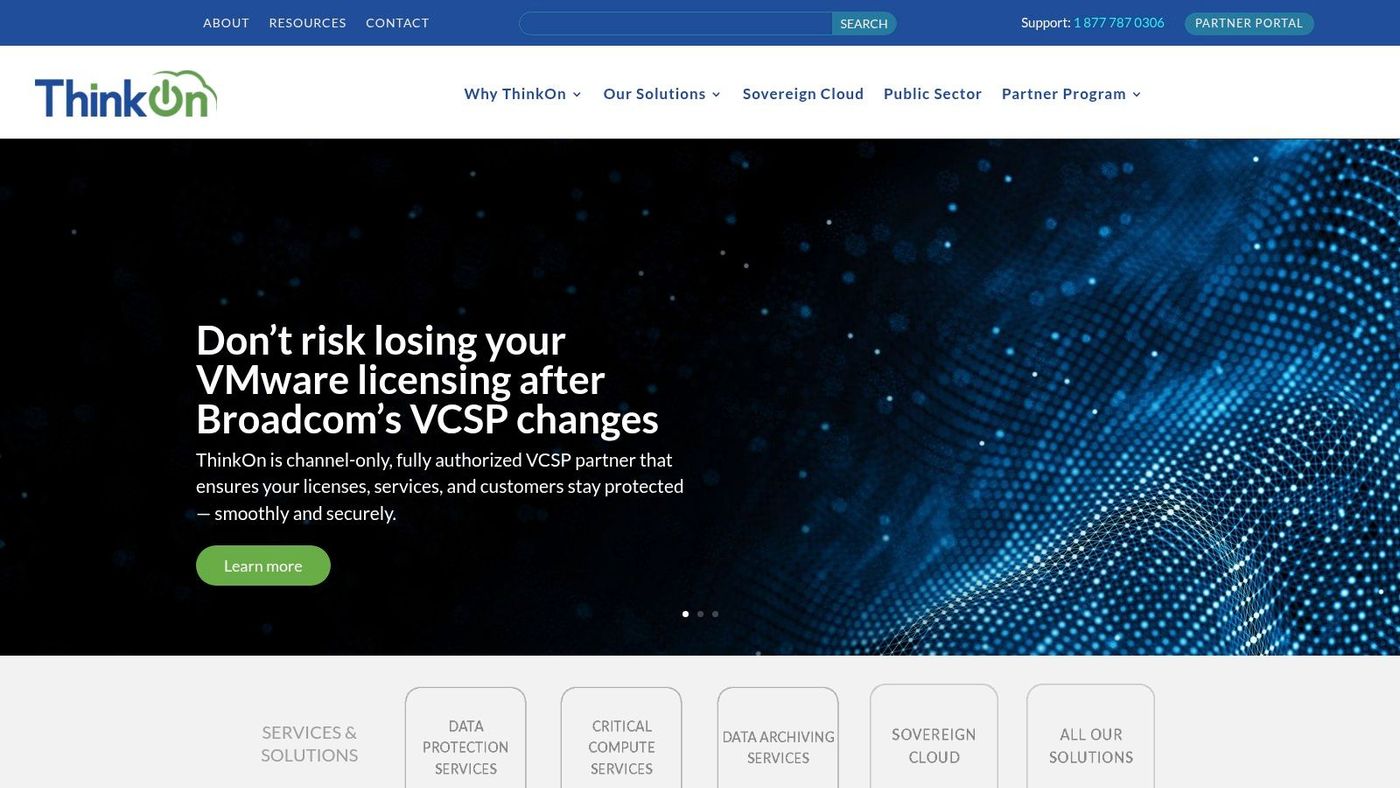
As an approved cloud service provider under Shared Services Canada's framework, ThinkOn is vetted for secure government workloads. This "sovereign-by-design" approach means no foreign contractors are involved in the operational chain, providing a level of assurance that is critical for entities handling sensitive citizen or patient data. For a healthcare organization, this ensures that patient records stored in the cloud are managed exclusively by cleared Canadian personnel, directly supporting PHIPA compliance.
ThinkOn’s strength lies in its specialized, secure infrastructure services built primarily on VMware technology. This focus makes it an ideal partner for businesses already familiar with the VMware ecosystem or those requiring robust, enterprise-grade virtualization.
By concentrating on these core areas, ThinkOn provides a controlled, high-security environment. This specialization contrasts with the broad, self-serve catalogues of hyperscalers, offering a more guided and partnership-oriented experience for customers with specific compliance mandates.
ThinkOn’s pricing model is generally quote-based rather than a public, pay-as-you-go menu. This approach reflects its focus on creating tailored solutions for specific business requirements, especially for complex private or hybrid cloud deployments. While this provides cost predictability, it requires an upfront engagement to get a clear price.
The service catalogue is narrower than that of AWS or Azure, with fewer publicly available Platform-as-a-Service (PaaS) or serverless computing options. This makes it a better fit for organizations looking for Infrastructure-as-a-Service (IaaS) and data protection, rather than those wanting a vast toolkit for cloud-native application development.
Key Insight: ThinkOn is the provider of choice when absolute data residency and operational control within Canada are non-negotiable. Its value proposition is built on trust and compliance, not on having the largest list of services.
Pros:
Cons:
Website: https://thinkon.com
Sherweb’s Performance Cloud offers a distinct approach among cloud computing providers in Canada, specifically targeting medium-sized businesses and Managed Service Providers (MSPs) seeking predictability and simplicity. Based in Québec with Canadian data centres in Montréal, Sherweb provides a VMware-powered Infrastructure as a Service (IaaS) solution built for organizations that prioritize straightforward budgeting and operational control over an expansive, complex service catalogue.
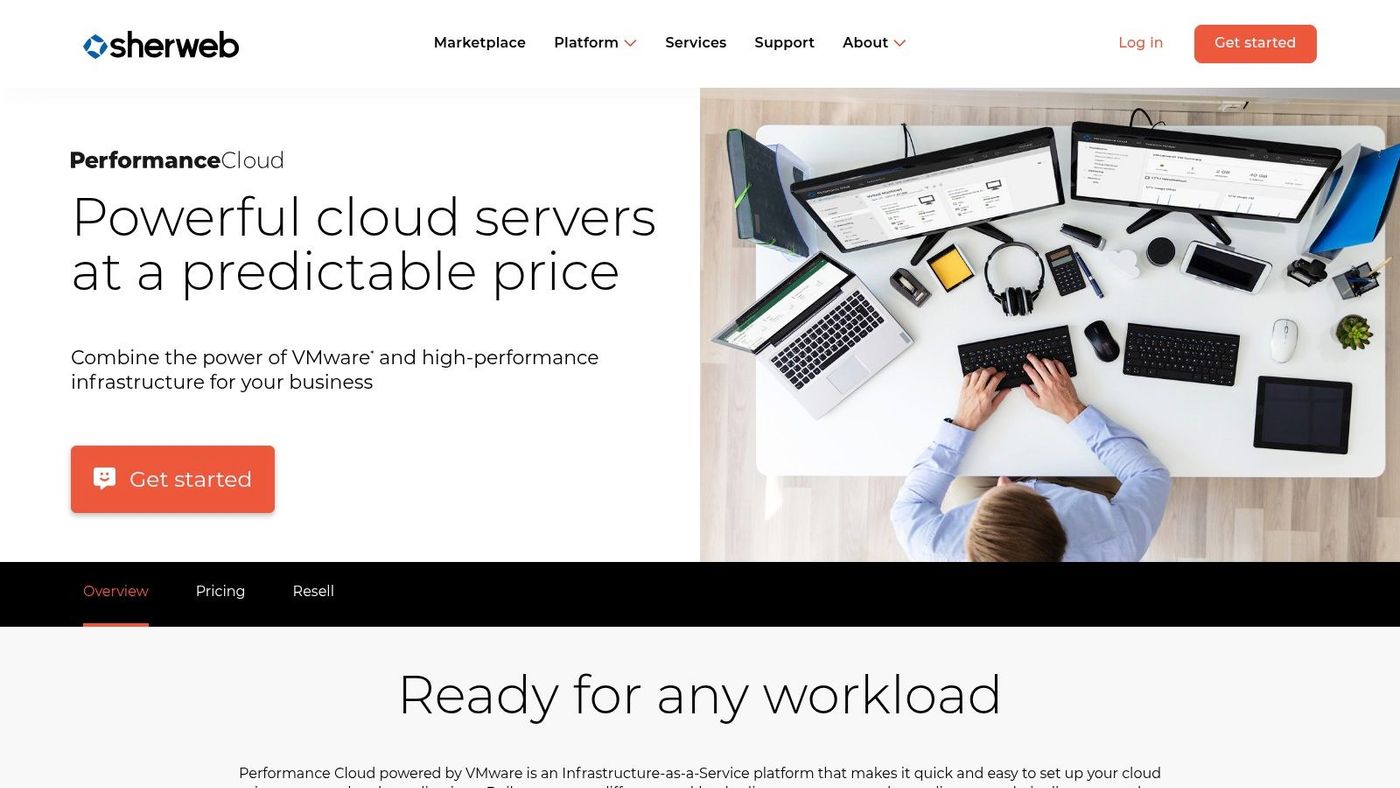
This model is particularly effective for companies moving away from on-premises servers. Because the platform uses the familiar VMware stack, migrating existing virtual machines (a "lift-and-shift" operation) is often less complex than re-architecting applications for a hyperscale cloud. For a legal or accounting firm in Ontario, this means a faster, lower-risk transition to a secure cloud environment that keeps all data within Canadian borders, satisfying PIPEDA requirements.
Sherweb’s value proposition is its clarity and focus. Instead of a pay-as-you-go model for every single resource, it offers pre-defined resource pools that bundle CPU, RAM, SSD storage, and backup into a fixed monthly cost. This financial predictability is a significant advantage for businesses without dedicated cost management teams.
The platform is also designed for partners, making it an excellent fit for organizations that prefer a co-managed IT model. For businesses exploring how to best manage their cloud infrastructure, partnering with a provider that understands platforms like Sherweb can be a strategic advantage. You can discover more about the benefits of a managed cloud computing approach and how it simplifies operations.
Sherweb’s greatest strength is its transparent, published pricing in CAD, which removes the guesswork often associated with cloud billing. Add-ons like extra storage or public IP addresses are also clearly priced. This structure allows a construction company, for example, to budget its yearly IT infrastructure costs with high accuracy.
Key Insight: The fixed-resource-pool model provides cost predictability but can be less granular than pure usage-based pricing. If your workloads are highly variable, you might pay for underutilized resources during quiet periods.
Pros:
Cons:
Website: https://www.sherweb.com/infrastructure/performance-cloud/
| Provider | Implementation complexity | Resource requirements | Expected outcomes | Ideal use cases | Key advantages |
|---|---|---|---|---|---|
| CloudOrbis Inc. | Low–Medium, managed onboarding (10‑step) reduces lift | Minimal internal IT; relies on MSP support | Faster issue resolution, reduced downtime, improved security posture | Canadian medium-sized businesses, regulated industries (healthcare, finance, legal) | 24/7 Canada helpdesk, proactive monitoring, industry expertise |
| Amazon Web Services (AWS) | High, broad catalog and architecture choices | Significant cloud ops, governance and cost controls | Highly scalable, resilient, flexible infrastructure with in‑country regions | Medium to Enterprise needing scale, diverse services and Canadian residency | Extensive service ecosystem, multi‑AZ regions, mature security tooling |
| Microsoft Azure | Medium–High, many services but streamlined for MS stack | Microsoft identity/365 expertise; governance tools | Tight integration with Microsoft products, paired region resilience | Organizations standardized on Microsoft 365/Dynamics and needing residency | Native MS integrations, ExpressRoute, strong compliance guidance |
| Google Cloud Platform (GCP) | Medium–High, strong focus on analytics/AI patterns | Data/ML engineering skills for BigQuery/Vertex workloads | High performance for analytics/AI, managed Kubernetes options | Data/AI workloads, analytics-driven apps, containerized platforms | Best‑in‑class analytics/AI tooling, transparent pricing/region tools |
| OVHcloud Canada | Low–Medium, straightforward IaaS/VPS offerings | Moderate; standard sysadmin skills for IaaS/VPS | Predictable, cost‑optimized infrastructure with CAD pricing | Cost‑sensitive IaaS/VPS workloads and dedicated server use cases | Competitive, transparent CAD pricing and sustainability focus |
| ThinkOn | Low–Medium, sovereign‑first with managed VMware options | Compliance-driven ops; fewer global dependencies | Canadian‑sovereign control, compliance alignment for sensitive data | Regulated public sector, healthcare, finance, legal requiring sovereignty | Sovereign‑by‑design operations, Shared Services Canada approval |
| Sherweb – Performance Cloud | Low, VMware lift‑and‑shift with published bundles | VMware vSphere skills; predictable resource pools | Predictable costs, easy scaling and Microsoft alignment for medium businesses/MSPs | Medium businesses & MSPs needing budgetable hosting & co‑managed infrastructure | Flat‑rate CAD pricing, VMware compatibility, 24/7 support |
Selecting a cloud provider is a significant milestone, but it is only the first step on a much longer journey. This article has laid out the key players, from global hyperscalers like AWS, Azure, and Google Cloud, to Canadian champions like OVHcloud, ThinkOn, and Sherweb. Each offers a distinct set of tools and advantages. Yet, the true measure of success isn't the logo on your invoice; it's how effectively you integrate that technology into your business operations to achieve tangible outcomes.
The path from simply choosing a provider to executing a robust, secure, and cost-effective cloud strategy is filled with complexities. It requires deep technical expertise, continuous vigilance against security threats, and a constant eye on performance and cost optimization. For many medium-sized businesses, particularly in regulated sectors like healthcare, finance, or manufacturing, managing this in-house is a formidable challenge that can divert focus from core business activities.
As you move forward, the central decision shifts from what cloud to use, to how you will manage it.
Making the right choice requires a clear, methodical process. Do not let the sheer number of cloud computing providers in Canada lead to decision paralysis. Instead, focus on these concrete actions:
Final Thought: Your cloud infrastructure should be an asset that accelerates your business, not a complex puzzle that consumes your resources. The right partnership transforms cloud computing from a mere technological utility into a strategic driver of growth, security, and innovation for your Canadian business.
Ready to build a cloud strategy that delivers real business value? As a 100% Canadian managed cloud service provider, CloudOrbis Inc. specializes in designing, migrating, and optimizing secure cloud environments on platforms like Microsoft Azure for businesses across Canada. Move beyond simply choosing a provider and start your journey with a dedicated partner by visiting CloudOrbis Inc. to schedule your free assessment.
Book a 30-minute call with a senior engineer. No sales script, just straight answers about your environment.


