A Guide to Cloud Solutions in Calgary for Secure, Scalable IT
Explore cloud solutions calgary trusted by SMEs for secure, scalable IaaS, PaaS, SaaS, and hybrid models.

Explore cloud solutions calgary trusted by SMEs for secure, scalable IaaS, PaaS, SaaS, and hybrid models.
For business leaders exploring cloud solutions in Calgary, there has never been a better time to make a move. Our city is quickly becoming a major Canadian hub for cloud innovation, thanks to massive infrastructure investments that are giving local companies a serious competitive edge.
This is not just a technical upgrade, it is a strategic necessity for any business serious about scaling up and staying secure.
Calgary is no longer just Canada's energy capital; it is rapidly transforming into a powerhouse for the country's digital future. This shift is not a happy accident. It is the direct result of strategic investments and a forward-thinking approach to technology that’s a game-changer for medium-sized organizations right here in our city.
For local business and IT leaders, this boom means world-class technology is no longer a distant concept, it is right in our backyard, more powerful and accessible than ever. It has created a robust digital ecosystem where businesses can tap into local infrastructure instead of relying on faraway data centres. The result? Faster performance, tighter data security, and easier compliance with Canadian privacy laws.
A huge catalyst for this growth was the launch of the AWS Canada West (Calgary) Region in late 2023. This was a massive deal, marking the second major AWS infrastructure zone in the country and instantly supercharging our local capabilities.
For businesses in key sectors like energy, logistics, and finance, this local presence brings several immediate wins:
This huge investment from AWS aligns perfectly with Alberta's impressive growth in cloud computing, which is projected to grow at a compound annual rate (CAGR) of 19.18%, well ahead of the national average. Provincial policies are smartly leveraging the region's energy resources to power the data centres needed for AI and other heavy-duty computing tasks.
This local infrastructure empowers Calgary businesses to operate with the same technological firepower as major global corporations. It levels the playing field, allowing you to innovate faster, scale more efficiently, and secure your operations without the crippling upfront cost of building your own data centre.
Ultimately, the rise of cloud solutions in Calgary is about more than just technology; it is about economic opportunity. Partnering with a local expert who truly understands this evolving environment is critical. By choosing the right team for your Calgary IT services, you can ensure your business is perfectly positioned to capitalize on this growth, turning advanced cloud capabilities into real-world success.
Diving into the world of cloud solutions can feel like learning a new language, especially with all the acronyms. For Calgary businesses looking to make a smart move, the first step is getting to know the three core service models: IaaS, PaaS, and SaaS.
These are not competing options; they are different levels of service. Think of it like making a pizza. You could build your own brick oven, source every ingredient, and create it from scratch. Or, you could buy a take-and-bake pizza, all assembled, you just handle the cooking. The third option? Just order a hot pizza delivered right to your door.
Each method gets you a pizza, but the effort, control, and expertise needed are completely different. Cloud services work the same way, offering specific levels of management and flexibility.
Infrastructure as a Service (IaaS) is like leasing the land and foundation to build your own custom house. Your cloud provider gives you the essential building blocks, servers, storage, and networking, but you are in charge of everything on top. That includes the operating system, middleware, and all your applications and data.
This model gives you the most control and customization. It’s perfect for a Calgary tech company with a seasoned IT team that needs to build and manage a highly specialized application. They get the raw power of enterprise-grade hardware without the huge upfront cost of buying and maintaining it themselves.
This infographic shows just where Calgary fits into the bigger Canadian cloud picture, highlighting our city's important role in the ecosystem.
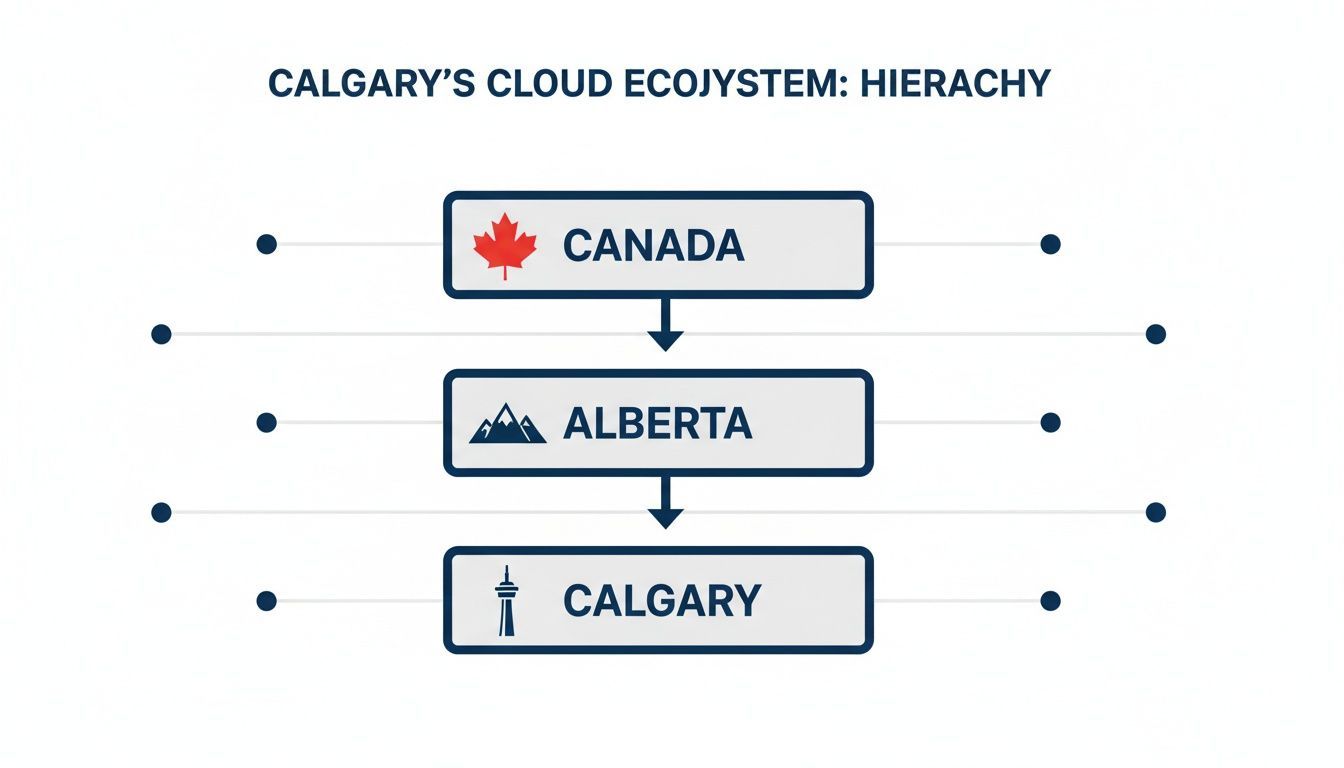
This visual drives home that when you choose cloud solutions in Calgary, you are not just getting a service; you are connecting to a powerful, local network backed by national and provincial strength.
Platform as a Service (PaaS) is like renting a fully equipped workshop. The provider handles the building, the power tools, and the workbenches, that is the servers, operating systems, and development tools. This frees up your team to focus on their real craft: building and deploying your applications.
PaaS is a massive shortcut for development teams. Imagine a local software firm creating a new logistics app for Calgary’s energy sector. Instead of burning weeks setting up servers and databases, they can jump right into a PaaS environment and start coding on day one, dramatically cutting their time to market.
For a deeper dive into the technical nuts and bolts of cloud infrastructure, this guide on What Is Cloud Hosting is a great resource.
Software as a Service (SaaS) is the most familiar cloud model to most of us, it is the delivered pizza. You subscribe to a finished software application that the provider fully manages. All you have to do is access it over the internet, usually right from your web browser.
You are likely already using SaaS tools every day, like Microsoft 365, Salesforce, or Dropbox. You never have to think about updates, maintenance, or the hardware it runs on. You just log in and get to work. A growing accounting firm here in Calgary would use a SaaS bookkeeping platform to manage client finances without ever installing or patching software on its own computers.
To help you see the differences at a glance, here’s a simple breakdown of who manages what in each model.
| Feature | IaaS (Infrastructure) | PaaS (Platform) | SaaS (Software) |
|---|---|---|---|
| You Manage | Applications, Data, Runtime, Middleware, Operating System | Applications, Data | Nothing, just user access |
| Provider Manages | Virtualization, Servers, Storage, Networking | Everything in IaaS + Runtime, Middleware, Operating System | The entire stack, from hardware to the application itself |
| Best For | Total infrastructure control, custom environments, DevOps | Rapid application development and deployment | Out-of-the-box software, business productivity, email, CRM |
| Calgary Example | A tech startup building a custom AI platform from the ground up. | A software company developing a new app for the oil and gas industry. | A marketing agency using a project management tool like Asana. |
Ultimately, choosing the right model comes down to how much you want to manage yourself versus how much you want the provider to handle for you.
The Key Takeaway: The "as a Service" model you choose directly impacts your team's responsibilities. Moving from IaaS to PaaS to SaaS means offloading more management tasks to your provider, freeing your team to focus on strategic business goals rather than IT maintenance.
After getting a handle on the "as-a-service" models, the next step is building a cloud strategy that actually works for your business. A common mistake we see is businesses trying to shoehorn all their needs into a single cloud solution. For many Calgary companies, especially those in regulated industries, that one-size-fits-all approach just does not cut it.
This is where you can think beyond the basics. Instead of picking one lane, you can build a custom environment that mixes different cloud models to hit your specific operational, security, and financial targets. The two main ways to do this are with a hybrid cloud or a multi-cloud setup.
A hybrid cloud strategy is exactly what it sounds like: a mix of a private cloud, your own servers on-site, and a public cloud service like AWS or Microsoft Azure. Think of it like owning your home but renting a storage unit for things you do not need every day. You keep your most valuable and sensitive items (like critical data) at home for maximum security and control, while using the convenient, scalable storage unit (the public cloud) for everything else.
This model is a game-changer for Calgary businesses in sectors like finance, law, and healthcare. You can keep confidential client files or patient data securely on your private servers, making it easier to meet strict compliance standards like PIPEDA and SOC 2.
At the same time, you can tap into the public cloud for less sensitive workloads, such as:
This approach gives you the perfect balance of security, control, and flexibility. It lets you modernize your operations without ever having to compromise on how you govern your data.
While a hybrid cloud blends public and private worlds, a multi-cloud strategy means using services from more than one public cloud provider. Imagine you are building an investment portfolio. You would not put all your money into a single stock, right? You diversify to minimize risk and chase the best returns.
A multi-cloud strategy applies the same logic to your digital infrastructure. By working with multiple providers, say, using AWS for its powerful data analytics and Google Cloud for its machine learning tools, you can cherry-pick the absolute best service for each specific job. This approach is quickly gaining ground as companies realize they do not want to be locked into a single vendor's ecosystem.
By diversifying your cloud providers, you not only gain access to best-in-class tools but also build resilience. If one provider has an outage, your entire business does not grind to a halt because critical operations can failover to another platform.
Cloud adoption among Calgary's medium-sized businesses is skyrocketing, right in line with national trends. Projections show that 90% of Canadian SMEs will use at least one cloud service by the end of 2025, a big jump from 71% in 2024. Hybrid models are proving especially popular, with growth pegged at a 19.94% CAGR. Meanwhile, multi-cloud strategies are expected in 70% of firms by 2025 as a way to avoid vendor lock-in and improve redundancy. Discover more about these SME growth trends and what they mean for businesses like yours.
Choosing between hybrid, multi-cloud, or even a mix of both is a major decision. It really comes down to your business goals, compliance needs, and technical capabilities. For many Calgary companies, crafting the right strategy is the key to unlocking the full potential of their cloud solutions, building an IT environment that is not just powerful, but also resilient, secure, and perfectly aligned with their vision for growth.
Let's cut through the technical jargon. When we talk about cloud solutions in Calgary, what we are really discussing are tangible, bottom-line results for your business. For local medium-sized companies, a smart cloud strategy is about much more than just modernizing your IT, it is about fuelling growth, tightening security, and building a more agile, resilient operation.
The advantages really click when you see how Calgary businesses are already putting the cloud to work.
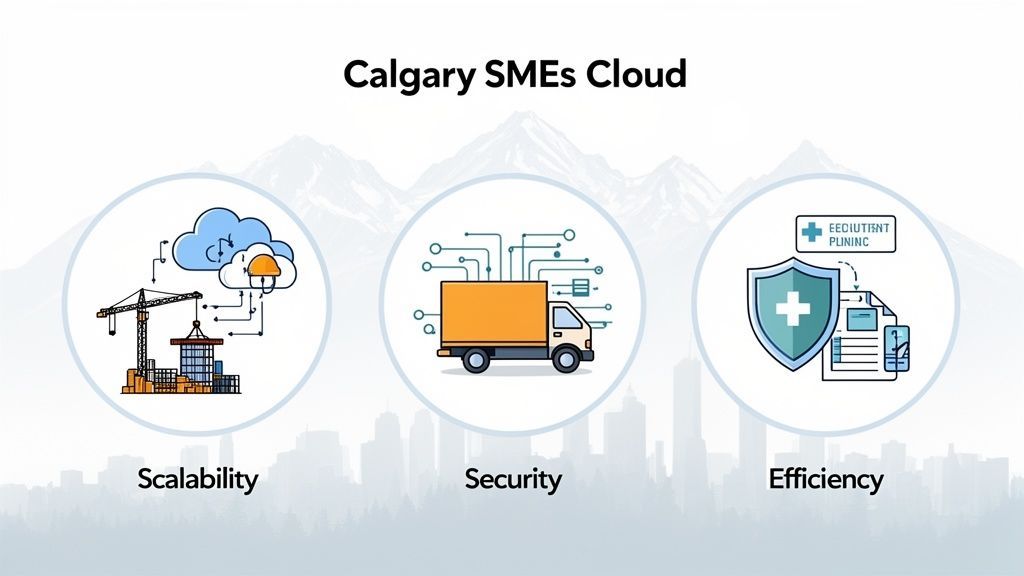
Picture a local construction firm. Project managers, architects, and on-site crews can pull up and edit blueprints in real-time, from any location. This kind of seamless collaboration nips costly errors in the bud, keeps projects on schedule, and opens up clear lines of communication for the entire team.
Or think about a Calgary-based logistics company trying to untangle a complex supply chain. Using cloud-based data analytics, they can track shipments, fine-tune routes, and forecast demand with startling accuracy. This is not just about being more efficient; it is a massive competitive advantage in an industry that never stops moving.
One of the first and most powerful benefits you will notice is the shift in how you pay for technology. Traditionally, growing your business meant sinking huge amounts of cash, capital expenditures (CapEx), into servers, networking gear, and software licences. This model not only ties up your money but also leaves you with equipment that becomes outdated surprisingly fast.
Cloud computing completely flips that script. It turns those large, unpredictable capital costs into manageable, predictable operational expenses (OpEx). Instead of buying a server, you pay a monthly fee for the exact computing resources you need.
This pay-as-you-go approach gives you incredible financial flexibility and makes IT budgeting far simpler and more accurate.
In today’s market, you have to be able to adapt. Fast. Cloud infrastructure gives your business the agility to scale resources up or down on demand, almost instantly.
Launching a new product and bracing for a flood of website traffic? You can ramp up your server capacity to handle it. Heading into a slow season? You can scale back down so you are not paying for power you are not using.
This elasticity means your IT infrastructure never holds you back. You can chase new opportunities with confidence, knowing your technology can grow right alongside you.
A local healthcare clinic, for example, needs this agility to keep patient data secure. A compliant cloud solution allows them to safely store records, expand their data management as the practice grows, and meet all PIPEDA requirements without a massive upfront investment in physical hardware.
Ask yourself: what would happen if a fire, flood, or major cyberattack hit your office tomorrow? For businesses still relying on on-premise servers, it could mean catastrophic data loss and days, or weeks, of downtime.
The cloud is a powerful answer to business continuity and disaster recovery.
By storing your data and applications in secure, geographically separate data centres, you ensure your business can keep running even if your physical office is out of commission. This goes way beyond simple backups; it is about building a truly resilient organization.
With a well-designed strategy, you can switch operations over to a secondary site in minutes, not days. Check out our guide on backup and disaster recovery services in Calgary to see how this can protect your business.
Calgary's cloud ecosystem is also getting a massive boost from major investments in AI and infrastructure. AWS has committed roughly $24.8 billion to its Calgary and Montreal regions through 2037, a move expected to support over 9,300 full-time jobs each year and add $43.02 billion to Canada's GDP. With one Canadian business adopting AI every three minutes, this local AWS presence gives Calgary SMEs access to enterprise-grade tools at prices that make sense. Learn more about how AI adoption is accelerating in Canada and what that means for your own operations.
So, you are ready to make the move to the cloud. It’s a big step, but thinking of it as one giant, complex project can be overwhelming. Instead, let's frame it like building a custom home: you start with a solid blueprint, check your foundation, and manage each stage carefully to ensure the final result is exactly what your business needs.
This checklist is designed to demystify that journey. It is a clear, actionable roadmap that will guide your transition, helping you plan a smooth migration while sidestepping the common pitfalls. A successful move to the cloud starts long before you move a single piece of data.
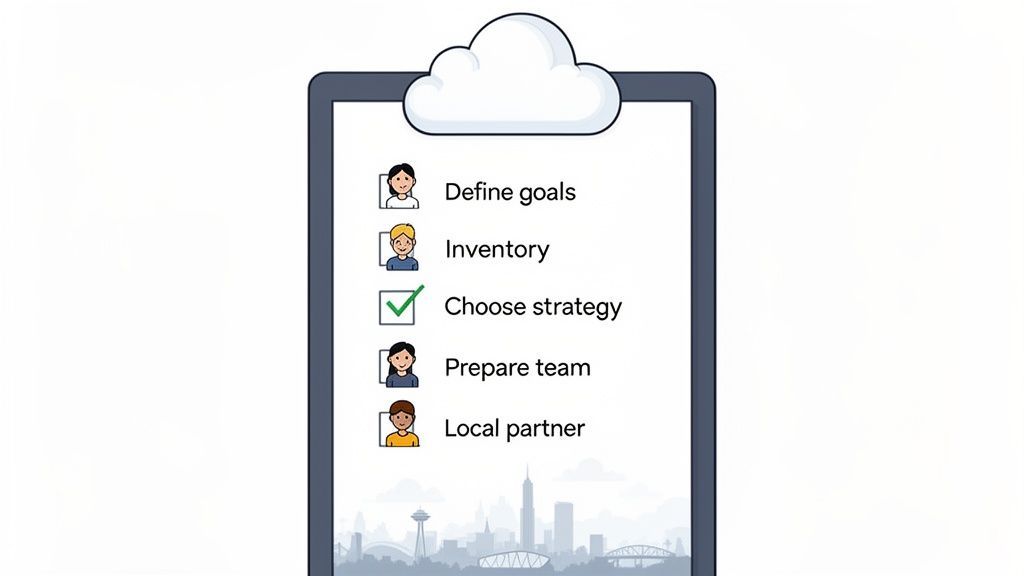
Before you even think about packing the digital boxes, you need to know where you are going and, more importantly, why. The first step is to nail down your business objectives for migrating. Are you looking to slash hardware costs, bulletproof your disaster recovery plan, or gain the agility to scale up (or down) on a moment's notice?
Your goals will steer every other decision in this process. Once they’re set, it’s time for a thorough inventory of your current IT setup.
With a clear picture of your IT landscape, you can pick the right migration strategy. The tech world loves its jargon, like the "6 R's of Migration," but for most businesses, it boils down to a combination of three main approaches:
The right path depends entirely on your goals, your timeline, and your budget. Working with a local team that offers expert guidance on Calgary cloud solutions and migrations can help you make the smart choice for each and every workload.
A thoughtful migration is not just about technology, it is about safeguarding your business assets. As you develop your plan, be sure to incorporate essential data migration best practices to protect your information at every stage.
A successful transition depends just as much on your people as it does on the technology. You need to get your team ready for the change with clear communication and proper training. Make sure your IT staff has the skills to manage the new cloud environment, or have a managed services partner like us ready to take the reins.
Finally, it is time to execute the migration. This should always be done in phases. Start with less critical workloads to test the waters and build some momentum. Always test thoroughly after each stage to make sure everything is working exactly as it should. A phased, methodical approach minimizes disruption and ensures a smooth, successful transition to your powerful new cloud environment.
Picking the right technology is only half the battle. The real make-or-break decision? Choosing the right local partner to manage it all.
When you are looking at cloud solutions in Calgary, you are not just buying a service. You are handing over a critical piece of your business to an outside team. That relationship has to be built on a solid foundation of trust, deep expertise, and a genuine understanding of what you’re trying to achieve.
A great provider does not just work for you; they become an extension of your own team. They should bring serious technical skills to the table, of course, but also an on-the-ground understanding of the Calgary business climate and the specific hurdles companies in our city face every day. That blend of world-class tech knowledge and local presence is what separates a simple vendor from a true partner.
When your business is on the line, you need a partner who is actually here, invested in the Calgary community. A local provider gets the regional economy. They have firsthand experience helping businesses in our key sectors, energy, logistics, construction, get past their unique operational roadblocks.
That local presence also means you get faster, more accountable support. You are not just another ticket number in a massive, faceless helpdesk queue somewhere on the other side of the world. You are working with a team in your own time zone that is completely committed to seeing you succeed.
Here in Canada, data privacy is not just a good idea, it is the law. Any cloud provider you consider must have an ironclad grasp of Canadian compliance standards like PIPEDA. They need to show you exactly how their security protocols are built from the ground up to protect your sensitive data and keep your business compliant.
Do not be shy about asking potential partners the tough questions about their security measures:
Top-tier security is not just a feature; it is the absolute bedrock of any cloud service worth its salt.
Choosing a provider is a huge decision that directly impacts your day-to-day stability and your long-term growth. The right partner will not just set up the tech and walk away; they will provide ongoing strategic advice to ensure your cloud environment keeps up with your business as it evolves.
For a deeper dive into what this kind of partnership looks like, check out our article on the benefits of managed cloud computing. Making an informed choice now will pay off for years, ensuring your move to the cloud is a smooth and successful one that delivers real, measurable results.
Moving your business to the cloud is a big step, and it is natural to have questions. For Calgary business leaders, getting clear, straightforward answers is the key to making a confident decision. We have put together some of the most common queries we hear from local companies to help you understand the practical side of adopting cloud solutions.
Working with a local provider means you have a team that understands the specific regulatory landscape affecting Calgary businesses, including PIPEDA and other industry-specific standards. We do not offer generic, one-size-fits-all security; instead, we build cybersecurity strategies tailored to your operation, including advanced threat detection, vulnerability assessments, and endpoint protection, all managed by a team right here in Canada.
This ensures your data is governed by Canadian privacy laws and that expert support is always available in your time zone. Having local oversight provides a much higher level of security and compliance assurance than you will get from a generic, offshore provider. You can learn more about how we approach cybersecurity services in Calgary and protect local businesses.
The cost of a cloud migration really depends on the complexity of your current IT setup and how much data you need to move. However, the most powerful financial shift is moving from unpredictable capital expenses (CapEx) to predictable operational expenses (OpEx).
Instead of facing massive upfront hardware costs every few years, you pay a manageable, consistent monthly fee. A proper assessment from a qualified provider will give you a clear cost-benefit analysis, which often reveals significant long-term savings from reduced maintenance, lower energy bills, and eliminating hardware refresh cycles.
By moving to a predictable OpEx model, Calgary businesses can free up capital for growth-focused initiatives instead of tying it up in depreciating hardware. This financial agility is one of the most powerful advantages of the cloud.
Absolutely. This is called a hybrid cloud strategy, and it is one of the most practical and popular models for businesses in Calgary. It gives you the freedom to keep sensitive data or legacy applications on your own servers while using the public cloud for scalable tools like Microsoft 365 and disaster recovery.
This approach truly offers the best of both worlds, combining flexibility, security, and control. It is a core part of the tailored cloud solutions we design for our clients, ensuring your IT infrastructure perfectly aligns with both your operational needs and your compliance requirements.
Ready to explore how the right cloud solutions in Calgary can transform your business? The expert team at CloudOrbis Inc. is here to build a secure, scalable, and cost-effective cloud strategy that drives your success. Get in touch with us today to start the conversation.
Book a 30-minute call with a senior engineer. No sales script, just straight answers about your environment.


