A Practical Guide to IT Support in Alberta for Medium-Sized Businesses
Discover it support alberta: a concise SMB guide to choosing IT services in Alberta, with questions to vet providers and tips for Calgary & Edmonton.

Discover it support alberta: a concise SMB guide to choosing IT services in Alberta, with questions to vet providers and tips for Calgary & Edmonton.
Choosing the right IT partner is one of the most critical decisions you will make for your Alberta business. It’s a choice that directly impacts your team’s productivity, your data’s security, and your company’s ability to grow.
Your first decision is a big one: do you go with proactive Managed IT Services or stick with reactive Break/Fix support? While both options provide IT support in Alberta, their approaches, and the results they deliver, are fundamentally different.
Let's break down the two main IT support models. Understanding the fundamental differences in their approach to cost, service, and overall business impact is the first step in making an informed decision for your company.
| Feature | Managed IT Services | Break/Fix Support |
|---|---|---|
| Cost Structure | Predictable, fixed monthly fee | Unpredictable, hourly rates plus parts |
| Service Approach | Proactive: Prevents issues before they happen | Reactive: Fixes problems after they occur |
| Incentive | Aligned with your success; uptime is the goal | Profits when your technology fails |
| Budgeting | Easy to budget for IT expenses (OpEx) | Difficult to predict, often a surprise (CapEx) |
| Downtime | Minimized through constant monitoring | High potential for significant downtime |
| Security | Continuous monitoring and management | Addressed only when a breach is suspected |
| Strategic Focus | Long-term planning and technology alignment | Short-term, immediate problem-solving only |
Ultimately, the model you choose defines your relationship with technology. One treats IT as a strategic asset to be nurtured, while the other treats it as a utility that only gets attention when it's broken.
Selecting an IT support model isn't just about who fixes your computers; it's a strategic decision that dictates how your business handles challenges and prepares for the future. For any growing business in Alberta, this choice can be the difference between smooth operations and constant, expensive disruptions.
Consider a Calgary logistics company whose main server crashes during its busiest season. With a traditional break/fix model, the panic begins after the system is already down. They are scrambling to find a technician, bracing for an unknown repair bill, and losing money every minute their operations are at a standstill. This is a purely reactive approach.
Now, imagine the same scenario with a managed services partner. That server crash likely never would have happened. Through 24/7 proactive monitoring, their IT provider would have spotted the warning signs, perhaps a failing hard drive or unusual network activity, and addressed the root cause long before it could impact the business.
The core difference comes down to philosophy. Break/fix is inherently reactive, trapping you in a frustrating cycle of downtime, emergency calls, and unpredictable bills. It can even create a conflict of interest, as the provider only earns money when your technology fails.
Conversely, a managed services model is proactive. Your IT partner’s primary goal is to keep your systems running so smoothly that problems do not happen in the first place. This aligns their success directly with yours; the fewer problems you have, the better they are doing their job. This strategic alignment is a key reason why so many Alberta businesses are making the switch. You can explore the benefits of managed IT services in Alberta in our detailed guide.

Alberta's business landscape is evolving rapidly. The province's technology sector contributes $12 billion to the GDP, with approximately 90% of that tech workforce concentrated in Calgary and Edmonton.
This digital shift extends across every industry. With over 8,700 small businesses in 222 Alberta municipalities participating in digital economy programs, the need for reliable, professional IT support has never been greater. As businesses become more reliant on technology, a reactive IT model cannot keep up with the demands for robust security and consistent uptime.
A proactive IT strategy is no longer a luxury, it is a foundational requirement for any Alberta business looking to compete effectively. It is about building a resilient technology framework that supports growth instead of hindering it.
The vetting process is your best defence against a poor IT partnership. When evaluating providers for IT support in Alberta, you must go deeper than a basic price quote. To find a true strategic partner, not just an outsourced helpdesk, you need to ask targeted questions that reveal their real-world capabilities, processes, and experience.
Moving past a generic sales pitch helps you understand how a provider operates. Instead of just asking if they have experience in your sector, frame the question with a specific scenario. This changes the conversation from a simple "yes" to a detailed explanation of their actual approach.
Every industry has unique challenges. A manufacturing plant in Red Deer has different IT needs than a healthcare clinic in Calgary or a law firm in Edmonton. A one-size-fits-all approach to IT support is ineffective, so you must confirm that a potential partner truly understands the nuances of your business.
Avoid broad questions. Try these specific, scenario-based inquiries instead:
These types of questions compel a provider to prove their knowledge, not just claim it. Their answers will clearly indicate whether they have genuine, hands-on experience or if they plan to learn on the job, at your expense.
Beyond industry knowledge, you need confidence in their technical skills and operational maturity. This is where you assess their team's qualifications, their commitment to proactive maintenance, and their policies on critical issues like data security.
A provider’s team is their greatest asset, but vague assurances are not enough. Ask for specifics about their technicians' skills and how they maintain them. Many Alberta institutions, like SAIT, work with local industries to develop focused micro-credentials. A forward-thinking IT provider will invest in this type of ongoing training for their staff.
An IT provider should be a proactive partner focused on preventing problems, not just a reactive service that cleans up messes. Their maintenance strategy and security protocols reveal everything about their commitment.
Here are some essential questions to gauge their technical and operational strength:
The answers to the last two questions are non-negotiable. For any Alberta business, ensuring data remains in Canada is a critical compliance and security standard. Likewise, a 100% Canada-based helpdesk guarantees you are working with a team that understands local business needs and operates in your time zone, which is absolutely crucial during an emergency.
For any Alberta business in healthcare, finance, or law, compliance is foundational. When vetting an IT support provider, their understanding of privacy laws like Alberta's Personal Information Protection Act (PIPA) and the federal PIPEDA is non-negotiable. A misstep can lead to massive fines and reputational damage.
This is why a detailed Service Level Agreement (SLA) is your most important document. A strong SLA goes beyond promising a quick callback; it provides solid, contractual guarantees on the things that keep your business running and manage risk.

A generic SLA that only promises a fast response time is of little use in a real crisis. Your agreement needs to specify what the provider will do to keep your business secure and operational. A solid SLA for an Alberta business should clearly define:
A detailed SLA is more than just a contract; it's a blueprint for resilience. It ensures both you and your IT partner have a shared, measurable understanding of what success and security look like.
Imagine an Edmonton law firm is hit with ransomware, locking all their client files and case documents. How they recover, and if they recover, depends entirely on the quality of their IT partner.
With a compliance-savvy IT provider, the response is immediate and methodical. Their 24/7 threat monitoring likely caught the intrusion in real-time. They instantly isolate affected systems, initiate their disaster recovery plan, and restore data from a clean, recent backup, all while meeting their RTO and RPO targets. Afterwards, they guide the firm through the breach notification steps required under PIPA. Downtime is minimal, data loss is near-zero, and liability is contained.
Now, consider the same scenario with a provider lacking this expertise. The response is slow, there is no formal incident plan, and backups may be unusable. The firm faces extended downtime, possible permanent data loss, and serious legal and financial consequences. The difference is stark, proving that investing in a partner with proven security expertise is a critical business decision.
As Alberta's digital infrastructure grows, with high-speed internet now reaching 95.3% of households, so does the attack surface for businesses. Better connectivity enables cloud solutions and remote work, but it also opens new avenues for cyber threats. Discover more about how the government is expanding this critical infrastructure across Alberta.
Protecting your business requires a multi-layered security strategy. When speaking with potential IT partners, ask detailed questions about how they plan to safeguard your operations. You can learn more about key strategies for robust IT Security and Protection. At a minimum, your IT support provider should offer:
For a deeper dive into compliance, see our guide on conducting a Privacy Impact Assessment in Alberta.
Determining the cost of IT support can seem challenging, but it becomes clearer once you understand the common pricing structures in Alberta. Most providers package their services in a few standard ways, and knowing the nuances is key to identifying which one delivers the best value for your business.
The real goal is to look beyond the monthly invoice. The true value of professional IT support is measured by the expensive problems you avoid. Calculating the genuine Return on Investment (ROI) means quantifying the hidden costs of technology issues, lost productivity, crippling downtime, and major security breaches.
Quotes for IT support will almost always fall into one of three categories. Each model has its own advantages, and the right fit depends on your team's size, the number of devices you have, and your budget's predictability.
Choosing the right model is about matching it to your business operations. A growing Calgary law firm will likely appreciate the simplicity of per-user pricing, while an Edmonton logistics company might find a per-device model more cost-effective.
The monthly fee for managed IT services is an operating expense, but the ROI comes from preventing much larger, more painful costs. It is an investment that pays for itself by stopping financial disruptions before they occur.
A significant part of the ROI puzzle involves optimizing software licenses to eliminate wasted spending, but that is just the beginning.
The biggest returns from managed IT never appear on an invoice. They are found in the downtime you never suffered, the data breach that was prevented, and the employee productivity that was not disrupted by technology glitches.
To determine your true ROI, consider the following:
Let's ground this in a real-world scenario for an Alberta business. You can learn more about how this proactive approach pays dividends in our complete guide to a managed IT service.
ROI Scenario: A 30-Employee Calgary Accounting Firm
In this case, the service only needs to prevent one major downtime event or recoup the lost productivity to deliver a clear, positive ROI. The monthly fee is a predictable cost that prevents far more damaging and unpredictable financial pain.
Switching IT providers is a critical moment. The onboarding process, how they handle the first few weeks, reveals everything about the partnership you are entering. It is your first real look at how they operate.
A top-tier partner arrives with a methodical plan designed to minimize disruption, learn your business inside and out, and ensure your team is comfortable from day one. This is about more than just installing software; it is about building the foundation for a long-term, strategic relationship.
A professional IT partner will almost always follow a phased approach to ensure a smooth transition.
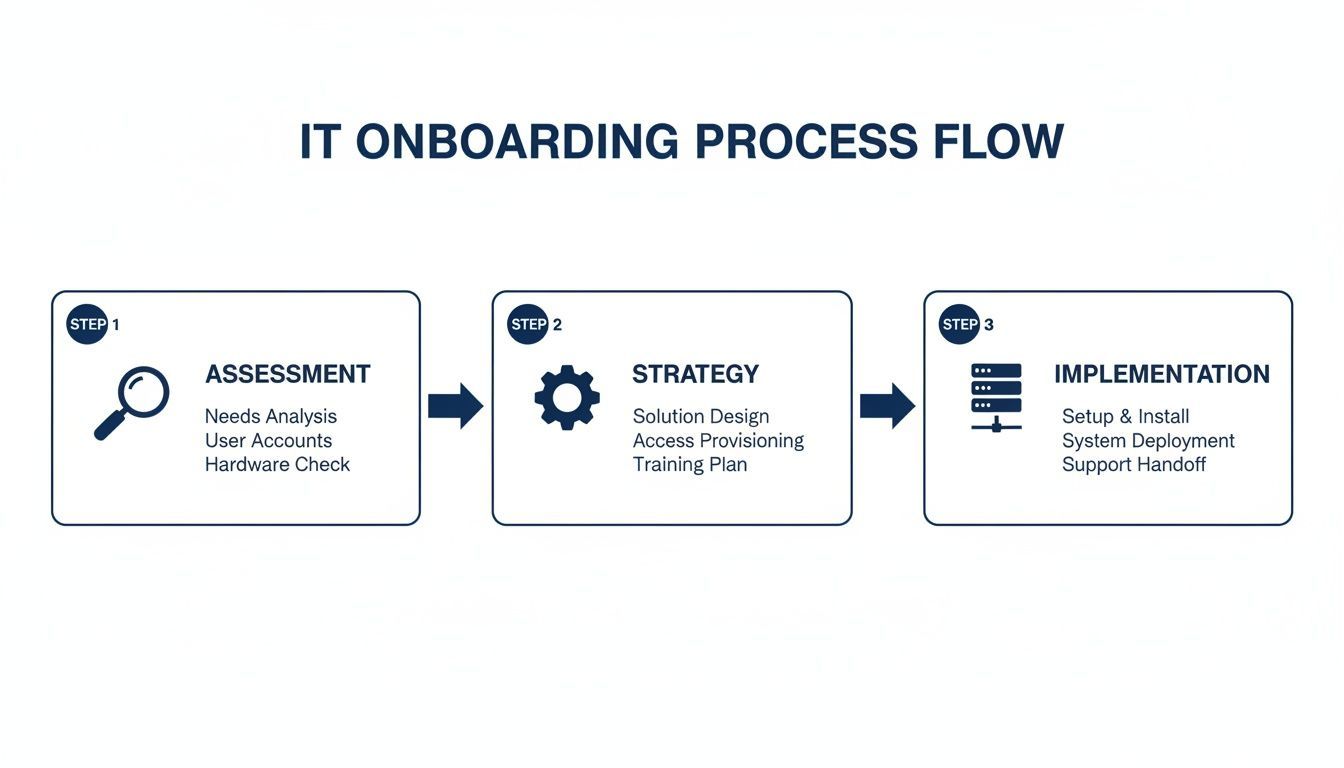
A successful onboarding journey moves logically from assessment to strategy and, finally, to implementation, leaving nothing to chance.
A professional onboarding process is a transparent, multi-step engagement that builds confidence at every stage. It is collaborative and focused on setting you up for success, not just closing a sale.
Here is what you should expect from a provider offering high-quality IT support in Alberta:
This methodical approach is the hallmark of a mature IT partner who respects your business and is invested in your success.
Just as a smooth onboarding process signals a great partner, a sloppy or rushed one is a major red flag. Spotting these warning signs early can save you from months of headaches, surprise bills, and serious security risks.
Be wary of any IT provider who promises an instant, "overnight" transition. A proper onboarding takes time and careful planning; rushing it is a recipe for overlooked security gaps and operational chaos.
Keep an eye out for these critical warning signs during your evaluation:
You have done the heavy lifting: compared the models, asked the tough questions, and analyzed the costs. The final step is to shift your mindset. You are not just buying a service; you are choosing a long-term technology partner who should operate as an extension of your team.
The right firm for IT support in Alberta will do far more than just fix things when they break. They become a strategic part of your business, bringing deep industry knowledge and a proven track record in the Calgary and Edmonton markets. Their success should be tied directly to yours, driving your growth, boosting efficiency, and building a modern, rock-solid technology foundation.
This decision is your chance to stop letting outdated IT hold your business back. A true partnership means you can delegate the entire burden of technology management. This frees you and your team to focus on what you do best: innovating, serving your clients, and growing the company.
The real test of a great IT partner is when technology starts to feel like a competitive advantage, not a constant headache. They should bring new ideas to the table that directly help you achieve your business goals.
Ultimately, this choice comes down to trust. Choose the provider who has proven they understand your vision and has the technical expertise to help you achieve it. When you partner with a team that delivers modern, secure, and reliable technology, you are making a direct investment in the future of your business.
If you are exploring IT support for your Alberta business, you likely have questions. To provide clarity, we have compiled answers to the most common queries we receive from business leaders in Calgary, Edmonton, and across the province.
For a medium-sized business in Alberta, you can expect managed IT support to cost between $75 and $250 per user, per month. The final price depends on the services included.
A basic plan might cover essential system monitoring and helpdesk access. A more comprehensive package will include advanced cybersecurity measures, strategic guidance from a virtual CIO (vCIO), and a robust disaster recovery plan. It is important to evaluate proposals based on the total value and risk they mitigate, not just the monthly fee.
A Canada-based helpdesk is non-negotiable for two key reasons: data sovereignty and timely support. Canadian privacy laws like PIPEDA and Alberta's PIPA have strict rules about how personal and business data is handled. Keeping your support tickets and data within Canada is a critical part of staying compliant.
Furthermore, a local or national helpdesk operates in your time zone and understands the nuances of the Canadian business environment. When a critical issue arises, you receive immediate assistance from an accountable team, not a delayed response from overseas. You can find more tips in our guide to the top IT support companies.
A 100% Canada-based helpdesk is not just a preference; it is a strategic advantage that ensures compliance, accountability, and faster problem resolution when every minute counts.
A properly managed transition to a new IT provider in Alberta typically takes between 30 and 90 days. The exact timeline depends on your company's size, the complexity of your systems, and your specific requirements.
A professional provider will never rush this process. They will guide you through a structured onboarding that begins with a deep dive into your current setup, moves to strategic planning, and then handles data migration and user training. This methodical approach ensures everything is configured correctly from day one and that your team feels supported without disrupting business operations.
At CloudOrbis Inc., we provide proactive, secure, and strategic IT support tailored for Alberta businesses, ensuring your technology acts as a catalyst for growth, not a barrier.
Ready to see how a true IT partnership can transform your business? Explore our managed IT services today.
Book a 30-minute call with a senior engineer. No sales script, just straight answers about your environment.


