Your Guide to Managed IT Services in Alberta
Discover how managed IT services Alberta can boost efficiency, cut costs, and secure your Calgary and Edmonton IT. Find your ideal partner today.

Discover how managed IT services Alberta can boost efficiency, cut costs, and secure your Calgary and Edmonton IT. Find your ideal partner today.
Managed IT services are about shifting your Alberta business from a reactive, break-fix model to a proactive, strategic partnership. For a predictable monthly fee, you partner with an entire team to manage your technology infrastructure, from continuous monitoring and maintenance to airtight security. This approach allows you to focus on your business, not on technical emergencies.
Imagine trying to navigate Alberta's competitive economy with your company's technology left to chance. For too many organizations, that’s the reality. They are stuck in the old 'break-fix' IT model, which means waiting for something to fail before calling for help. This isn't just inefficient; it's a direct threat to your productivity, security, and growth.
Think of your business as a high-performance vehicle. To keep it running smoothly, you need a dedicated pit crew performing proactive maintenance, not just a tow truck to call after you've already crashed. That's what a Managed Services Provider (MSP) does. They become your strategic partner, ensuring your IT systems are secure, optimized, and aligned with your business goals.
In Alberta's key sectors, whether energy, logistics, healthcare, or construction, reliable technology is non-negotiable. Downtime isn't just a minor headache; it means lost revenue and damaged client trust. A proactive partnership with an MSP helps you get ahead of problems before they can disrupt your operations.
This strategic shift brings several major advantages:
Of course, before a business can upgrade its IT strategy, it needs to be legally established. For new ventures in the province, comprehensive Alberta incorporation services are an essential first step.
Ultimately, engaging an MSP is a core business decision, not just an outsourced task. It’s about building a scalable and resilient technology foundation that supports your ambitions.
By modernizing outdated systems and processes, you position your organization to stay competitive and seize new opportunities. This kind of partnership empowers your team to work efficiently and securely, without the constant burden of IT headaches.
Partnering with a managed IT services provider in Alberta is about more than outsourcing tech support. It’s about integrating a complete suite of strategic solutions into the fabric of your business. Each service is designed to tackle a specific business challenge, from eliminating downtime to laying a secure foundation for growth.
Think of these services as interconnected gears. When they work together, they form the backbone of a strong, modern IT strategy. This is a world away from the reactive "break-fix" model, where you call for help only after something has already gone wrong.
This diagram shows the fundamental difference between the proactive, predictable managed IT model and the chaotic, costly break-fix alternative.
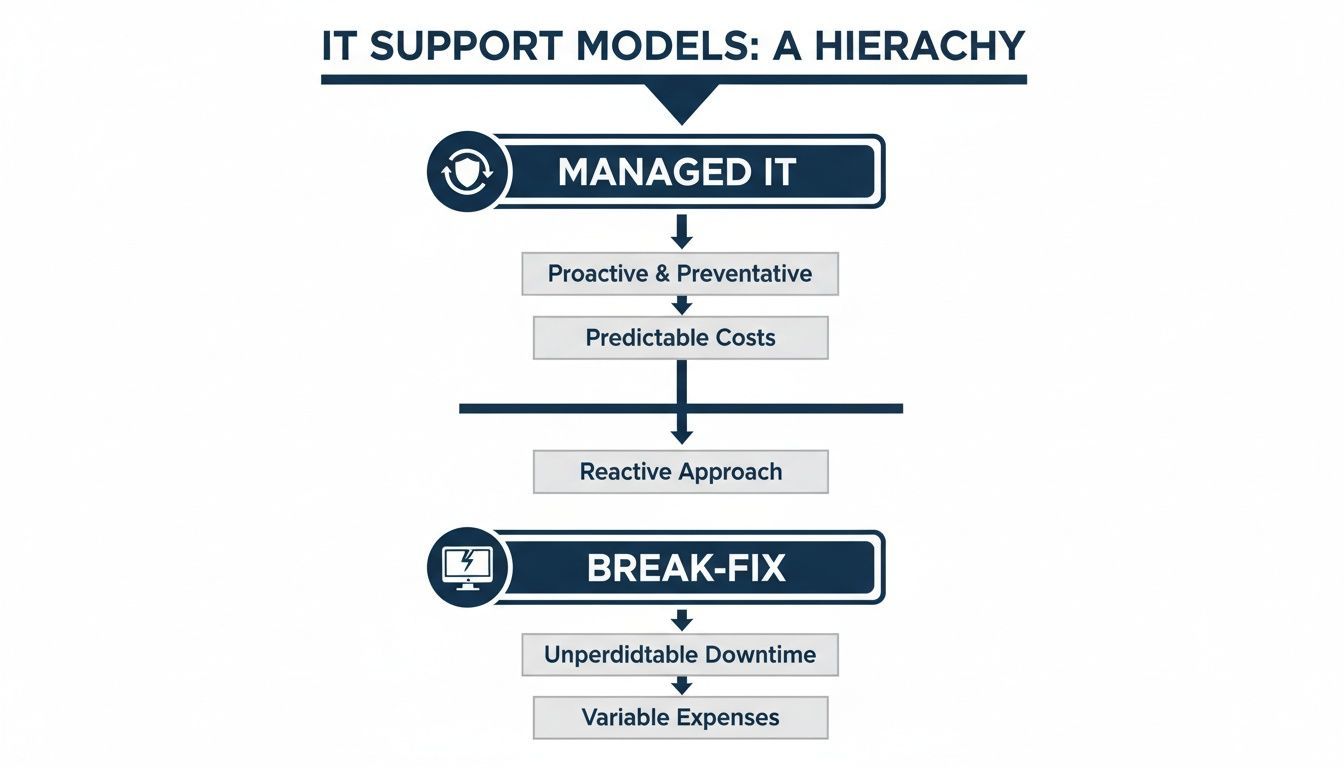
As you can see, the managed approach focuses on preventative care and predictable costs. The break-fix model is a recipe for unexpected downtime and expenses that can derail your budget.
Let's break down what a top-tier Managed Services Provider (MSP) brings to the table. The table below outlines the core services you should expect and the direct impact each has on your business in Alberta.
| Service Component | What It Is | Benefit for Your Alberta Business |
|---|---|---|
| 24/7/365 Helpdesk | On-demand, expert technical support available anytime, day or night. | Minimizes employee downtime and frustration, keeping your team productive and focused on their roles. |
| Proactive Cybersecurity | A multi-layered defence system that constantly monitors, detects, and neutralizes cyber threats. | Protects your sensitive data, preserves client trust, and safeguards your reputation from costly breaches. |
| Cloud Solutions & Migrations | Expert management of your move to the cloud (like Microsoft 365 or Azure) and ongoing optimization. | Boosts flexibility for remote/hybrid work, reduces hardware costs, and makes your business more scalable. |
| Data Backup & Disaster Recovery | Automated, secure backups of your critical data with a tested plan to restore operations quickly. | Acts as your ultimate insurance policy, ensuring your business can survive a major data loss event. |
| Virtual CIO (vCIO) | C-suite-level strategic IT guidance and planning, without the executive salary. | Aligns your technology investments with your long-term business goals for a measurable return on investment. |
Each of these components is crucial. A great MSP doesn't just offer them à la carte; they integrate them into a cohesive strategy that supports your entire operation.
An employee's computer freezes minutes before a major deadline. A critical file suddenly becomes inaccessible. Productivity grinds to a halt, and frustration mounts. A 24/7/365 helpdesk acts as your tech concierge, providing immediate, expert support to get your team back on track quickly.
This isn’t just about fixing broken things; it’s about empowering your people to work without technology getting in the way. Whether it's a simple password reset or a complex software glitch, on-demand support means your staff can focus on what they do best.
In today’s threat-filled world, waiting for a cyberattack to happen is a losing strategy. Proactive cybersecurity services act as your digital security detail, constantly on the lookout for threats and neutralizing them before they can cause harm. This isn't optional, it's essential for any business in Alberta's key industries.
This multi-layered defence includes:
By taking a preventative stance, you protect your sensitive data, maintain client trust, and safeguard your business's reputation from the costly consequences of a breach.
This approach is fundamental to building a truly resilient security posture. You can learn more about how we implement this with our proactive maintenance and monitoring services.
Imagine transforming a clunky server in a closet into a secure, globally accessible digital headquarters. That’s what a well-executed cloud strategy does. It offers incredible flexibility, scalability, and collaboration for modern businesses. A good MSP handles everything, from planning and migration to day-to-day management.
This move allows your team to access data and applications securely from anywhere, a must-have for any business with a remote or hybrid workforce. It also swaps the large capital expense and maintenance headaches of physical hardware for a predictable monthly operational cost.
What would happen if a fire, flood, or ransomware attack wiped out all your company's data tomorrow? For most organizations, it would be a catastrophic, business-ending event. Data backup and disaster recovery (BDR) services are your ultimate insurance policy against this.
A solid BDR strategy isn't just about backups. It involves:
This ensures that even if the worst happens, your business can get back on its feet with minimal downtime and data loss.
Many medium-sized businesses need high-level IT strategy but can’t justify the six-figure salary of a full-time Chief Information Officer (CIO). A virtual CIO (vCIO) service provides that C-suite expertise as part of your managed services package.
Your vCIO works directly with your leadership team to ensure your technology actively supports your business goals. They help with IT budgeting, creating a technology roadmap, and making sure every dollar you spend on IT is driving growth and delivering a clear return.
Operating a business in Alberta isn't just about understanding the market; it's about navigating a specific set of regulations and rising security threats. A generic, off-the-shelf IT plan is not sufficient. You need a strategy built for our province, one that understands local laws and the particular cyber threats targeting Alberta’s key industries like energy and construction.
This is where a local partner for managed IT services in Alberta becomes invaluable. They’re not just a vendor; they’re your guide, making sure your technology not only functions but actively shields you from regional risks and costly regulatory mistakes.
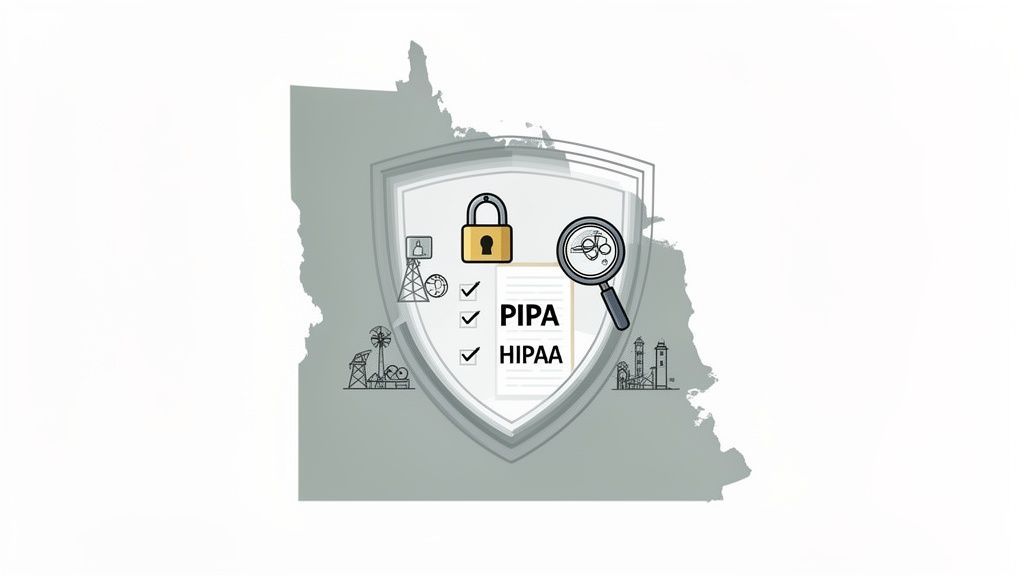
If your business collects, uses, or stores personal information, you must comply with Alberta's Personal Information Protection Act (PIPA). PIPA dictates exactly how private-sector organizations must handle employee and customer data. A misstep could lead to steep fines and a devastating loss of client trust.
An experienced MSP can help you cut through the legal jargon. They implement the right security controls and policies to ensure your data handling processes are compliant. This is an ongoing cycle of management and verification, not a one-time task. To get a better handle on this, check out our guide on how to complete a Privacy Impact Assessment in Alberta.
The complexity increases if you work with clients across borders. Suddenly, you may also need to navigate Europe's GDPR or HIPAA from the United States. A knowledgeable IT partner helps you manage these cross-border data flows securely, keeping you compliant with all applicable laws.
Think of a local MSP as a translator. They turn dense legal requirements into practical, technical safeguards that protect your business without slowing down your team.
Alberta's key industries, energy, manufacturing, logistics, and construction, are prime targets for skilled cybercriminals. These sectors rely on complex operational technology (OT) and interconnected supply chains, creating unique vulnerabilities that attackers are eager to exploit.
A specialized MSP delivers a defence strategy built for these realities, not for a generic office. This includes:
The financial pressure is mounting. As attacks intensify, Alberta businesses are seeing their cyber insurance premiums jump by over 28% annually. This reality is pushing more companies to seek out specialized security providers. You can explore the data in the full market research on IT services in Canada.
This kind of tailored defence is about more than avoiding financial loss; it’s about protecting your operational continuity. In sectors where an hour of downtime can shut down a production line or disrupt critical infrastructure, a proactive security posture is a requirement for survival.
One of the first questions business leaders ask is, "How much will this cost?" There is no single price tag. The cost of managed IT services reflects the value and specific support your business needs. The key is to shift from viewing IT as an unpredictable expense to treating it as a strategic investment, one that transforms your technology from a source of headaches into a stable, operational advantage.
In Alberta, most IT providers use a few common pricing structures. Each has its own strengths, depending on your company's size, complexity, and goals. The objective is always to find a predictable, fixed monthly fee that eliminates surprise repair bills and protects you from the massive costs of downtime.
This is one of the most popular and straightforward models. You pay a flat fee for each employee, every month. It’s clean, predictable, and scales up or down with your business.
When you hire a new team member, your IT costs adjust, and that person is fully supported from day one with helpdesk access, security tools, and software licences. This model is ideal for businesses that want all-inclusive support for every person on the payroll, regardless of how many devices they use.
Another common approach is the per-device model. Here, you are charged a flat fee for each piece of hardware being managed, desktops, servers, laptops, and network equipment. This is a great fit for organizations where the number of devices doesn't align directly with the number of employees.
Imagine a manufacturing floor with dozens of specialized machines or an office where staff share workstations. This model ensures every critical piece of technology is monitored and maintained, making it a cost-effective way to cover tech-heavy environments.
A well-structured managed services agreement provides a clear return on investment. By preventing just a few hours of productivity loss or a single security incident, the service often pays for itself, safeguarding your revenue and reputation.
You will also see many providers of managed IT services in Alberta offer tiered plans. This approach bundles services into different levels, often named something like Bronze, Silver, and Gold, at various price points. A basic tier might cover essentials like monitoring and helpdesk, while higher tiers add proactive cybersecurity, strategic guidance from a vCIO, and full disaster recovery.
Tiered plans give you the flexibility to choose a service level that fits both your operational needs and your budget. You can start with a foundational package and move up as your business grows and your technology needs become more complex. You can explore how these models work in practice with our managed IT services in Calgary.
Ultimately, choosing the right pricing model comes down to finding a partner that delivers measurable value. When you convert chaotic IT expenses into a predictable monthly investment, you're not just buying support, you're buying the peace of mind to focus on what matters most: growing your business.
Selecting a provider for managed IT services in Alberta isn't just hiring a vendor; it’s finding a strategic partner. With many options in Calgary and Edmonton, the process can feel overwhelming. The goal is to find a team that feels like an extension of your own, one that understands the local business landscape and is genuinely invested in your success.
The right partner goes beyond fixing things when they break. They bring proactive, strategic thinking to help you grow. Not all providers are created equal, and the wrong choice can leave you with recurring IT headaches, security gaps, and wasted money. To make the right decision, you need to know what to look for and, just as importantly, what to avoid.
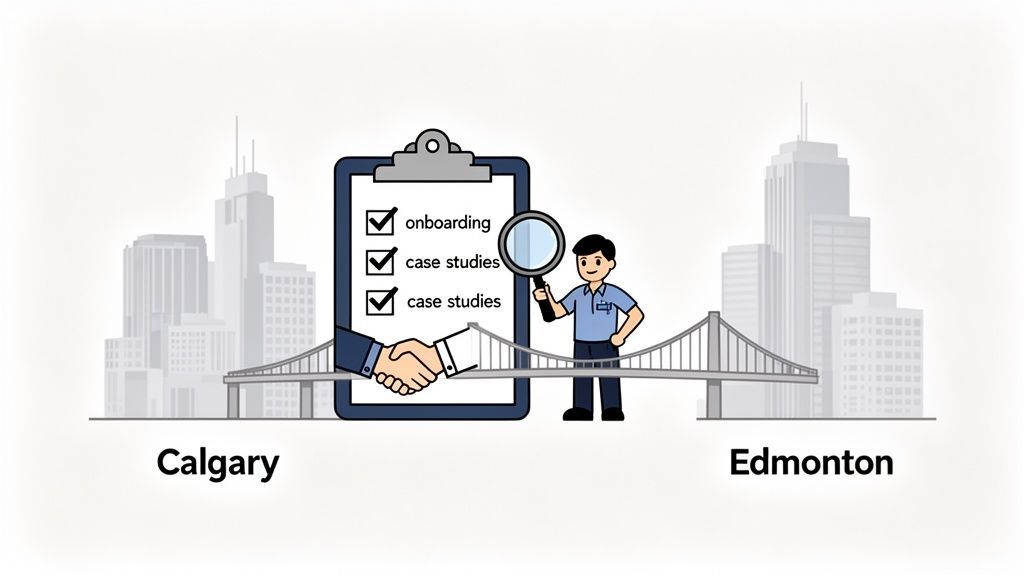
Entering conversations armed with the right questions will reveal a lot about a potential IT partner. Vague, jargon-filled answers are a major red flag. A quality provider will welcome detailed questions and provide clear, confident answers they can back up.
Here are some critical questions to ask:
These questions shift the conversation from a sales pitch to a substantive discussion about partnership and capability. To dig deeper, check out our guide on choosing an MSP in Edmonton for more expert insights.
Knowing what to look for is only half the battle; you also need to spot the warning signs. A provider might look great on their website, but certain behaviours can predict future problems. A little vigilance now can save you from a costly and frustrating partnership later.
Be wary of any provider pushing a rigid, one-size-fits-all package. Your business is unique, and your IT strategy should be too. A true partner invests time to understand your specific goals and pain points before proposing a solution.
Keep an eye out for these critical red flags:
Choosing your IT partner is a foundational business decision. Taking the time to do your due diligence now will pay significant dividends in security, efficiency, and peace of mind.
We’ve covered a lot of ground in this guide, and the main takeaway is simple: proactive IT management is no longer a "nice-to-have", it’s the new standard for business resilience. For organizations in Alberta, the right IT partnership turns technology from a source of frustration into a powerful asset that drives growth.
It’s about making a deliberate shift. Instead of reacting to problems as they arise, you build a solid, secure foundation for your operations. This isn’t just about feeling safer; it’s about real, measurable results. You gain stronger security to protect your data, predictable costs to stabilize your budget, and a more efficient team that can work without technology-related interruptions.
Ultimately, it frees you to focus on what you do best, running your business, knowing your technology is in expert hands.
Reading about the benefits is one thing, but seeing how they apply directly to your business is the next logical step. This is your chance to get an expert, outside perspective on your current IT setup and discover what a custom-built strategy could look like.
A proactive IT strategy isn’t a luxury anymore; it's a core component of a resilient, modern business. Identifying weaknesses and opportunities for improvement now is how you safeguard your future and gain a competitive edge in Alberta’s market.
This is about more than just fixing broken computers. It’s about finding a partner who understands what you’re trying to achieve and builds the technology strategy to get you there. Taking that first step to have your systems assessed is how you start building a more secure and efficient future.
Don’t wait for a system crash or a security breach to force your hand. Schedule a no-obligation IT assessment with CloudOrbis today and let’s map out what a proactive and secure IT future looks like for your business.
When Alberta business leaders start exploring managed IT, a few questions consistently come up. Here are straightforward answers to help you get a clearer picture.
The investment depends on your company’s size, the complexity of your systems, and your specific security needs. That said, most small and medium-sized businesses in Alberta can expect pricing in the range of $100 to $250 per user per month.
The goal is to move to a predictable monthly fee, which helps you avoid the financial shock of a sudden system failure or emergency repair. The only way to get a firm number is with a proper assessment of your current environment and future goals. This ensures you’re paying only for what you need.
Yes, and this is a critical function. A good local provider will be well-versed in provincial rules like Alberta's PIPA and federal laws like PIPEDA. If you operate in a tightly regulated field like healthcare or finance, they can build and manage your IT environment to meet those strict compliance demands.
When speaking with potential providers, be sure to ask about their direct experience in your industry. You need to know they have a proven track record of protecting sensitive data and keeping clients fully compliant with all relevant regulations.
Getting this right is non-negotiable, it helps you sidestep hefty fines and protects the professional reputation you’ve worked hard to build.
A well-managed transition is designed to cause minimal disruption to your daily operations. For a typical medium-sized business, a structured onboarding process, which includes a deep dive into your current systems, careful planning, and a phased rollout, usually takes between two and six weeks.
This deliberate pace ensures everything is migrated smoothly, all security measures are configured correctly, and your team receives the training they need on any new tools or processes without feeling overwhelmed.
Absolutely. In fact, this is a very common and effective setup called co-managed IT. The MSP takes over the routine, time-consuming tasks like 24/7 network monitoring, advanced cybersecurity defence, and day-to-day helpdesk support.
This frees your internal IT expert from the constant "firefighting" cycle. They can then shift their focus to strategic, high-impact projects that drive the business forward, contributing directly to growth and innovation. It’s the best of both worlds, blending your team's intimate knowledge of the business with the MSP's broad expertise and specialized tools.
Ready to see how a proactive IT strategy can transform your business? The team at CloudOrbis offers a no-obligation IT assessment to help you identify opportunities for enhanced security, efficiency, and growth.
Book a 30-minute call with a senior engineer. No sales script, just straight answers about your environment.


