Network Security in Calgary: A Practical Guide for Business Leaders
Explore network security calgary essentials for Calgary businesses: threats, tools, and a clear path to the right IT partner.

Explore network security calgary essentials for Calgary businesses: threats, tools, and a clear path to the right IT partner.
For any business in Calgary, network security has moved from the "nice-to-have" list to being absolutely essential for survival. It protects your day-to-day operations, keeps your client data safe, and defends the hard-earned trust you've built in the community.
This guide provides leaders in Calgary’s key sectors, from energy and logistics to professional services, a clear, no-nonsense roadmap to stronger security.

Let's be honest: the world of cybersecurity can feel like a minefield of technical jargon and endless threat alerts. Our goal is to cut through that noise. We’re here to frame network security in Calgary not as an IT chore, but as a core business function vital to your company's future.
Think of your business network as its central nervous system. It’s the invisible thread connecting your employees to each other, your clients, and your critical data. Without proper protection, that system is open to risks that can bring operations to a grinding halt, cause serious financial loss, and badly damage your reputation. A data breach isn't just an IT problem; it's a full-blown business catastrophe.
Generic cybersecurity advice often falls flat because it doesn’t account for the unique landscape of Calgary's economy. The threats targeting an energy firm in the Beltline are fundamentally different from those aimed at a logistics company near the airport. A one-size-fits-all approach simply doesn't work here.
Understanding our local context is the first step toward building a defence that holds up. A smart, localized security strategy considers:
A proactive security strategy is one of the most important investments a Calgary business can make. It’s about more than just defence; it’s about building a foundation for sustainable growth and client confidence in our unique market.
Ultimately, making sharp, informed decisions about your company's security is fundamental to thriving in Calgary’s competitive market. For a wider perspective on your entire technology foundation, learn more about our comprehensive Calgary IT services and how they integrate with a powerful security posture.
Generic cybersecurity warnings often miss the mark for businesses here in Calgary. The risks we face are not abstract concepts from a global report; they are specific, localized, and tied directly to our economy. To protect your business properly, you must understand the real threats targeting Alberta's core industries, from the executive offices of energy companies to the dispatch centres of logistics firms.
Think of it like navigating Rocky Mountain weather. A generic forecast will not do you much good when you need to prepare for the sudden shifts you'll face on the ground. The same principle applies to defending your digital assets in Calgary.
Cybercriminals are strategic. They follow the money, and in Calgary, that means they have a laser focus on the sectors that drive our economy.
These industry-specific threats make it clear why a one-size-fits-all security plan is ineffective. Your defence must be built around the unique risks your business faces daily.
The average cost of a data breach for a Canadian company now sits at a staggering $7 million. This number drives home the high financial stakes and proves that investing proactively in security is far less painful than cleaning up after an incident.
The game is constantly changing because cybercriminal methods are always evolving. Organized cybercrime groups now operate like sophisticated businesses, using advanced tools and collaborative strategies to hit our region with more precision. AI-powered tools are making phishing emails and other social engineering tactics frighteningly convincing and much harder for your employees to spot.
This evolution means that yesterday's security measures are no longer enough. Businesses need a dynamic, adaptive approach to stay ahead. As you review your own security, it is a good idea to see how it compares to what leading cybersecurity companies in Calgary recommend for total protection.
Here’s an interesting paradox: as Calgary becomes a centre for cybersecurity expertise, it also becomes a more prominent target. The city has emerged as a powerhouse in the field, with its cybersecurity workforce now over 4,000 professionals and growing at an impressive rate of more than 40% annually. This boom is largely driven by the energy sector's urgent need to safeguard its critical infrastructure. You can learn more about how Calgary is becoming a key market for cybersecurity talent.
While this growing talent pool is a huge asset for the city, it doesn't automatically protect every small and medium-sized organization (SMO). Many SMOs remain vulnerable, lacking the internal resources to compete for top talent or implement enterprise-level security controls. This gap creates a massive risk, as cybercriminals know that smaller companies are often the weakest link in a bigger economic chain. Understanding this local dynamic is the first step toward building a defence that works.
Knowing the threats Calgary businesses face is step one. Step two is building a defence that works. Solid network security isn't about finding a single piece of software. It’s about creating layers of protection that work together to defend your business from all angles.
You don't need to become a technical expert, but understanding what each of these layers does is crucial for making smart investments in your company's safety. Let's break down the essential pillars of a modern security strategy.
The most common attacks we see hitting Calgary businesses, like phishing and ransomware, are rarely one-trick ponies; they exploit multiple weak spots. This flow chart shows a typical attack in action.
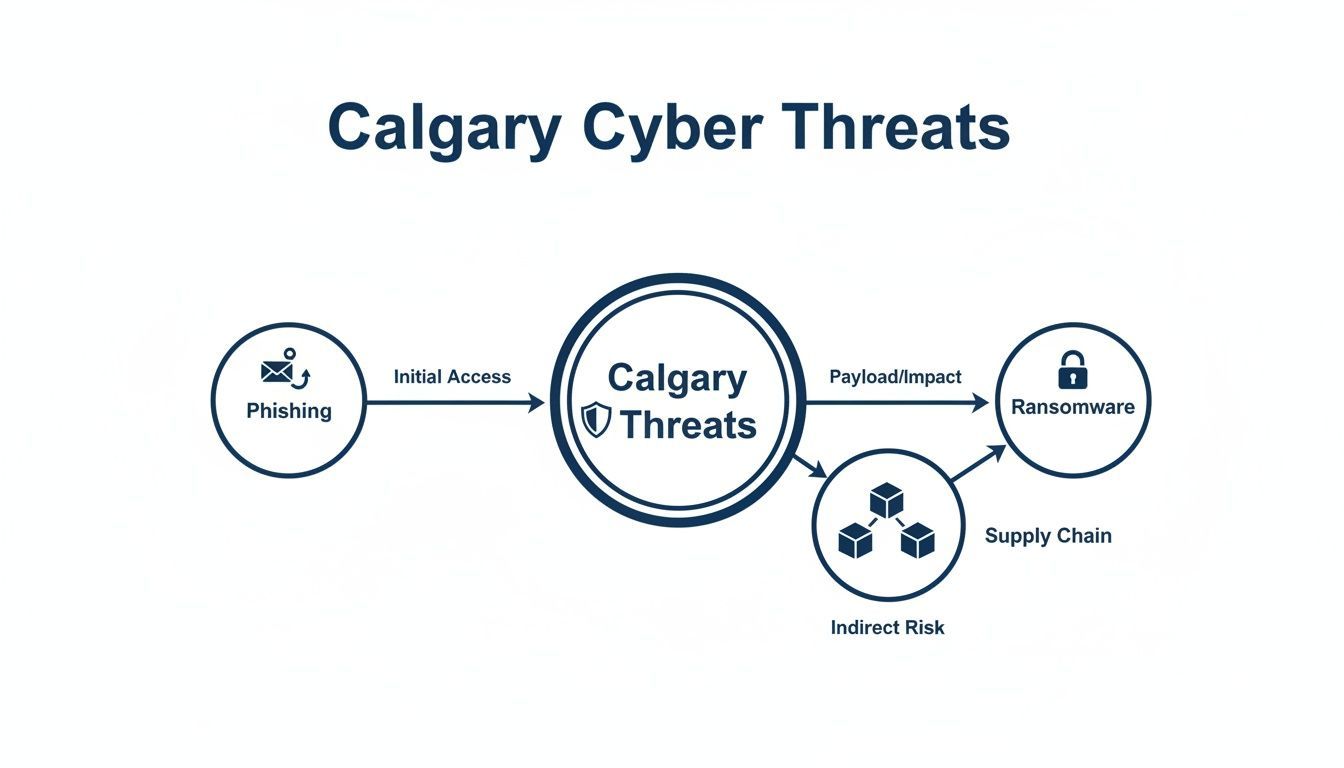
As you can see, a simple phishing email can become the entry point for a devastating ransomware attack. This is why having multiple, overlapping defences is non-negotiable.
To help you visualize how these layers work together, here's a quick summary of the core security controls every Calgary business should have in place.
This table breaks down the essential security tools, what they do in simple terms, and the specific business disasters they help you avoid.
| Security Control | Primary Function (Analogy) | Key Risk Mitigated |
|---|---|---|
| Next-Gen Firewall | A highly trained security guard at the main entrance, inspecting every package. | Unauthorized access from the internet; blocking malware at the perimeter. |
| Network Segmentation | Creating locked-down departments in your office; a breach in one can't spread. | Ransomware spreading across your entire network; data theft from critical systems. |
| EDR | A dedicated security detail for every computer and server inside the building. | Active ransomware attacks on devices; malware that slips past the firewall. |
| Secure VPN | An armoured, private courier for data travelling outside the office. | Data interception on public Wi-Fi; insecure remote connections. |
| MFA | Needing both a key and a PIN code to open a high-security safe. | Stolen passwords leading to account takeovers and data breaches. |
| Data Backups | A complete, off-site blueprint and duplicate inventory of your entire business. | Business-ending data loss from ransomware, hardware failure, or human error. |
These controls are the building blocks of a resilient security posture. Let's dig deeper into what makes each one so important.
Think of a traditional firewall as a simple bouncer checking IDs. A Next-Generation Firewall (NGFW) is more like a highly-trained corporate security team.
These guards don't just glance at IDs. They inspect package contents, recognize suspicious behaviour, and know who is allowed in specific areas. An NGFW does this for your network traffic, providing "deep-packet inspection" to spot and block malicious code and intrusions that older firewalls would miss. It’s your first and most critical line of defence.
Imagine your entire business operates out of one giant, open-plan room. If one person gets sick, everyone gets sick. Network Segmentation is like putting up walls and creating secure, badge-access-only zones for different departments.
Your finance team can only get to finance servers, and your sales team can only access the CRM. If a computer in the sales department is compromised, the digital "walls" prevent the threat from spreading to your critical financial systems. This containment principle is fundamental to minimizing the impact of a breach.
By containing a threat to a small, isolated network segment, you can prevent a minor security incident from escalating into a full-blown, business-halting disaster.
Your firewall protects the perimeter, but what about the devices inside your network? Endpoint Detection and Response (EDR) is like having a dedicated security detail assigned to every computer, server, and phone (the "endpoints") your company uses.
EDR tools are far more advanced than traditional antivirus software. They constantly monitor device activity for suspicious behaviour, like a program suddenly trying to encrypt thousands of files, a classic sign of ransomware. When a threat is detected, EDR can automatically quarantine the infected device to stop the attack and provide security professionals with the forensic data needed to understand how it happened.
With remote and hybrid work now standard for many Calgary companies, securing outside connections has never been more important.
Even with the best defences, nothing is 100% invincible. That’s why reliable, tested Data Backups are your ultimate safety net. It’s like having a complete, off-site blueprint and duplicate inventory for your entire business.
If a ransomware attack locks up all your files, a proper backup allows you to restore your systems to how they were before the attack. This neutralizes the threat without paying a ransom. For Calgary businesses, this means having multiple copies of your data, keeping at least one copy securely off-site, and, most importantly, testing your ability to restore from it regularly.
A key part of any strong security program involves proactively looking for weaknesses. You can learn more about how we rigorously test defences in our guide on penetration testing services. When implemented correctly, these foundational controls form a powerful framework for any robust network security calgary strategy.
For many small and medium-sized organizations in Calgary, the thought of building a cybersecurity team from the ground up is overwhelming. The reality is that hiring, training, and retaining top-tier security talent is incredibly difficult and expensive. On top of payroll, the costs for enterprise-grade security software, licensing, and ongoing training can spiral quickly.
This is where a managed security provider changes the equation. Partnering with a specialized firm shifts cybersecurity from a large, unpredictable capital expense to a predictable, manageable operational one. It's a strategic move away from a reactive, break-fix IT model and toward a proactive framework built for long-term business resilience.
Instead of scrambling to find an expert after something goes wrong, you gain immediate access to a dedicated team of professionals who are always on guard.
A managed security partner delivers far more than just software; they provide a constant, watchful presence over your entire network. This proactive approach is built on a few key pillars.
This continuous oversight is non-negotiable today. Ransomware remains a huge threat to Calgary’s critical infrastructure, especially in the energy sector. As outlined in Canada's National Cyber Threat Assessment, attackers are constantly sharpening their tactics. With the average Canadian data breach costing $7 million and a national cybersecurity skills shortage of over 25,000 jobs, partnering with an expert team is a sound business decision. You can explore the full report for more details on Canada's cyber threat landscape.
Choosing a Canada-based partner offers a distinct advantage for any business serious about its network security in Calgary. A local team understands not just the technology but also the operational realities and regulatory pressures specific to our region and industries.
This local knowledge is invaluable for compliance with provincial and federal data privacy laws like PIPEDA. A Canadian provider ensures your data is stored and managed within our borders, simplifying compliance and giving you peace of mind.
A local managed security partner acts as a true extension of your business. They understand the context of your operations, the specific threats targeting your industry in Alberta, and the importance of building a security strategy that supports, not hinders, your growth.
Furthermore, when a critical incident occurs, having a team in your own time zone ready to respond immediately makes all the difference. This alignment means faster communication and quicker resolutions, minimizing potential downtime and financial fallout. By integrating these expert capabilities, you can build a far more resilient organization.
Discover how our cybersecurity services in Calgary are structured to provide this exact level of localized, proactive protection. This strategic partnership frees your internal team to focus on their core business goals, confident that your digital assets are in expert hands.
Picking the right managed security partner is one of the most critical decisions you will make for your business. This isn't just about hiring another IT vendor; it's about finding a strategic ally who will protect your assets and help you grow. To do that, you need a solid framework to look past marketing claims and evaluate a provider's true capabilities.

To make a smart choice, you must ask pointed questions, the kind that reveal how a potential partner operates, the depth of their expertise, and whether they are invested in your success. This checklist is designed to do exactly that.
First, you need to confirm that a provider has the technical skill and local focus to meet your needs. A team on the other side of the country cannot offer the same immediate response as one that understands the Calgary market.
This focus on local presence is crucial. A partner rooted in the community will have a better handle on the specific threats targeting businesses that need network security in Calgary.
A great security partner does more than just put out fires; they prevent them from starting. Their role should be that of a strategic advisor, helping you build a resilient and forward-thinking security program.
Your security partner shouldn't just be a reactive helpline. They should act as a true extension of your leadership team, offering strategic guidance to align your security posture with your core business objectives.
Here are the questions to ask to gauge their strategic value:
Making the right choice comes down to finding a provider who offers both deep technical skill and a genuine commitment to your business. For more insights, you might find our guide to choosing a top-tier MSP in Calgary helpful. This framework will equip you to find a partner who will help secure your business today and prepare you for the challenges of tomorrow.
We've covered a lot of ground. But moving from knowing about a problem to actually solving it is the most critical step you can take.
We’ve established that solid network security in Calgary isn't just another IT expense, it’s a fundamental investment in your company’s survival and growth. It protects your operations, reputation, and ultimately, gives you a real competitive advantage. Now, it's time to build a clear path forward.
Your security strategy cannot be reactive. You must get ahead of the threats. The attacks targeting Calgary businesses are getting smarter and more aggressive. Alberta's cybersecurity landscape is bracing for a more dangerous 2026, with sophisticated AI-driven phishing and complex supply-chain exploits becoming the new normal. We're already seeing a 53% jump in DDoS attacks, and sectors like manufacturing and logistics face huge risks from vulnerable IoT devices. You can read more about the 2026 expectations for Alberta's IT security here.
Getting control of your security starts with one simple thing: knowing where you stand today. A thorough assessment isn't about guesswork; it's about using data to find vulnerabilities before an attacker does. It gives you a clear, prioritized list of what to fix first.
But being resilient isn't just about defence. It’s also about having solid disaster recovery and data recovery strategies ready to go. This comprehensive approach ensures you can get back on your feet quickly after any disruption, whether it's a cyberattack or a simple hardware failure.
Your goal should be to create a security framework that is both strong and adaptable, one that protects you today and can evolve to meet the threats of tomorrow.
The most effective way to do this? Partner with experts who can provide an objective, deep-dive analysis of your network.
This is your chance to build a more secure, more resilient business. CloudOrbis is ready to help. We invite Calgary business leaders to schedule a complimentary, no-obligation network security assessment. Our experts will provide a clear picture of your vulnerabilities and work with you to create a practical roadmap for a stronger, more secure future.
Navigating network security can bring up many questions. To help clear things up, we've gathered the most common queries we hear from Calgary business leaders and answered them directly.
Our goal is to cut through the jargon and give you practical insights that build on what we have already covered.
While a layered defence is always the best strategy, the single most impactful security measure you can deploy is Multi-Factor Authentication (MFA). Think of it as adding a deadbolt to your front door instead of relying on a simple lock.
Even if a criminal manages to steal a user's password, a common result of phishing attacks, MFA creates a powerful second barrier. It requires another verification step, usually a code sent to a phone, before granting access. This simple step blocks the vast majority of account takeover attempts.
There is no magic number that fits every business. The right investment depends on your company's size, your industry's risk profile, and the sensitivity of the data you handle. That said, a widely accepted benchmark is for organizations to allocate between 7% and 10% of their total IT budget to cybersecurity.
A managed security provider can turn unpredictable security costs into a clear, fixed monthly expense. This makes budgeting far more predictable and ensures you get enterprise-grade protection without a massive upfront investment in tools and talent.
This approach gives you a scalable and cost-effective way to secure your operations.
Yes, absolutely. A common myth is that cybercriminals only chase after large, multinational corporations. The reality is that attackers often use automated tools to scan thousands of businesses at once for vulnerabilities, regardless of their size.
Small and medium-sized organizations (SMOs) in Calgary are especially attractive targets for a few key reasons:
Because of this, no business can afford to think it is "too small to be a target."
The main difference is their core approach: one is proactive, while the other is reactive.
Traditional IT support usually follows a break-fix model. When a computer breaks or a server goes down, you call them, and they fix the problem. Their job typically starts after something has already gone wrong.
A managed security service, on the other hand, is built on proactivity. The service involves 24/7 monitoring, continuous threat hunting, and strategic planning to stop security incidents before they happen. The goal is to find and neutralize threats before they can disrupt your business, making it a cornerstone of a modern network security Calgary strategy.
Ready to build a stronger, more resilient security posture for your business? The expert team at CloudOrbis Inc. is here to provide the clarity and protection you need. Schedule a complimentary, no-obligation network security assessment today to understand your risks and create a clear roadmap for a secure future. Learn more and get in touch at https://cloudorbis.com.
Book a 30-minute call with a senior engineer. No sales script, just straight answers about your environment.


