Vendor Risk Assessment for SMBs: The Practical Playbook
Learn how to conduct a vendor risk assessment for your SMB with our step-by-step playbook covering due diligence, risk scoring, and compliance for 2026.

Learn how to conduct a vendor risk assessment for your SMB with our step-by-step playbook covering due diligence, risk scoring, and compliance for 2026.
Only 51% of Canadian respondents audit or verify the security posture and compliance of their suppliers. That leaves nearly half of organisations making vendor decisions without regular independent assurance, which makes unverified suppliers one of the clearest operational threats facing SMBs today.
Vendor risk assessment isn't a paperwork exercise reserved for large enterprises. A payroll provider, medical transcription service, logistics partner, cloud platform, or even a small local contractor can interrupt operations, expose personal information, or create a compliance problem that your business must still answer for.
The practical response is to assess vendors according to business criticality, data access, financial resilience, legal exposure, and subcontractor dependence, not just cybersecurity controls. A vendor that doesn't run complex software can still be enterprise-critical if its failure stops patient scheduling, delays shipments, or blocks access to essential records.
The Canadian business case is difficult to dismiss. Seven in ten Canadian companies experienced at least one significant supply-chain disruption, monetary loss, or reputational hit caused by a third party in the previous three years, while only 51% said they audit or verify the security posture and compliance of their suppliers. The figures are reported in Canadian guidance on vendor diversification, and they show the gap between vendor dependence and vendor visibility.
The risk isn't limited to a data breach. A supplier can fail to deliver, lose a key subcontractor, become insolvent, mishandle confidential information, or make a regulatory decision that affects your organisation. Smaller businesses feel these failures sharply because they often have fewer replacement suppliers, less internal capacity, and tighter operational margins.
Practical rule: If a vendor's failure would force your team to improvise, that vendor deserves a documented continuity plan before the contract is signed.
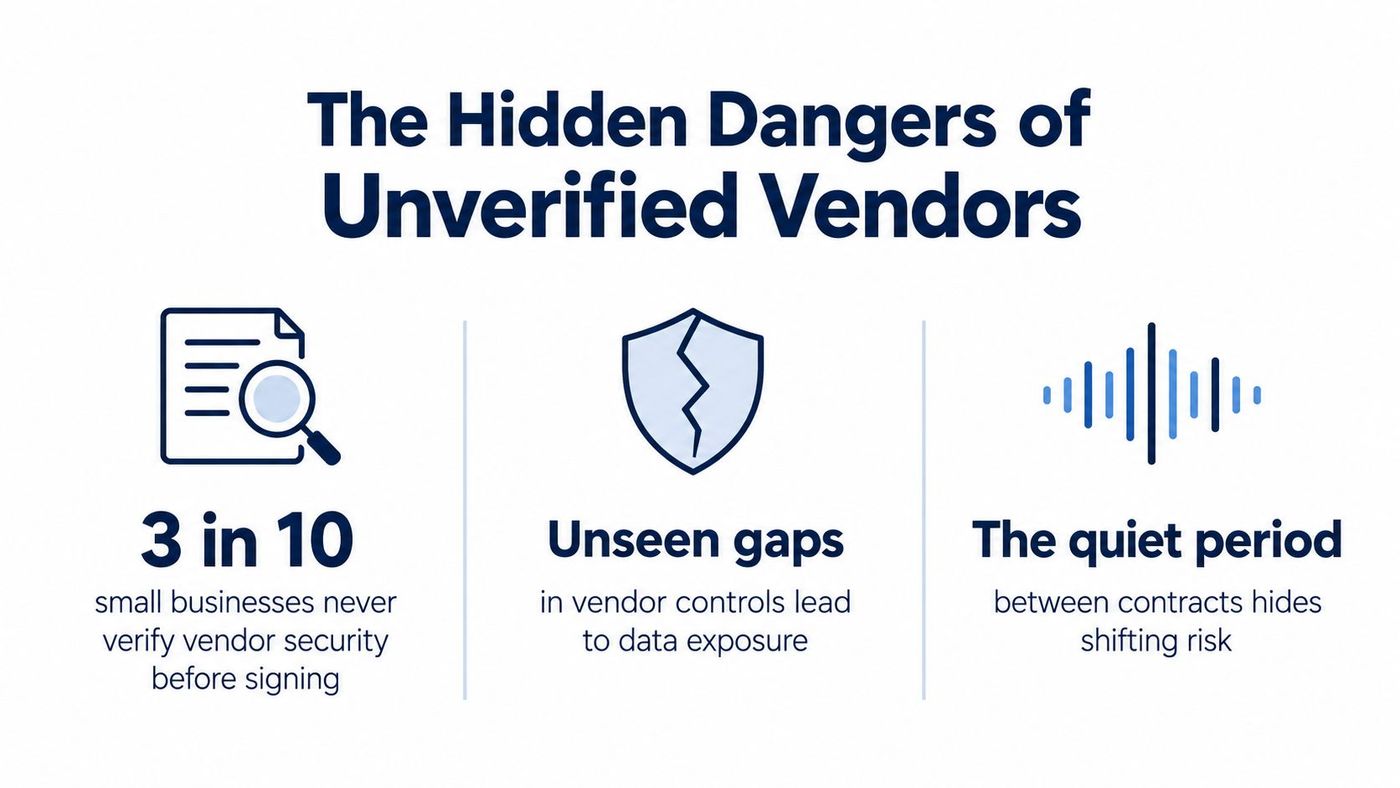
Many organisations collect a security questionnaire during procurement, file it away, and never revisit the answers. That approach treats vendor risk as a static property, even though services change, ownership changes, subcontractors change, and data flows expand.
The quiet period between onboarding and renewal is where risk often becomes invisible. A supplier may introduce a new sub-processor, move data to another location, reduce its support coverage, or change its recovery arrangements without creating an obvious signal for procurement.
That is why vendor oversight belongs beside business continuity and privacy management. Teams that need a practical foundation can connect their supplier review process with broader data security and privacy practices, rather than treating third-party exposure as a separate compliance file.
A cyber checklist can identify weak authentication or outdated patching. It won't necessarily reveal that a small supplier depends on one employee, has weak cash flow, stores records with an undisclosed subcontractor, or can't restore service within a timeframe your business can tolerate.
A useful assessment asks a harder question: what happens to our customers, staff, revenue, and obligations if this supplier fails tomorrow? That answer determines the depth of due diligence, the contract protections, the contingency plan, and the review frequency.
Don't give every supplier the same questionnaire. Start by building a complete inventory from procurement records, accounts payable data, department lists, and technology systems. Include informal arrangements and cloud tools that staff adopted without a central purchasing process.
Then classify vendors using two dimensions: what they can access and what breaks if they stop operating. A local stationery supplier may have limited access and low operational impact. A payroll provider may be small and non-technical from your perspective, yet highly critical because it handles sensitive employee information and supports an essential business process.
Use three working tiers, then adjust the labels to fit your organisation:
A vendor can move tiers when its service changes. For example, a medical support provider that only answers general enquiries may become critical when it starts handling patient information or accessing a clinic system. Organisations evaluating this type of relationship may find a medical virtual assistant company useful as a reference point for defining service scope and access expectations.
Document the reason for each classification. A simple explanation, such as “critical because it processes health information and supports appointment operations,” gives procurement, IT, legal, and leadership a shared basis for decisions. Guidance on what IT vendor management involves can help connect classification with ownership and lifecycle controls.
A completed questionnaire is evidence that a vendor answered questions. It isn't proof that the answers are accurate or that the controls work. Effective vendor risk assessment combines documentary review, interviews, validation, risk scoring, and an agreed response to every material weakness.
Start with the vendor's identity and viability. Confirm its corporate status, CRA Business Number, provincial registrations, insolvency records, ownership information, and relevant legal history. Review available financial statements, customer concentration, payment dependencies, and PPSA security interests where they could affect continuity. For a critical supplier, ask what would happen if its largest customer left or if its main subcontractor became unavailable.
Request security and privacy policies, current independent reports where applicable, incident response procedures, business continuity and disaster recovery documentation, recovery test results, insurance details, and a map of subcontractors. You don't need every document from every supplier. You do need enough evidence to test whether the vendor's claims match the service you are buying.
Canada's assessment gap is clear. Only 41% of Canadian respondents said they thoroughly understand third-party breach risk using formal enterprise-wide exposure scoring, and only 31% had formally assessed software-supply-chain risk, according to PwC Canada's third-party and supply-chain risk analysis.
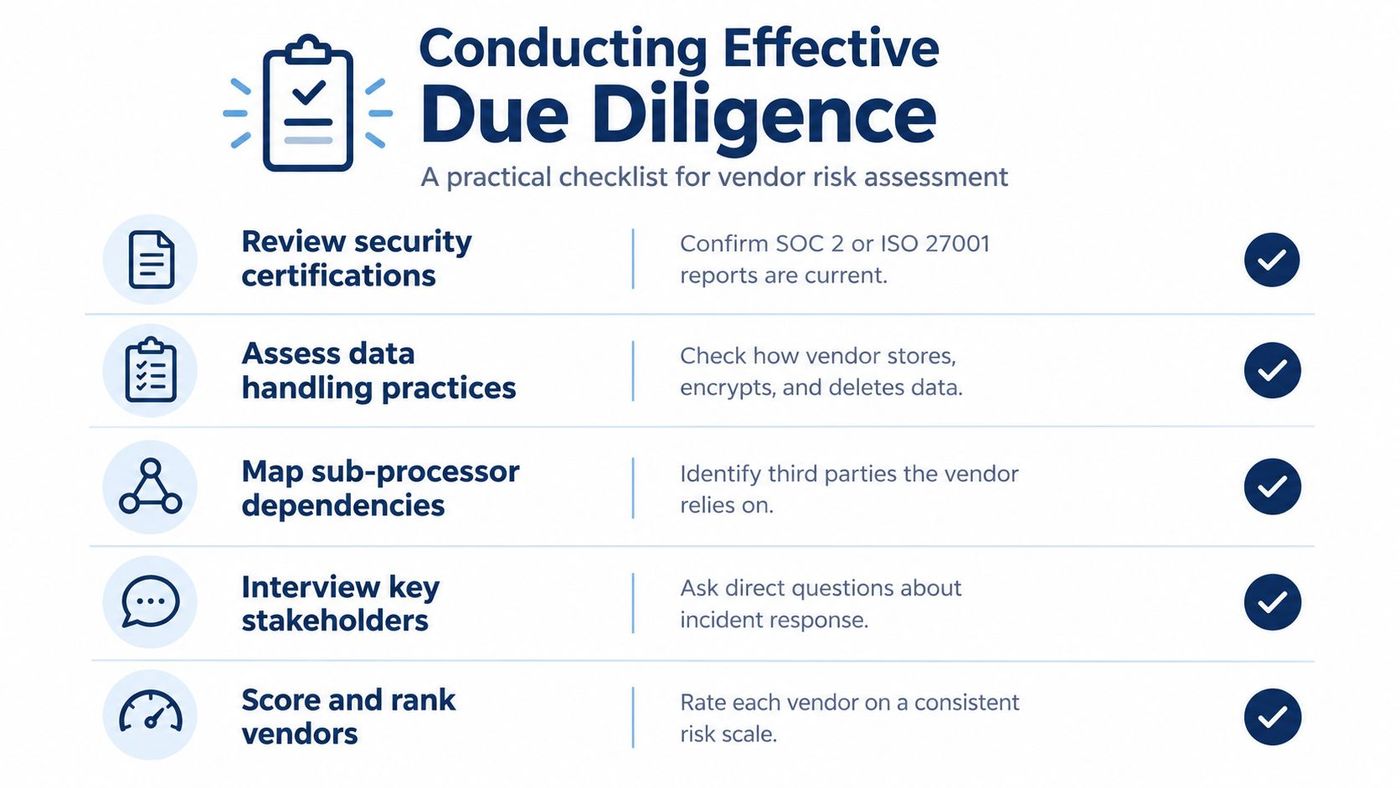
A useful scoring model separates inherent risk from residual risk. Score the service before controls are considered, then score the remaining exposure after safeguards, contractual protections, insurance, and recovery measures are applied. Keep the scale consistent, but don't let a single number hide a serious weakness in privacy, solvency, or continuity.
Use interviews for high-impact relationships. Ask the service owner to explain incident notification, privileged access, data deletion, restoration priorities, subcontractor oversight, and the process for communicating material changes. Where identity, fraud, or ownership concerns are material, specialist Private investigator services may complement routine corporate checks.
Finish with an action register. Each finding needs an owner, a due date, an acceptance decision, and a consequence if the vendor doesn't remediate it. A managed services questionnaire can provide a practical starting point for organising the questions and evidence, but the assessment still needs business judgement.
Vendor controls should reflect the information and workflow involved, not just the industry label. A healthcare clinic, law firm, finance company, and manufacturer may all use cloud software, but their assessment priorities differ.
Healthcare teams should map patient information, clinical workflows, support access, retention, and incident escalation. A Canadian organisation may also need to consider HIPAA when it handles US-connected relationships, but it shouldn't assume an American framework replaces Canadian privacy obligations. Legal firms should focus on solicitor-client confidentiality, matter segregation, document access, and the consequences of a provider exposing sensitive case material.
Financial organisations usually need stronger scrutiny of transaction data, identity information, access permissions, service availability, and regulatory evidence. Manufacturers and logistics companies may place greater emphasis on production dependencies, operational technology interfaces, shipment data, site access, and recovery from supplier interruption. These categories overlap, but the failure modes are different.
Canadian federal privacy guidance requires organisations to assess a third party's privacy practices before obtaining a product, service, or technology involving personal information, and to ensure comparable protection for information handled on their behalf. The Office of the Privacy Commissioner of Canada guidance also supports mapping how information moves between your organisation, clients, the provider, and additional parties.
Create a data-flow map that identifies:
Location and jurisdiction deserve explicit review. The University of Toronto's third-party data-location guideline highlights geopolitical context, contractual protections, security posture, and data sensitivity as factors to consider before contracting.
Public-sector-style privacy analysis can also sharpen private-sector decisions. Treasury Board guidance recommends considering the sensitivity of information, individuals' expectations, and potential injury from wrongful disclosure or misuse, including identity theft or foreign government access. Those questions are useful whether the supplier is a records platform, a Medical Virtual Assistants provider, or a specialist finance service.
A practical PIPEDA compliance checklist can help teams turn these requirements into procurement evidence instead of leaving privacy review until after implementation.
A yearly questionnaire can't capture a vendor's changing financial position, ownership, subcontractors, service architecture, or incident history. It creates a snapshot, while the relationship keeps moving. Critical suppliers need monitoring between formal reviews, with reassessment triggered by meaningful changes.
Deloitte Canada reported that 87% of businesses experienced a third-party disruption, 28% faced a major disruption, and 11% suffered a complete third-party failure. Those figures, documented in Deloitte Canada's third-party risk analysis, support a more active operating model.
Track signals that matter to the vendor's tier. Security alerts and external exposure can be relevant, but so can missed service levels, unresolved audit findings, ownership changes, insolvency indicators, insurance expiry, new subcontractors, data-location changes, and failed recovery tests.
Set a response path before an alert arrives:
A vulnerability management programme can connect external findings with internal assets and prioritise remediation. Monitoring works when it changes decisions. A dashboard that produces alerts nobody owns is only a more modern filing cabinet.
A workable vendor risk assessment programme has four connected parts. Classify the relationship according to criticality and access. Validate the supplier through corporate, financial, privacy, security, continuity, and subcontractor checks. Contract for the actual exposure, including notification, audit rights, data handling, recovery, service levels, and termination assistance. Then monitor and reassess when the vendor or your reliance on it changes.
The trade-off is straightforward. A small business can't perform an intensive audit on every supplier, and it shouldn't try. It can, however, reserve deep review for the vendors that could expose sensitive information or interrupt essential work, while applying proportionate controls to lower-risk relationships.
Assign ownership across procurement, IT, legal, privacy, finance, and the business service owner. Keep a central register containing the vendor's tier, services, data access, contract dates, evidence, open findings, risk acceptance, and exit plan. Review the register when a department buys a new tool, expands a service, changes a data flow, or prepares for renewal.
The strongest programme also connects vendor decisions to your existing IT operations. Access should be limited to what the service requires. Backups and recovery plans should account for supplier dependencies. Security alerts should reach someone who can act. Contract commitments should appear in the same operational calendar as renewals, certificate expiries, and continuity tests.
For medium-sized organisations, this approach turns vendor risk from a procurement bottleneck into a repeatable management discipline. It also gives leadership a clearer answer to the question that matters most: which third parties could materially harm the business, and what are we doing about them?
CloudOrbis Inc. provides managed IT support, cybersecurity, vulnerability assessment, compliance assistance, cloud services, backup and disaster recovery, and strategic IT consulting for Canadian SMBs. Visit CloudOrbis Inc. to discuss how your team can organise vendor evidence, monitor third-party exposure, and build a more resilient IT environment.
Book a 30-minute call with a senior engineer. No sales script, just straight answers about your environment.


