

September 22, 2026
Security Audit Services Guide for SMBs in CanadaDiscover why security audit services are vital for Canadian SMBs. Explore typical scope, deliverables, timelines, and tips to choose the right provider.
Read Full Post%20(1).webp)
Usman Malik
Chief Executive Officer
September 23, 2026
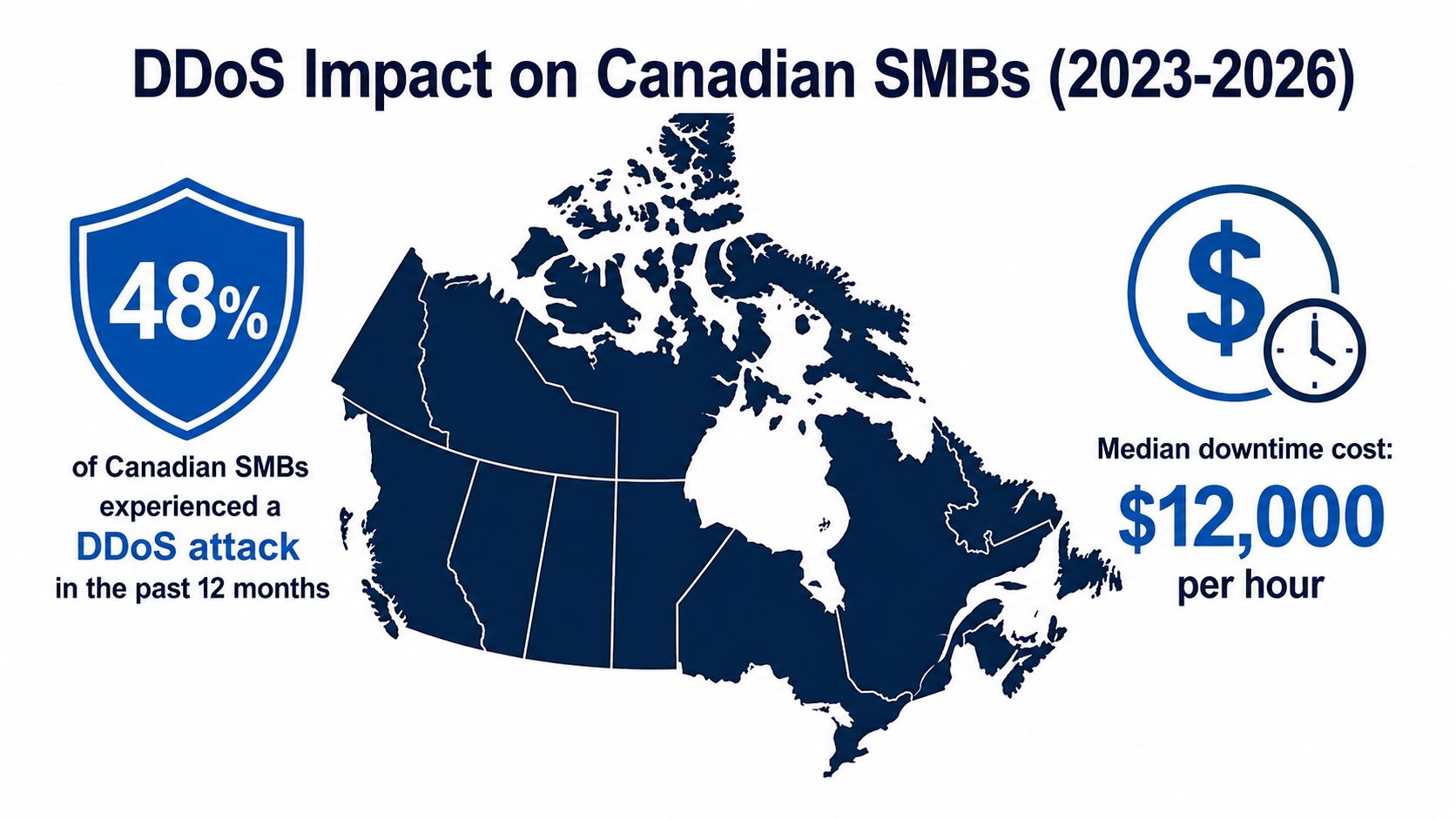
Canada ranks fifth globally for large DDoS attacks above 10 Gbps, receiving 7% of attacks in that category, according to CIRA's Canadian perspective on infrastructure security. That's not an abstract internet problem. For a Canadian business, a successful attack can stop an online store, interrupt a client portal, breach an availability commitment, and leave staff explaining an outage to customers instead of doing billable work.
The threat is also changing shape. Canadian authorities documented DDoS campaigns against government, financial, and transportation targets in 2023, while politically motivated disruption continues to affect visible Canadian websites. Recent botnet takedowns have temporarily reduced the size of some attack networks, but that doesn't make businesses safe. It shows that attackers, infrastructure, and tactics are shifting.
This guide gives Canadian SMB leaders a practical way to assess the risk. You'll learn how the main attack types work, which deployment model fits your organization, what to prepare before an incident, what to ask a provider, and how to run the first minutes of an attack without improvising.
Many owners still treat DDoS protection as something reserved for banks, government departments, or global technology companies. Canadian evidence doesn't support that assumption. The Cyber Centre reported several DDoS campaigns in September 2023 targeting multiple levels of the Government of Canada, as well as financial and transportation organizations, and advised organizations to consolidate and defend Internet gateways and isolate web-facing applications in its National Cyber Threat Assessment 2025–2026.
Canadian incident reporting also described 2023 as a record year for hacktivist-style DDoS activity, with four major episodes affecting roughly fifty Canadian organizations across public and private sectors. The lesson for an SMB is direct. Attackers don't need a personal dispute with your company. A public website, exposed portal, supplier relationship, or visible brand can be enough.
CIRA's older Canadian survey offers useful context on frequency, although it shouldn't be treated as a current forecast. It reported that 78% of organizations experienced no DDoS attacks, 18% experienced one to three, 3% experienced three to ten, and 1% experienced more than one attack in its survey distribution. The risk isn't evenly distributed, but “unlikely” still isn't the same as “unprepared”.
The botnet ecosystem is volatile. In Q2 2026, the largest observed DDoS botnet had 2.09 million devices, down from the previous quarter's 13.5 million-device record, with analysts linking part of the reduction to a law-enforcement operation involving authorities in the United States, Canada, and Germany. That's a temporary disruption, not a permanent reduction in risk. Attack infrastructure can be rebuilt, fragmented, or replaced with DDoS-for-hire services.
For Canadian leaders, the correct response is to plan for availability resilience, not just a large traffic spike. Government services, banking platforms, transportation systems, healthcare portals, legal client systems, and their suppliers all depend on reachable public-facing services.
Think of a busy storefront during a street festival. Legitimate customers are trying to enter, but a crowd is deliberately blocking the doorway. DDoS protection acts like a managed traffic control point. It identifies suspicious traffic, diverts or filters it, and lets genuine customers reach the business.
Technically, the process has two jobs:
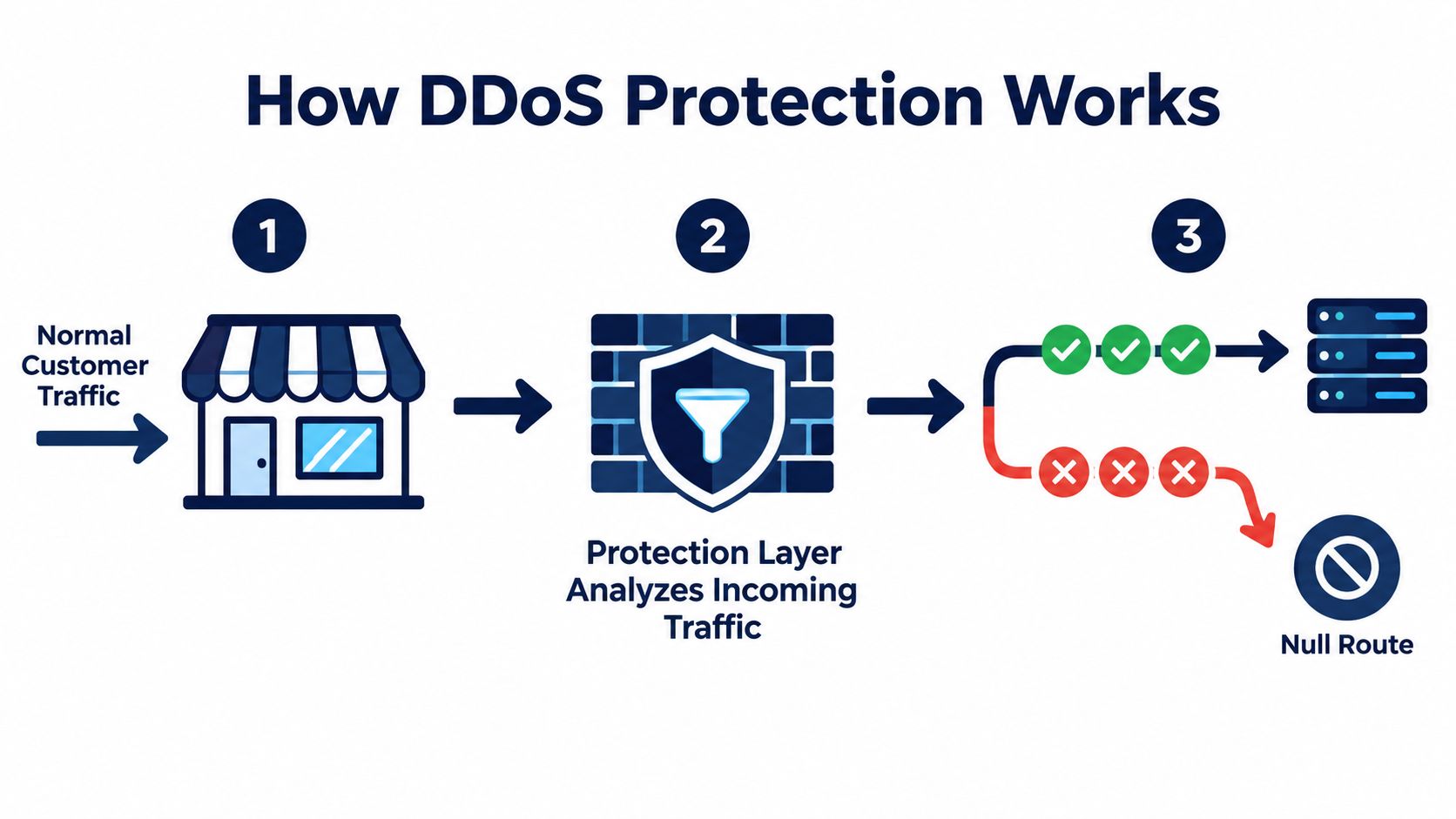
With always-on protection, traffic passes through the protection provider before reaching your origin environment during normal operations. The provider can compare activity against an established baseline and respond without waiting for your team to change routing.
With on-demand protection, your normal traffic path stays unchanged until an alert triggers a diversion. Your organization or provider then reroutes traffic through a scrubbing centre. This can reduce ongoing service cost and routing complexity, but it makes tested procedures and accurate contact details essential.
A scrubbing centre is a facility that receives traffic, separates harmful requests from legitimate ones, and forwards the clean traffic to your systems. Capacity means the provider's ability to absorb attack traffic without becoming saturated itself. Even a small business needs a provider with substantial capacity because attackers target the upstream connection, not just the size of the company's server.
An anycast network advertises the same service from geographically distributed locations. Traffic can reach a nearby node, while an attack gets spread across multiple sites instead of concentrating on one connection. The Cyber Centre recommends layered controls that include blackhole routing, rate limiting, WAF controls, continuous traffic monitoring, anycast network diffusion, and a prebuilt response plan in its guidance on defending against DDoS attacks.
Practical rule: DDoS protection is successful when customers can still use the service during the attack, not when the incident report looks tidy afterward.
For owners building a broader security baseline, the small business network security playbook from Nerds 2 You Edmonton provides useful foundational context. DDoS controls should sit alongside secure identity, endpoint protection, monitoring, backups, and an incident response process.
DDoS attacks don't all consume the same resource. A bandwidth flood overwhelms the road into your business. A protocol attack fills the connection system. An application-layer attack makes the server perform expensive work until real users are pushed out.
Volumetric attacks generate enough traffic to consume bandwidth. UDP floods and DNS amplification attacks are common examples. NETSCOUT recorded 25,091 DNS amplification attacks in Canada between July 2025 and December 2025, alongside 109,816 TCP ACK attacks, 13,404 TCP RST attacks, and 10,397 TCP SYN attacks in the same period, as reported in its Canada-specific data referenced by the Cyber Centre's national threat assessment. For an SMB, the consequence can be simple and severe: the Internet connection becomes unusable, even if the application server itself is healthy.
Protocol attacks exhaust connection state or network equipment resources. A SYN flood can leave a portal or gateway holding incomplete connection requests, reducing its ability to accept legitimate sessions. A municipal service portal, for example, may remain powered on while residents can't submit forms or access account information.
Application-layer attacks target the logic of a website or API. A low-and-slow HTTP attack might send apparently valid requests that consume CPU, database connections, or application workers. The traffic may look less dramatic than a volumetric flood, but an e-commerce site can still become slow or unavailable.
| Attack Type | What It Exhausts | Canadian Example | Primary Defence Layer |
|---|---|---|---|
| Volumetric | Internet bandwidth | UDP flood against a Canadian telecom or gaming service | Network and upstream scrubbing |
| Protocol | Connection state and gateway resources | SYN flood against a public service portal | Transport controls, rate limiting, ISP filtering |
| Application layer | CPU, sessions, database, and application logic | Low-and-slow HTTP traffic against regional e-commerce | WAF, behavioural detection, application rules |
No single firewall rule covers all three. The provider must combine upstream capacity, transport controls, traffic baselines, and WAF policies. Canadian telecom carriers were among the top targeted industries in the NETSCOUT data, with wired telecommunications carriers seeing 138,518 attacks at an average duration of 19 minutes during the stated reporting period. That combination of frequency and short duration makes delayed, manual response a poor strategy.
The right deployment depends less on company size than on where your public services run, how quickly you need mitigation, and who can operate the controls.
| Criterion | On-Prem Appliance | Cloud Scrubbing | Hybrid |
|---|---|---|---|
| Capital cost | Higher hardware investment | Lower initial investment | Moderate |
| Operations | Requires trained internal staff | Provider operates the mitigation layer | Shared responsibility |
| Attack capacity | Limited by local equipment and upstream bandwidth | Elastic, distributed capacity | Cloud absorbs floods, local tools inspect traffic |
| Control | Direct control over equipment and policies | Greater provider dependence | Control over sensitive traffic paths |
| Routing | Usually stays local until upstream saturation | Requires DNS or BGP diversion, depending on service | Uses both local and external paths |
| Compliance questions | Easier to keep inspection local | Requires data residency and provider review | Can separate sensitive workloads from public flood absorption |
An on-premises appliance can suit a regulated organization with capable network staff, predictable traffic, and a strong reason to retain inspection locally. It won't solve an upstream bandwidth problem if the attack saturates the connection before traffic reaches the appliance. You'll also need hardware capacity beyond normal demand and a tested relationship with the ISP.
Cloud scrubbing is usually the practical starting point for an SMB. The provider absorbs traffic away from your office or hosting environment, then forwards clean traffic to the origin. The trade-off is dependency on routing, DNS changes, provider response, and clear answers about where traffic is processed. Canadian healthcare, legal, and financial organizations should review privacy, confidentiality, contractual access, and residency implications before signing.
Control is valuable only if your team can operate it under pressure.
A hybrid design fits organizations that need local policy control but can't absorb a large flood on their own. A clinic might keep application inspection and sensitive integration traffic under local control while using cloud capacity for public web services. A legal firm could separate a client portal from internal document systems rather than expose the entire environment to one mitigation path.
For a 30-person firm, managed cloud protection is often easier to maintain. A 300-person organization with compliance staff, multiple sites, and internal network expertise may justify hybrid controls. Review the operational differences between these models in cloud computing versus on-premise environments before choosing based on purchase price alone.
Preparation determines whether your team makes one controlled routing change or spends the morning searching for access details. Canadian healthcare clinics, law firms, accounting practices, and professional services companies should complete the following before an alert arrives.
Start with every public-facing asset. Include websites, client portals, remote access gateways, APIs, hosted applications, domain names, and third-party services that customers depend on. Record the business owner, technical owner, hosting provider, ISP, escalation route, and acceptable outage decision for each asset.
Establish normal traffic baselines, including peak bandwidth and typical request patterns. Without a baseline, your provider may struggle to distinguish a campaign from a legitimate product launch, payroll run, appointment period, or seasonal surge.
Secure the registrar and DNS account with strong authentication and restricted administrative access. Review TTL settings so your team can support rapid failover, but don't assume a DNS change alone solves a saturated network path. Back up authoritative DNS zones and routing configurations offline, where an attacker or compromised administrator can't alter them.
Test WAF rules and rate limits in staging before applying them to production. A rule that blocks malicious automation may also block a legitimate partner, accessibility tool, mobile client, or API integration if nobody tests it.
Ask your ISP and hosting provider precise questions:
The Cyber Centre recommends explicit DoS defence provisions in agreements with cloud and Internet service providers because mitigation depends on filtering or absorbing traffic before it reaches your environment. Its guidance on protecting organizations against denial-of-service attacks also emphasizes recording the targeted asset, attack method, and duration to improve controls after recovery.
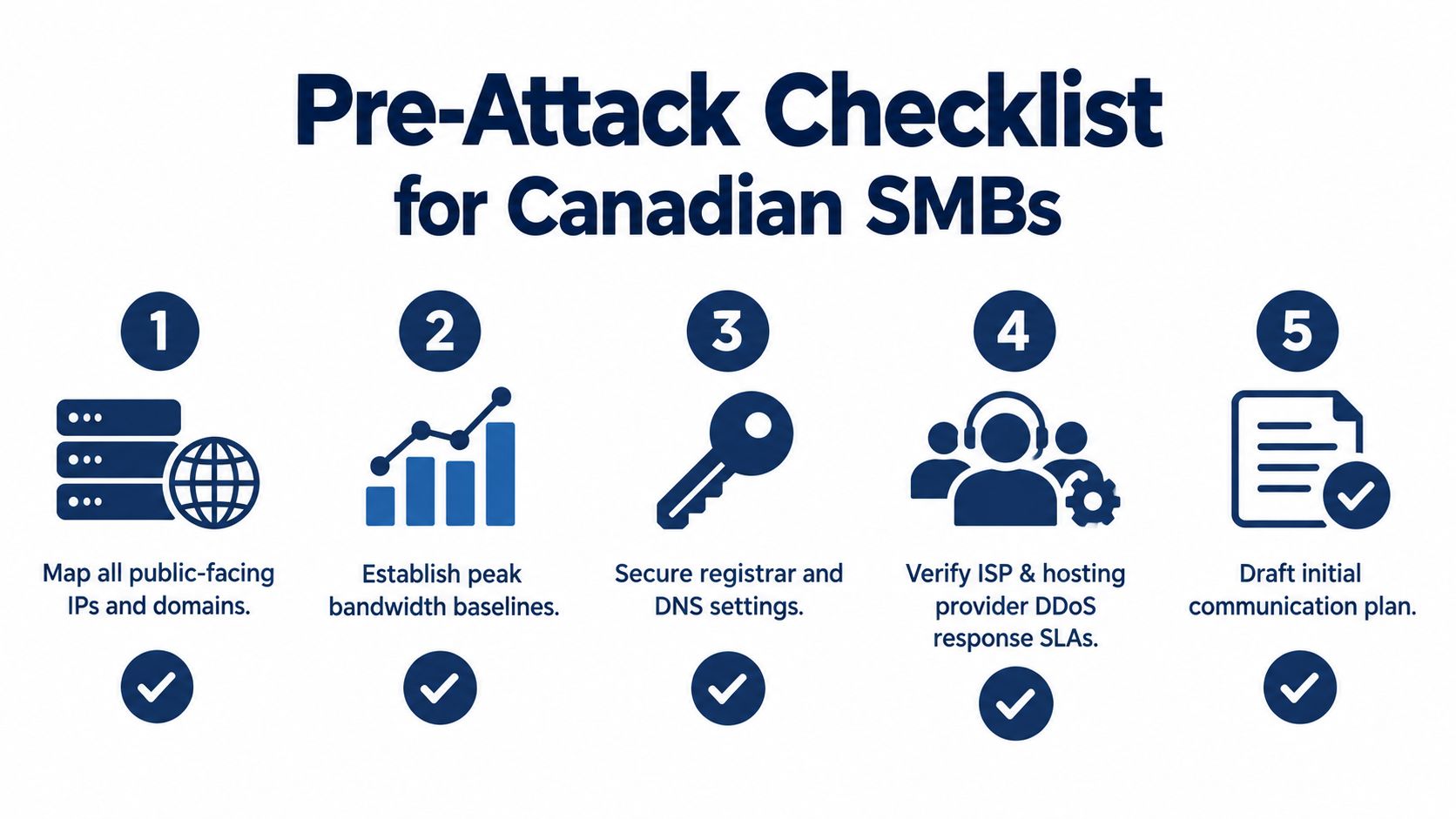
Schedule a tabletop exercise with the IT lead and executive sponsor. Include client communications, legal review, insurance contacts, and the decision-maker who can authorize emergency routing or service restrictions.
If your clinic handles US patient data, review applicable HIPAA obligations alongside Canadian requirements. For personal information, assess PIPEDA obligations and provincial rules relevant to your operations, including health-specific requirements in Ontario, British Columbia, and Quebec. Treat confidentiality as part of the incident plan, not a separate compliance exercise.
Run a 48-hour readiness test. Can the responsible person reach the provider, authenticate to the required account, approve rerouting, and restore normal traffic in under 15 minutes? If not, the organization isn't ready, regardless of what the contract says. Review broader observability practices in network monitoring best practices.
Ask one question first: where does mitigation happen, and where does clean traffic land? A provider that can't clearly explain whether traffic is processed in Canada, the United States, or another location hasn't given you enough information to assess privacy, latency, and contractual risk.
Use these evaluation dimensions during procurement:
Request Canadian customer references where confidentiality permits, written data-residency terms, and pricing that won't balloon during an active incident. Red flags include providers that won't identify scrubbing locations, sell “unlimited” protection without committed capacity, or bundle DDoS as a free add-on with no meaningful response obligation.
CloudOrbis Inc. is one managed IT and cybersecurity option Canadian SMBs can include in that comparison, particularly when the organization wants monitoring, threat detection, compliance support, and incident coordination managed with its broader IT environment. Use a structured managed services questionnaire to force comparable answers from every vendor.
A representative scenario makes the process easier to apply. A 40-person professional services firm in Mississauga notices that its client portal is saturated on the morning payroll runs. The numbers and timing are illustrative, but the ownership model should be written into your plan.
Owner: monitoring lead or managed provider. Action: confirm the anomaly, identify the affected asset, preserve the initial alert, and page the executive sponsor. Exit signal: the team has confirmed that the issue is abnormal traffic rather than an internal application failure.
At the first alert, don't restart servers repeatedly or make random firewall changes. Capture timestamps, dashboards, alerts, source patterns, affected domains, and user reports. The Cyber Centre recommends identifying the targeted asset, attack method, and duration because those details improve post-incident controls.
Owner: incident lead. Action: activate the playbook, contact the DDoS provider and ISP, and approve the agreed routing change. Exit signal: mitigation is engaged and the provider confirms that traffic is being analysed upstream.
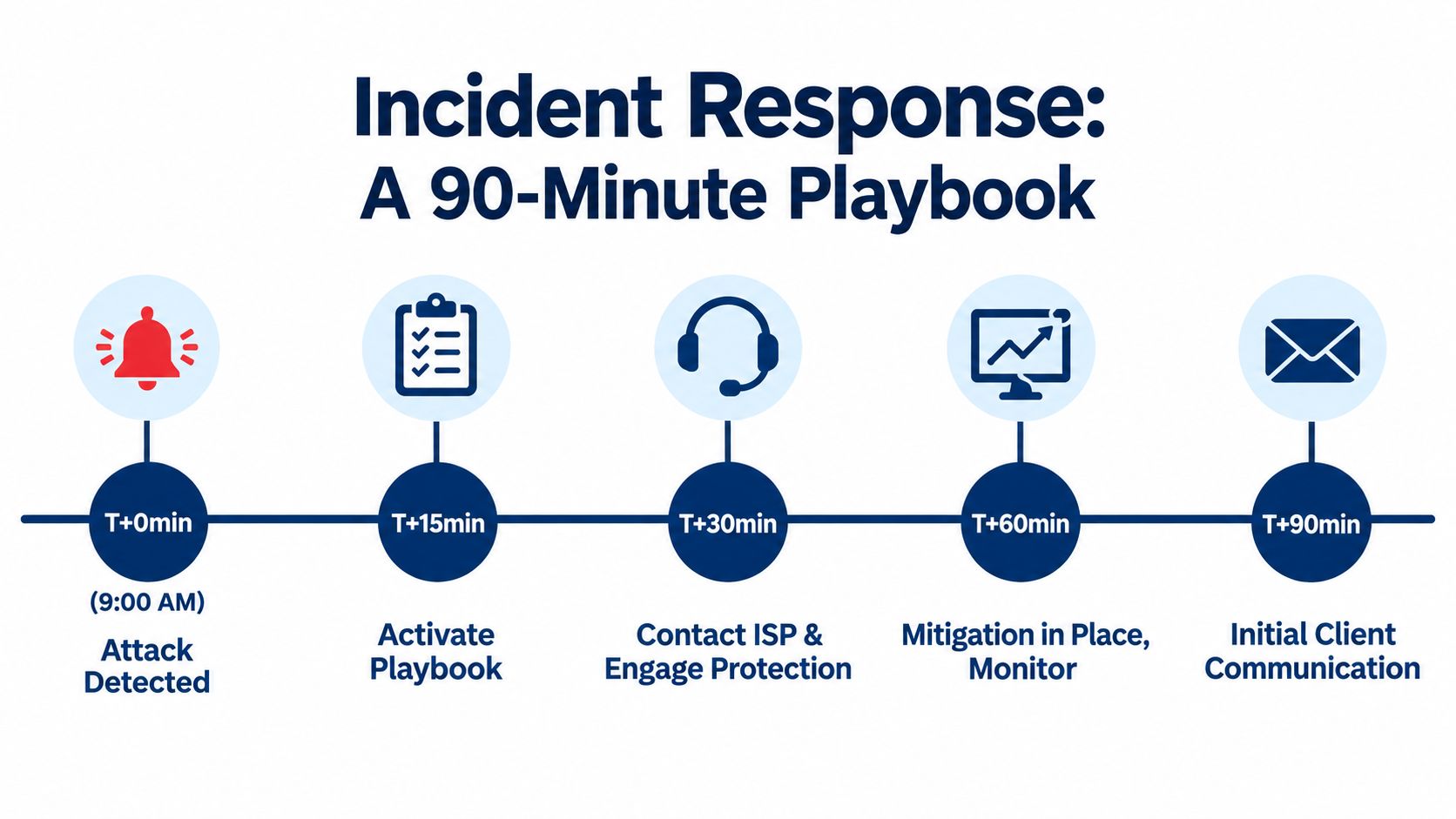
By the next phase, the portal traffic should route through scrubbing while the ISP monitors the connection. The application owner checks login, search, payment, and document functions from outside the office network. Exit signal: legitimate users can complete the critical workflow and monitoring shows stable service.
Owner: executive sponsor and communications lead. Action: prepare a short client message that explains service impact without speculating about the attacker. If personal information may be involved, involve privacy and legal advisers before making notifications. DDoS alone doesn't prove a data breach, but an outage can still trigger contractual, regulatory, or customer communication duties.
Owner: technical lead. Action: preserve logs and provider reports for potential reporting to the RCMP, insurers, or other relevant authorities. Don't erase traffic evidence while trying to clean up. Record decisions, contacts, routing changes, and service restoration times.
For broader preparation, align this process with a documented threat detection and response capability rather than leaving DDoS as an isolated network task.
Restore normal routing only after the provider confirms that the attack has subsided and the application owner verifies service health. On day 30, hold a formal post-mortem. Reconcile lost productivity and recovery costs, assess insurance coverage, close control gaps, update contact lists, and share a written debrief with staff.
Myth one: “We're too small to be targeted.” Automated scanning, compromised devices, and politically motivated campaigns do not exclude small businesses. Canadian reporting has recorded hacktivist-style DDoS activity against public and private organizations, while the Cyber Centre has documented short attacks on Canadian websites, including public-facing Canadian Armed Forces sites. A clinic, manufacturer, or supplier can be selected directly or caught in a wider campaign.
Myth two: “Our firewall already covers DDoS.” Firewalls still enforce useful access and application rules. A stateful appliance cannot solve an attack after the upstream circuit is saturated, and its connection tables may fill first. Keep local controls, then add upstream filtering and distributed capacity so traffic is stopped before it reaches the office or hosting connection.
Myth three: “Cloud protection is too expensive.” Compare the recurring service cost with the business consequence of losing a customer portal, online ordering, or time-sensitive service. Review what a dedicated cyber security service should cover for SMBs, including monitoring, escalation, and incident coordination. The business decision is whether the added resilience costs less than managing an outage during a customer-critical period.
Myth four: “Once we turn it on, we're finished.” Protection requires tuning, tested WAF rules, accurate contacts, and regular exercises. Run tabletop sessions quarterly, update escalation lists, and retest failover after major hosting, DNS, ISP, or application changes. A control that has never been tested is only an assumption.
Myth five: “Canada is less exposed.” CIRA's country-level analysis places Canada fifth globally for large DDoS attacks above 10 Gbps, with 7% of attacks in that category. More recent Canada-specific reporting recorded substantial activity across multiple TCP and DNS vectors. A Canadian location offers no protection when customers can reach the service from the Internet.
Botnet disruption has changed the threat shape, not removed it. The Q2 2026 reduction in the largest observed botnet followed international law-enforcement action, while attackers can rebuild infrastructure and change methods. Hacktivism also keeps short, disruptive campaigns relevant to public-facing businesses.
The right next step is a 30-minute scoping call with your IT lead, provider, and executive sponsor. Decide whether always-on or on-demand mitigation fits the service, confirm where traffic will be handled, and document the response playbook before an attack. Compare the plan with your maximum tolerable outage and customer obligations.
If your organization needs help assessing exposure, CloudOrbis Inc. offers managed IT support, cybersecurity monitoring, threat detection, compliance assistance, cloud solutions, backup, and incident coordination for Canadian SMBs. Use that review to identify public-facing services, clarify ownership, and build a DDoS response plan your team can execute under pressure.
September 22, 2026
Security Audit Services Guide for SMBs in CanadaDiscover why security audit services are vital for Canadian SMBs. Explore typical scope, deliverables, timelines, and tips to choose the right provider.
Read Full Post
September 21, 2026
Secure File Sharing Guide for Canadian BusinessesLearn secure file sharing essentials for Canadian SMBs — encryption, compliance, protocols and best practices to protect data and stay compliant.
Read Full Post
September 20, 2026
Disaster Recovery Plan Business Continuity for SMBsBuild a disaster recovery plan business continuity strategy tailored for Canadian SMBs. Covers risk assessment, RTO/RPO, backup, testing, and ownership.
Read Full Post
