

September 20, 2026
Disaster Recovery Plan Business Continuity for SMBsBuild a disaster recovery plan business continuity strategy tailored for Canadian SMBs. Covers risk assessment, RTO/RPO, backup, testing, and ownership.
Read Full Post%20(1).webp)
Usman Malik
Chief Executive Officer
September 21, 2026

A manager at a clinic sends a lab report to a specialist. An accountant shares a year-end package with an external bookkeeper. A logistics firm emails a pricing spreadsheet to a partner from a phone between meetings. None of that feels unusual. It's just work.
The problem is that everyday file sharing often grows faster than the rules around it. Teams start with email attachments, then add OneDrive, Google Drive, text messages, shared folders, and personal mobile apps. Before long, sensitive files are moving through five different channels, and nobody can clearly answer a basic question: who had access, for how long, and how was that file protected?
For Canadian small and mid-sized businesses, secure file sharing isn't only about buying a safer upload tool. It's a governance issue. It touches privacy, accountability, retention, offboarding, and whether your team shares only the information that's needed. That matters in environments shaped by PIPEDA and, in healthcare, PHIPA.
Busy teams rarely set out to create risky sharing habits. They usually create convenient ones.
A clinic may need to send imaging results quickly. A finance team may need signatures before month-end. A construction company may need to move drawings between the field and the office. In each case, the pressure is speed. If the secure option feels awkward, staff will use the familiar option instead.
That's why secure file sharing needs to feel like a business enabler, not IT friction. It should help your team move faster with fewer workarounds, while keeping sensitive information protected and traceable.

Canadian organizations are operating in a real risk environment. Just under three in ten Canadian organizations, 29%, said they experienced a breach of customer and/or employee data in the period covered by a CIRA snapshot on cybersecurity and remote work, which is a useful reminder that exposure is common when controls are loose (CIRA cybersecurity snapshot).
Government guidance shows what “good” looks like in practice. Federal handling rules require encrypted transmission, encrypted transportable media, restricted-access folders, and secure file-transfer procedures for sensitive information. In plain terms, Canada's own public-sector baseline treats encryption, access control, and secure transmission as normal operating controls, not premium extras.
Practical rule: If your team shares confidential files in a way you can't monitor, limit, or revoke, you don't have a file-sharing process. You have a blind spot.
Many articles reduce secure file sharing to a product checklist. Encryption. Passwords. Link sharing. Done.
That's not enough. The harder questions are operational. Who approves external sharing? How do you avoid sending more data than needed? What happens to shared files in backups? How quickly can you cut off access when an employee leaves? Those are the questions that turn a tool into a governed workflow.
If your current setup is a patchwork of habits, start with your data controls before your software shortlist. CloudOrbis has written about this from the broader angle of cloud data protection, and the same principle applies here. The file is only one part of the risk. The surrounding process matters just as much.
When a file leaves your device, several things should happen before anyone else can open it. If they don't, the file may still arrive, but it won't be secure.
A useful way to think about this is a vault, key, and delivery route.
If any one of those is weak, the whole process weakens with it.
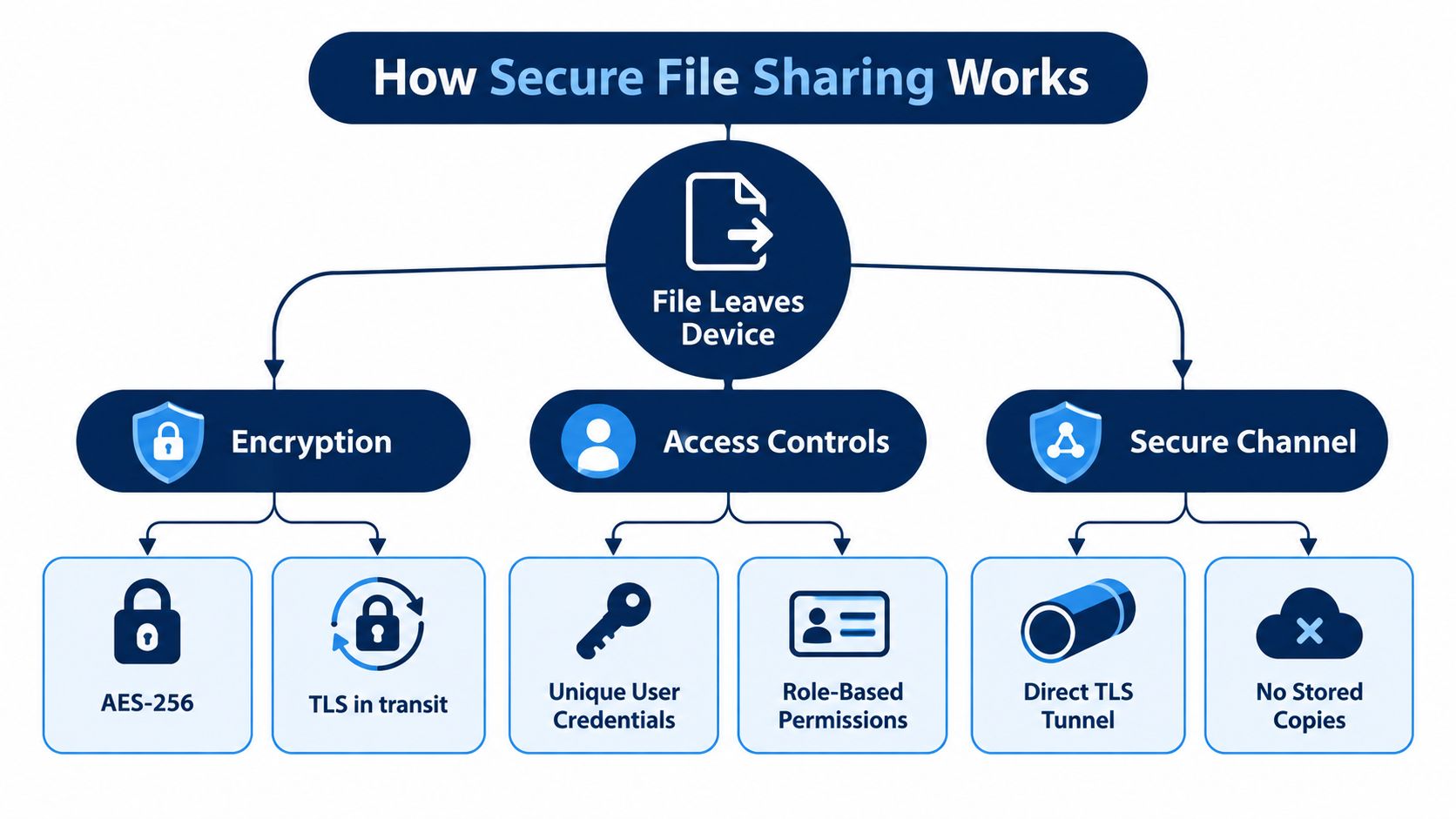
Encryption in transit protects the file while it's moving across networks. Think of it as a locked armoured truck on the road.
Encryption at rest protects the file when it's stored in a folder, cloud platform, or server after delivery. That's the locked vault once the truck reaches the building.
Canadian federal cloud guardrails make the transport part very concrete. They require TLS 1.2 or above for all cloud services and external communications, and they require encryption at rest when risk assessment warrants it (Treasury Board cloud guardrails). For business leaders, the practical lesson is simple: access permissions alone don't protect a file if the route itself isn't encrypted.
The next layer is identity. The system needs to know who is asking for the file and what they're allowed to do with it.
That usually means:
A payroll manager might need edit rights. An external auditor might need view-only access. A patient may need access to one document and nothing else. Secure file sharing should make those differences easy to enforce.
One of the most common mistakes is sending an encrypted file and its password in the same email thread. That's like locking a briefcase and taping the combination to the lid.
Ontario's eHealth guidance recommends strong password protection, different passwords per document, a minimum of 8 characters, and an out-of-band password exchange, meaning the password should be communicated separately from the file (Ontario eHealth file encryption guidance).
Send the file one way. Send the password another way.
That separate-channel habit is easy to explain to staff and easy to audit later. If your team wants a plain-language primer on the technical side, CloudOrbis also has a useful overview of SMB encryption basics.
Most file-sharing failures don't look dramatic at first. They look ordinary.
A staff member sends a link to the wrong contact. A folder inherits broader permissions than expected. Someone downloads sensitive files onto an unmanaged laptop. A departing employee still has access to a shared workspace for days after offboarding starts.
These aren't exotic attacks. They're routine control failures.
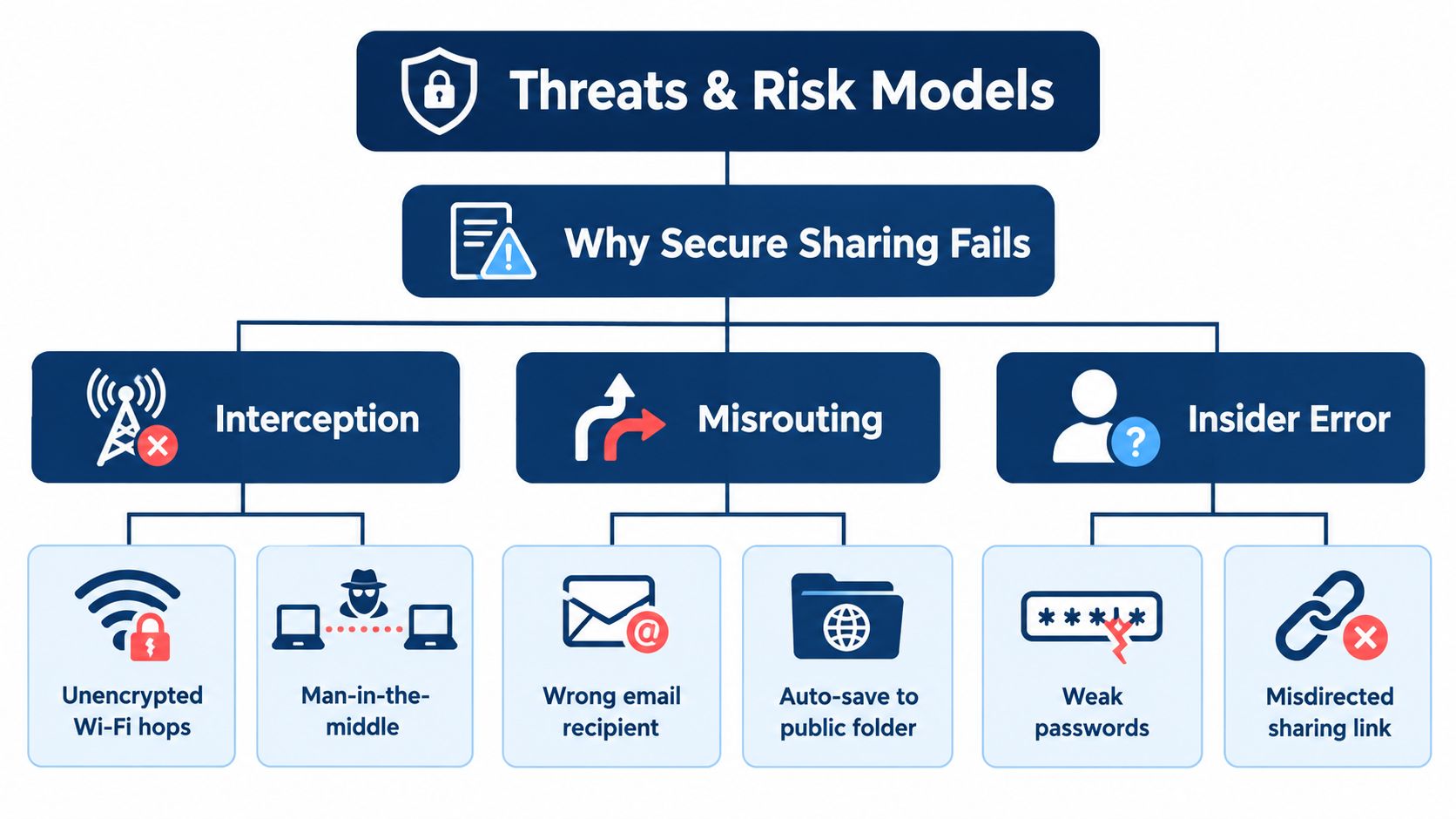
Here are the patterns Canadian SMBs should watch for most closely:
You don't need a complex framework to make better decisions. Use two questions.
| Risk question | What to ask |
|---|---|
| How likely is it | Does this happen often in our normal workflow, such as email attachments, mobile access, or external partner sharing? |
| How serious is it | If this file were exposed, would it create privacy, legal, contractual, or reputational harm? |
A public brochure has low impact. A patient summary, payroll file, or customer contract package has much higher impact. The tighter the data sensitivity, the less tolerance you should have for convenience-based shortcuts.
Ontario healthcare guidance pushes this further by focusing on minimum necessary disclosure, secure transfer, encrypted e-communication for PHI, and audit trails for access to electronic records (Ontario PHIPA guidance summary). That's a good model even outside healthcare. Share less. Prove access. Keep records.
A useful test is this. If a file reached the wrong person today, could your team quickly tell what was shared, who opened it, and whether access can still be revoked?
If the answer is no, your file-sharing risk isn't just technical. It's operational. That's where related controls like data loss prevention become part of the conversation.
Not every secure file-sharing setup needs the same architecture. A small clinic exchanging referrals has different needs than a manufacturer sending drawings to suppliers, or a logistics firm automating file transfers with partners.
The key is matching the architecture to the workflow, not chasing feature lists.
SFTP works well when you need structured, controlled file transfer between known parties. It's common for recurring exchanges, batch files, and system-to-system workflows.
TLS-protected web or cloud sharing is often the better fit for employee and client collaboration. It's easier for non-technical users, especially when combined with secure folders, link controls, and identity-based permissions.
Restricted-access cloud folders fit internal and external collaboration where people need to review or update documents over time, not just send them once.
DLP and CASB controls sit above the transfer itself. They help enforce policy, such as detecting sensitive data, blocking risky sharing behaviour, or applying rules across cloud services.
Federal guidance in Canada is very clear that secure channels matter. Statistics Canada's receiving-organization requirements call for logical access controls, encryption for transportable media, network firewalls, secure internet connections, and secure folders with restricted access. The same guidance says to avoid sending Statistics Canada data files by email and to use folder links accessible only to authorized users (Statistics Canada receiving-organization obligations).
That's a strong practical benchmark for SMBs too. If a workflow still depends on ordinary email attachments for sensitive files, it's worth redesigning.
| Architecture | Best For | Key Protection | Watch Out For |
|---|---|---|---|
| SFTP | Recurring partner exchanges, scheduled file drops, accounting exports | Encrypted transfer path, controlled endpoints | Can be less intuitive for non-technical users |
| TLS-secured cloud sharing | Staff collaboration, client document exchange, approvals | Encrypted transit, identity checks, link controls | Weak configuration can leave links too broad |
| Restricted secure folders | Ongoing workspaces for projects, clinics, legal matters | Folder permissions, controlled membership, auditability | Permission sprawl over time |
| DLP and CASB layered over sharing tools | Regulated environments and multi-cloud operations | Policy enforcement, visibility, blocking risky actions | Needs clear ownership and tuning |
A useful parallel comes from another sector. The overview on Reworx Recycling breach prevention highlights that breach prevention is often about process discipline around data handling, not just perimeter defence. File-sharing architecture works the same way. The safest protocol still fails if people can overshare, bypass logging, or keep stale access in place.
If you're comparing platforms, include operational questions in the review. Who controls keys? Can you expire links? Can you restrict by user, not just by link? Are logs detailed enough for investigations? Those questions matter more than a long feature grid.
A secure setup doesn't appear all at once. It's usually built through a sequence of practical decisions, each one reducing a different kind of exposure.
That sequence matters. Teams often start with storage and skip identity, or they enable encryption but forget monitoring. A better approach is to harden the workflow from the user outward.
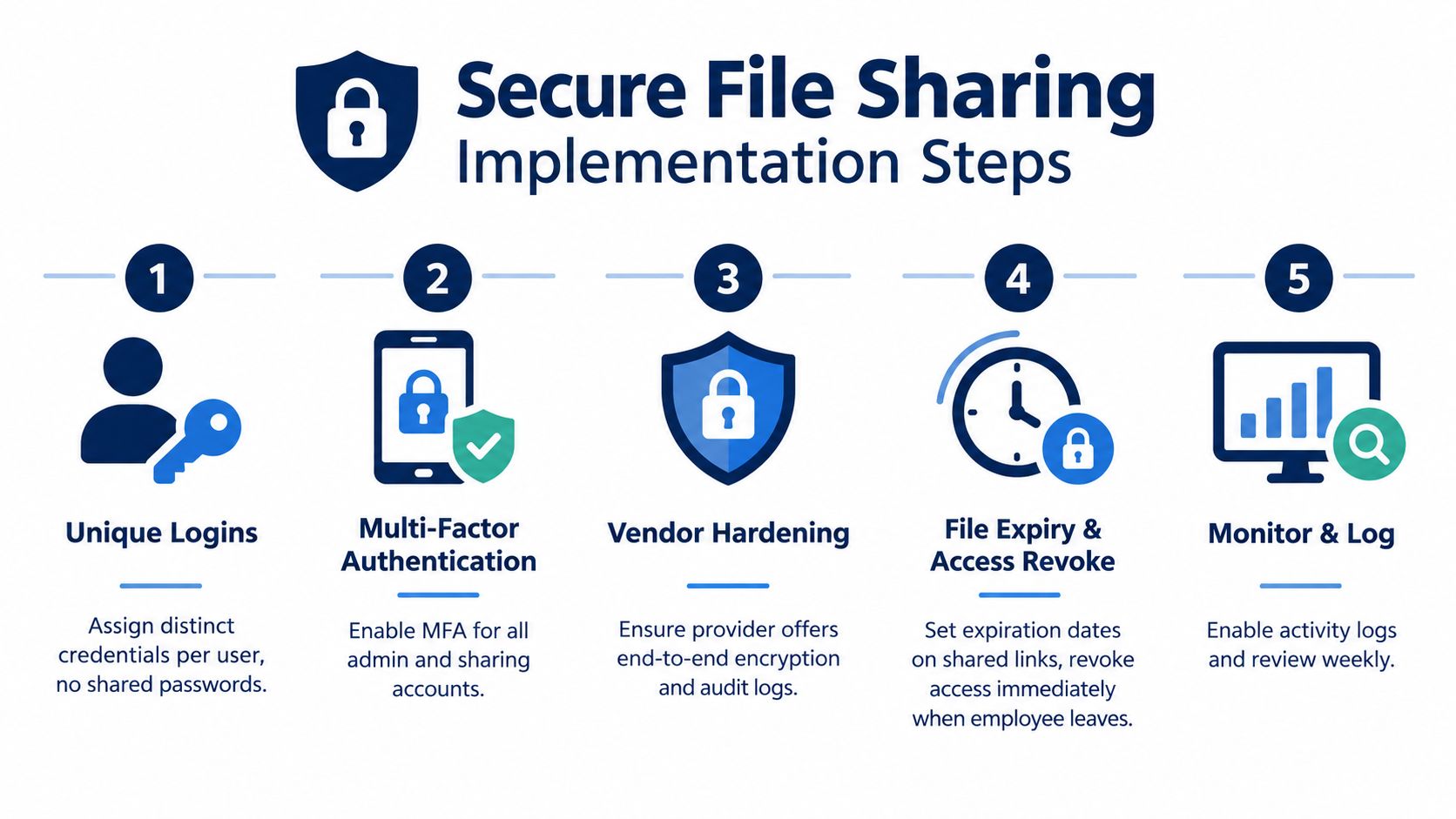
Secure file sharing begins with named accountability.
A practical offboarding test helps here. If someone leaves today, can your team revoke their access to all shared files quickly and confidently?
Next, verify the technical protections behind the workflow.
Federal protected-cloud guidance requires that protected data be encrypted while in transit and at rest, and that the Government maintain exclusive control of encryption keys (Government of Canada data sovereignty white paper). Even if you're not a public-sector organization, that's a useful standard when evaluating platforms for regulated or sensitive information.
For most SMBs, that means checking for:
Once a secure platform is in place, tighten the actual sharing behaviour.
Use link expiry for temporary access. Prefer specific named recipients over broad links. If you must send an encrypted file outside the platform, send the password separately. Restrict downloads where the business case allows it.
Field check: Ask one manager to share a sensitive file with an external party using your current process. Then verify three things: the link can expire, access can be revoked, and the event appears in logs.
Auditability is what turns a file-sharing tool into a controlled workflow. You need to know who shared, who opened, who downloaded, and when.
Product configuration often gets neglected. Teams may buy Microsoft 365 or another cloud platform with strong controls available, then leave default sharing policies too open. CloudOrbis publishes practical guidance on OneDrive file sharing controls, including specific-people links, access review habits, passwords, and expiry settings that help make those defaults safer.
If you use a managed provider, this is one place where CloudOrbis Inc. can fit as one option among others. Its managed IT and cybersecurity services include support for Microsoft 365 configuration, security monitoring, and policy enforcement around collaboration tools.
For Canadian SMBs, the vendor question shouldn't be “Which file-sharing tool has encryption?” Many do.
The better question is “Which option helps us enforce accountability from first share to final deletion?”
That shift matters because privacy obligations don't end when the file arrives. They continue through storage, access reviews, mobile use, backups, offboarding, and retention.
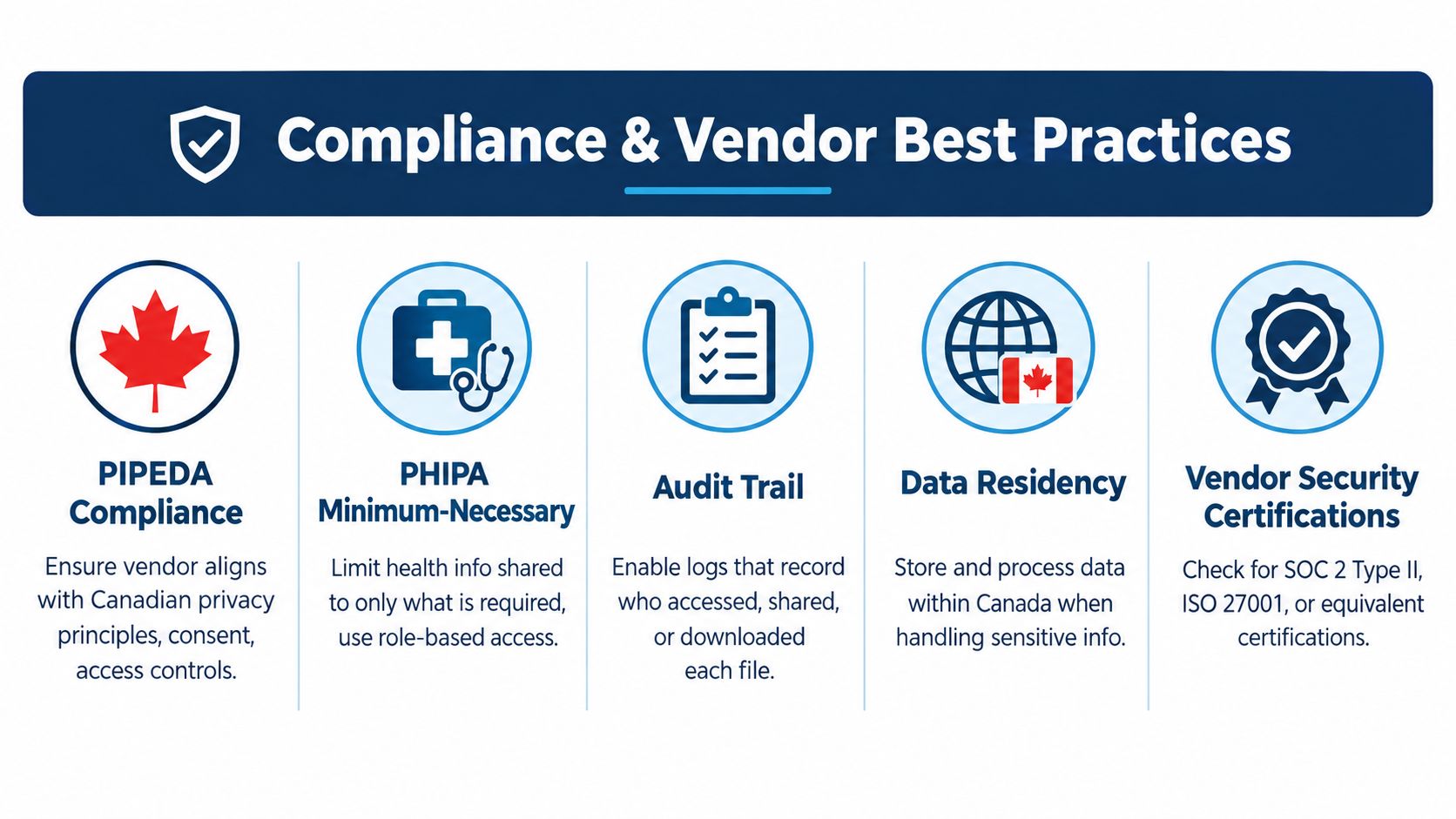
Use this shortlist during procurement:
One practical reference point comes from British Columbia's Secure File Transfer Service. It can send packages of files, receive authorized files, support secure shared folders, and automatically deletes shared files after 35 days (BC Secure File Transfer Service). That kind of explicit retention mechanic is useful because it turns cleanup from a manual habit into a system control.
A clinic sharing files with an external specialist doesn't just need encryption. It needs to share only the minimum necessary information, keep an audit trail, and avoid leaving shared copies in too many places.
A manufacturer sharing drawings with a supplier needs similar discipline. Which version is authoritative? Can the supplier still access old folders after the project closes? Are mobile downloads controlled? Are backup copies retained longer than the business intended?
Ontario guidance around PHI pushes this point clearly by tying secure transfer to minimum necessary data, reasonable safeguards, encrypted e-communication, and audit trails. PIPEDA-driven organizations should think the same way even when the data isn't health-related. Privacy isn't only about stopping attackers. It's also about proving appropriate handling.
The category itself is growing. Market research projects the Canada secure file transfer market will grow from USD 209.9 million in 2026 to USD 303.3 million by 2031, a 7.6% CAGR (Canada secure file transfer market projection). That projection shows rising demand, but it doesn't solve the core operating question: who owns the rules when files move between email, cloud storage, and phones?
For teams working through that governance layer, a practical companion is a PIPEDA compliance checklist that helps connect privacy requirements to daily operational controls.
The strongest secure file-sharing setups don't feel complicated to end users. They feel normal. Staff know where to send files, how to share them, when access expires, and what not to do. Leaders know the process is logged, reviewed, and governed.
That's goal. Not a shiny new transfer tool. A repeatable workflow that reduces guesswork.
If you want to move quickly, start here:
If your team remembers only one idea, make it this: secure file sharing is a governance practice supported by technology.
Encryption matters. So do permissions. But the true maturity test is whether your business can answer simple questions under pressure. Who shared the file? Was it the minimum necessary? Who accessed it? When does it expire? Has it been deleted where it should be deleted?
Good secure sharing reduces risk and removes friction at the same time. People stop improvising because the approved method is clear and workable.
For Canadian SMBs, that's the standard worth aiming for. It supports compliance, lowers exposure, and gives busy teams a process they can follow.
CloudOrbis Inc. provides managed IT, cybersecurity, cloud, and compliance support for Canadian SMBs that need secure, practical file-sharing workflows across Microsoft 365, cloud platforms, and mobile teams. If you want help assessing your current sharing risks, tightening permissions, and building a simpler governed process, visit CloudOrbis Inc..
September 20, 2026
Disaster Recovery Plan Business Continuity for SMBsBuild a disaster recovery plan business continuity strategy tailored for Canadian SMBs. Covers risk assessment, RTO/RPO, backup, testing, and ownership.
Read Full Post
September 19, 2026
Database Migration Services Explained for Canadian SMBsLearn how database migration services move data to the cloud securely with minimal downtime. Types, risks, costs and a Canadian provider checklist.
Read Full Post
September 18, 2026
Business VoIP Telephone Systems Explained for SMBsLearn how business VoIP telephone systems work, what they cost and how to choose a secure, resilient option for your Canadian SMB.
Read Full Post
