Vulnerability Management: Boost SMB Security in 2026
Discover why vulnerability management is critical for Canadian SMBs. Our 2026 guide covers the lifecycle, HIPAA compliance, and choosing the right solution.

Discover why vulnerability management is critical for Canadian SMBs. Our 2026 guide covers the lifecycle, HIPAA compliance, and choosing the right solution.
Police-reported cybercrime in Canada reached 225.1 incidents per 100,000 people in 2024, more than double the 91.9 per 100,000 recorded in 2018, according to Statistics Canada's Computer Security Day release. That matters to every business owner because most attacks don't begin with movie-style hacking. They begin with an overlooked weakness, an old server, a missing patch, a misconfigured cloud service, or a web application nobody realised was still exposed.
For Canadian SMBs, especially in healthcare, finance, legal, and other regulated environments, vulnerability management isn't an IT housekeeping task. It's a business discipline. It protects uptime, supports audits, reduces remediation costs, and gives leadership a clearer picture of operational risk. If you already have antivirus, backups, and MFA, that's useful. It still doesn't answer a basic question: where are your current weaknesses, and how quickly are they being closed?
Vulnerability management is the ongoing process of finding weaknesses in your systems, deciding which ones matter, fixing what you can, and formally tracking what you can't fix yet. The key word is ongoing. A one-time scan is an assessment. A repeatable program is management.

Business owners usually first encounter this topic in one of three ways. A client sends a security questionnaire. An insurer asks for proof of controls. Or an incident exposes the gap the hard way. In all three cases, the problem isn't just technical. It's governance, accountability, and speed.
A solid program covers more than servers and laptops. It also includes cloud workloads, line-of-business applications, firewalls, remote access tools, and third-party software dependencies. If your team doesn't know what assets exist, no scanner can give you a complete answer. That's why vulnerability management always starts with visibility.
If you want a straightforward comparison of what an assessment looks like before building a full program, this Overton Security property assessment offers a useful outside perspective. For a service-focused view on identifying exposures in business environments, CloudOrbis also outlines the role of vulnerability assessment services.
Practical rule: If a finding can't be tied to a business asset owner, a remediation deadline, and a verification step, it usually won't get fixed on time.
Think of vulnerability management the same way you think about financial controls. You wouldn't review your books once, declare them clean, and stop accounting. Security weaknesses work the same way. New software flaws appear constantly, systems change, staff add tools, and vendors release updates on their own schedules.
For regulated Canadian SMBs, this process becomes even more important because audit questions rarely ask whether you care about security. They ask whether you can prove what you found, what you fixed, what you deferred, and who approved the risk.
The financial case is already strong. According to Cybersecurity Canada's summary of Statistics Canada data, Canadian businesses spent approximately $1.2 billion recovering from cyber security incidents in 2023, and that figure had roughly doubled since 2021. The same source notes that the Government of Canada defines vulnerability management as “a risk management function.”
That definition is important because it changes the discussion in the boardroom. This isn't about scanning for the sake of scanning. It's about reducing business risk before it becomes downtime, legal exposure, or avoidable recovery cost.
Most SMBs don't get hit by a single dramatic event. They get worn down by interruption. A server can't be patched because no one knows what depends on it. A clinic delays an update because the application owner is worried about disruption. A finance team leaves an old internet-facing system in place because replacement is planned “next quarter.” Attackers look for those gaps because they work.
A mature vulnerability management program helps leadership answer questions like these:
Healthcare and finance firms deal with more than security best practices. They deal with evidence. Under PIPEDA, organisations need a defensible approach to protecting sensitive information and responding to security incidents. Clinics that support U.S. patient workflows or business relationships may also have HIPAA obligations. In both cases, undocumented remediation work creates problems during reviews.
A spreadsheet full of vulnerabilities is not a program. Auditors look for process, ownership, timelines, exceptions, and proof that fixes were verified.
Many SMBs fall short in their vulnerability management efforts. They run scans, export reports, and stop there. What works is a documented cycle that ties findings to risk decisions and business owners. What doesn't work is treating every issue as equally urgent, then closing none of them fast enough.
For leaders looking at broader threat patterns beyond Canada, this guide to protecting Atlanta organizations is a useful reminder that regional markets differ, but the business consequences of weak cyber hygiene look very similar everywhere.
Security maturity helps sales, vendor due diligence, and insurance conversations. It also reduces friction during mergers, expansion, and cloud adoption. When a company can show repeatable vulnerability management, it signals operational discipline. That matters to customers and partners who don't want to inherit your risk.
A good way to think about vulnerability management is a building maintenance schedule. You don't inspect a facility once and assume it stays safe forever. You inspect, rank problems, repair what matters first, confirm the repair worked, and keep records.
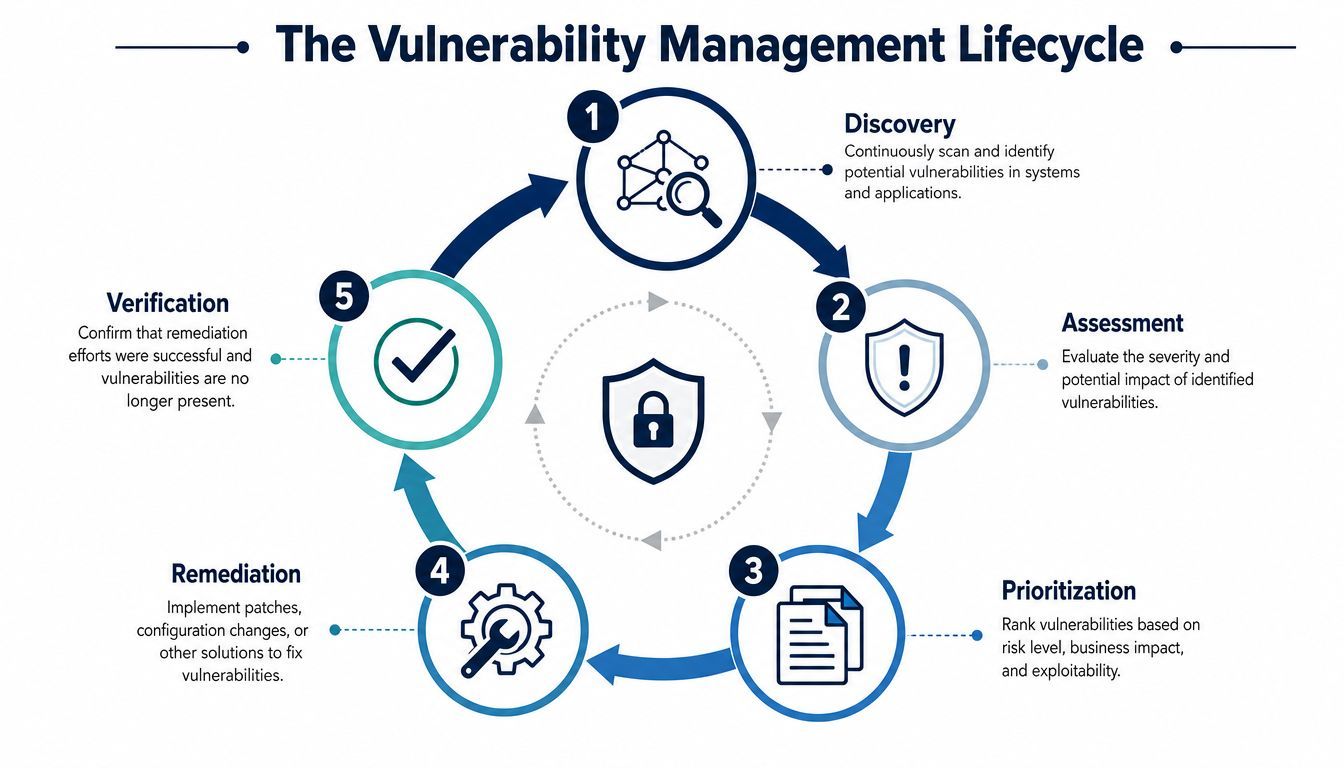
In this stage, teams identify assets and scan them for known weaknesses. Discovery fails when the asset list is incomplete. It also fails when internet-facing systems, cloud workloads, or remote offices sit outside the scanning scope.
That's why asset discipline matters so much. If your inventory is messy, your security picture will be too. This is also where a structured IT asset management approach supports better vulnerability data.
Once issues are found, teams need to understand what each one means. A flaw on a public-facing server that stores client records isn't the same as the same flaw on an isolated test machine. Assessment adds technical detail. Prioritization adds business context.
A useful review usually includes:
Remediation includes patching, configuration changes, software upgrades, removing unused services, or replacing unsupported systems. This is the stage where reality gets messy. Some patches break applications. Some vendors take time to certify updates. Some systems can only be changed during maintenance windows.
That's why strong teams don't treat patching as the only response. They also use temporary controls when needed.
Field advice: If a patch would create unacceptable downtime, document the decision, reduce exposure immediately, and set a hard review date. Don't let “temporary” become permanent.
After the fix, you need proof. Verification means rescanning, retesting, or otherwise confirming the issue is closed. Reporting then turns technical findings into business information for leadership, IT, compliance, and auditors.
This stage is where many firms realise they've been operating informally. The Government of Canada states that compensating controls must be reviewed and re-approved at least yearly in its Guideline on Vulnerability Management. That requirement reinforces a simple point. Vulnerability management is cyclical. A workaround without review becomes unmanaged risk.
A healthy program produces more than a list of CVEs. It should produce a repeatable operating rhythm:
| Outcome | Why it matters |
|---|---|
| Clear asset ownership | Someone is accountable for action |
| Defined remediation paths | Teams know whether to patch, mitigate, or defer |
| Verified closure | Leadership sees real progress, not assumed progress |
| Risk exceptions with review dates | Deferred issues don't disappear into email threads |
In this process, SMBs usually get overwhelmed. The scanner finds too much. The report is noisy. Everything looks urgent. Then nothing moves.
The volume problem is real. According to the Edgescan 2026 Vulnerability Statistics Report, 48,185 CVEs were published globally in 2025, and the CISA Known Exploited Vulnerabilities catalog was tracking over 1,400 actively exploited flaws. That's why a risk-based approach matters. No practical team fixes everything at once.
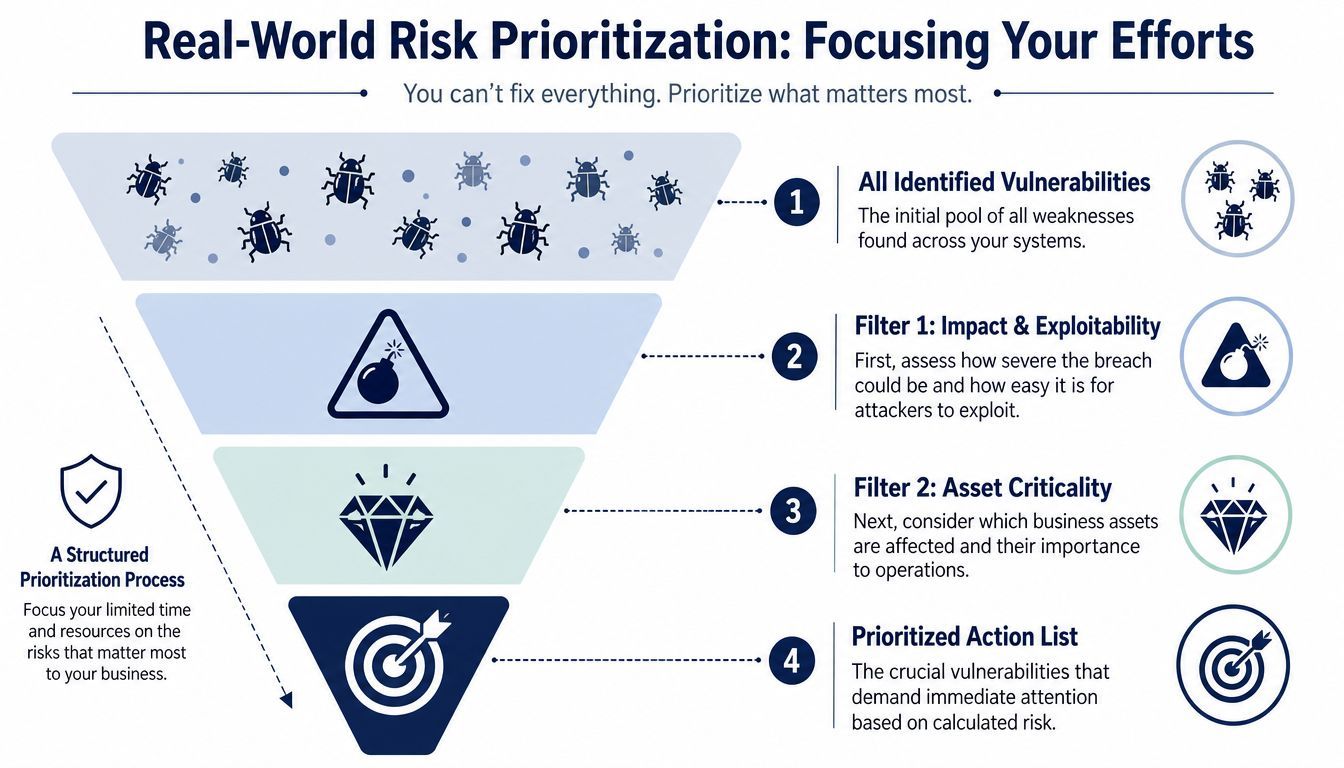
Many organisations rely too heavily on severity ratings. That creates two problems. First, high severity doesn't always mean high business risk. Second, medium-rated issues on critical systems can become urgent if attackers are already exploiting them.
A better approach combines scanner output with business context and threat context.
Use a short set of questions:
For organisations building a broader governance model around these decisions, a formal risk management framework helps connect technical findings to business-level treatment choices.
What works is narrowing the queue. Security teams need a short, defensible action list, not a giant report dumped on operations.
What doesn't work:
The right question isn't “Which vulnerabilities are worst on paper?” It's “Which vulnerabilities can hurt this business first?”
Immediate patching sounds ideal, but business systems don't always allow it. In regulated environments, unsupported software, vendor restrictions, and uptime requirements complicate remediation. In those cases, mature teams document deferral, add controls, assign ownership, and set review dates.
That's the difference between accepted risk and neglected risk. One is governed. The other becomes tomorrow's incident report.
The right toolset should make decisions faster, not just generate more tickets. For SMBs, that usually means combining a scanner, a reliable asset source, patch or configuration management, and reporting that non-technical leaders can understand.
Most programs need three layers.
First, vulnerability scanners identify known issues across endpoints, servers, network devices, and applications. Common products include Nessus and Qualys. These tools are useful, but they only work well when credentials, scope, and asset coverage are set up properly.
Second, asset and context sources tell you what the device is, who owns it, and how important it is. Without this layer, teams can't prioritize effectively.
Third, patch and remediation tools help push updates, validate deployment, and reduce manual effort. In cloud-heavy environments, configuration management also matters because not every issue is solved with a patch.
In the Canadian healthcare sector, integrating automated scanning into workflows can reduce the average time to remediate critical vulnerabilities by 40%, and using tools such as Nessus and Qualys helps address 85% of known CVEs within 72 hours of announcement, according to Sprocket Security's vulnerability management best practices summary. That kind of speed matters in clinics and regulated environments where audit evidence and service continuity both matter.
A useful shortlist should include these criteria:
For organisations with larger cloud footprints, cloud security posture management should sit beside traditional scanning. Many modern exposures come from misconfigurations, not just missing patches.
One practical option is to have an MSP run scanning and reporting while your internal team controls approval and maintenance windows. CloudOrbis supports vulnerability assessment and monitoring as part of its broader managed security services, using common commercial tools rather than a proprietary black box.
The hardest question isn't usually what vulnerability management is. It's who's going to run it every week without letting it slip.
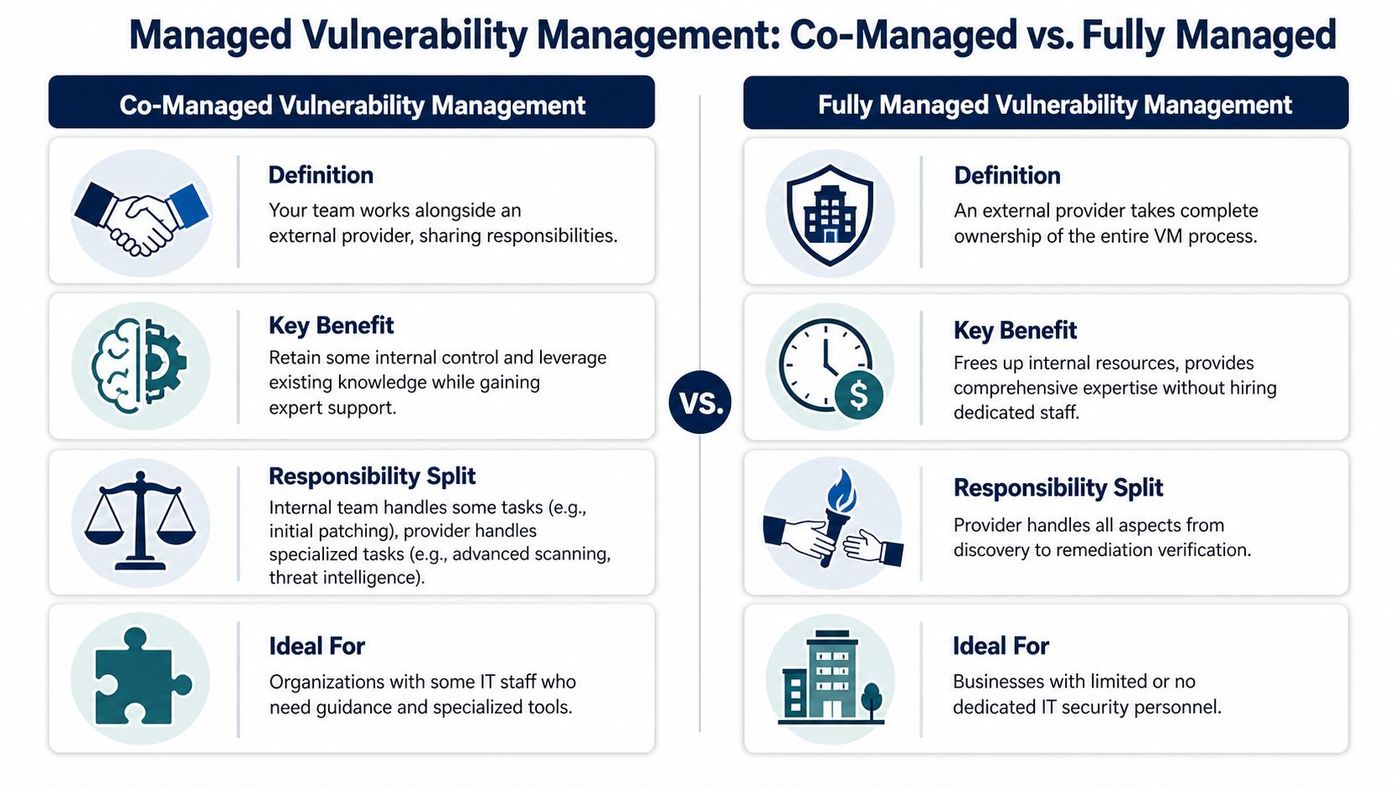
For SMBs, there are two practical service models. Co-managed means your internal IT staff and an external provider share responsibility. Fully managed means the provider handles the program end to end, including scanning, triage, reporting, tracking, and verification coordination.
Co-managed works best when you already have capable internal IT staff, but they don't have the time, tooling, or security depth to run a mature program on their own.
A co-managed model is often a fit when:
Fully managed is usually the better choice when security tasks are already falling behind, staff are stretched thin, or compliance reporting has become inconsistent.
According to the University of Toronto vulnerability management guideline, organisations must formally accept risk for open vulnerabilities through a logged risk register. That documentation burden matters. The same source notes that 30% of Canadian manufacturing firms often accept risks related to unsupported software. In a managed model, the provider can handle that tracking, review support, and reporting workload more consistently.
| Question | Co-managed | Fully managed |
|---|---|---|
| Internal IT capacity | Moderate to strong | Limited |
| Control over remediation timing | Higher | Shared through provider process |
| Security expertise required in-house | Some | Minimal |
| Documentation burden on internal team | Shared | Lower |
The service decision often comes down to staffing reality, not philosophy. If your IT manager is already handling vendors, projects, user support, and outages, adding a disciplined vulnerability management cycle on top can be unrealistic. In that case, reviewing security managed services is a sensible next step.
Good service models don't remove accountability. They make accountability visible, repeatable, and easier to prove.
If your organisation doesn't have a formal vulnerability management process today, start smaller than you think. The goal isn't to build a perfect program in one quarter. The goal is to establish control, ownership, and cadence.
Use this short checklist to assess where you stand:
The most common failures are operational, not theoretical. Teams scan without complete asset coverage. They generate reports nobody owns. They delay fixes without documenting the business decision. Or they patch without confirming the issue is closed.
A practical program does the opposite. It narrows focus, documents trade-offs, and creates evidence leadership can use during audits, insurance reviews, and customer security questionnaires.
If you're unsure whether your current setup is enough, that's usually the signal to get an external review. A good assessment should show where the exposure is, how mature your process really is, and whether co-managed or fully managed support fits your team better.
CloudOrbis Inc. helps Canadian SMBs build practical vulnerability management programs that support compliance, reduce operational risk, and fit real-world staffing limits. If you need an outside assessment, co-managed support for your internal IT team, or a fully managed security model, start with a conversation at CloudOrbis Inc..
Book a 30-minute call with a senior engineer. No sales script, just straight answers about your environment.


