Cloud Security Posture Management: SMB Guide 2026
Understand cloud security posture management (CSPM) essentials for Canadian SMBs. Our 2026 guide covers vital features, common risks, and how to begin.

Understand cloud security posture management (CSPM) essentials for Canadian SMBs. Our 2026 guide covers vital features, common risks, and how to begin.

Your team moved systems to Microsoft 365, shifted files into cloud storage, spun up a few workloads in Azure or AWS, and gave staff remote access. The business got what it wanted. Faster rollout, less hardware to maintain, and more flexibility across offices and home networks.
Then the cloud estate started to behave like a building that keeps adding rooms without updating the fire plan.
That's where cloud security posture management matters. It isn't just another security dashboard. It's the discipline of continuously checking whether your cloud environment is configured the way you think it is, whether access is tighter than it needs to be, and whether regulated data is sitting in places that create avoidable risk.
For Canadian SMBs, especially in healthcare, legal, finance, and other regulated sectors, this is no longer an edge issue. It's part of ordinary operations.
A common pattern shows up in mid-sized businesses. Leadership approves a cloud-first move because on-premise systems are hard to scale, backup windows are messy, and staff want easier collaboration. IT gets the migration done. The project looks successful.
A few months later, the risks don't come from dramatic attacks. They come from ordinary decisions. A storage location is left more open than intended. An admin role stays assigned after a project ends. A contractor account isn't removed. A new SaaS app gets connected to the main tenant without a proper review.
Those aren't exotic failures. They're operational misses.
For many leaders, the problem starts with an outdated mental model. They still compare security as if the question is cloud versus server room. That framing misses the core issue. In the cloud, the environment changes constantly, and each change can alter your exposure. This is one reason the conversation in cloud computing vs on-premise needs to include governance, not just cost and convenience.
Traditional infrastructure gave teams visible boundaries. You could point to the firewall, the server rack, the backup appliance. Cloud platforms spread responsibility across services, identities, policies, integrations, and data stores. A single misstep can remain undetected until someone notices the wrong person has access, or the wrong system is exposed.
Security failures in cloud environments often begin as configuration problems long before they become incident response problems.
Business leaders don't need to know every cloud control to grasp the risk. Consider office key management. If too many people have master keys, if old keys aren't collected, and if doors are reconfigured every week, the building may look secure while access control is drifting.
If you want a simple non-technical primer on the broader question of trust and shared responsibility, Cloudvara's cloud security guidance is a useful companion read.
Cloud security posture management is best understood as a digital building inspector for your cloud environment. It checks your cloud estate continuously, looks for unsafe conditions, compares them to policy and compliance expectations, and points your team toward remediation.
Unlike a traditional firewall, CSPM isn't mainly concerned with guarding a fixed perimeter. Cloud environments don't stay fixed. New storage, apps, service accounts, workloads, and access paths appear all the time. CSPM is designed for that motion.

Your security posture is the current state of your cloud controls. Not the policy binder. Not what the team intended. The actual condition of the environment today.
That includes questions like these:
Cloud adoption in Canada has become mainstream; Statistics Canada's 2023 survey found that 48% of businesses used cloud computing services in 2023, up from 35% in 2021, and the most common uses were file storage and sharing (92%) and email (86%). Those are precisely the environments where configuration mistakes can create exposure, as noted in this overview of cloud security posture management.
A good CSPM capability usually performs five jobs well.
| Function | What it means for the business |
|---|---|
| Asset visibility | You can see what cloud resources, accounts, and services actually exist |
| Configuration assessment | The platform checks settings against security standards and internal policy |
| Compliance alignment | It maps technical findings to compliance obligations and governance rules |
| Risk identification | It highlights misconfigurations, excessive permissions, and insecure defaults |
| Remediation support | It tells the team what to fix, and in some cases can automate the correction |
That's why a CSPM platform is valuable even when you already use Microsoft, AWS, or other native tools. It creates a repeatable way to see problems across the estate instead of relying on scattered checks and manual review.
CSPM isn't a breach guarantee, and it isn't the same thing as protecting data itself. It focuses on the posture of the environment. That's an important distinction for leaders who hear “cloud security” and assume every risk is covered by one tool.
Practical rule: If your environment changes faster than your team can manually review it, you need continuous posture management, not periodic clean-up.
For leaders who want broader context on day-to-day cybersecurity for individuals and businesses, it helps to pair that general guidance with a cloud-specific lens. The controls are related, but cloud posture introduces its own operational discipline.
For regulated businesses, CSPM is not a nice-to-have reporting layer. It's part of how you stay operationally safe while meeting privacy and governance obligations.
A healthcare clinic, law firm, accounting practice, or finance team doesn't just need systems that work. It needs systems that can stand up to scrutiny. If a regulator, insurer, auditor, or client asks who had access, what changed, and whether cloud controls were monitored, “we assumed the defaults were fine” won't hold up well.

Many SMBs think of cloud risk as a settings problem. In practice, identity is often the sharper issue. A configuration error becomes much more dangerous when it meets stale credentials, broad admin rights, or weak separation of duties.
That pressure is especially relevant in Canada. The 2022 Canadian Survey of Cyber Security and Cybercrime found that 29% of Canadian businesses experienced a cybersecurity incident, a point discussed in this article on improving cloud security posture management. For SMBs, the hard part isn't only detecting a problem. It's doing so without a mature IAM program or a 24/7 internal security function.
In regulated environments, cloud mistakes have a wider blast radius. They can affect privacy obligations, client trust, record handling, and internal accountability all at once.
Three situations show up repeatedly:
A stronger posture also supports adjacent disciplines like classification, retention, and secure handling. That's one reason many firms pair posture work with broader data security management, rather than treating cloud settings as a standalone issue.
If your business handles regulated information, cloud security posture management is less about tooling and more about proving that cloud controls remain in bounds after every change.
Most SMBs don't have staff who can spend all day reviewing Azure policies, Microsoft 365 sharing configurations, and IAM drift across multiple services. Manual checking tends to happen after an audit request, after a staff departure, or after an alert from somewhere else.
That's too late.
CSPM changes the timing. Instead of waiting for an annual review or an incident, it spots deviations while they're still fixable routine work. For a regulated business, that's a meaningful difference. It reduces the chance that a basic cloud hygiene issue turns into a compliance conversation.
Not every CSPM tool is worth buying, and not every dashboard marketed as cloud security posture management provides what a mid-sized business needs. Good solutions share a handful of capabilities that are hard to fake.

If a platform only checks one cloud segment well, it leaves blind spots everywhere else. Effective CSPM should cover the full estate continuously across IaaS, PaaS, and SaaS, not just a narrow slice. It also needs to keep pace with change, because cloud risk is dynamic. Guidance from Rubrik stresses that CSPM works best when it is continuous and coverage-complete, with automated remediation to reduce exposure when a misconfiguration appears, as described in this explanation of cloud security posture management.
That requirement sounds technical, but the business meaning is simple. You can't govern what you can't see, and you can't secure what you only inspect occasionally.
A practical evaluation should include these capabilities:
The biggest failure I see in security tooling isn't lack of detection. It's overproduction of findings without enough context to act. A CSPM platform that only generates long lists will exhaust the team and train people to ignore medium-priority issues that may indeed matter more.
That's why many businesses connect posture management with broader threat detection and response. Posture tells you where the environment is weak. Detection tells you whether someone is attempting to exploit that weakness. The combination is far stronger than either one alone.
Buyer's test: Ask whether the product helps your team decide what to fix first on Monday morning. If it doesn't, it's reporting software dressed up as risk reduction.
Automation matters, but mature teams use it with judgement. A good platform can auto-remediate low-risk, repeatable issues and route higher-risk changes for approval. That balance is especially important in production systems where a security fix can also affect uptime, integrations, or user access.
In other words, “more automation” isn't always better. The right model is controlled automation with clear ownership.
Cloud misconfigurations rarely look dramatic when they happen. Someone clicks through a default, grants a temporary exception, or deploys a service quickly to meet a deadline. The damage comes later, when that shortcut becomes normal.
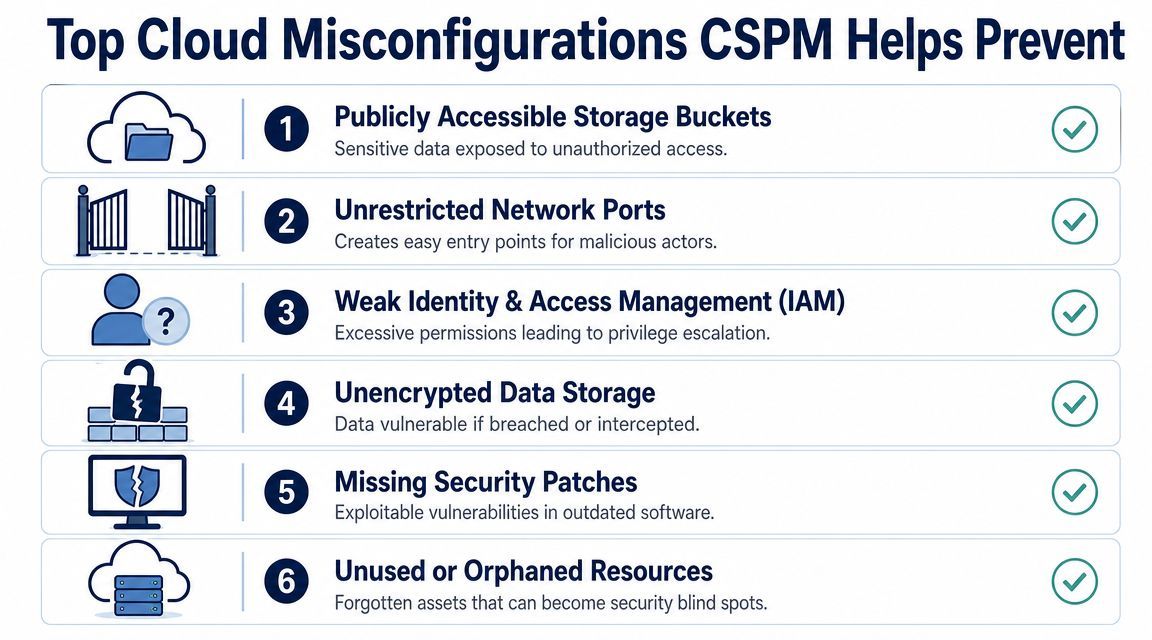
A legal firm stores documents in cloud storage for external collaboration. A matter team opens broader access for a time-sensitive exchange and forgets to tighten it afterward. Nothing breaks. No one notices. Weeks later, the exposure is still there. CSPM would flag that storage configuration as inconsistent with policy and push it into a remediation queue before it becomes a business problem.
A finance company launches a new cloud-hosted application. The application works, but the network configuration leaves unnecessary ports or paths more open than intended. The issue may not look severe by itself. In reality, if the workload is internet-facing and tied to sensitive business processes, the risk is much higher.
A clinic gives broad administrator rights to speed up vendor onboarding and after-hours troubleshooting. The project ends, but the permissions remain. That's one of the most common ways routine access turns into avoidable exposure. CSPM tools are good at identifying over-permissioned roles and stale privilege assignments.
Then there's the forgotten resource. A test system, an old database snapshot, a retired account, an unused connector. These leftovers don't attract attention, but they often fall outside normal review. In cloud environments, abandoned assets can still carry permissions, connectivity, and data.
Not all findings deserve the same urgency. A medium-severity issue on a production system with internet reachability and sensitive data may be more important than a theoretically higher-severity issue on an isolated development asset.
That's why effective CSPM increasingly focuses on compound risk. Security platforms recommend scoring findings by factors such as exposure, internet reachability, identity privilege, data sensitivity, workload criticality, and compliance scope. This approach is outlined in Cloudaware's discussion of cloud security posture management.
Here's a practical way to think about it.
| Misconfiguration | Looks like | Business impact |
|---|---|---|
| Overly broad sharing | Files or storage available more widely than intended | Confidentiality risk and regulatory exposure |
| Excessive IAM permissions | Users or apps can do more than their role requires | Higher chance of misuse or privilege escalation |
| Unreviewed internet exposure | Services reachable externally without tight controls | Expanded attack surface |
| Orphaned cloud assets | Old resources remain active after projects end | Blind spots, unmanaged access, unexpected data retention |
A firm planning or expanding cloud use often uncovers these issues during migration work. That's one reason posture reviews fit naturally alongside projects such as Azure migration in Calgary, where speed can otherwise outrun governance.
Don't ask only, “Is this finding severe?” Ask, “What happens if this exact issue exists on a critical system with sensitive data and broad access?”
The implementation question usually comes down to this. Should you run CSPM in-house, or should you work with a managed partner that can operate it with you?
For large enterprises with dedicated cloud security engineers, strong IAM maturity, and disciplined infrastructure processes, an in-house model can work. For most SMBs, especially in regulated sectors, the challenge isn't acquiring a tool. It's making the tool produce consistent action.
A simple comparison helps.
| Model | Strength | Limitation |
|---|---|---|
| DIY CSPM | Full internal control and direct platform ownership | Requires skilled staff, tuning, follow-through, and ongoing review |
| Co-managed approach | Shared responsibility, stronger governance, internal visibility remains | Needs clear decision rights and escalation paths |
| Fully managed model | Offloads monitoring, triage, and operational burden | Works best when expectations and remediation workflows are defined well |
The hidden cost of DIY is rarely the licence. It's the backlog. Teams deploy the platform, generate findings, and then discover they don't have time to validate alerts, coordinate ownership, clean up identity sprawl, and translate posture issues into compliance actions.
A managed partner helps in three ways that matter to business leaders.
First, it shortens the path from finding to decision. Someone is responsible for triage, context, and escalation. Findings don't sit untouched because everyone assumes someone else owns them.
Second, it helps prevent a narrow definition of success. Many Canadian organizations use SaaS heavily, and CSPM alone can create a false sense of security when the actual risk sits in exposed data inside tools like Microsoft 365 rather than only in infrastructure settings. Orca makes that distinction clearly in its explanation of what CSPM is. A managed partner can help decide when you also need data-centric controls, SaaS governance, or stronger IAM work before buying more tooling.
Third, it gives SMBs a realistic operating model. Budget constraints are real. So are competing priorities. You may not need a sprawling cloud security stack. You do need someone to decide what should be fixed now, what can wait, and what requires process change rather than another product.
The best implementations tend to follow this order:
For security leaders assessing sourcing options, AuditReady's guide for CISOs gives a useful lens on what managed security services should deliver beyond tool administration.
Many SMBs arrive at the same conclusion. They don't need another disconnected dashboard. They need a partner who can fold cloud posture into daily operations, compliance expectations, and incident readiness. That's where a broader managed IT services approach for small business often makes more sense than trying to assemble one-off security tooling in isolation.
If your organization is relying on cloud services without a clear view of configuration drift, access sprawl, or SaaS data exposure, it's time for a practical assessment. CloudOrbis Inc. helps Canadian SMBs evaluate cloud risk, strengthen governance, and build a managed security model that fits regulated environments without adding unnecessary complexity.
Book a 30-minute call with a senior engineer. No sales script, just straight answers about your environment.


