Azure Migration in Calgary: A Practical Guide for a Smooth Cloud Transition
Azure migration Calgary: Learn a practical, checklist-driven approach with local tips for a smooth, cost-effective cloud transition.

Azure migration Calgary: Learn a practical, checklist-driven approach with local tips for a smooth, cost-effective cloud transition.
For Calgary businesses, an Azure migration is a key strategy for building a more resilient, scalable, and secure operational foundation. It’s a strategic move that tackles local challenges, from aging on-premise hardware to the growing need for flexibility in a competitive market.

The conversation around cloud adoption in Calgary has shifted from "if" to "how" and "when." For organizations across the city, from logistics firms and healthcare clinics to manufacturers, the reasons for choosing Azure are tied directly to real-world business pressures. Outdated servers, unexpected maintenance bills, and the constant threat of downtime are no longer acceptable trade-offs.
A common scenario involves a medium-sized Calgary business facing an end-of-life server refresh. They are wrestling with fluctuating operational demands and know their security is at risk. A single hardware failure could bring their entire operation to a grinding halt.
By migrating to Azure, they not only sidestep a massive capital expense on new hardware but also gain the ability to scale resources up or down in minutes, paying only for what they use.
This need for agility and resilience is a recurring theme. The dynamic nature of Alberta's economy means businesses must be ready to pivot quickly. Azure provides the infrastructure to do exactly that, offering a stable yet flexible platform that fuels growth without requiring a significant upfront investment.
Microsoft's commitment to the region makes this transition even more compelling. The company’s landmark $19 billion investment in its Canadian cloud infrastructure is a significant benefit for local businesses. This funding expands Azure's Canada Central and Canada East datacentre regions, giving Calgary firms the confidence that their data will remain within Canadian borders.
Key Takeaway: Moving to Azure isn't just about modernizing IT. It's about future-proofing your Calgary business with scalable infrastructure, predictable costs, and top-tier security that aligns with Canadian data residency laws.
The benefits extend far beyond replacing old servers. A well-planned Azure migration for your Calgary business unlocks real advantages that resonate in our local economic landscape. For a closer look at the specifics, review our guide on Calgary cloud solutions and migrations.
Here are some of the key benefits we help our clients realize:
Ultimately, a professionally managed Azure migration frees you to focus on core business activities. It transforms IT from a cost centre into a strategic asset that drives innovation and growth.
A successful migration is not a simple switch; it is a project built on a solid foundation of planning. Before any files are moved to the cloud, a thorough discovery and assessment of your current environment is essential. Skipping this phase is the single biggest cause of unexpected costs, performance issues, and project delays.
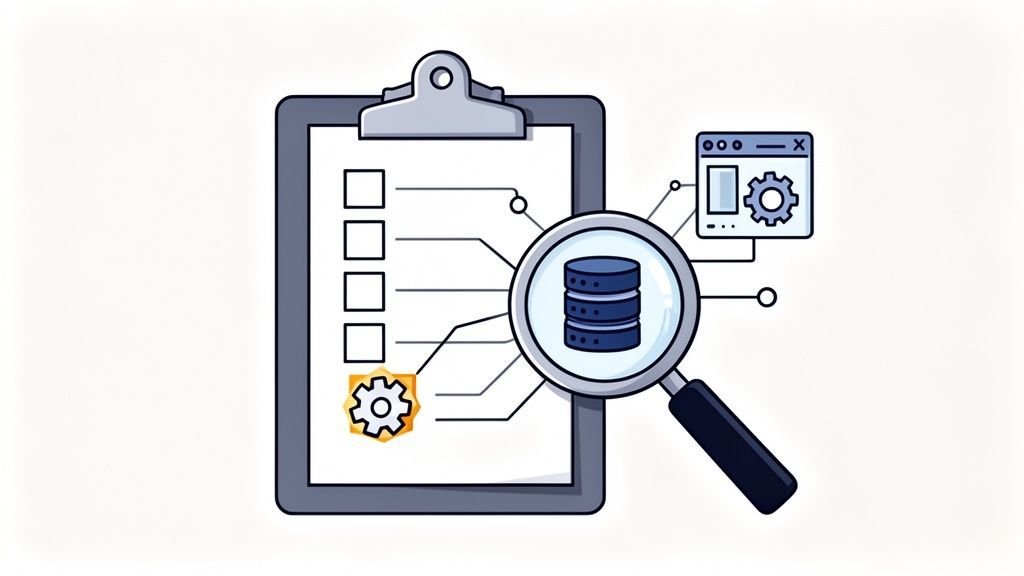
Think of this as creating the blueprint for your entire Azure migration in Calgary. It’s about understanding what you have, how it all works together, and what it will need to perform well in its new environment. This deep dive prevents costly assumptions and ensures the final result supports your business goals.
First, you need to take a meticulous inventory of your entire IT estate. This goes beyond just counting servers. You must document every piece of hardware, software license, and network component that keeps your business running.
For a Calgary-based logistics firm, this meant identifying not just their main servers but also the specific applications they ran, from warehouse management systems to their CRM. We had to understand the resources each one consumed (CPU, memory, storage) during a normal day versus a peak period, such as month-end reporting or the holiday shipping rush.
This detailed inventory provides the raw data needed to make smart decisions about sizing resources in Azure. It helps ensure you don't overspend on capacity you don't need or under-provision critical systems. For a more detailed breakdown, our IT infrastructure checklist is a helpful starting point.
Once you have a complete inventory, the real investigative work begins. Applications rarely exist in isolation. They communicate with databases, rely on other services, and are all connected across your network. Mapping these connections is one of the most critical parts of the assessment.
A common pitfall is migrating a front-end application without realizing it has a hard-coded connection to an on-premise database that was left behind. The result? The application fails, and business operations grind to a halt.
To avoid this, you must trace how data flows through your systems. Which application talks to which database? What services need to communicate to complete a business process? Answering these questions now prevents you from accidentally breaking your business workflows during the move.
Not every application is ready for the cloud out of the box. A crucial part of your assessment is examining the architecture of each workload to determine the best migration method.
It helps to ask a few key questions:
By analyzing each application's unique needs, you can group them into logical migration waves and select the right strategy for each. This methodical approach ensures your most important systems are moved with care, minimizing risk and setting you up for a smooth, successful transition to Azure.
With your pre-migration assessment complete, you have a solid map of your current IT landscape. Now comes the decision: how exactly will you get to Azure? Choosing the right migration strategy for your Calgary business is more than a technical choice, it will define your project's timeline, budget, and the real-world benefits you'll achieve.
There is no one-size-fits-all answer. The best path forward depends on your objectives. Are you racing to exit a datacentre contract? Or is your goal to completely modernize an old application and gain a competitive edge? Your "why" is the key to choosing the right "how."
Often called "lift and shift," rehosting is exactly what it sounds like. You are essentially picking up your existing servers and applications and moving them to Azure virtual machines (VMs) with minimal changes. It’s about replicating what you have now, just in a new, cloud-based environment.
This is by far the fastest approach and usually has the lowest upfront cost. That makes it a perfect fit for companies with a hard deadline or those running legacy applications that are too complex or expensive to modify. For many Calgary businesses, it's a practical first step into the cloud.
We saw this with a local law firm whose on-premise document management system was running on servers with an expiring hardware warranty. A lift-and-shift migration got them onto Azure quickly, solving their immediate infrastructure problem without disrupting daily workflows or requiring extensive staff retraining.
Expert Tip: While rehosting is quick, it doesn't automatically optimize your systems for the cloud. You gain the immediate benefits of scalability and reliability, but long-term operational costs could be higher than with other strategies unless you actively manage and fine-tune your VMs post-migration.
Think of replatforming as the middle ground, sometimes called "lift and reshape." This strategy involves making a few smart, targeted changes to your applications to take advantage of cloud capabilities, but without a complete rebuild. You're moving your workloads to Azure while upgrading key components along the way.
A classic example is moving an on-premise SQL database to a managed service like Azure SQL Database. Suddenly, tasks like patching, backups, and routine maintenance are no longer your IT team's responsibility, Microsoft handles it. This simple switch frees up your team and boosts resilience.
Take a Calgary-based logistics company that depended on an SQL database for its core inventory system. By replatforming to Azure SQL, they instantly shed the management overhead of their old server. They also gained automated backups and high availability, which are essential for keeping their supply chain running smoothly. It was a moderate effort that delivered immediate, tangible value. We see similar trends with our clients up north, as we covered in our guide to Azure migration in Edmonton.
The most involved strategy is refactoring. This isn't just about moving an application; it's about re-architecting and rewriting it to be truly cloud-native. The goal is to fully tap into powerful Azure services like serverless computing, microservices, and AI platforms.
Refactoring is a major investment of time and resources. But the payoff can be huge, delivering the greatest long-term benefits:
Imagine a Calgary energy company with a custom analytics platform built on a monolithic architecture. To process massive datasets and start using machine learning, they decided to refactor. By breaking the application into smaller, independent microservices running on Azure, they could scale individual parts of the platform and innovate at a speed they never could before.
This kind of move is a strategic business decision, turning IT into a competitive advantage.
Choosing between Rehost, Replatform, and Refactor can feel overwhelming. To make it clearer, we've broken down each approach to help you see which one aligns best with your business goals here in Calgary.
| Strategy | Best For | Pros | Cons | Typical Calgary Scenario |
|---|---|---|---|---|
| Rehost | Speed, budget constraints, datacentre exits, minimal disruption. | Fastest, lowest initial cost, low risk, requires few new skills. | Doesn't leverage cloud-native features, potentially higher long-term costs. | A construction firm needs to move its accounting software off aging hardware before a major project starts. |
| Replatform | Gaining specific cloud benefits (e.g., managed databases) without a full rewrite. | Moderate cost and effort, improved performance and resilience, reduces management overhead. | Some code changes are needed, requires more planning than rehosting. | A retail business moves its e-commerce database to Azure SQL for automated backups and scalability during peak shopping seasons. |
| Refactor | Maximizing long-term value, innovation, scalability, and performance for critical applications. | Highest ROI, maximum agility, best performance, lowest operational cost over time. | Highest upfront cost, most time-consuming, requires specialized cloud skills. | A financial tech startup rebuilds its customer-facing app as microservices to accelerate feature releases and handle rapid user growth. |
Ultimately, making the right choice from these three ensures your Azure migration not only meets the immediate needs of your Calgary business but also sets you up for future success and growth.
Moving to the cloud offers incredible flexibility and power, but for any Calgary business, that move must be built on a rock-solid foundation of security and compliance. This isn't just a "nice-to-have", it's an absolute must.
This is especially true for regulated industries like finance, healthcare, or legal services. For these sectors, protecting sensitive data isn’t just a best practice; it's a legal requirement. An Azure migration in Calgary is the perfect opportunity to enhance your security posture, not just replicate what you had before.
Success means thinking about security from the beginning. It's about building a layered defence to protect your data, control access, and ensure you comply with Canadian regulations like the Personal Information Protection and Electronic Documents Act (PIPEDA). The great news? Azure comes with a powerful set of tools designed to help you do exactly that.
Your first line of defence in a modern IT environment is identity. You need to know, without a doubt, who is accessing your systems and what they’re allowed to do. This is where Azure Active Directory (Azure AD), now part of Microsoft Entra ID, is indispensable. Think of it as the gatekeeper for all your cloud resources.
Implementing strong access policies is a critical step. This goes beyond just setting passwords. It means enforcing multi-factor authentication (MFA) for every user and strictly applying the principle of least privilege. This principle is simple but powerful: employees should only have access to the specific data and applications they need for their jobs, and nothing more. This drastically reduces your potential attack surface.
For example, a Calgary accounting firm would use Azure AD to ensure administrative staff can access billing software but cannot access client legal files. At the same time, lawyers can access their case files but have no ability to change underlying server settings.
Once you've secured access, the next task is to protect the data itself. Azure helps by allowing you to encrypt data both when it's stored on servers (at rest) and when it's moving across the internet (in transit). This is a non-negotiable step for both security and compliance.
Think of it this way: encryption at rest scrambles your data on the server, making it useless to anyone without the key. Encryption in transit acts like an armoured truck for your information as it travels between your users and the cloud.
By enabling these encryption features in Azure, you ensure that even in the unlikely event of a breach, your sensitive information remains secure and unreadable, directly supporting PIPEDA's mandate to safeguard personal information.
This double layer of protection provides both you and your clients with much-needed peace of mind. To take your defence even further, you can integrate Azure's native tools with our expert-led cybersecurity services in Calgary.
A modern security strategy cannot just wait for something to go wrong; it must be proactive. Azure provides powerful tools that constantly monitor your environment for threats and help enforce your governance rules automatically.
Here are a few essential tools to get familiar with:
By weaving these tools together, you shift your security from a manual checklist to an automated, intelligent system that actively protects your Calgary business 24/7.
With your strategy locked in and a security framework designed, it's time to shift from planning to action. A successful migration is like a well-rehearsed performance, every step is documented, and every team member knows their role. This phase is all about precision and control, ensuring the final cutover causes minimal disruption to your Calgary business.
The foundation for a smooth execution is your migration runbook. This is not just another checklist; it's the master script for the entire event. This document details every single task, assigns clear responsibilities, and sets a strict timeline. It transforms a complex project into a series of manageable actions and significantly minimizes the risk of errors.
Before touching a live system, you need to test everything in a staging environment. This is a non-negotiable step where you create a sandboxed replica of your new Azure setup. It’s here that you will test the migration process, validate application performance, and resolve any issues without putting your daily operations at risk.
For instance, a Calgary-based manufacturing firm we worked with used their staging area to confirm that their custom inventory management software was communicating correctly with the newly migrated database. Finding and fixing a small configuration issue there saved them from a significant operational headache later on.
This testing phase is also your last chance to validate your rollback plan.
A rollback plan is your safety net. It's a documented, step-by-step procedure to revert to your original on-premise systems if a critical, unresolvable issue appears during the cutover. You hope you never need it, but having one ready provides the confidence to move forward decisively.
Getting your workloads onto Azure is a huge milestone, but the job isn’t done. The real value of an Azure migration in Calgary is unlocked in the days and weeks that follow. This is the optimization phase, where you fine-tune your new environment to maximize performance and keep costs under control.
This is where Azure's native tools become invaluable:
This post-migration phase separates a good migration from a great one. It ensures you're not just running in the cloud, you're running efficiently, securely, and cost-effectively. For businesses looking to move other critical systems, similar principles apply, which we cover in our practical guide to SharePoint migration in Calgary.
A strong security posture is also a continuous process of governance, detection, and control.
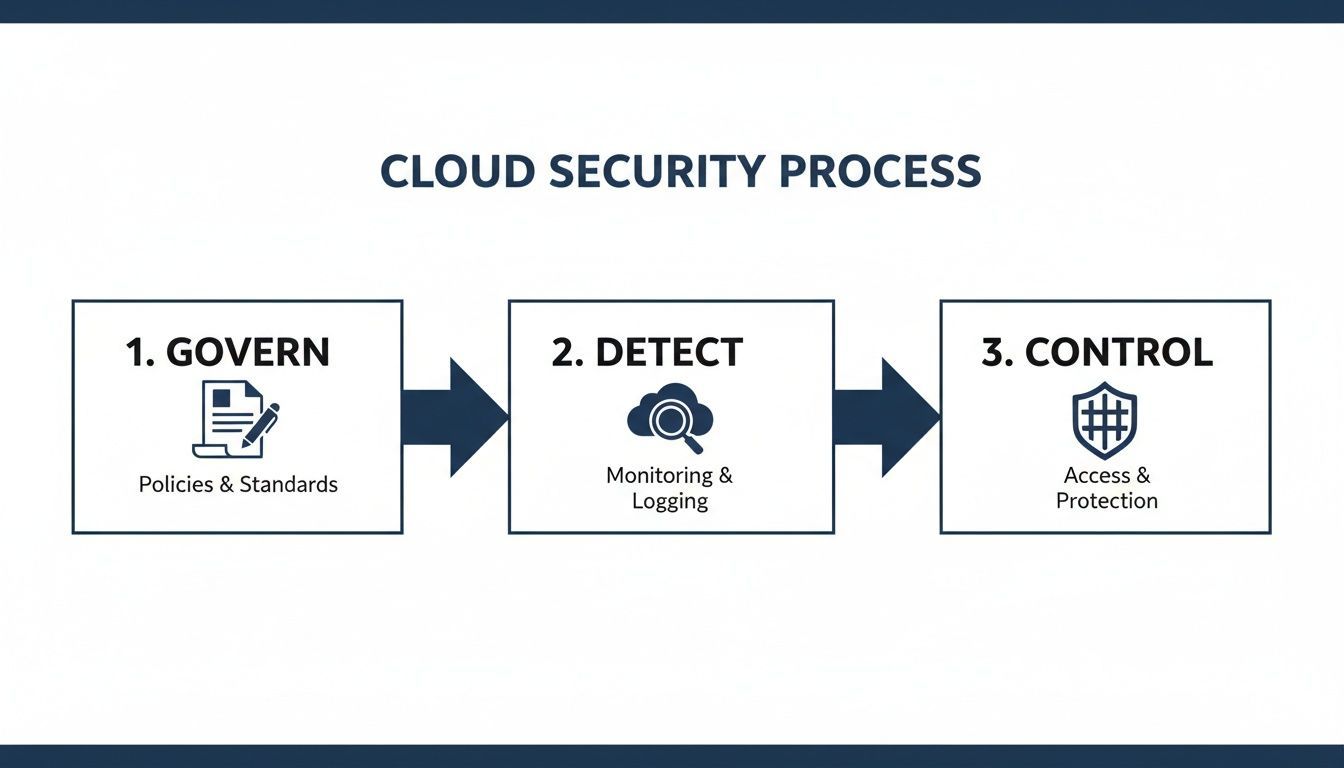
This cycle shows that effective cloud security isn't a one-time setup; it's an ongoing effort to keep your environment secure as threats evolve.
This proactive approach is essential for realizing the full return on your cloud investment. It’s why Calgary businesses are increasingly turning to cloud services to gain a competitive edge. Azure's growing market dominance reflects this trend; it captured nearly 25% of the global cloud market while growing revenue by an impressive 33% in Q1 2025. Here in Canada, Azure's customer base of over 16,000 demonstrates strong local adoption, particularly among the small and medium-sized businesses that are the backbone of Calgary's economy.
With the Canadian cloud migration services market projected to hit USD 8,377.5 million by 2030, the demand for expert cloud migration services has never been higher.
Moving your business to the cloud is a significant step, and it's natural to have questions. For business leaders in Calgary, understanding the practical aspects, cost, timelines, and potential disruption, is key to making a confident decision. We receive these questions regularly, and our goal is to provide clear, straightforward answers.
This is about sharing insights gained from guiding countless local businesses through this exact process, so you can plan effectively and see the real value.
This is usually the first question, and the honest answer is: it depends. There is no flat fee for an Azure migration. Think of it less like buying an off-the-shelf product and more like a custom project for your company.
The final budget for an Azure migration in Calgary hinges on a few key variables:
This is why a thorough discovery and assessment is so critical. That initial analysis provides the clarity needed to build a precise, transparent budget and a phased plan that manages expenses throughout the project.
Timelines, like costs, are determined by complexity. A small business with a handful of servers could be up and running on Azure in a few weeks. However, for a medium-sized Calgary business with interconnected applications and significant data, a three to six-month timeline is more realistic.
That timeframe covers the entire process: the in-depth assessment, detailed planning, pilot migration, final execution, and the crucial post-migration optimization.
Our project management approach is structured to set and meet clear deadlines for each phase. The goal is not to rush; it is to be methodical. We ensure every step is executed flawlessly to keep disruption to your daily operations at an absolute minimum.
Keeping your business running is our top priority. While guaranteeing zero impact for every type of migration is challenging, our strategies are designed to make the transition as seamless as possible for your team and customers.
For many workloads, we can achieve a near-zero downtime cutover. We accomplish this by:
The economic landscape in Calgary is shifting. A recent look at Alberta migration data shows interprovincial migration slowed in 2025, changing business priorities. With a more selective market, local companies are focusing on smart, cost-effective IT optimization to stay competitive, making seamless cloud migrations more critical than ever.
Going live on Azure is a major milestone, but our partnership doesn't stop there. In fact, that is where the real long-term value begins. We provide ongoing managed IT services to ensure you are getting the most out of your cloud investment.
Post-migration, our support includes:
Our commitment is to be your long-term strategic partner, ensuring your technology isn't just stable, it's an engine for your business growth.
Ready to move your Calgary business to the cloud with confidence? The team at CloudOrbis Inc. provides expert, end-to-end guidance for your Azure migration, guaranteeing a smooth, secure, and cost-effective transition. We handle the technical complexities so you can focus on what matters most, growing your business.
Learn more at https://cloudorbis.com.
Book a 30-minute call with a senior engineer. No sales script, just straight answers about your environment.


