Backup and Disaster Recovery in Calgary: A Guide to Business Resilience
Learn how backup and disaster recovery Calgary protects your business from threats, downtime, and financial loss with expert guidance.

Learn how backup and disaster recovery Calgary protects your business from threats, downtime, and financial loss with expert guidance.
Effective backup and disaster recovery in Calgary isn't just an IT policy on a checklist; it's a core pillar of business survival. For local leaders, the conversation has shifted from if a disruption will happen to when. A resilient strategy is absolutely essential to keep your doors open and your business running.

A robust BDR strategy is essential for navigating Calgary's unique operational landscape.
Whether it’s a sudden server crash or a city-wide power outage, any period where your team cannot work carries a steep price. Downtime isn’t a temporary headache; it's a direct hit to your bottom line, your brand’s reputation, and the trust you’ve built with your customers.
Every minute your systems are offline translates into lost revenue, stalled productivity, and potential contract penalties.
For medium-sized organizations, these consequences are amplified. Without the vast resources of a large enterprise, even a few hours of disruption can derail projects, cause you to miss critical deadlines, and strain client relationships. The costs quickly spiral beyond immediate financial loss to include long-term brand damage that can be difficult, if not impossible, to repair.
Think about the tangible effects a disaster, big or small, can have on your daily operations. A robust Backup and Disaster Recovery (BDR) plan acts as your business’s emergency power system, keeping the lights on when everything else goes dark.
Without one, you're facing serious risks:
Beyond the usual hardware failures and cyber threats, Calgary’s location presents distinct environmental challenges that demand a localized approach to disaster recovery. Our region, often called ‘Hail Alley,’ faces extreme weather that can cause physical damage to buildings and trigger widespread power failures.
Over the last five years, Calgary businesses have faced over $6 billion in insured damages from hail alone. This intense weather pattern has increased insurance claims by 115% and repair costs by a staggering 485% since 2019, putting immense pressure on local small and mid-sized businesses.
This reality makes a proactive BDR strategy non-negotiable. It’s not just about getting files back; it’s about ensuring your entire operation can withstand localized threats and bounce back quickly.
Understanding these risks is the first step in building a resilient framework. To learn more about maintaining operational stability, check out our guide on proactive IT maintenance in Calgary. After all, a well-maintained system is always your first line of defence.
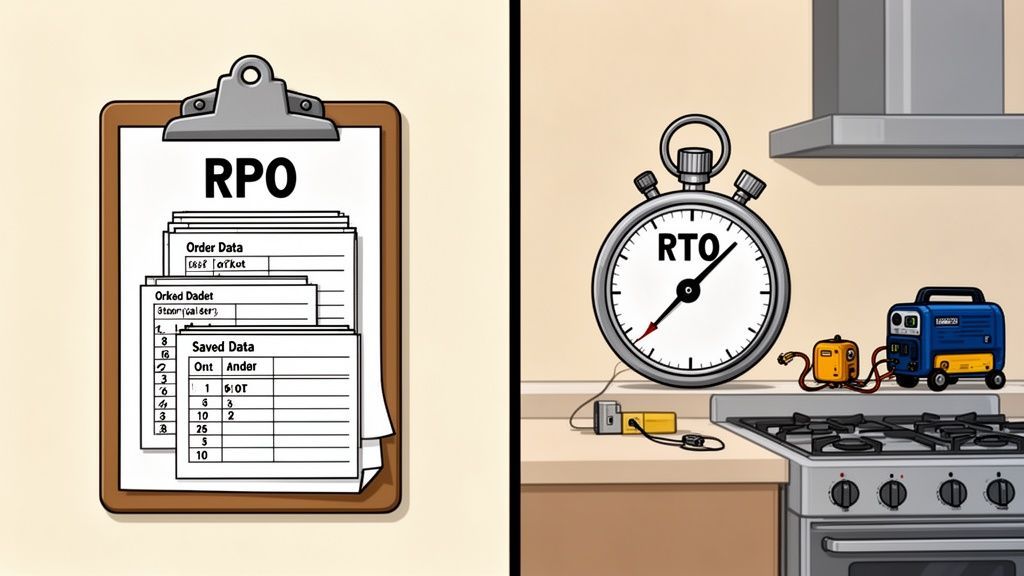
RTO and RPO are the foundational metrics that define your recovery strategy.
Before you can build a strong defence, you need to speak the language of resilience. For many business leaders, the world of backup and disaster recovery is filled with acronyms that obscure a simple goal: getting back to work quickly after something goes wrong.
The two most important terms you’ll encounter are Recovery Time Objective (RTO) and Recovery Point Objective (RPO). Gaining a real-world grip on these concepts is the key to creating a backup and disaster recovery plan that actually fits how your Calgary business operates.
Let's use a simple analogy. Imagine your business is a busy restaurant kitchen.
Your RPO answers the question: "How much data can we afford to lose?" It’s the maximum amount of data loss your business can tolerate, measured in time from the moment of an incident backwards to your last usable backup.
In our kitchen, your RPO is like the last order the staff successfully processed before a sudden power outage. An RPO of one hour means you’re okay with losing up to an hour’s worth of new orders. A near-zero RPO, on the other hand, means you cannot afford to lose a single one.
This metric directly dictates how frequently you need to back up your data.
Your RTO tackles a different question: "How quickly do we need to be back online?" This is the target for the maximum amount of time your systems and applications can be down before your business starts to feel serious pain.
Back in the kitchen, the RTO is how fast you need the lights on and the ovens hot after that power outage. An RTO of 30 minutes means your team must be able to take new orders and start cooking again within half an hour. This defines the kind of technology and processes you need for a speedy recovery.
A common mistake is thinking backups and disaster recovery are the same. A backup is just a copy of your data, the ingredients in your kitchen. A disaster recovery plan is the complete recipe and process for getting the entire kitchen operational again after a crisis.
Understanding both RTO and RPO is the foundation for effective business continuity management and disaster recovery. These numbers provide a clear framework for making smart, strategic decisions.
To bring this all together, here’s a quick guide showing how these metrics translate to real-world impact for a Calgary business.
| Metric | Business Question It Answers | Low Tolerance (e.g., Under 1 Hour) | High Tolerance (e.g., 24 Hours) |
|---|---|---|---|
| RTO | "How quickly must we be operational again?" | Critical for e-commerce or point-of-sale systems where every minute of downtime means lost revenue. Recovery needs to be nearly instant. | Suitable for internal HR systems or archival data where a day of downtime is an inconvenience but not a financial catastrophe. |
| RPO | "How much recent data can we afford to lose?" | Essential for financial firms or online retailers processing constant transactions. Losing even a few minutes of data is unacceptable. | Acceptable for a marketing team working on a long-term project. Losing a day's worth of draft work might be frustrating but is recoverable. |
As you can see, there's no "one-size-fits-all" answer. The right objectives depend entirely on how your specific business functions and which processes are most critical to your bottom line.
Of course, it's not all about data. Businesses in Calgary also face physical threats. Knowing about resources like a guide to commercial water damage restoration can be just as crucial for minimizing downtime. After all, a burst pipe or a flooded server room can be every bit as disruptive as a ransomware attack.
By translating these technical terms into practical business questions, you move from abstract concepts to concrete goals. This empowers you to assess what you truly need and build a strategy that protects what matters most.
An effective disaster recovery plan isn't a generic template you can download online. It must be a strategic defence built on a deep understanding of local threats. For businesses in Calgary, this means looking beyond common hardware failures and recognizing the specific environmental and human-made risks that define our city.
A cookie-cutter plan that works in another region will miss the mark here. It simply will not account for the unique mix of severe weather, infrastructure pressures, and digital threats that Calgary businesses face. This is why a localized approach to backup and disaster recovery in Calgary isn’t just an advantage, it's essential for survival.
To build a truly resilient strategy, you must map your defences against the specific challenges you're most likely to encounter. It's time to move from abstract worries to a concrete, data-driven look at where your operations are most vulnerable.
The Calgary Emergency Management Agency (CEMA) provides a clear picture of the city's risk landscape. Their latest Disaster Risk Assessment highlights a growing list of threats, proving the need for a multi-layered defence. A modern BDR strategy must be just as ready for a server damaged by a windstorm as it is for a targeted ransomware attack.
According to the latest CEMA report, Calgary now faces 19 identified High Risks, a notable increase from previous years. This list includes not just natural events but also critical human-induced dangers like cybercrime and infrastructure failures. It’s worth a look at the full CEMA assessment to understand the evolving local risk landscape for yourself.
This official data gives you a critical foundation for your planning, showing you exactly where your weak spots might be.
While severe weather often grabs headlines, some of the most pressing risks are those caused by people or our city's infrastructure.
Think about it: an infrastructure failure could easily shut down a manufacturing line that relies on internet-connected machinery. In the same way, a single data breach could paralyze a legal or financial firm, compromising sensitive client information and putting you in violation of compliance regulations.
Calgary's unique geography also presents a distinct set of environmental challenges that must be factored into any serious disaster recovery plan.
These natural risks aren't just abstract possibilities; they are recurring events with a documented history of impacting local businesses and their ability to operate.
Key environmental threats identified by CEMA include:
A robust backup and disaster recovery strategy in Calgary must account for all of these variables. It’s about ensuring that whether a threat is digital, physical, or environmental, your business has the tools, processes, and support it needs to recover quickly and keep moving forward.
Picking the best approach to backup and disaster recovery for your Calgary business can feel like staring at a complex puzzle. With so many options, it’s easy to get tangled in technical jargon. But the decision becomes simpler when you frame it around one core goal: finding the model that fits your operations, budget, and risk tolerance.
To make the choice easier, let's break down the main solutions into four categories. Each comes with its own set of advantages and is built for different business scenarios.
An on-premises BDR solution is like owning your own private generator. You have total control over the hardware, software, and data because it all lives in your office. You decide when to do maintenance, how to configure security, and who gets access.
This model is a go-to for organizations with tight regulatory requirements or those that need lightning-fast access to large datasets. The trade-off, however, is significant. You’re responsible for everything, the initial investment in equipment, ongoing maintenance, security patches, and having a team to manage it. When something goes wrong, it's all on you to fix it.
A cloud-based solution, on the other hand, is like plugging into the city’s power grid. You get a reliable, scalable service managed by experts, and you don’t have to worry about the infrastructure behind it. A third-party provider takes care of the data centres, hardware, and maintenance, and you pay a predictable subscription fee.
This approach offers incredible flexibility. You can easily scale your storage up or down as your needs change, and your data is safely stored off-site, protecting it from local disasters like a flood or fire. It’s a fantastic choice for businesses that want a cost-effective, low-maintenance way to secure their data.
A hybrid model gives you the best of both worlds, it’s like having a generator and a connection to the city’s grid. This popular strategy combines on-premises hardware for quick, local recoveries with cloud backups for rock-solid, off-site redundancy.
For instance, you might back up mission-critical files to a local server for near-instant restoration while also replicating all your data to the cloud for true disaster recovery. This balanced approach delivers both speed and security, making it a powerful choice for many medium-sized Calgary businesses. It addresses the need for fast operational recovery while still offering robust protection against a site-wide disaster.
This flowchart helps visualize the kinds of local risks your BDR strategy needs to account for, from natural disasters to human-caused threats.
A complete BDR strategy must account for multiple, interconnected points of failure.
As you can see, a complete strategy must consider multiple points of failure, whether it's a cyberattack, a severe weather event, or an internal hardware meltdown.
Finally, there’s Disaster Recovery as a Service (DRaaS), which is the ultimate resilience plan. Think of it as having a dedicated emergency response team on permanent standby, ready to restore power instantly if both your generator and the city grid fail at the same time.
With DRaaS, a provider doesn't just back up your data; they replicate your entire IT environment, servers, applications, and networks, in the cloud. If a disaster strikes, you can "failover" to this replicated environment and continue operating with minimal disruption.
This is the gold standard for any business that cannot afford significant downtime. While it represents a higher investment, it delivers the lowest possible RTOs and ensures genuine business continuity. For a deeper dive into the foundations of data protection, you might be interested in our complete data backup and recovery guide.
Beyond just recovery, a critical piece of the puzzle involves preventative measures. Strong Network Security for Small Business is essential to protect your data and minimize the kinds of risks that make disaster recovery necessary in the first place. By matching your business needs with one of these models, you can build a strategy that provides true protection and peace of mind.
Choosing a partner for your backup and disaster recovery in Calgary is about much more than technology. The right provider is a strategic ally who understands your business and local risks. The wrong one can leave you dangerously exposed when you can least afford it.
This decision shouldn’t feel like a shot in the dark. With a clear evaluation process, you can confidently pick a partner who will genuinely protect your business, not just sell you a service. You're looking for a team that is on your side, providing proactive and reliable support.
To get there, you need to ask the right questions. This goes beyond technical specifications, it’s about proving their local know-how, industry experience, and commitment to your success.
A generic, one-size-fits-all provider won't cut it. They won't understand the specific hurdles Calgary businesses face. Your partner needs a proven track record of helping local companies navigate everything from our infamous hailstorms to industry-specific compliance demands.
Start by digging in with some pointed questions:
A partner who can answer these with specific, relevant examples has been in the trenches. They’ve already solved the problems you’re trying to avoid.
Where your data lives is a massive deal. For any business operating in Canada, data residency is a critical piece of complying with privacy laws like the Personal Information Protection and Electronic Documents Act (PIPEDA). If you handle sensitive client information, this is a firm deal-breaker.
Your data must be stored within Canada’s borders, full stop. It's the only way to ensure it's protected under Canadian law.
When you're talking to a potential provider, demand a straight answer to one simple question: "Are your primary and backup data centres located 100% within Canada?" Any hesitation or vague response is a major red flag.
This isn’t just a box-ticking exercise; it’s a fundamental security and legal requirement that protects your business and your customers from cross-border data risks.
When a disaster strikes, you need more than just technology, you need immediate, expert help from people who know your systems inside and out. A provider's support structure is often what separates a true partner from a simple vendor. You need to understand what their support looks like before you sign anything.
Here’s what to ask:
Picking the right IT partner is a foundational business decision. For more on what to look for, our guide on selecting a managed service provider in Calgary offers other valuable considerations. In the end, the right BDR partner gives you something priceless: the confidence that your business is ready for anything.
A disaster recovery plan isn't a trophy to put on a shelf; it's a living document that needs regular attention to stay effective. You’ve done the hard work of creating the plan, but that’s just step one. Without consistent testing and maintenance, even the best strategy can fail under pressure, leaving your business exposed when you need that protection the most.
Think of it like a fire drill. You don’t just install smoke alarms and hope for the best. You practice the evacuation route so that if a real fire ever breaks out, everyone knows exactly what to do without a second thought. The same principle applies to your backup and disaster recovery strategy here in Calgary.
Regular testing is what transforms a theoretical plan into a proven, reliable process. It’s how you uncover weaknesses, highlight gaps, and build the muscle memory your team needs to act decisively during a real crisis.
A plan that looks perfect on paper can crumble in a real-world scenario. Systems change, software gets updated, and new team members come on board. If you aren’t testing, you’re essentially gambling that everything will work perfectly when the stakes are highest.
For Calgary businesses, this risk is amplified by our unique environment. A recent massive hailstorm pelted the city with golf-ball-sized hail, causing an estimated $3.29 billion in insured losses, becoming the costliest in Canadian history. The Insurance Bureau of Canada (IBC) also notes a startling 115% surge in personal property damage claims and a 485% rise in repair costs since 2019. Imagine a local clinic losing patient data or a logistics firm whose IT is crippled from storm damage; recovery could take weeks without a tested plan. You can learn more about how escalating risks demand resilient IT.
The purpose of a disaster recovery test isn't to pass or fail; it's to find and fix problems before a real disaster does it for you. It’s a proactive step that ensures your investment in BDR actually delivers when you need it.
Effective testing doesn't have to be an all-consuming event. It should be a structured, ongoing process that covers different scenarios, building confidence in your recovery capabilities over time.
A good testing schedule includes a mix of approaches:
For a more structured approach, a framework can be invaluable. You can learn more about building a solid foundation by exploring this IT disaster recovery plan template.
A managed service provider handles all this proactive maintenance for you, scheduling and executing regular tests to ensure your plan remains effective. This continuous refinement keeps your BDR strategy resilient against tomorrow’s threats and guarantees that your business is always prepared.
Stepping into the world of backup and disaster recovery brings up many practical questions. For business leaders here in Calgary, those questions usually boil down to cost, security, and whether it’s an investment that their specific company really needs to make.
Let’s tackle some of the most common questions we hear, with straightforward answers to give you the clarity you need.
There’s no one-size-fits-all price tag, as the investment depends entirely on your needs. The final cost is shaped by factors like how much data you have, how fast you need to be back up and running (your RTO/RPO), and any specific industry compliance rules you must follow.
A small business might spend a few hundred dollars a month for secure, automated cloud backup. On the other hand, a mid-sized company needing instant failover to a secondary site will budget more for a comprehensive DRaaS solution.
The key is to stop thinking of it as a cost and start seeing it as essential insurance. The expense of a solid BDR plan is tiny compared to the massive financial hit of days or weeks of downtime. A professional assessment will give you a quote that balances your unique risks with your budget, and it's almost always more cost-effective than trying to build it yourself.
Not automatically. This is a common and dangerous misconception. Basic cloud sync tools like Dropbox or OneDrive can actually work against you in a ransomware attack. If a hacker encrypts your local files, those corrupted versions will sync to the cloud, overwriting your clean copies.
A true backup and disaster recovery Calgary strategy is much smarter. It uses features like immutable backups, which are locked so they cannot be changed or deleted for a set time. It also involves air-gapped copies, which are stored completely offline and disconnected from your network.
This creates a multi-layered shield that ransomware cannot easily penetrate. Of course, this needs to be paired with strong cybersecurity to stop the attack from happening in the first place.
Yes, absolutely. In fact, small and mid-sized businesses are often the most vulnerable. They typically don’t have the deep cash reserves to survive being out of commission for long. A "disaster" does not have to be the next big flood; it could be a single server crashing, a critical file accidentally deleted by an employee, or a targeted cyberattack.
Your plan doesn’t need to be a 200-page binder. But it does need to be written down, tested, and focused on your most critical operations. A good managed service provider can scale a solution to fit your exact size and budget, giving you the resilience to recover quickly without paying for complexity you don’t need.
For any business operating in Calgary, the main piece of legislation you need to know is the Personal Information Protection and Electronic Documents Act (PIPEDA). This is the federal law that dictates how businesses collect, use, and store personal information.
Depending on your industry, you might also be subject to Alberta's Health Information Act (HIA) or other provincial rules. A huge piece of the compliance puzzle is data residency. To stay on the right side of the law, you must partner with a BDR provider who guarantees your data is stored in 100% Canadian-based data centres. This keeps your information under Canadian legal jurisdiction and away from foreign data laws.
A resilient business is a prepared one. At CloudOrbis Inc., we build customized backup and disaster recovery solutions that protect Calgary businesses from local threats and keep you operational. Ready to secure your operations? Let's talk about a plan that fits your needs. Learn more at https://cloudorbis.com.
Book a 30-minute call with a senior engineer. No sales script, just straight answers about your environment.


