

September 19, 2026
Database Migration Services Explained for Canadian SMBsLearn how database migration services move data to the cloud securely with minimal downtime. Types, risks, costs and a Canadian provider checklist.
Read Full Post%20(1).webp)
Usman Malik
Chief Executive Officer
December 22, 2025
In our hyper-connected world, disruptions are not a possibility; they are an inevitability. For medium-sized Canadian organizations, a solid plan for business continuity management and disaster recovery is not an optional extra—it is a core survival tool. Understanding how these two concepts work together is the first step toward protecting your operations, reputation, and ultimately, your revenue.
Imagine a modern cargo ship navigating a fierce storm. For that ship to stay afloat and reach its destination, it needs a few critical things: a skilled crew (your team), a clear destination (your continuity plan), and reliable life rafts (your recovery systems). Without all three, the entire voyage is at risk.
This is the exact challenge businesses face today. The "storms" we encounter are constant and come in many forms, from sophisticated cyber-attacks and supply chain failures to severe weather events right here in Canada.

In this scenario, Business Continuity Management (BCM) is your overarching strategy to keep the entire business sailing through the disruption. It is the comprehensive game plan ensuring your core operations keep running, your people are safe, and you can still meet customer commitments. BCM answers the big-picture question: "How do we keep the whole ship moving forward during the storm?"
On the other hand, Disaster Recovery (DR) is a critical piece within your BCM plan. It is laser-focused on rescuing your IT infrastructure when things go wrong. Think of it as the detailed procedure for getting your servers, data, and essential applications back online after an outage. DR answers the more tactical question: "How do we launch the life rafts to save our technology?"
Going into a storm without a plan carries a heavy price. The financial fallout from downtime can be crippling for a medium-sized organization, often leading to:
The reality is that without a robust resilience strategy, organizations are putting their future at risk. The consequences of IT downtime can profoundly impact not just the bottom line, but also your data, reputation, and customer experiences.
Integrating both BCM and DR is not just an IT task; it is a fundamental business function that is essential for both survival and growth.
People often use these terms interchangeably, but business continuity management and disaster recovery are two distinct—though closely related—pieces of the resilience puzzle. Getting the distinction right is not just about using the correct jargon; it is about having the strategic clarity to build a plan that truly protects your entire business when things go wrong.
Let’s use a real-world example. Imagine a major flood forces your office to close for a week. Your Business Continuity Management (BCM) plan is the master strategy that keeps the company operating. It covers how your team will work remotely, how you will communicate with clients, and how you will manage payroll and supplier payments without missing a beat.
BCM is proactive and all-encompassing. It is built to answer the big-picture question: "How do we keep the entire business running through a crisis?"
Disaster Recovery (DR), on the other hand, is one of the most critical components of that master BCM plan. In our flood scenario, the DR plan is the specific, technical playbook for getting your technology back online. It details the exact steps to fail over your servers to a cloud environment, restore critical data from backups, and ensure your team can securely access all the applications they need from home.
DR is laser-focused on your IT infrastructure. Its job is to answer the tactical question: "How do we get our technology and data back after an incident?"
A business continuity plan without a solid disaster recovery component is just wishful thinking. On the flip side, a DR plan without the strategic direction of BCM is a technical solution looking for a business problem to solve. Real resilience only happens when they work together perfectly.
Put simply, BCM is the umbrella that keeps the entire business—your people, processes, and technology—safe and operational. DR is the high-tech toolkit under that umbrella, dedicated to fixing the IT that powers everything. Grasping this difference is key to allocating your resources properly and creating a plan that protects both your operations and your infrastructure.
You can dive deeper into building these strategies in our complete guide on what business continuity planning entails.
Seeing their core attributes side-by-side clarifies how they work together. One handles the big-picture strategy, while the other executes the vital technical tasks needed to make that strategy a reality.
This clear division of labour ensures every angle of a potential crisis is covered. BCM provides the strategic roadmap for survival, while DR delivers the technical muscle needed to bring your digital operations back from the brink.
Knowing you need business continuity management and disaster recovery is one thing. Turning those concepts into a working, real-world plan can feel like a massive undertaking. The key is to build your resilience strategy one manageable layer at a time.
This roadmap breaks the process down into five clear stages, designed specifically for medium-sized organizations.
When you follow these steps, you are not just creating a dusty document to sit on a shelf. You are building a living operational tool that will guide your team through a crisis with clarity and confidence.
The diagram below shows how the big-picture business continuity framework activates the more specific disaster recovery process when an incident hits.
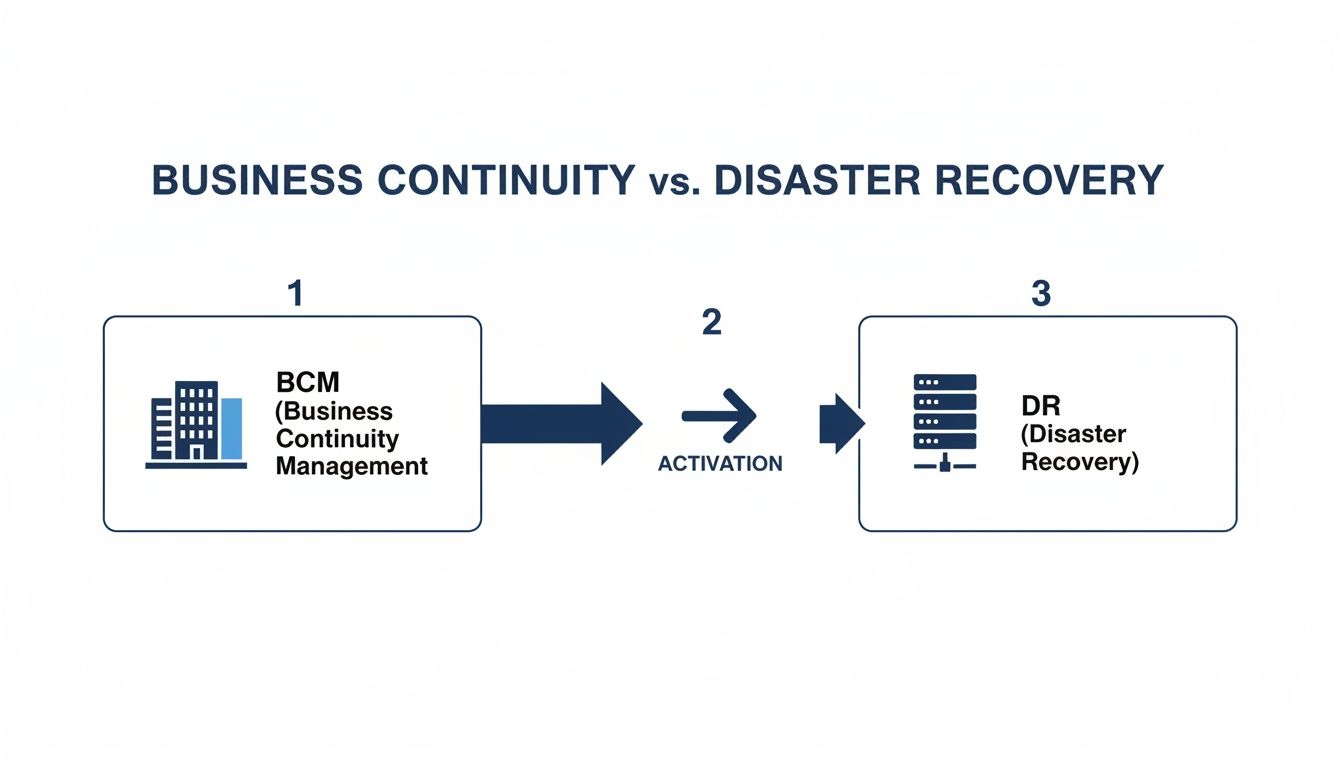
This makes it clear: DR is the critical, IT-focused engine that kicks into gear within the larger BCM vehicle.
Before you can protect your operations, you must understand what you are protecting and why. That is the entire point of a Business Impact Analysis (BIA). This is not just an IT task; it is a thorough look across your entire company to identify which functions are absolutely essential and what it would actually cost if they went down.
Your goal here is to put a real number on downtime. How much revenue vanishes if your e-commerce site is offline for an hour? What about for a full day? What happens to client relationships and project deadlines if your CRM is inaccessible?
A solid BIA prioritizes your recovery efforts by answering two simple but vital questions:
This analysis is the foundation of your entire plan, ensuring everything you do is tied back to what the business truly needs to survive.
Once your BIA is complete, you can set the technical targets your IT team needs to hit. These are the core metrics that your disaster recovery plan must be built to achieve. The two most important ones are the Recovery Time Objective (RTO) and the Recovery Point Objective (RPO).
RTO (Recovery Time Objective): This is the deadline. It is the maximum amount of time your business can afford for a critical system to be offline after a disaster. An RTO of one hour means that system must be back up and running within 60 minutes.
RPO (Recovery Point Objective): This is all about data loss. It defines the maximum amount of data you can stand to lose, measured in time. An RPO of 15 minutes means you need backups running at least every quarter-hour, so you would never lose more than the last 15 minutes of work.
These objectives are non-negotiable because they directly shape the technology and processes you will need. A near-zero RTO, for instance, points toward an automated cloud failover system. A 24-hour RTO, on the other hand, might be perfectly fine with more traditional backup and restoration methods.
A plan is useless if nobody knows how to use it when the pressure is on. Your next step is to write down clear, step-by-step instructions for every part of your response. Ensure this documentation is accessible—do not lock it away on a server that will be down during the very crisis you are planning for.
Just as important is assigning roles and responsibilities before an emergency happens. There can be no confusion about who is in charge of what.
Your crisis management team should include:
This structure prevents the chaos and indecision that can cripple a response. For a closer look at how different companies structure their plans, you can explore these business continuity plan examples.
Now it is time to put the tools in place that will let you meet your RTO and RPO targets. Your BIA will guide you here, pointing to solutions that fit your specific needs and budget. For most medium-sized businesses, this usually involves a smart mix of cloud-based backups, replication, and failover systems.
Common solutions include:
The right tech stack is the one that directly supports the recovery objectives you have already defined.
Finally, and this is crucial, a business continuity management and disaster recovery plan is never "done." It is a living process. An untested plan is just a theory, and you cannot bet your business on a theory. You must commit to regular testing to prove it works and to ensure your team is ready.
There are a few ways to do this:
This cycle of testing, reviewing, and updating is what keeps your plan relevant and effective. In some areas, this is not just good practice—it is a survival requirement. For example, in the Caribbean, where small and medium businesses make up 85% of the economy, a striking 17% are actively preparing for disasters because they face constant hurricane threats. Regular maintenance turns your plan from a static document into a dynamic shield.
In today’s world, a cyber-attack is not just a remote possibility—it is one of the most probable disasters your business will ever face. The old lines separating business continuity management and disaster recovery from cybersecurity have completely dissolved. A modern resilience strategy must have cybersecurity woven into its very fabric from the ground up.
A sophisticated ransomware attack can bring your operations to a screeching halt just as effectively as a physical fire or flood. This reality demands a critical shift in how we approach resilience. Your first line of defence is no longer just about having good backups, but about having robust, proactive security measures in place. A cyber incident is a business disaster, plain and simple.
Viewing cybersecurity as a siloed IT problem is a dangerous mistake. It needs to be seen for what it is: a fundamental pillar of business survival. The best way to recover from a digital disaster is to prevent it from happening in the first place.
This proactive approach involves a few key practices:
These proactive steps are essential for building a strong defensive posture. You can see how these elements fit into a broader security framework in our guide to cybersecurity services.
Even with the strongest defences, you have to plan for the possibility of a breach. This is where your disaster recovery plan kicks in, but with a specific cybersecurity focus. Restoring your systems after a cyber-attack is far more complex than recovering from a simple server failure. The main goal is to restore clean, uninfected data without accidentally re-introducing the malware that caused the problem.
This requires a very specific type of backup strategy.
Your backups must be both isolated and immutable. Isolated means they are kept separate from your primary network—creating an "air gap"—which makes them invisible and inaccessible to ransomware. Immutable means the backups cannot be altered or deleted, even by an attacker who gains administrative credentials.
Without these protections, your backups could be encrypted right along with your live systems, leaving you with no way to recover. This modern approach ensures you always have a pristine copy of your data ready to go, turning a potentially catastrophic event into a manageable recovery process.
The need for this integrated approach is only growing as the threat environment gets more intense. In regions like the Caribbean, for example, organizations now face an average of 2,582 cyber-attacks per week. That rate is a staggering 40% higher than the global average. This kind of pressure makes it crystal clear why disaster recovery must now be synonymous with digital resilience. You can find more insights on this in the cyber threats facing key industries on symptai.com.
Ultimately, a successful strategy for business continuity management and disaster recovery does not just treat cybersecurity as an add-on; it makes it the core foundation. By combining proactive defence with a robust, breach-aware recovery plan, you build true resilience that can withstand the most pressing threats businesses face today.
Not too long ago, a solid disaster recovery plan meant building—and maintaining—an entire second, physical data centre. This was a massive undertaking, in both complexity and cost, putting true business resilience out of reach for most medium-sized companies. The cloud has completely flipped that script, making enterprise-grade protection accessible and affordable for everyone.
This shift lets businesses move from a capital-heavy model of buying duplicate hardware to a flexible, operational one. Instead of paying for idle servers you hope you never have to use, you are paying for a service that is ready to go at a moment's notice. This approach to business continuity management and disaster recovery is not just easier on the budget; it is smarter, faster, and far more scalable.
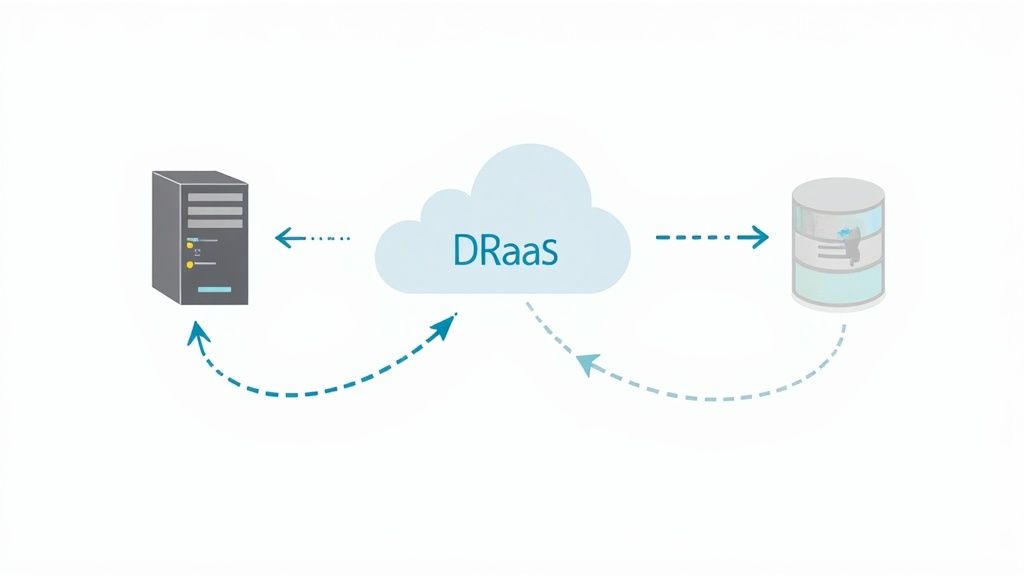
The most powerful solution born from this cloud revolution is Disaster Recovery as a Service (DRaaS). Think of it like having an expert emergency response team and a fully equipped hospital on standby for your IT systems, 24/7. It works by constantly copying your critical servers, applications, and data to a secure cloud environment.
When disaster strikes—be it a server failure, a widespread power outage, or a nasty ransomware attack—the DRaaS platform is activated. This is a process called failover.
The failover process automatically spins up your systems in the cloud, allowing your team to keep working with minimal disruption. Once your primary site is back on its feet, the system performs a failback, smoothly transitioning operations back to your original infrastructure. This automation takes the high-pressure guesswork out of a crisis, ensuring your recovery is quick and clean.
DRaaS democratizes resilience. It gives medium-sized businesses the same level of protection that was once reserved for large corporations, but without the massive upfront investment in hardware and specialized staff. This makes it a cornerstone of modern business continuity.
The beauty of the cloud is its flexibility. You can tailor a disaster recovery solution that perfectly fits your specific recovery goals, budget, and compliance needs. There is no one-size-fits-all answer here; the right model truly depends on your unique business situation. For a deeper look into these options, you can explore our guide to managed cloud computing.
The main cloud models for DR include:
By embracing a cloud-based approach, you are not just buying a backup service; you are building a forward-thinking resilience strategy. The cloud gives you geographic diversity, protecting your business from localized events like power outages or floods that could knock out both your primary and backup sites if they were in the same city.
This modern take on business continuity management and disaster recovery also makes testing a breeze. Instead of coordinating disruptive and complex physical tests, you can run failover drills in an isolated cloud environment without affecting your day-to-day operations. This makes it far easier to regularly validate your plan and ensure your team is always ready.
Ultimately, using the cloud for disaster recovery transforms it from a pricey insurance policy into a dynamic, strategic asset that protects your revenue, your reputation, and your future. It gives you the agility and power to face disruptions with confidence, ensuring your business stays on its feet no matter what comes your way.
Building an effective program for business continuity management and disaster recovery is a full-time job. It is a demanding role that requires niche expertise, constant watchfulness, and a serious investment in technology—three things most medium-sized businesses cannot spare. This is where a strategic partnership with a managed service provider (MSP) like CloudOrbis can completely change the game.
Working with an MSP turns resilience from a costly, complex burden into a genuine competitive advantage. Instead of trying to piece together an enterprise-grade program from scratch, you get immediate access to a team of experts and proven technologies, all without the massive overhead. For most businesses, it is the smartest way to ensure your resilience plan is not just created, but expertly implemented, tested, and always ready.
An MSP brings specialized knowledge to the table, helping you navigate the tricky parts of BCM and DR. From running a detailed Business Impact Analysis (BIA) and setting precise RTOs and RPOs to deploying sophisticated cloud backup solutions, a partner brings years of hands-on experience. This guidance ensures your strategy is built on best practices and perfectly fits your specific operational risks and compliance needs.
A partnership also opens the door to advanced tools that would otherwise be out of reach, including:
The alternative—facing a disaster without a professionally managed plan—can be devastating. Businesses that are not prepared often face catastrophic consequences that go far beyond a temporary outage.
Research shows that businesses without a robust plan endured an average of 14 days of downtime, suffered 60% data loss rates, and faced recovery costs three times higher than their prepared counterparts. Alarmingly, they were also 40% more likely to close permanently after a major incident. Read more about these business continuity findings on solvecrisis.org.
This stark reality drives home the value of a partnership. By handing off the heavy lifting of business continuity management and disaster recovery to a dedicated team, you free up your internal resources to focus on what they do best. More importantly, you gain the peace of mind that comes from knowing your organization is protected by a plan that is well-designed, professionally managed, and always ready for action.
Even with a clear strategy in mind, leaders often have specific questions when it comes time to build out their business continuity and disaster recovery plans. Here are some of the most common ones we hear from businesses just like yours.
The textbook answer is to run a full test of your disaster recovery plan at least once a year. In reality, your most critical systems need more frequent attention. You cannot just let the plan collect dust on a shelf.
We recommend a mix of quarterly tabletop exercises—where you talk through a scenario—and at least semi-annual failover tests to keep your team sharp and your processes validated. It is non-negotiable: you must re-test after any significant change to your IT environment, like moving to the cloud. Consistent testing is what transforms a document into a reliable, real-world action plan.
Think of these two metrics as the bedrock of your entire DR strategy. Crucially, they should be driven by business needs, not just what the IT department thinks is possible.
Getting your RTO and RPO right is everything. These two numbers directly dictate the technology, processes, and budget required to shield your organization from unacceptable losses.
The better question is whether you can afford the staggering cost of doing nothing. Modern solutions, especially cloud-based Disaster Recovery as a Service (DRaaS), have made enterprise-grade resilience surprisingly affordable, even for medium-sized organizations.
The investment in a proactive plan is a fraction of the lost revenue, customer churn, and reputational damage that follows a real incident. A good managed service partner can design a cost-effective strategy that fits your specific budget and risk profile, ensuring you are protected without overspending.
A resilient business is not just a survivor; it is a thriver. At CloudOrbis Inc., we provide the expert guidance and managed services to build a robust business continuity and disaster recovery plan that protects your operations, data, and hard-earned reputation. Get in touch with us today to build a resilience strategy that gives you true peace of mind.
September 19, 2026
Database Migration Services Explained for Canadian SMBsLearn how database migration services move data to the cloud securely with minimal downtime. Types, risks, costs and a Canadian provider checklist.
Read Full Post
September 18, 2026
Business VoIP Telephone Systems Explained for SMBsLearn how business VoIP telephone systems work, what they cost and how to choose a secure, resilient option for your Canadian SMB.
Read Full Post
September 17, 2026
Cloud Migration Roadmap Template That Prevents Costly ReworkGet a practical cloud migration roadmap template plus steps to customize it for assessment, waves, testing and cutover without budget surprises.
Read Full Post
