

September 19, 2026
Database Migration Services Explained for Canadian SMBsLearn how database migration services move data to the cloud securely with minimal downtime. Types, risks, costs and a Canadian provider checklist.
Read Full Post%20(1).webp)
Usman Malik
Chief Executive Officer
February 5, 2026
Think about how you handle your office's electricity. You don't manage the power grid; you just expect the lights to turn on. That’s the core idea behind managed IT services in Edmonton—treating your technology like a reliable utility.
It's a proactive partnership. Instead of waiting for something to break, you engage an expert third-party company to manage your entire technology infrastructure for a predictable monthly fee. This simple shift moves your business away from the stressful, reactive "break-fix" cycle and toward a strategic approach where your systems are always on, always secure, and optimized for growth.

A Managed Services Provider (MSP) takes full ownership of your IT environment, from network security and cloud infrastructure to day-to-day helpdesk support. They work quietly in the background, monitoring your systems 24/7 to identify and fix potential problems before they can disrupt your workday.
This means no more frantic calls when a server crashes or the network goes down. Proactive maintenance transforms your IT from a source of unexpected costs and headaches into a stable, strategic asset. For many Edmonton businesses, making this change is fundamental to boosting efficiency and staying competitive.
The old break-fix model is simple: something breaks, you call a technician, you get a bill. This approach is inherently reactive and often leads to expensive downtime, lost productivity, and the same problems reoccurring. It's a costly cycle.
Managed services flip that model on its head. An MSP's goals are perfectly aligned with yours—to keep your business running without a hitch. Since you pay a flat monthly fee, it's in their best interest to prevent issues from ever happening. This creates a genuine partnership focused on long-term stability and security.
By outsourcing your IT, you gain access to a team of specialized experts with enterprise-grade tools and knowledge, all for a fraction of the cost of hiring a comparable in-house team. This model is particularly effective for medium-sized organizations that need robust IT capabilities without the associated overhead.
Working with a local MSP in Edmonton offers more than just technical support; it delivers real business advantages that directly impact your bottom line. You can explore a deeper breakdown of the value an MSP provides, but the core benefits are clear:
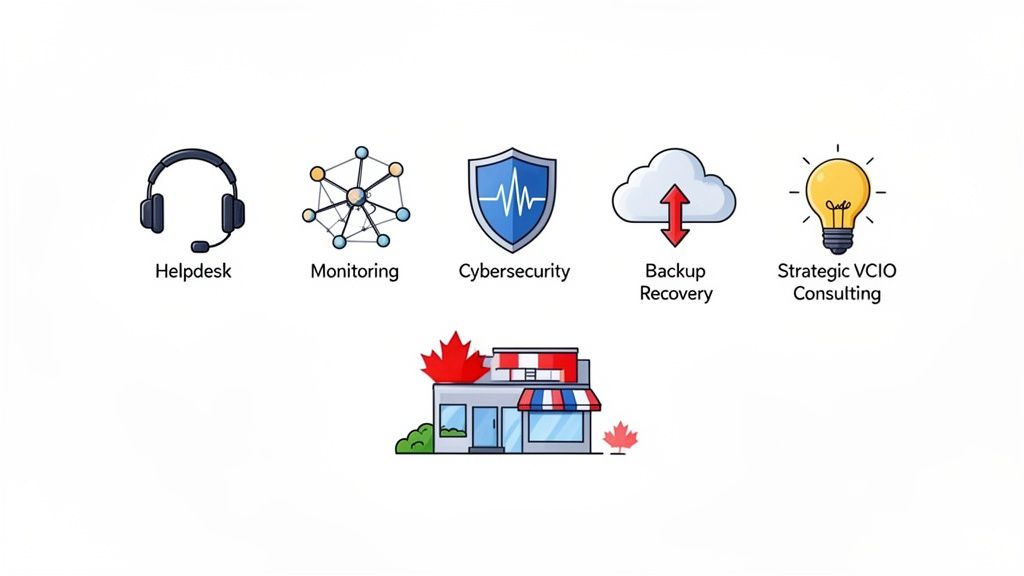
When you partner with a provider for managed IT services in Edmonton, you are not just paying someone to fix computers when they break. You are bringing in a dedicated team whose entire job is to keep your business secure, efficient, and running without a hitch.
Think of it like the expert crew that keeps a high-performance race car on the track. They aren't just waiting for a breakdown; they're constantly monitoring, tuning, and strengthening every component. The goal is peak performance and preventing those costly, race-ending failures. That's exactly what an MSP does for your business technology every day.
Let's break down what this crew handles for you.
It’s a familiar story: an employee cannot access a critical file right before a deadline, or the main office printer just gives up. Productivity grinds to a halt. A foundational piece of any managed IT package is the 24/7/365 IT helpdesk. This gives your team a direct line to immediate, expert help from a Canadian-based support crew.
Instead of your staff sinking valuable time into troubleshooting tech issues they are not trained for, they get fast, effective solutions. This is about more than just convenience—it’s about plugging the leaks that drain your profitability. Research shows employees can lose up to five hours of weekly productivity wrestling with IT problems. A responsive helpdesk gets that time back. If you want to see how this works in detail, you can learn more about a professional IT helpdesk support structure.
The best way to solve an IT problem is to prevent it from ever happening. That's the core idea behind proactive monitoring. Your MSP uses sophisticated tools to keep a constant watch over your entire network—from servers and workstations to your cloud setup. The system flags potential issues long before they can cause downtime.
This service is all about prevention and includes essential maintenance tasks like:
This constant vigilance is what truly separates modern managed services from the old, reactive "break-fix" model of waiting for something to fail.
In today's digital landscape, solid cybersecurity is not optional; it's a fundamental business requirement. A good MSP delivers a multi-layered security strategy to shield your sensitive data, client information, and financial records from a relentless list of digital threats.
Your MSP effectively becomes your dedicated security operations centre. They implement and manage enterprise-grade security tools that are often too complex or expensive for a typical Edmonton business to handle on its own.
This means deploying and managing things like next-generation firewalls, advanced antivirus software, and Endpoint Detection and Response (EDR). It also involves running regular vulnerability scans to find and fix weak spots in your defences before a hacker does.
Ask yourself this: what would happen if your Edmonton office was hit by a fire, a flood, or a crippling ransomware attack tomorrow? A well-crafted data backup and disaster recovery plan is what ensures your business can get back online quickly, with minimal—if any—data loss.
Your MSP will set up automated, secure backups of all your critical business data. More importantly, they’ll create a clear, actionable recovery plan to restore your operations when a catastrophe strikes. This is not just a tech feature; it's your business's ultimate insurance policy, guaranteeing you can continue operating when the unexpected happens. It’s the difference between a major inconvenience and a business-ending event.
A generic, one-size-fits-all IT strategy does not work in Edmonton's diverse economy. Every industry here faces its own unique set of operational challenges, regulatory hurdles, and security threats. The technology needed to run a healthcare clinic handling sensitive patient data is worlds apart from what’s required to manage a complex manufacturing supply chain.
This is where specialized managed IT services in Edmonton really make a difference. An IT partner who genuinely knows your industry understands your world—they speak your language, anticipate your challenges, and build tech solutions that actually solve your problems. They don't just put out fires; they provide a strategic tech framework that boosts efficiency, ensures compliance, and supports your growth.
For anyone in Edmonton's healthcare sector, IT is not just about keeping the computers running. It’s about patient safety and adhering to the law. Alberta’s Health Information Act (HIA) has very strict rules about how patient information is handled, stored, and protected. A data breach is not a simple technical glitch—it's a massive legal and ethical disaster.
A specialized MSP helps clinics and healthcare organizations navigate these complex requirements by:
It’s no surprise that so many are turning to experts for help. In fact, 46% of businesses in Edmonton now rely on managed IT services, a telling statistic about the move away from in-house IT. You can see more about how Edmonton's key sectors are adopting these services on trinustech.com.
Confidentiality and data integrity are the absolute bedrock for legal and financial firms in Edmonton. These businesses hold a treasure trove of sensitive client information, from financial statements to confidential case strategies, which makes them a prime target for cybercriminals. A breach can be catastrophic, leading to huge financial losses, a shattered reputation, and serious regulatory consequences.
An MSP that specializes in these fields focuses on creating multiple layers of security and rock-solid compliance.
A provider with experience in the legal and financial sectors will understand the specific requirements of regulations like PIPEDA. They'll build a security posture designed not just to prevent breaches but also to provide a clear, auditable trail of data handling and protection.
Key IT services for these firms include:
Edmonton's manufacturing and logistics sectors are the engine of our local economy, built on precision, efficiency, and flawless coordination. Here, the biggest IT challenges are not about data privacy but about keeping the entire operation moving without interruption. A network outage can grind a production line to a halt, and a communication breakdown can throw the supply chain into chaos.
An IT partner who understands this will prioritize a robust infrastructure and systems that can scale with you. For instance, they can implement and manage a reliable Voice over IP (VoIP) phone system that seamlessly connects the office, the warehouse, and drivers on the road. They’ll also design networks that can handle the massive amounts of data from modern machinery and logistics software, ensuring your technology never becomes a bottleneck to your growth. This operational focus keeps every piece of your business connected and running smoothly.
Of course, other sectors have unique needs as well. For instance, if you're curious about how tailored IT support benefits charitable organizations, check out our guide on IT services for nonprofits in Edmonton.
Determining what managed IT services will cost in Edmonton can feel challenging. With so many providers and different packages, it's easy to get lost in the details. The key is to understand the common pricing models so you can find a predictable, high-value solution that fits your budget.
Most IT providers in the city structure their fees in one of a few standard ways. Once you know how each model works, you can cut through the sales jargon and properly compare what different companies are offering. This clarity helps you shift from unpredictable IT bills to a stable, manageable operational expense.
Here in Edmonton, you will typically encounter three main pricing structures. Each has its pros and cons, and one will likely be a much better fit for your business than the others, depending on your specific needs.
The best pricing model is the one that gives you predictability and directly supports your business goals. You want a plan that covers all your essentials without making you pay for features you will never use.
While the monthly number is a huge factor, the true value of managed IT services in Edmonton goes much deeper. A provider with a rock-bottom price might look great at first, but hidden fees for "out-of-scope" work or painfully slow response times can wipe out those initial savings in a hurry.
The most important document to obtain is the Service Level Agreement (SLA). This contract specifies exactly what you are getting for your money, including guaranteed response times, uptime promises, and specific performance metrics. A solid SLA is your guarantee that the provider is accountable for keeping your systems running smoothly.
When you are talking to potential partners, ask direct questions to uncover any potential hidden costs. Find out about charges for onboarding, after-hours support, or on-site visits. A transparent provider will be completely upfront about all possible expenses, ensuring your IT budget stays predictable and you get the full value you're paying for.
Selecting a provider for managed IT services in Edmonton is much more than a simple technical decision—it’s a strategic move for your business. The right partner becomes a true extension of your team, boosting your efficiency and security. Get it wrong, and you’re stuck with a source of constant frustration and risk.
Making the right choice means having a clear, structured way to evaluate your options. You have to look past the slick sales pitches and dig into the concrete details that will actually affect your business's performance and long-term goals. It's all about finding a partner whose technical skills, service culture, and strategic thinking are a perfect match for yours.
This roadmap will walk you through the essential factors to weigh, helping you find an IT partner who won’t just fix what’s broken, but will actively help you grow.
When your systems go down, you want a local team that truly understands the Edmonton business scene. A provider with a physical office in the city can get on-site fast when a remote fix is not enough—a massive advantage over a faceless national call centre.
Just as important is their experience in your specific industry. An MSP that has already worked with other legal, healthcare, or manufacturing firms in the area will come in knowing your unique compliance rules, operational workflows, and security challenges. They won't be learning on your dime.
Choosing a partner with proven industry expertise means they come equipped with solutions tailored to your world. They understand the regulatory pressures and operational demands you face, allowing them to provide proactive, relevant guidance from day one.
For businesses in sectors like legal, finance, and accounting, this kind of specialization is non-negotiable. As cyber threats and compliance demands have ramped up, the need for secure, knowledgeable IT support has exploded. The Canadian managed services market grew from USD 8.2 billion in 2018 to USD 17.3 billion in 2024, and it's projected to hit USD 45 billion by 2032. This growth is driven by these critical needs.
A key difference between providers lies in their Service Level Agreement (SLA). This document is not just a piece of paper; it's a contractually guaranteed promise of service. It should spell out, in no uncertain terms, their response times for issues of different severity levels.
Do not settle for vague promises of "fast support." You need to ask for specifics:
Beyond the SLA, look for real-world proof. Ask for case studies or testimonials from their current clients right here in Edmonton, ideally from businesses similar to yours. A provider who is confident in their service will have no problem connecting you with references who can vouch for their reliability and quality. Reading up on what makes a great IT support company in Edmonton can also give you a better feel for what to look for.
At the end of the day, you are not just hiring a vendor; you are choosing a long-term partner. The provider's company culture should align with yours. Do they communicate openly and honestly? Are they focused on helping you achieve your business goals, or are they just trying to sell you the latest technology?
A true partner invests the time to understand your business strategy. They act as a virtual Chief Information Officer (vCIO), offering guidance to ensure your technology roadmap supports your growth plans. They should be asking you about your five-year vision, not just your current server setup. Once you have narrowed down your list, digging into IT vendor management best practices can offer insights into their operational maturity and how they manage their own partnerships—a good reflection of how they will manage their relationship with you.
To help you systematically evaluate potential partners, we've put together a practical checklist. Use these questions to steer your conversations and compare providers on a level playing field.
This checklist is designed to help you ask the right questions and identify the key qualities of a great IT partner for your Edmonton-based business.
By using this framework, you can move beyond the marketing noise and focus on finding a provider who will be a genuine asset to your business for years to come.
The thought of switching your IT provider can be stressful. Visions of downtime, lost data, and general chaos are enough to make anyone hesitant. But a well-planned move to a managed IT service in Edmonton should not feel like a leap of faith. It should feel like a controlled, strategic upgrade for your business.
The right partner will not just show up and start unplugging things. They follow a proven process designed to understand your business inside and out, integrate their systems smoothly, and ensure your team is comfortable from day one. The whole point is a seamless handover that lays the groundwork for a strong, long-term relationship.
Switching providers is a structured process, not an overnight flip of a switch. While the details will vary based on your specific business, the journey usually follows a clear, logical path. This ensures nothing falls through the cracks and your business is protected every step of the way.
Here’s what that typically looks like:
Choosing the right IT partner comes down to a clear process of assessing your needs, evaluating your options, and then committing to a partnership.
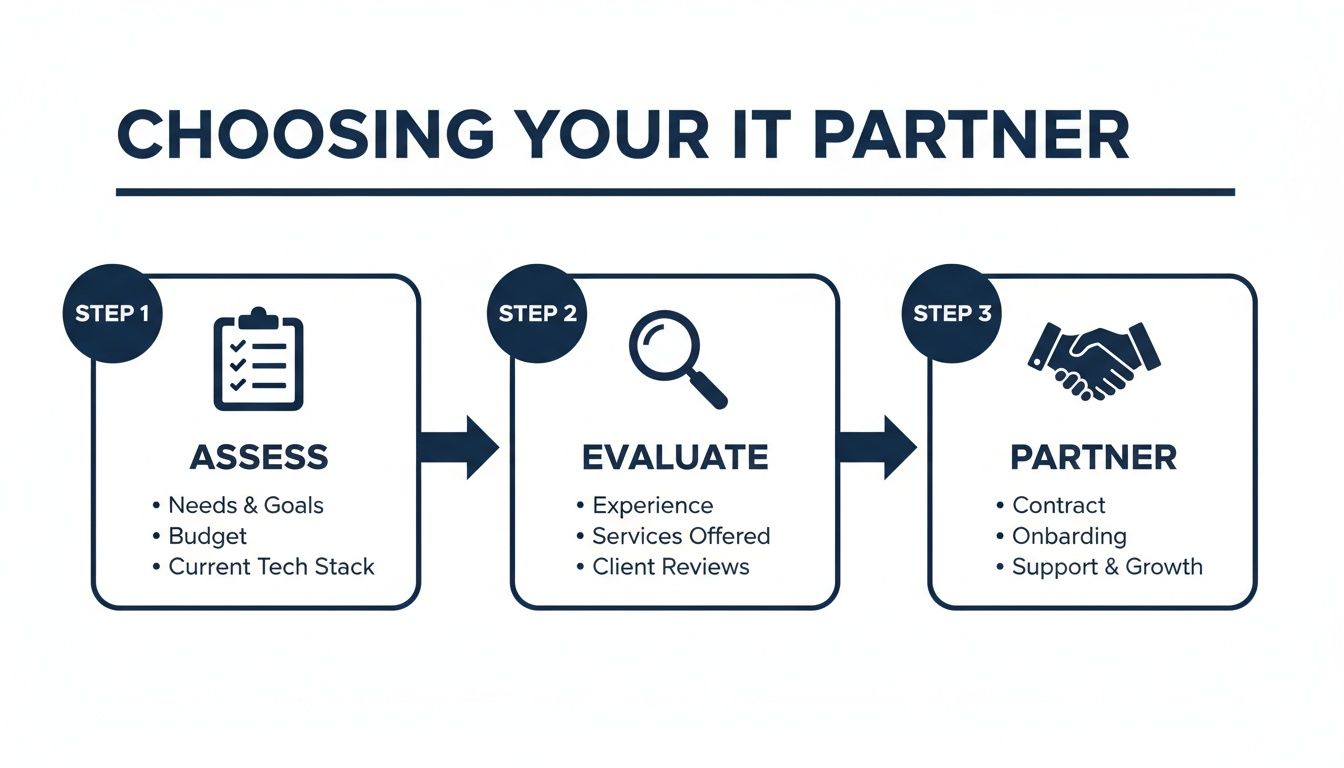
This simple roadmap helps break down the selection journey, showing the logical steps from figuring out what you need to building a strong, lasting relationship.
A well-executed transition is an opportunity for immediate improvement. It should feel like a fresh start, where persistent IT issues begin to disappear and your team gains access to faster, more reliable support.
This proactive approach ensures your business keeps running smoothly while you start seeing the benefits of your new partnership right away. This is especially true for more complex moves, like shifting to the cloud. You can get a better sense of what a structured approach entails in our guide to cloud migration services.
Ultimately, a seamless onboarding experience is the first clear sign that you have chosen the right partner to support your business's future.
Deciding to bring on a managed IT services partner is a big move. It’s natural to have a few questions before you commit. We hear many of the same queries from business owners right here in Edmonton, so we have laid out some straightforward answers to help you feel confident about your next steps.
Here in Edmonton, you can expect to see managed IT plans ranging from approximately $175 to over $325 per user, per month. What you end up paying really depends on what you need. A basic plan might cover simple helpdesk support, while the more comprehensive packages will include advanced cybersecurity, 24/7 monitoring, and guidance on meeting specific compliance standards.
It all boils down to whether you need reactive help or a proactive team steering your technology strategy.
Think of it this way: traditional IT support is like a firefighter. You call them when something is already on fire and needs to be put out. Managed services are more like a fire marshal—they are all about prevention.
The whole point is to stop problems before they even start. We do this with constant monitoring, regular maintenance, and proactive security management. It's the difference between calling a tow truck after your car breaks down and having a dedicated pit crew keeping your engine tuned for race day.
A smooth, well-planned onboarding is non-negotiable, and it typically takes anywhere from 30 to 90 days. This is not just about plugging things in. This timeline gives your new provider the space to properly audit your current systems, roll out their security and monitoring tools, and get your team comfortable—all without disrupting your daily operations.
A rushed setup is a recipe for headaches. A structured transition ensures everything just works from day one.
A well-managed onboarding process isn't just about technical setup; it's the foundation of a successful long-term partnership. It ensures your new IT team understands your business goals and can start delivering value from day one.
This is one of the best parts about managed services: they scale with you. Most pricing models, especially the per-user plans, are built for flexibility. If you bring on new team members, your IT support scales up right alongside them. If you need to downsize, your IT costs adjust accordingly.
You only ever pay for what you actually use. It’s that simple.
Ready to transform your technology from a constant headache into your biggest competitive advantage? The team at CloudOrbis Inc. is here to provide the proactive, reliable managed IT services your Edmonton business deserves. Let’s build a technology foundation that helps you grow.
September 19, 2026
Database Migration Services Explained for Canadian SMBsLearn how database migration services move data to the cloud securely with minimal downtime. Types, risks, costs and a Canadian provider checklist.
Read Full Post
September 18, 2026
Business VoIP Telephone Systems Explained for SMBsLearn how business VoIP telephone systems work, what they cost and how to choose a secure, resilient option for your Canadian SMB.
Read Full Post
September 17, 2026
Cloud Migration Roadmap Template That Prevents Costly ReworkGet a practical cloud migration roadmap template plus steps to customize it for assessment, waves, testing and cutover without budget surprises.
Read Full Post
