Choosing the Right IT Support Company in Edmonton for Your Business
Looking for it support company edmonton? Compare providers, pricing, and cybersecurity essentials to choose the best IT partner for your Alberta business.

Looking for it support company edmonton? Compare providers, pricing, and cybersecurity essentials to choose the best IT partner for your Alberta business.

When you're running a business in Edmonton, the last thing you want is for your IT to be a liability. The old "break-fix" model, waiting for something to fail before calling for help, is a recipe for disruption in today's market. It is simply no longer sufficient.
The right IT partner does more than just fix computers. They provide a strategic advantage, protecting your operations and paving the way for growth. For medium-sized organizations in Edmonton, that means finding a provider who understands the local landscape and thinks a few steps ahead.
Relying on outdated IT support in Edmonton's fast-paced business environment is a significant risk. You might be operational, but you are not optimized, and a complete breakdown could be just around the corner.
Consider this: when you only call for IT help after something goes wrong, you are already losing. That reactive approach is a direct threat to your bottom line and your reputation.
Picture an Edmonton logistics firm during its frantic holiday season. Their server suddenly crashes, bringing the entire dispatch system to a halt. Drivers are stranded, deliveries are piling up, and customers are growing frustrated. Every hour of that downtime costs them money and goodwill. This is not just a technical glitch; it is a major business failure born from a reactive IT strategy.

Modern, effective IT support is about prevention. It is about anticipating problems long before they have a chance to disrupt your operations. A strategic partner takes a proactive stance, which means they are always monitoring and maintaining your systems.
This includes:
Making this shift turns your IT from an unpredictable expense into a genuine competitive advantage. With a stable and secure technology foundation, your team can stop wrestling with technical issues and start focusing on core business activities. For a deeper dive into what this looks like, explore our guide on IT strategy and consulting.
The need for a smarter approach to IT is clear when you examine the local business climate. Edmonton's tech industry has seen a significant 26% increase in jobs since 2014, a sure sign that local businesses are demanding more from their technology providers.
This growth is pushing businesses in our key sectors, healthcare, manufacturing, and oil and gas, to find an it support company edmonton teams can truly depend on.
A provider with a presence in Edmonton understands the specific challenges and compliance regulations we face, such as Alberta's Personal Information Protection Act (PIPA). This is not just about getting a computer fixed. It is about building a resilient, secure business that is prepared for future challenges.
Before you begin searching for an IT support company Edmonton businesses rely on, you must first conduct an internal assessment. It is a common mistake to enter consultations without a clear picture of what your business truly needs to operate efficiently and grow. A solid self-assessment cuts through the technical jargon and puts the focus back on business outcomes.
Start by examining the day-to-day friction your team experiences. Are they constantly battling slow network speeds that bring projects to a halt? Does your sales team struggle to get reliable access to client data when they are out in the field? These are not just minor annoyances, they are symptoms of a technology gap that is quietly eroding your productivity and revenue.
Consider your team's daily operations. A construction firm here in Edmonton, for instance, absolutely needs dependable, secure connectivity for crews in the field to access blueprints and file daily reports. If that process is inefficient or the connection is unreliable, it creates delays that disrupt the entire project timeline.
On the other hand, a local law firm's biggest challenge might be document management. They need a secure, compliant system for handling sensitive client files, ensuring they adhere to privacy laws like PIPEDA. Their IT requirements are completely different from the construction company's, which is why a one-size-fits-all approach to IT support is ineffective.
To properly define your needs, ask yourself:
A proper needs assessment is not about creating a list of every computer and server you own. It is about defining what successful technology looks like for your business, whether that is achieving 99.9% uptime for your e-commerce site or ensuring your remote team can collaborate seamlessly and securely.
Once you have a good understanding of your current challenges, it is time to look ahead. Where is your business headed in the next one, three, or five years? Your technology should be the engine for that growth, not an anchor holding you back.
For example, if you plan to scale and double your team, your IT infrastructure must be ready for that expansion. That means planning for more users, more data storage, and much stronger security. If a move to the cloud is on your roadmap, you need a partner with proven experience in executing those migrations smoothly. Understanding this connection is critical, and you can explore the principles of business technology alignment for more insight.
This table can help you connect your daily operational challenges with the specific IT support services that can solve them.
| Business Challenge (e.g., Remote Team Collaboration) | Required IT Capability (e.g., Secure Cloud File Sharing, VoIP) | Key Questions to Ask a Provider |
|---|---|---|
| Slow network performance hampering productivity | Network optimization, modern hardware (switches, access points) | How do you diagnose and resolve network bottlenecks? What hardware do you recommend for our size? |
| Inconsistent remote access for field/sales teams | Secure VPN, cloud-based applications, mobile device management | Can you show us examples of how you've set up secure remote access for a business like ours? |
| Concerns over data security and PIPEDA compliance | Managed firewall, endpoint protection, data backup & recovery | What is your process for ensuring we meet our compliance obligations? How do you test backups? |
| Difficulty scaling IT to support business growth | Scalable cloud solutions (e.g., Microsoft 365, Azure), VoIP | How do your solutions scale as we add new employees and locations? What does that process look like? |
By mapping your technology needs directly to your business goals, you completely change the conversation with potential IT providers. You are no longer asking generic questions. Instead, you can present a clear vision: "We need an IT solution that supports our expansion into Western Canada by providing secure, scalable remote access for 20 new employees." This focus ensures you find a partner who delivers real solutions, not just services.
Understanding the financial side of IT support can be challenging. Quotes are often packed with different models and jargon, making it difficult to compare them accurately. Gaining a firm grasp of these structures is the first step toward finding an IT support company Edmonton businesses can trust with their budget.
Most IT providers use one of three main pricing models. The one you choose will have a significant impact on your monthly costs, your operational stability, and your ability to budget for IT predictably.
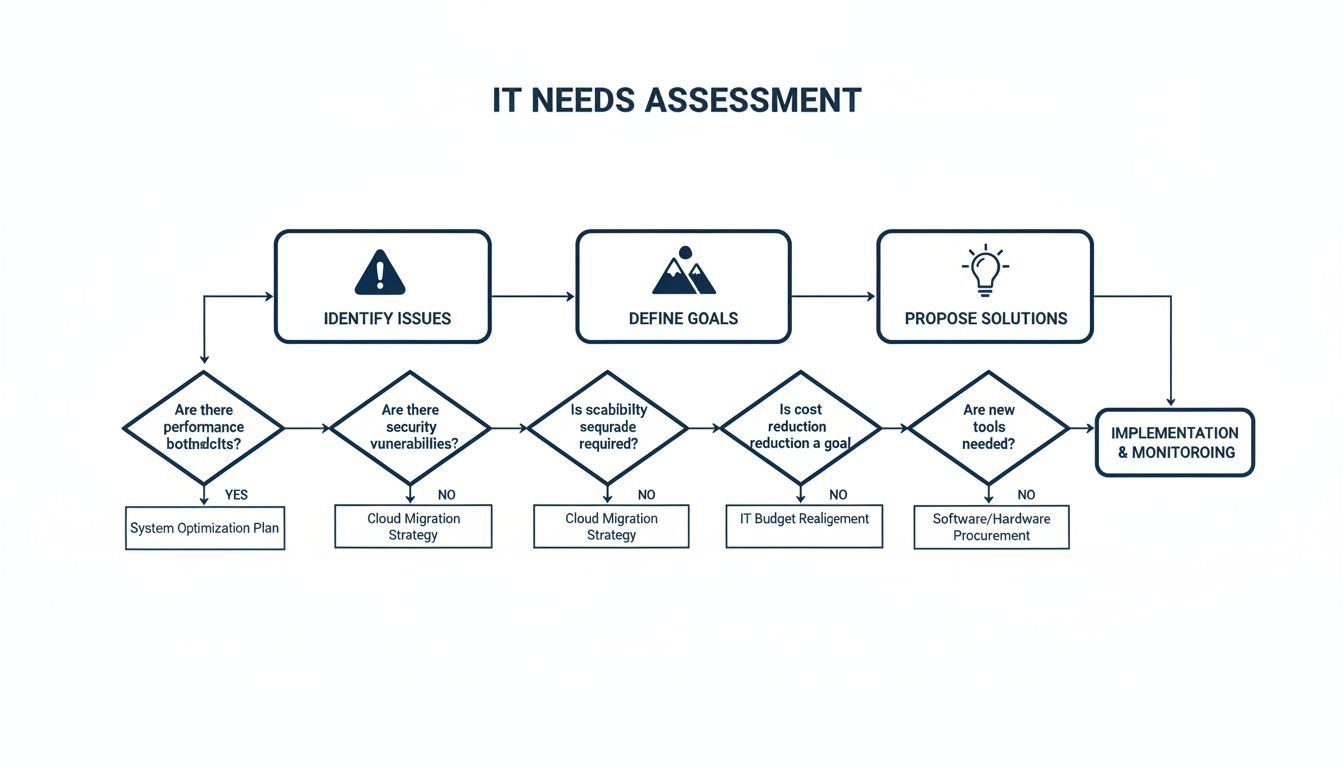
This decision tree helps visualize how connecting your current frustrations to your long-term goals leads you straight to the right technology solutions.
The pricing model you agree to sets the tone for your entire relationship with an IT provider. It defines whether they are paid to prevent problems or simply to respond after something has already gone wrong.
If you want to delve deeper into these models, our guide on the benefits of different managed IT service companies is a great resource.
Imagine an Edmonton healthcare clinic operating on a break-fix IT model. Their patient management system crashes on a busy Tuesday morning. They must call a technician and wait. Every minute of downtime means lost revenue, stressed staff, and frustrated patients. Worse, if data access is compromised, they could face PIPEDA compliance risks. The hourly bill for the repair is just the beginning; the real cost is in the operational chaos it causes.
A fully managed plan completely changes that scenario. The same clinic would have 24/7 monitoring that would likely have caught the server issue before it caused an outage, all for one fixed monthly fee.
The goal is to shift your mindset from treating IT as an unpredictable expense to viewing it as a strategic, budgetable investment. A good partner helps you see the total cost of ownership, not just the number on an invoice.
Once you have settled on a pricing model, the contract itself becomes the most important document. Your Managed Services Agreement (MSA) and Service Level Agreement (SLA) need to be crystal clear.
Be on high alert for vague language. An SLA that promises a "four-hour response time" might just mean they will send an automated email acknowledging your ticket within four hours, not that they will actually start fixing the problem. A strong SLA will have guaranteed resolution times for different types of issues, so you know exactly what to expect when you need help.
Your agreement should spell out precisely what is included, from cybersecurity and backups to on-site visits, leaving no room for surprise charges down the line.
In today's business climate, treating cybersecurity as just another item on a checklist is a risk no Alberta business can afford to take. It is not just a technical detail, it is a fundamental pillar of trust and operational stability. When you are evaluating an IT support company in Edmonton, their security expertise is every bit as important as their technical skill.
A single data breach can cause devastating financial and reputational damage. That is why you need a partner who sees security as a multi-layered strategy, not just a subscription to an antivirus program. It is about building a defensive system that protects your business from every angle.
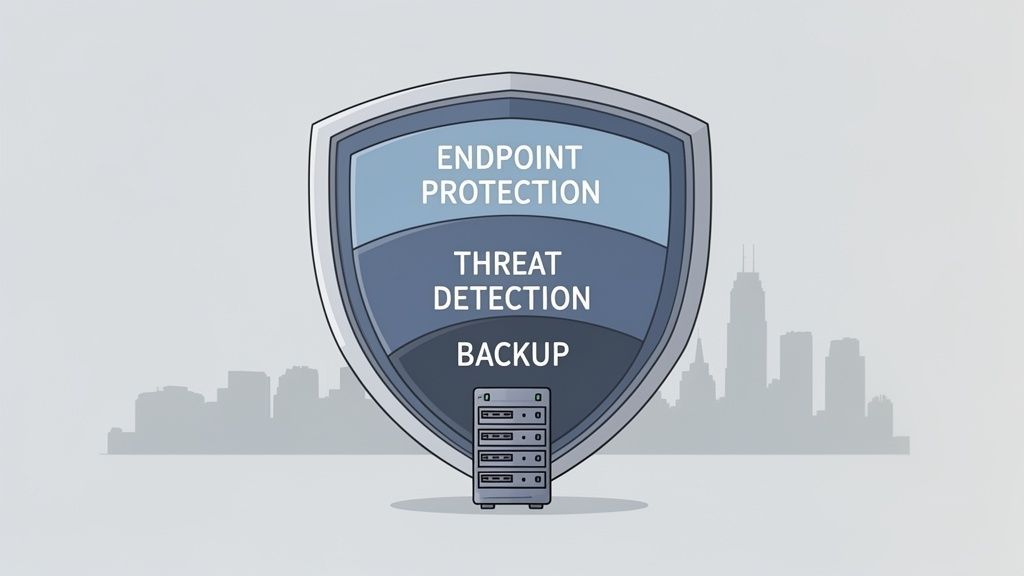
A proactive provider will defend your business with several layers of protection. Each layer is designed to counter different types of threats, creating a resilient security posture that can stand up to modern attacks.
Here is what that defence should always include:
These elements work together to form a comprehensive defence. You can learn more about how we structure these defences in our overview of cybersecurity services in Edmonton.
For many Edmonton businesses, especially those in finance, healthcare, or legal sectors, compliance with privacy legislation is mandatory. This includes Alberta's Personal Information Protection Act (PIPA) and the federal PIPEDA. Failing to comply can lead to severe penalties and a serious loss of client trust.
Your IT provider must understand the technical requirements of these regulations. They need to show you exactly how their security measures, like data encryption, access controls, and secure data storage, directly support your compliance obligations.
Imagine a financial services firm here in Edmonton facing a potential data breach. A proactive IT partner would not just react; they would have systems in place to contain the threat, document the incident for regulatory reporting, and execute a recovery plan, all while keeping the firm's leadership informed.
This is the level of preparedness that separates a true security partner from a simple service provider.
When you are interviewing a potential IT support company Edmonton businesses can trust, it is time to ask direct and specific questions. Do not settle for vague assurances about "keeping you safe."
Get specific. Ask them to explain:
Edmonton's IT services market is a bustling hub, with 97 companies listed on TechBehemoths, covering 96 services from cybersecurity to cloud migrations. This thriving ecosystem makes it critical to find a provider with proven expertise tailored to industries like construction, finance, and healthcare. A partner who can answer your security questions confidently is one who takes your protection as seriously as you do.
When you are facing a critical system failure at 3:00 p.m. on a Tuesday, marketing promises about great IT support mean nothing. What truly matters is how a provider acts under pressure. You need to look past the sales pitch to find out how responsive they really are.
It all starts with the Service Level Agreement (SLA), but you must read the fine print. Too many business owners get burned by SLAs that promise a fast "response" time. Often, that just means you get an automated email confirming they received your ticket. That is not a fix. The metric that actually impacts your business is the resolution time, how long it takes to get you back up and running.

When your entire network crashes, the last thing you want is to be shuffled through an offshore call centre that reads from a script. They do not grasp the urgency or the nuances of your business. This is where a 100% Canada-based 24/7 helpdesk makes a world of difference. The support team understands the local business context, there are no language barriers, and their business hours align with yours.
Beyond that, a local Edmonton team brings something to the table that a remote-only provider cannot: on-site support. For hardware failures, complex server issues, or anything that requires a hands-on solution, having technicians who can physically come to your office is a game-changer. This hybrid approach, rock-solid remote support backed by a local presence, is the most practical and resilient setup for any Edmonton business.
The true value of an IT partner is not just in the solutions they sell, but in the speed and effectiveness with which they resolve problems. A local presence transforms IT support from a remote service into a tangible, hands-on partnership.
One of the best ways to get the real story on performance is to talk to a provider's current clients. Do not just ask if they are "happy." You need to ask pointed questions that reveal the truth about how they operate when things go wrong.
Here are a few questions we always recommend asking:
Choosing the right it support company edmonton businesses can rely on demands this kind of thorough vetting. Edmonton's tech sector is booming, we have seen a 26% job increase since 2014, and the city is climbing the North American tech rankings. With smart medium-sized businesses budgeting 3-6% of revenue for technology, you cannot afford to settle for a partner who makes empty promises. Do your homework to find a team that delivers genuine, timely solutions. You can get more insights on the Edmonton IT services market and its top firms to help inform your decision.
Selecting the right IT partner is a huge step, but the real work begins after the contract is signed. The transition from your old provider (or your in-house setup) to a new IT support company in Edmonton is the first true test of the partnership.
A bumpy, disruptive onboarding process can damage the relationship from day one, leading to frustrating downtime and an unhappy team.
You are not looking for a sudden jolt. A well-managed transition should feel like a carefully guided process. It starts long before any software is installed, with your new partner performing a deep dive to understand your business operations, not just your network map. This discovery phase is what allows them to build a strategic roadmap that truly fits your goals.
Those first three months are critical. They set the tone for the entire relationship. A proficient provider will not improvise; they will have a structured plan designed to integrate their services without disrupting your daily workflow.
This process usually breaks down into a few key stages:
A detailed strategy is what separates a smooth transition from a chaotic one. You can learn more about what goes into effective IT project planning to better understand these crucial early stages.
Let's imagine a mid-sized Edmonton logistics company switching IT providers. Their biggest fear was a major operational disruption right in the middle of their busy spring season.
Their new IT partner understood this. They created a phased rollout, starting with non-critical systems first. During the main transition, they had support staff physically on-site. They also held brief, targeted training sessions with dispatchers and drivers to show them how the new, more efficient systems would make their jobs easier.
A great IT partner understands that their job is not just technical; it is about people. A clear change management plan, transparent communication, and dedicated employee training are the ingredients that prevent resistance and ensure a smooth, successful transition.
This proactive approach did not just prevent downtime, it actually got the team excited about the upgrades. They saw the benefits firsthand, turning a potentially stressful change into a clear operational win. That foundation of trust, built in the first 90 days, is what turns a simple service provider into a genuine long-term partner.
Choosing the right IT partner is a significant decision, and it is natural to have questions. Here are some of the most common ones we hear from business leaders in Edmonton, answered clearly and concisely.
The honest answer is: it depends. Pricing varies based on the number of users you have, the complexity of your IT environment, and the specific services you require. The industry standard is a flat monthly fee, either per user or per device, which makes budgeting predictable.
While some providers offer hourly rates for "break-fix" support, that model is reactive. The real value in managed IT services lies in being proactive, preventing expensive problems before they cause downtime. Over the long term, this is always the more cost-effective approach. The only way to get a firm number is to ask for a custom quote based on a thorough assessment of your business.
Think of it as the difference between hiring a specialized contractor versus engaging a general manager for your entire IT operation.
Having a local team on the ground offers clear benefits, especially when a server goes down or you need someone physically present for a complex installation. An IT support company in Edmonton will naturally have a better feel for the local business environment and its unique challenges.
That said, the most important factors should always be expertise, responsiveness, and genuine capability. A national provider with a strong local team and a 100% Canada-based helpdesk can offer the best of both worlds: the deep resources of a large organization combined with the personal, hands-on support you need.
Ultimately, you need a partner who can meet your specific technical and compliance needs, regardless of their head office's postal code.
Ready to partner with an IT support company Edmonton businesses trust for security, reliability, and growth? The expert team at CloudOrbis Inc. is here to build a strategic IT roadmap that aligns with your business goals. Learn more about our managed IT services.
Book a 30-minute call with a senior engineer. No sales script, just straight answers about your environment.


