Your Guide to IT Consulting in Vancouver, BC for Smarter Business Decisions
it consulting vancouver bc: Discover practical tips to vet partners, compare pricing, and understand BC PIPA to choose the right IT consultant.

it consulting vancouver bc: Discover practical tips to vet partners, compare pricing, and understand BC PIPA to choose the right IT consultant.
When you're running a growing business in Vancouver, it's easy to see technology as just another recurring cost. But what if it could be your single greatest competitive advantage? The right IT partner does more than just fix what's broken; they provide the strategic guidance to turn your technology into an engine for growth and security. This guide is for business and IT leaders in medium-sized organizations looking to make smarter IT decisions.

In Vancouver's fast-paced business scene, a strategic IT partner is no longer a luxury, it's essential. As you scale, you face complex challenges that a small internal team or a simple break-fix provider cannot handle. These problems demand more than a quick fix; they require forward-thinking strategy.
A true IT consulting partner helps your organization:
British Columbia’s IT services market is a major hub in Canada. Recent analysis shows that BC holds 18% of the country's managed services market share, a figure driven by tech startups and medium-sized businesses needing proactive solutions to thrive. This demand is especially strong in sectors like healthcare and finance, where secure data and regulatory compliance are non-negotiable.
This is where a Vancouver-based consultant makes all the difference. They bring firsthand knowledge of provincial laws like the Personal Information Protection Act (BC PIPA), ensuring your data handling practices remain compliant.
To truly optimize IT operations, Vancouver businesses often require strategic IT partners, and understanding the role of expert GRC consultants is a critical step in identifying the right fit. This specialized guidance ensures your governance, risk, and compliance frameworks align with both business goals and legal obligations.
Ultimately, a partner rooted in the local community understands the specific pressures and opportunities facing businesses in the Lower Mainland. They are perfectly positioned to deliver outcomes that matter to your bottom line. To build a robust framework, learn more about effective IT strategy and consulting.
Before searching for an IT consulting firm in Vancouver, BC, you need to look inward. We have seen businesses rush into meetings with potential partners without a solid grasp of their own problems. The result? Vague proposals and solutions that miss the mark.
To avoid this common pitfall, start with an internal technology audit. This does not have to be a complex, technical deep-dive. Start by talking to your people. What are the persistent IT headaches that hinder their work? Perhaps the sales team fights with a slow CRM, or project managers struggle to collaborate effectively from home. These daily frustrations are often symptoms of a larger issue.
Once you have gathered feedback on daily challenges, you can connect the dots to specific technology gaps. Take a hard look at your current infrastructure and be honest about its weaknesses.
By pinpointing these specific pain points, you change the conversation. It is no longer "our IT is slow," but "we need to improve our network speed and secure our remote access." That clarity is vital for productive discussions with any potential IT consultant.
A well-defined scope is the foundation of a successful IT partnership. When you can clearly articulate your challenges and goals, you empower prospective consultants to provide accurate, relevant, and effective proposals that address your true needs from day one.
With your pain points identified, the final step is to translate them into clear, actionable goals. These goals will act as your North Star throughout the selection process and become the benchmark for measuring a consultant's performance. Move beyond a vague desire for "better IT" and frame your objectives around specific business outcomes.
For example:
This level of detail is invaluable. For business leaders wanting to align technology with high-level strategy, understanding the role of a virtual CIO can guide this process. Explore our article on whether your business needs a virtual CIO for more insights. This strategic self-assessment ensures that when you engage an IT consulting firm in Vancouver, BC, the conversation is focused, productive, and geared toward a successful outcome.
Finding the right IT partner in Vancouver goes beyond a quick search for "IT consulting Vancouver BC." While a search engine is a decent starting point, the best partners often come from trusted recommendations within your professional circles.
Start by asking your peers for honest feedback. Tap into local industry groups like the Greater Vancouver Board of Trade or sector-specific associations. These firsthand accounts are valuable because they come with real-world context, how a firm handled a crisis, how quickly they responded, and whether they delivered on their promises. That is insight you will not find on a company’s homepage.
Once you have a few names, it is time to dig in and verify their expertise. Look for objective markers of skill and specialization relevant to your business.
For example, a Microsoft Solutions Partner designation is significant. It signals a high level of competency and a close working relationship with Microsoft, which is critical if your operations depend on platforms like Azure or Microsoft 365.
This is also when you should scrutinize their online presence. Do they have detailed case studies with businesses of your size and in your industry? A firm specializing in supporting legal practices in the Lower Mainland will have a different skillset than one focused on manufacturing. You need to see tangible proof they understand your world.
To help you organize your evaluation, we've put together a checklist of what to look for, and what to watch out for. A systematic approach ensures you compare each potential partner fairly and do not miss any critical details.
| Evaluation Area | What to Look For | Red Flags |
|---|---|---|
| Local Presence & Expertise | A physical office in the Lower Mainland. Case studies from local Vancouver businesses in your industry. | Vague answers about their local client base. All staff located in another province or country. |
| Technical Certifications | Relevant partner statuses (e.g., Microsoft Solutions Partner). Certifications for specific technologies you use. | No verifiable certifications. Staff who seem to lack deep technical knowledge. |
| Support Model & Location | A 100% Canada-based helpdesk. A clear focus on proactive monitoring to prevent issues. | Outsourced helpdesk (especially outside Canada). A model that only focuses on fixing things after they break. |
| Client Testimonials | Specific, verifiable reviews and references you can contact. Detailed case studies with measurable results. | Generic testimonials without company names. Reluctance to provide references. |
| Cultural Fit & Communication | Clear, jargon-free communication. A team that listens to your goals and seems genuinely interested. | High-pressure sales tactics. A one-size-fits-all approach that ignores your unique needs. |
This checklist is not exhaustive, but it provides a solid framework for your initial vetting process. The goal is to move beyond the sales pitch and understand how a firm truly operates.
Once you have a handful of promising firms, the initial meetings are where you separate the contenders from the pretenders. Go into these conversations ready with questions that get to the heart of their operations and company culture.
Here are a few essential questions you should ask:
How a potential partner answers these questions reveals their entire philosophy. A firm that proudly details its proactive security measures and local support structure shows a commitment to being a true partner, not just another vendor.
The IT consulting market in Canada is growing fast, with projections from IBISWorld valuing it at USD 114.0 billion by 2026. This growth is driven by trends like IT infrastructure optimization and cybersecurity advisory services, creating massive opportunities for managed IT providers to deliver strategic value. Getting a clear picture of a firm’s capabilities now ensures you partner with one that can guide you through these changes.
By taking this thorough approach, you can confidently assess a firm’s real-world skills and, just as importantly, decide if they are the right cultural fit for your team. This process is about finding a partner you can trust to help your business grow. For a broader look at what to expect from support providers, check out our guide on what to look for in top IT support companies.
When it comes to IT consulting, one size does not fit all, and neither should the pricing. You need to become familiar with how different firms structure their services. This is the only way to find a partner that works with your budget and delivers the results your business needs.
Figuring out the right model for it consulting in Vancouver, bc is about more than just cost. It’s about creating financial transparency from day one, which is the foundation of any good long-term partnership.
The good news is that most businesses are finally ditching the old "break-fix" model, where you only call for help after something has already gone wrong. Today, smart businesses invest in proactive, strategic support that stops problems before they start. This shift has given rise to a few common service models you will encounter.
Think of this as an all-inclusive subscription for your IT. You pay a predictable, flat monthly fee for complete and ongoing management of your entire technology stack. It’s built for businesses that cannot afford surprises and need rock-solid support and security.
A typical managed services plan covers everything from 24/7 network monitoring and helpdesk support to cybersecurity threat management and data backups.
For example, a busy manufacturing firm in Burnaby cannot afford a minute of downtime. A managed services plan gives them peace of mind, ensuring their critical operational technology is constantly monitored and maintained to prevent costly production halts. It makes budgeting a breeze. To learn more, you can explore the value of a comprehensive managed IT service.
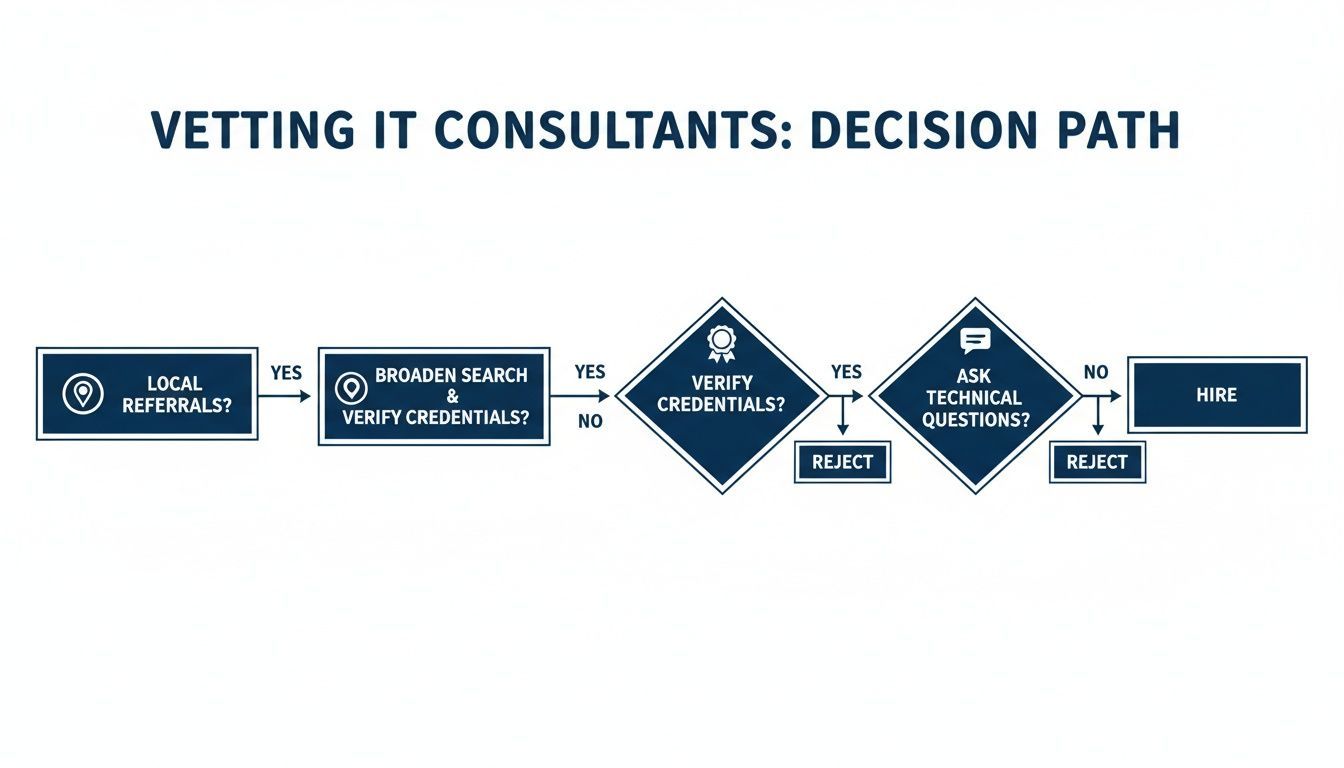
As you can see, a solid vetting process involves more than just a quick online search. You have to move from referrals to checking credentials and, most importantly, asking the right technical questions to find a truly qualified partner.
Sometimes you do not need constant oversight. You just need an expert for a specific, time-sensitive initiative. That’s where a project-based model shines. You receive a fixed quote for a clearly defined outcome, like migrating your servers to the cloud, overhauling your cybersecurity, or setting up the IT for a new office.
Imagine a law firm in downtown Vancouver preparing for an office move. Project-based work is perfect for this. The consulting firm can handle the entire IT transition, from network cabling to setting up every workstation, ensuring the move is seamless and does not cut into billable hours.
A retainer model, often for a virtual CIO (vCIO), provides ongoing strategic advice for a set monthly fee. This is ideal for businesses that have a capable internal team for daily tasks but need high-level guidance on their technology roadmap, budgeting, and long-term planning without the cost of a full-time executive.
When looking for an IT consultant in Vancouver, you are searching for more than just technical ability. You need a partner with a deep, practical understanding of British Columbia’s unique regulatory environment. Generic, one-size-fits-all IT support does not work here.
BC operates under the Personal Information Protection Act (BC PIPA), a law that dictates how businesses must handle the personal information they collect, use, and share. An experienced local partner does not just know about these rules, they live by them. They understand that BC PIPA is not a suggestion; it is a legal requirement to have clear data policies, get proper consent, and implement "reasonable" security measures.
That means going far beyond a basic firewall. It requires building a comprehensive security strategy from the ground up. For instance, a key part of BC PIPA compliance involves protecting data in transit and at rest, which is why understanding end-to-end encryption is critical. A consultant who understands these provincial rules can build a compliance framework that shields your business from large fines and reputational damage.
Compliance is not a monolith. In addition to provincial laws, your business must meet the specific demands of your industry. The right partner for IT consulting in Vancouver, BC, will already speak your sector's language and understand its unique pressures.
Choosing a consultant with proven experience in your field is a strategic advantage. They will not need a crash course on your business realities and can deliver targeted solutions that address your most pressing security and operational needs right away.
This need for specialized expertise is occurring during a huge shift in Canada’s IT landscape. IT consulting and implementation services are set to capture 27.80% of the 2026 Canada IT services market share, a trend fuelled by massive modernization programs.
At the same time, businesses are flocking to the cloud. Cloud-hosted workloads are projected to grow at a 20.01% compound annual growth rate through 2030 as more companies ditch their on-premises servers.
This migration makes it even more important to find a consultant who can manage both compliance and your cloud strategy. For anyone grappling with privacy rules, our guide on how to conduct a Privacy Impact Assessment offers valuable and related insights.
So, you have signed the contract. This is where the real work, and the real partnership, begins. A top-tier IT firm will not just show up and start unplugging things. Instead, they will kick off a structured onboarding process designed to get up to speed on your business with minimal disruption.
This initial period is foundational and sets the tone for the entire relationship.
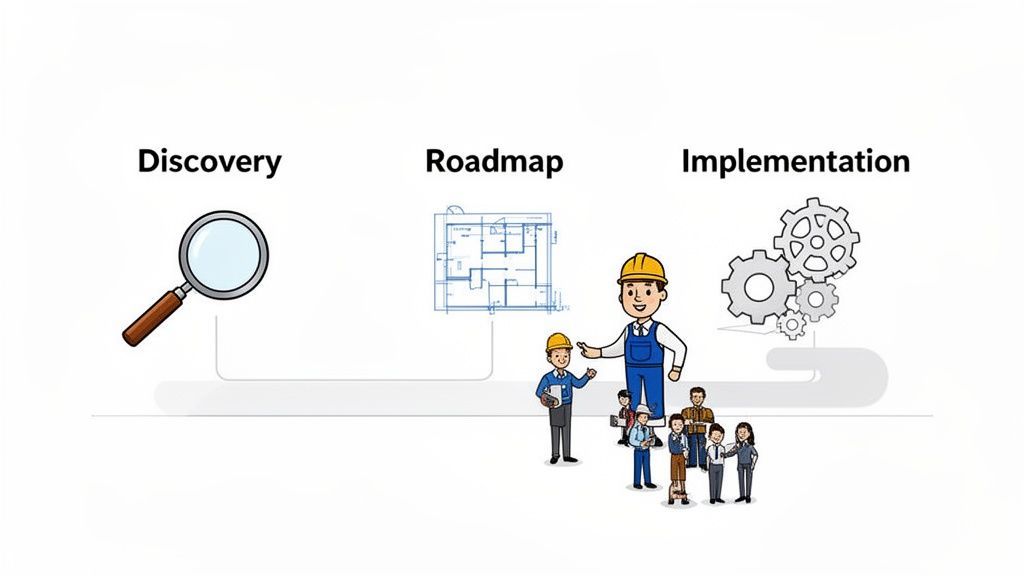
The first thing you should see is a deep discovery phase. Your new consultants will dig in to understand your business inside and out. This means mapping your current infrastructure, identifying hidden weak spots, and talking to your key people.
It is not just a technical audit; it is about understanding how your team works day-to-day and what your big-picture goals are.
Once the assessment is complete, the next step is to build a strategic technology roadmap. This is not just a list of fixes; it is a comprehensive blueprint that turns all those initial findings into a clear, actionable plan.
This roadmap aligns everyone on priorities, timelines, and what success looks like. It will break down specific projects, such as:
A well-crafted roadmap is a sign of a true strategic partner. It demonstrates that the firm is not just thinking about immediate fixes but is invested in your long-term success, providing a clear path to achieving your business objectives through technology.
Finally, with the roadmap approved, the implementation phase begins. This is where your IT consulting Vancouver BC partner manages the projects from start to finish, installing hardware, configuring software, and training your staff.
Communication throughout this stage is non-negotiable. You should expect regular progress updates, performance metrics as defined in your Service Level Agreement (SLA), and a partner who is organized and fully invested in making the transition a success from day one.
Even with a solid plan, it’s natural to have lingering questions. We hear many of the same queries from business leaders across Vancouver, so let’s tackle them head-on to give you complete confidence in your next steps.
The cost of IT consulting in Vancouver, BC, depends on the type of engagement you need. There is no one-size-fits-all price tag.
For ongoing, proactive support, a Managed Services plan typically runs between $100 to $250 per user each month. This model covers everything from daily helpdesk needs to security monitoring.
If you’re looking at a one-time initiative, like a major cloud migration or a complete security overhaul, that’s usually quoted as a fixed-price project. Alternatively, for high-level strategic advice, a virtual CIO (vCIO) retainer provides you with expert guidance for a set monthly fee. Any firm worth its salt will give you a transparent, detailed quote after properly assessing what your business actually needs.
It’s easy to confuse the two, but they serve different purposes. Think of IT consulting as strategic and project-based. It is for when you need an expert to help you plan and execute a specific, large-scale initiative, like mapping out your three-year IT roadmap or preparing for a new ERP implementation. It's about getting targeted advice for a major business goal.
Managed IT services, on the other hand, is about the day-to-day. It is the hands-on, proactive management of your entire technology stack. This includes everything from routine maintenance and security monitoring to answering your team’s support tickets, all bundled into a predictable monthly fee. Many leading firms, including CloudOrbis, offer both, creating a complete technology partnership that covers strategy and execution.
While remote support is fantastic for handling many daily issues quickly and efficiently, a local Vancouver presence offers real advantages. A local team understands the regional business culture. More importantly, they can provide fast on-site support when you’re facing a critical hardware failure or a network outage that brings your operations to a halt.
They also have firsthand experience navigating provincial regulations like BC's PIPA.
A local team can build a stronger, more personal partnership. Having experts who can be on-site when it matters most provides a level of assurance that purely remote providers simply cannot match.
Ready to partner with an IT consulting firm that understands the unique needs of Vancouver businesses? CloudOrbis offers the local expertise and strategic guidance to turn your technology into a competitive advantage. Learn more about how we can help your business thrive.
Book a 30-minute call with a senior engineer. No sales script, just straight answers about your environment.


