
September 14, 2026
Vulnerability Management vs Vulnerability AssessmentVulnerability management vs vulnerability assessment explained for Canadian SMBs. Compare scope, process, tools, and how to choose the right approach.
Read Full Post%20(1).webp)
Usman Malik
Chief Executive Officer
September 15, 2026

Canadian businesses spent about $1.2 billion recovering from cybersecurity incidents in 2023, double the amount recorded in 2021, even though the share experiencing an incident fell to 16%. Statistics Canada data summarised by Cybersecurity Canada makes the reason for managed IT services difficult to dismiss: Canadian SMBs aren't only defending against attacks. They're paying to recover, restore operations, investigate damage, and rebuild customer confidence.
For an owner in Oakville, Mississauga, Burlington, or Hamilton, the practical question isn't whether IT matters. It's whether your current support model can prevent a locked account at 8:45 AM, contain a phishing attempt in finance, and keep a slow server from becoming an outage. Managed IT services provide that operating model, but only when the agreement includes genuine security, monitoring, accountability, and strategic oversight.
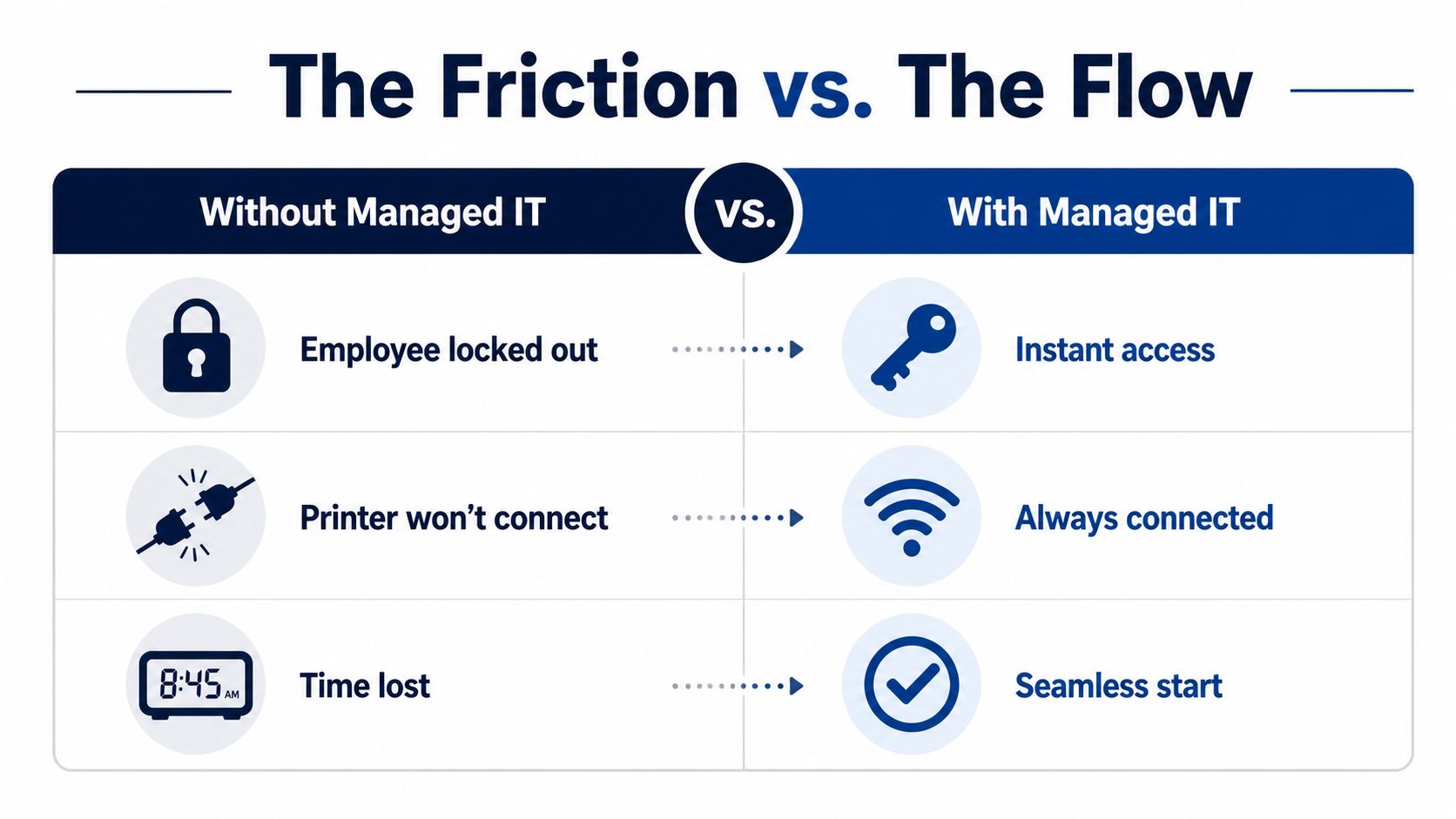
A typical morning exposes the weakness of break-fix support quickly. An employee can't sign in before a client meeting. A printer refuses to connect. A suspicious email reaches the finance inbox. A server has been “a bit slow” for weeks, and nobody has had time to investigate.
Managed IT services replace that reactive pattern with ongoing responsibility. Your business pays a recurring monthly fee for defined services such as remote and on-site support, endpoint and network monitoring, patch management, backup oversight, security tooling, and scheduled strategy reviews. The provider manages the environment continuously, rather than waiting for someone to report a failure.
Break-fix support charges when something goes wrong. Managed IT is paid to reduce the likelihood and impact of those failures. That distinction affects more than the invoice. It changes whether your provider has an incentive to identify an expiring certificate, an unpatched laptop, or an unusual login before employees lose access.
A credible arrangement should identify who answers the phone, where the helpdesk operates, how urgent incidents escalate, and which work is included. For many Canadian organisations, that means a Canada-based helpdesk, local on-site capability when necessary, and access to a security operations centre that can monitor threats outside office hours.
The exact package varies, but the baseline should include:
Use this managed IT service overview to clarify the service model before comparing providers.
The rest of the decision should be measured against this standard. A provider offering only a ticket queue and occasional repairs isn't delivering full managed IT. It's selling outsourced troubleshooting.
Managed IT creates value through four connected outcomes: predictable spending, continuous support, stronger security governance, and earlier fault detection. Features matter only when they produce one of those outcomes.
Break-fix invoices are difficult to forecast. A failed server, urgent site visit, or weekend recovery can create an unplanned expense precisely when operations are already disrupted. A properly scoped monthly agreement turns routine support and preventive work into a budgetable line item.
That predictability helps finance plan technology spending and helps owners compare IT costs with operational risk. It also exposes poor contracts. If a provider advertises a low monthly fee but bills separately for every useful security control, the headline price isn't the actual cost.
A business that serves customers, patients, drivers, or production teams outside nine to five can't treat after-hours incidents as next-business-day problems. A failed service at night can interrupt morning operations, delay shipments, or leave staff unable to work.
A 24/7 service model matters only if it includes real triage and escalation. “Emergency voicemail” isn't the same as an actively monitored service desk or security operations centre.
Security is now an operating requirement for Canadian SMBs. Statistics Canada found that only 26% of Canadian businesses had written cybersecurity policies in 2021, according to the Cybersecurity Canada report summary. That gap leaves employees without clear rules and managers without documented evidence of governance.
Managed detection, MFA enforcement, vulnerability patching, email controls, policy development, and incident-response planning provide a practical foundation. Depending on the organisation, the provider may also support obligations connected to PIPEDA, PHIPA, contractual privacy requirements, or sector-specific controls.
Monitoring shifts the conversation from “who reported the problem?” to “what changed in the environment?” Failed drives, expiring certificates, unusual authentication attempts, storage pressure, and missing patches can be investigated before users notice.
The four drivers compound. Predictable spending funds continuous coverage. Continuous coverage improves detection. Better detection reduces disruption and gives leadership clearer evidence for planning. For broader continuity planning, the business continuity guide 2026 offers useful context on linking technology controls to operational resilience.
| Value Driver | What It Includes | Business Outcome |
|---|---|---|
| Cost predictability | Defined monthly scope, service levels, and billing rules | More reliable budgeting |
| 24/7 support | Helpdesk coverage, monitoring, and escalation | Faster response to disruption |
| Security and compliance | MFA, endpoint controls, patching, policies, and response planning | Reduced exposure and clearer governance |
| Proactive monitoring | Device, network, backup, and certificate oversight | Earlier intervention and fewer emergency repairs |
A managed service benefits guide can help leadership teams compare these outcomes with the limitations of hourly support.
The strongest ROI argument is recovery cost, not software convenience. Canadian businesses spent about $600 million recovering from cyber incidents in 2021 and $1.2 billion in 2023, according to Statistics Canada's cybersecurity information. That escalation shows why prevention, detection, and recovery readiness belong in the operating budget.
Incident outcomes vary widely. Among Canadian businesses that paid a ransom, 84% paid less than $10,000, while 4% paid more than $500,000, according to the Communications Security Establishment's annual report information. The figures don't create a universal ROI calculation, but they do establish the financial asymmetry. A recurring managed IT fee is visible and planned. A serious incident can create a sudden, much larger obligation.
Scenario A, professional services. A 25-person firm might compare its monthly managed IT proposal with the cost of a weekend outage. If the outage prevents billable work, delays client deliverables, and requires emergency recovery, the direct loss can quickly exceed the support budget. The correct analysis includes lost productivity, partner time, client communication, and remediation, not just the technician's invoice.
Scenario B, manufacturing. A small manufacturer should assess whether its provider can protect finance accounts, production endpoints, and shared systems against phishing and credential misuse. A monthly service that includes MFA enforcement, email filtering, endpoint detection, monitoring, and response may cost more than a helpdesk-only plan, but it addresses a much larger exposure.
Don't use invented breakeven maths to justify the purchase. Build the comparison from your own invoices, downtime records, payroll impact, recovery requirements, and insurance obligations. The managed services cost guide can support that budgeting exercise, but the provider must still state exactly what the fee includes.
| Scenario | Annual Managed IT Cost | Cost of One Prevented Incident |
|---|---|---|
| Professional services firm | Calculate from the provider's documented monthly fee and user count | Lost billable work, recovery, staff time, and client disruption |
| Small manufacturer | Calculate from the selected service scope and operating requirements | Production interruption, fraud exposure, restoration, and investigation |
The conclusion is straightforward. Flat monthly spending is easier to control than an unplanned incident, especially when the agreement reduces the time between detection and response.
The service model stays consistent across sectors, but the controls and response priorities should change. A clinic, bookkeeping firm, and manufacturer don't need identical policies, monitoring thresholds, or maintenance windows.
A lean clinic may not have an internal specialist dedicated to privacy, access controls, backups, and audit evidence. Managed IT can enforce encryption, MFA, role-based access, endpoint protection, logging, and documented procedures that support privacy obligations.
The provider should also understand clinical schedules. Maintenance can't interrupt appointment systems without planning, and an incident affecting patient records requires a clear escalation path. Quarterly reporting should show unresolved risks, backup status, policy updates, and recommended improvements in language the practice owner can act on.
A bookkeeping practice handles sensitive financial information while relying on cloud applications, email, laptops, and remote access. Its priority is preventing one compromised account from exposing multiple client environments.
A managed programme can combine MFA, encrypted email, endpoint monitoring, secure device configuration, access reviews, and staff training. The provider should separate client data logically, document administrator access, and review unusual sign-in activity rather than treating every ticket as a routine desktop issue.
A manufacturer running multiple shifts faces a different risk. Legacy line-control systems may depend on stable network paths and carefully scheduled changes. A rushed patch or unmanaged switch failure can interrupt production, while an unmonitored remote-access account can create a security route into operational systems.
The right arrangement uses planned patch windows, network segmentation, asset documentation, backup validation, and continuous monitoring. A 24/7 network operations function can investigate alerts outside office hours, while the account team coordinates changes with production leadership.
| Industry | Top Compliance Pressure | Primary Managed IT Focus | Typical Outcome |
|---|---|---|---|
| Healthcare | Privacy, patient information, and audit readiness | Encryption, access controls, logging, backups, and response planning | More consistent protection and documentation |
| Finance and bookkeeping | Confidential client and financial data | MFA, email security, endpoint monitoring, and access reviews | Reduced account and data exposure |
| Manufacturing | Operational continuity and legacy-system risk | Segmentation, maintenance windows, monitoring, and recovery planning | Fewer unmanaged changes and clearer escalation |
The important point is fit. A provider should tailor the security stack, response SLA, reporting cadence, and maintenance approach to the sector, rather than install the same package at every office.
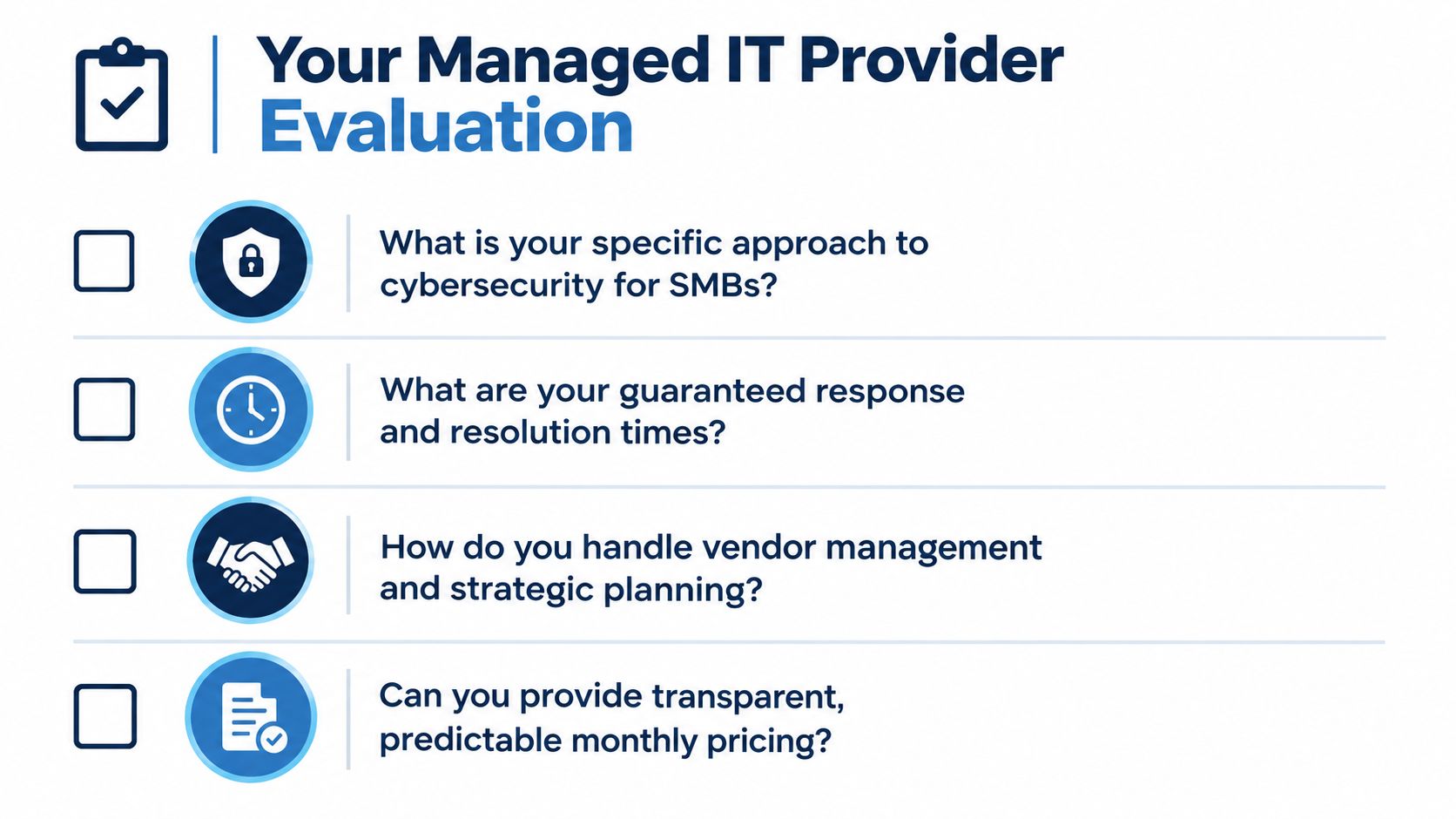
Walk into the provider meeting with a printed question list. Price is useful, but it shouldn't carry the decision. I recommend weighting security capability, local delivery, and contractual fairness equally with cost.
Ask where the helpdesk staff sit and who answers outside normal business hours. Ask whether calls reach trained technicians, an on-call rotation, or voicemail. Then ask which issues receive immediate escalation and how the provider communicates during a major incident.
Clarify the commercial model in writing:
Don't accept “industry-leading tools” as an answer to a security question. Ask whether the proposal includes EDR, MDR, SIEM capabilities, MFA, email filtering, vulnerability assessment, patch management, backup testing, and incident response. The provider should explain what each control does, who reviews alerts, and how incidents move from detection to containment.
It's also useful to compare helpdesk and service desk, because providers often use those terms loosely. You need to know whether you're buying basic technical assistance or a structured service-management function.
Ask about cyber liability insurance and whether its limits suit your exposure. Review data ownership, administrator access, documentation rights, subcontractors, project rates, renewal terms, and exit provisions. I favour clear 30 or 60-day exit clauses, provided the agreement defines the actual notice period and transition responsibilities.
Practical rule: If the provider won't explain the boundary between included service and extra billing before signing, expect arguments after signing.
Use the managed services questionnaire to document answers consistently across shortlisted firms. Score each provider on security depth, Canadian support availability, escalation discipline, documentation, strategic planning, contract clarity, and price. The cheapest proposal often wins only because it excludes the controls your business needs.
A managed IT fee shouldn't buy a faster version of the same break-fix experience. It should buy continuous control over the environment.
That means monitoring endpoints and networks for a failing drive, abnormal authentication, resource exhaustion, or a brute-force attempt before a user reports a symptom. It means patching systems through planned processes, checking that backups complete, and investigating exceptions instead of marking them as routine alerts.
A provider should help maintain written security policies and review them with leadership. It should provide phishing simulations and user training connected to your actual email environment, not generic annual slides. It should also maintain a documented incident-response plan and exercise it regularly, so employees know who makes decisions when an account or system is compromised.
Modern coverage should extend into cloud administration:
A helpdesk resolves problems you already have. Managed security and governance reduce the chance that those problems become a prolonged outage, privacy issue, or major recovery project.
A proposal without proactive monitoring, policy support, and incident response is outsourced support, not modern managed IT.
Push back when a salesperson treats security as an optional add-on. Basic support may be appropriate for a very narrow environment, but a Canadian SMB handling patient, financial, legal, operational, or customer data needs a service model that addresses prevention and response together.
Use this five-step checklist during the coming week.
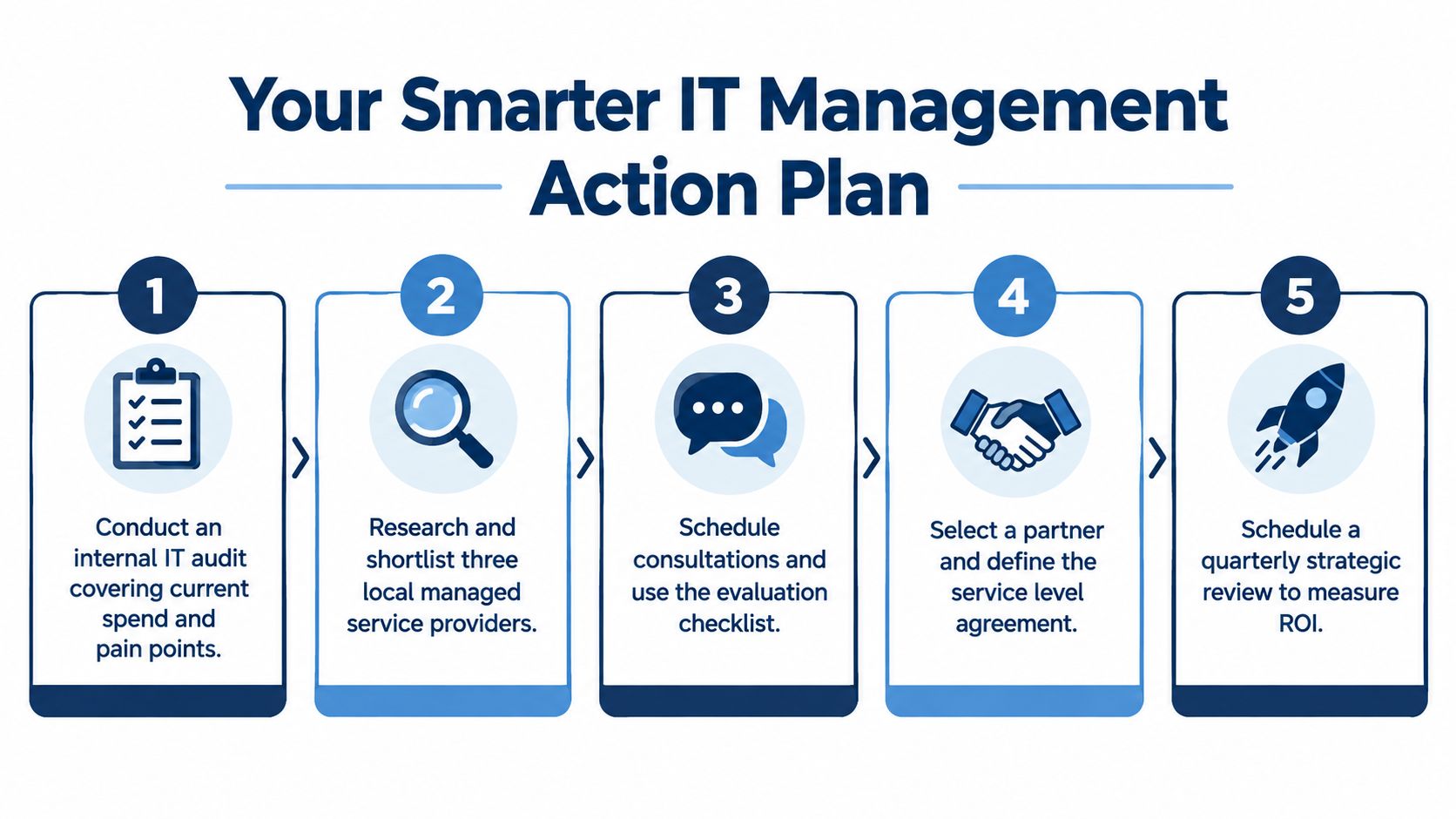
Your decision should rest on evidence, not fear or a low introductory price. Review the service scope, test the escalation model, and choose a partner that can protect daily productivity while preparing the business for disruption.
CloudOrbis Inc. provides Canada-based managed IT support, cybersecurity, cloud management, backup and disaster recovery, and strategic IT consulting for SMBs. Visit CloudOrbis Inc. to book a complimentary IT assessment and map your current support costs, security gaps, and next practical steps.
September 14, 2026
Vulnerability Management vs Vulnerability AssessmentVulnerability management vs vulnerability assessment explained for Canadian SMBs. Compare scope, process, tools, and how to choose the right approach.
Read Full PostSeptember 13, 2026
Third-Party Risk Management for Canadian SMBsMaster third-party risk management for your Canadian SMB. Learn OSFI compliance, vendor monitoring frameworks, and how to secure your supply chain.
Read Full Post
September 12, 2026
Managed Services Cost: A Practical Guide for Canadian SMBsUnderstand managed services cost for Canadian SMBs. Learn pricing models, industry factors, ROI, and how to choose the right provider for your business.
Read Full Post
