

September 12, 2026
Managed Services Cost: A Practical Guide for Canadian SMBsUnderstand managed services cost for Canadian SMBs. Learn pricing models, industry factors, ROI, and how to choose the right provider for your business.
Read Full Post%20(1).webp)
Usman Malik
Chief Executive Officer
September 13, 2026
Third-party breaches accounted for 29% of incidents in Canada during 2024, while 31% of Canadian companies said they had no way to detect issues with third-party vendors. Only 32% reported using continuous monitoring for third-party cyber risk management. These findings from the Canadian Cybersecurity Network's 2025 State of Cybersecurity report change the conversation for Canadian small and mid-sized businesses. Vendor risk isn't a paperwork problem waiting for the next procurement cycle. It's an operational control gap that can interrupt services, expose sensitive information, and weaken regulatory readiness.
A practical third-party risk management programme gives leaders visibility into every supplier, prioritises relationships by business impact, verifies controls with evidence, and keeps watching after a contract is signed. That matters particularly in healthcare, finance, legal services, manufacturing, and logistics, where an external provider may handle personal information, connect to critical systems, or support a process the business can't quickly replace.
Canadian organisations already see supplier exposure affect business continuity. The Canadian Cybersecurity Network reported that 93% of Canadian organisations had been negatively impacted by a cyber breach within their supply chain, and Canadian firms averaged 3.96 breaches in the previous 12 months, compared with a global average of 3.68. The same report found that third-party breaches represented 29% of incidents in 2024. The same Canadian report supports a practical conclusion: vendor risk belongs in continuity planning, not only in technical security reviews.
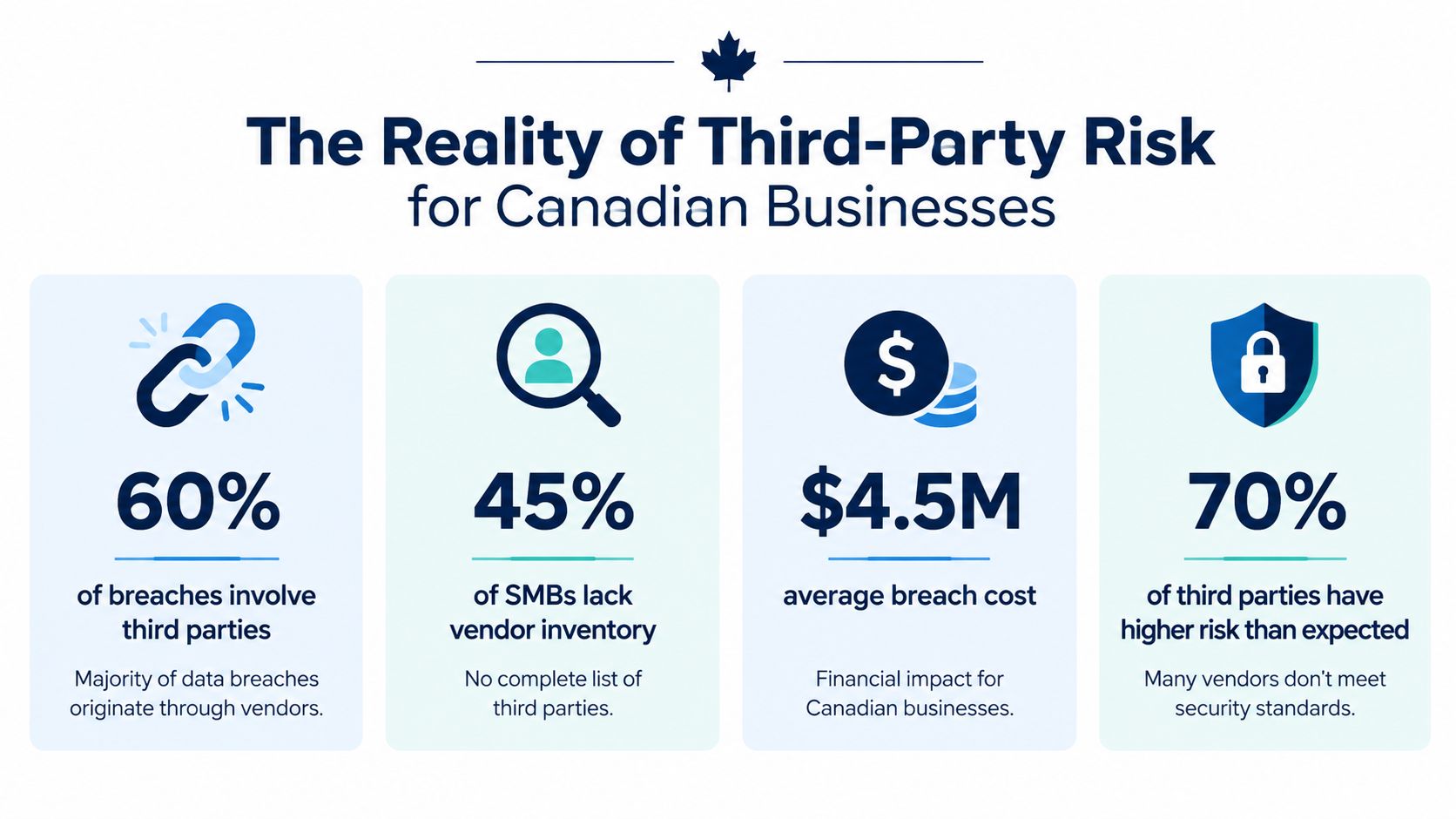
Third-party risk management covers vendors, suppliers, contractors, cloud providers, software partners, and service firms. Its scope extends beyond cyber attacks. A supplier outage creates operational risk. Poor data handling creates privacy risk. Financial instability can interrupt delivery, while a supplier's conduct can create reputational risk for the organisation that hired it.
Many medium-sized businesses can identify strategic suppliers but cannot produce a complete, current record of every external relationship. Procurement files may omit a marketing platform, temporary contractor, software integration, or subcontractor used by a key provider. Accounts payable shows who receives payment, not necessarily who can access systems or personal information.
Canadian research illustrates the scale challenge. Thirty-nine per cent of Canadian firms said they evaluate only 501 to 1,000 suppliers for cyber risk, according to MNP's analysis of the interconnected future. Evaluation coverage therefore requires deliberate prioritisation. Identify vendors that can affect essential services, sensitive data, or regulatory obligations, then apply controls that match the exposure.
Practical rule: If a vendor isn't in the inventory, it can't be assessed, monitored, escalated, or offboarded properly.
A one-time onboarding questionnaire cannot maintain that control. Procurement, IT, security, legal, privacy, finance, and operations each hold part of the relationship record. Assign ownership, connect supplier data to business processes, and review material changes throughout the contract.
A useful guide to IT vendor management can help clarify ownership, record access, and keep supplier oversight tied to operational responsibilities. For many Canadian SMBs, that foundation is also the point at which continuous monitoring or managed TPRM services becomes more practical than relying on periodic questionnaires alone.
Canadian compliance obligations vary by organisation, data type, province, and industry. A small supplier may not be directly subject to every rule governing its customer, yet contractual requirements often extend those expectations into the supplier relationship. Healthcare providers, banks, and public-sector customers may require evidence of safeguards, incident reporting, access controls, retention practices, and subcontractor oversight before approving a vendor.
PIPEDA establishes accountability for organisations handling personal information in commercial activities. An organisation generally remains responsible for information shared with a service provider, so vendor contracts and oversight processes must support that responsibility. Provincial privacy requirements can add further obligations, particularly for organisations operating in Quebec or other jurisdictions with their own privacy regimes. This overview of Canadian data privacy laws can help leaders map the rules affecting their operations and customer relationships.
OSFI's revised Guideline B-10 was published on June 2, 2023, with an effective date of May 1, 2024. It applies to federally regulated financial institutions, excluding foreign bank branches and foreign insurance company branches operating under a separate branch regime. The guideline establishes six expected outcomes for effective third-party risk management. OSFI gave institutions roughly one year to assess their programmes, address gaps, and update legacy contracts at the earliest renewal or revision point. The final OSFI Guideline B-10 sets the supervisory benchmark.
Arrangements beginning on or after May 1, 2024 must comply, while older arrangements must be brought into line as soon as possible thereafter. OSFI expects institutions to identify and assess third-party risk, manage and mitigate it within their risk appetite, and monitor provider performance over time, as explained in OSFI's announcement on the new guideline.
Foreign bank branches and foreign insurance company branches received a specific transition period. OSFI's consequential amendments gave those entities until March 31, 2025 to adhere to Guideline B-10 in the manner set out by OSFI, according to the guidance on foreign branch amendments.
For federally regulated financial institutions, Guideline E-21 operational resilience expectations require full adherence by September 1, 2026. Compliance checks are already underway, and scenario testing is expected by September 1, 2027, as described in this Canada-focused OSFI compliance analysis. The practical message is clear. A vendor programme must address what happens when a provider fails, not only whether the provider has completed a security form.
Contracts should define service continuity, incident coordination, recovery expectations, data access, audit rights, and exit planning. A medium-sized business may not be federally regulated, but an enterprise customer can still require these controls because its supervisory obligations extend through the supply chain. That pressure is accelerating the move from periodic questionnaires toward continuous oversight and managed TPRM services.
A sustainable TPRM programme follows the vendor relationship from discovery to exit. The process works best when each stage creates information for the next one, rather than producing disconnected spreadsheets and approval emails.

Search procurement records, accounts payable, contracts, identity systems, application registers, cloud consoles, and department-level purchasing. Record the vendor's service, business owner, data handled, system access, geographic footprint, subcontractors, contract dates, renewal terms, and dependency on the vendor. A supplier inventory isn't complete until operations and finance can reconcile it with what IT and procurement know.
For businesses with physical supply chains, a directory such as browse bulk commodity suppliers can help teams understand the breadth of supplier relationships they may need to classify and document. The point isn't to treat every supplier as a cyber vendor. It's to distinguish operational dependencies from technology access and then apply the right control set.
A vendor that provides office supplies shouldn't receive the same scrutiny as a cloud hosting provider, payroll processor, electronic medical records platform, or managed network provider. Risk tiering should consider data sensitivity, system access, service criticality, substitutability, regulatory relevance, and the effect of a prolonged outage.
High-risk vendors receive deeper due diligence, stronger contractual requirements, and closer monitoring. Lower-risk relationships still need ownership and basic records, but a proportional model prevents a small team from spending its limited capacity on low-impact suppliers.
Due diligence validates the supplier's controls before access is granted. Contracting turns expectations into obligations. Monitoring checks whether the relationship remains within tolerance as the vendor changes its systems, personnel, services, or subcontractors. Offboarding removes access, retrieves or deletes data, closes open obligations, and updates the inventory.
A useful risk management framework helps connect vendor decisions to the organisation's broader risk appetite instead of leaving TPRM as an isolated procurement exercise.
A good questionnaire is a starting point, not proof of security. Ask for evidence that matches the vendor's risk tier, such as independent assurance reports, penetration testing summaries, business continuity documentation, privacy procedures, insurance details, and relevant policies. Review the scope and date of each document. A certificate that excludes the service your business uses shouldn't close the assessment.
Use a scoring model that makes decisions explainable. One approach rates inherent risk before controls, then considers control strength and residual risk after mitigation. The calculation doesn't need to be complex. It needs consistent definitions, named approvers, documented exceptions, and a clear escalation path when the remaining risk exceeds the organisation's appetite.
| Vendor Tier | Risk Profile | Assessment Depth | Monitoring Cadence |
|---|---|---|---|
| Critical | Supports essential operations, sensitive information, or deeply integrated systems | Evidence-led review, resilience testing, privacy review, subcontractor analysis, and senior approval | Continuous signals with formal reassessment when conditions change |
| High | Handles important data or supports a material business process | Detailed questionnaire, control evidence, incident process review, and contract negotiation | Frequent monitoring with scheduled management review |
| Moderate | Provides a meaningful service with limited access or recoverable disruption | Proportionate questionnaire, contract review, and validation of key safeguards | Periodic review plus event-driven reassessment |
| Low | Limited access, low sensitivity, and readily replaceable service | Basic inventory, ownership, terms review, and minimum security requirements | Review at renewal or after a material change |
Contracts should define what the vendor must do, how the business will verify it, and what happens after an incident. Include requirements for least-privilege access, encryption where appropriate, secure disposal, approved subcontractors, notification and cooperation during incidents, recovery support, service levels, and data return or deletion.
A right-to-audit clause needs practical boundaries. It should explain what evidence the customer can request, how often reviews may occur, how confidentiality is protected, and when an independent assessment can substitute for an on-site visit. Incident provisions should identify communication channels, required cooperation, preservation of evidence, and responsibility for customer notifications where applicable.
A contract shouldn't promise oversight that the business has no process or people to perform.
For teams comparing assessment practices, a focused resource for compliance teams can help sharpen questions about supplier evidence and product-level accountability. Organisations that lack internal capacity can also review guidance on a managed services questionnaire before selecting an external provider.
Quarterly reviews support governance, but they can leave a long gap between a vendor's change in risk and its discovery. Canadian organisations need monitoring that reflects service criticality and operational change, not only the review calendar. Event-driven oversight should trigger reassessment when a supplier reports an incident, changes a material subcontractor, exposes a new asset, or misses recovery commitments.
Continuous monitoring does not mean treating every alert as an emergency. It means collecting relevant signals, connecting them to vendor criticality, and setting clear thresholds for action. Useful measures include:
A board report should provide decisions, not a pile of vendor scores. Show critical relationships, material open findings, overdue remediation, unresolved incidents, and changes since the previous report. Connect each issue to the business service it affects, the owner responsible, and the action executives must approve.
External attack-surface intelligence can identify changes a vendor may not report promptly. Contract and ticketing integrations can surface renewals, incidents, and unresolved actions. Automated risk scoring helps a small team prioritise work, but it cannot replace business judgement. A new technical alert may be tolerable for a low-impact supplier and unacceptable for a provider supporting a core operation.
The effective model combines automated collection with human review. The system identifies change. The risk owner determines its business meaning, confirms who must act, and sets the escalation point.
Canadian SMBs may not have the staff to operate this process internally. Managed TPRM services can provide monitoring, evidence collection, triage, and reporting, while internal owners retain decisions about risk acceptance and business continuity. The service should connect to procurement, contracts, incident response, and executive reporting. That integration turns monitoring into an operating practice rather than another compliance dashboard.
The most dangerous TPRM failure is often the vendor nobody knows about. A department may adopt a cloud application, engage a contractor, or use a supplier's subcontractor without entering the relationship into the central inventory. The corrective action is straightforward, though it requires discipline: route new suppliers through a common intake, reconcile records across finance and procurement, and give every relationship a business owner.

A completed form can reflect the vendor's understanding of its controls, but it may not demonstrate that those controls operate consistently. Ask for relevant evidence, validate claims against the service scope, and use independent reports where the risk justifies them. If the supplier can't provide evidence, document the gap and decide whether to mitigate, accept, delay, or reject the relationship.
Security controls won't keep a business operating if a supplier is unavailable. Define recovery responsibilities, communication procedures, alternative arrangements, data portability, and exit assistance before a disruption. Test the assumptions with the vendor and internal process owners.
IT can assess access, architecture, and technical safeguards, but operations understands service dependency, legal understands enforceability, procurement understands bargaining power, and finance understands supplier viability. Assign a cross-functional owner and bring each discipline into decisions for higher-risk relationships. That arrangement produces a more realistic view than a security score alone.
Medium-sized organisations often understand the need for TPRM but lack a dedicated analyst, privacy specialist, contract resource, and monitoring platform. Building every capability internally provides direct control, but it also creates staffing, tooling, training, and coverage demands. A co-managed model can keep ownership with the business while an external team supplies assessment capacity, monitoring, documentation, and escalation support.
Fully managed TPRM can make sense when vendor relationships are numerous, regulatory expectations are increasing, or internal teams are already overloaded. The trade-off is governance. The provider can operate the process, but business leaders still need to set risk appetite, approve exceptions, and decide which services are critical. Outsourcing the work doesn't outsource accountability.
CloudOrbis Inc. is one provider that combines managed IT support with cybersecurity, vulnerability assessments, compliance assistance, backup and disaster recovery, cloud services, and strategic IT consulting. Its managed IT services for small businesses can support organisations that need external operational capacity while retaining business ownership of risk decisions.
CloudOrbis Inc. helps Canadian small and mid-sized businesses build practical vendor inventories, strengthen third-party controls, monitor changing risk, and connect TPRM with broader IT security and resilience. Visit CloudOrbis Inc. to discuss a baseline assessment and determine whether co-managed or fully managed support fits your organisation.
September 12, 2026
Managed Services Cost: A Practical Guide for Canadian SMBsUnderstand managed services cost for Canadian SMBs. Learn pricing models, industry factors, ROI, and how to choose the right provider for your business.
Read Full Post
September 11, 2026
Managed EDR Services: A Practical Guide for Canadian SMBsLearn how managed EDR services detect, contain, and respond to threats around the clock. A practical guide for Canadian SMBs evaluating providers, pricing
Read Full Post
September 10, 2026
8 Managed Service Benefits for SMBsExplore eight managed service benefits for SMBs, from predictable costs and stronger security to scalable cloud support and strategic IT planning.
Read Full Post
