

September 25, 2026
Is VoIP Good for Small Business in Canada? a 2026 GuideIs VoIP good for small business in Canada? Explore costs, benefits, reliability, security, and migration tips for SMBs considering VoIP in 2026.
Read Full Post%20(1).webp)
Usman Malik
Chief Executive Officer
August 11, 2026
You're probably sitting on a half-built plan right now. The team has a list of upgrades, the board wants less risk, finance wants predictability, and operations just wants the systems to stop getting in the way. That's exactly why strategic IT planning has to be treated as a funding and governance exercise, not a document exercise.
In Canada, that shift is overdue. The Canadian Centre for Cyber Security warned in its 2023 to 2024 National Cyber Threat Assessment that Canada is a frequent target of ransomware and other financially motivated attacks, and that cybercrime is expected to keep causing operational disruption for Canadian organisations. The same assessment makes it clear that critical infrastructure sectors and small and medium-sized enterprises stay attractive targets because they often have fewer resilience resources, which means IT planning has become a risk-management function, not a technical side project. The practical result is simple, foundational IT decisions now have to cover identity, backup and recovery, incident response, vendor risk, and compliance across sectors like healthcare, legal, finance, and manufacturing. Canadian Centre for Cyber Security's National Cyber Threat Assessment should be on every owner's desk, not buried in a security folder.
The other reason this matters is scale. Statistics Canada reported that 94.1% of Canadian businesses had internet access in 2023, which tells you how digital dependency is already embedded in the business base. For a Canadian SMB, the question isn't whether to modernise. It's whether you'll fund the right controls, in the right order, and keep them alive after the first approval cycle.
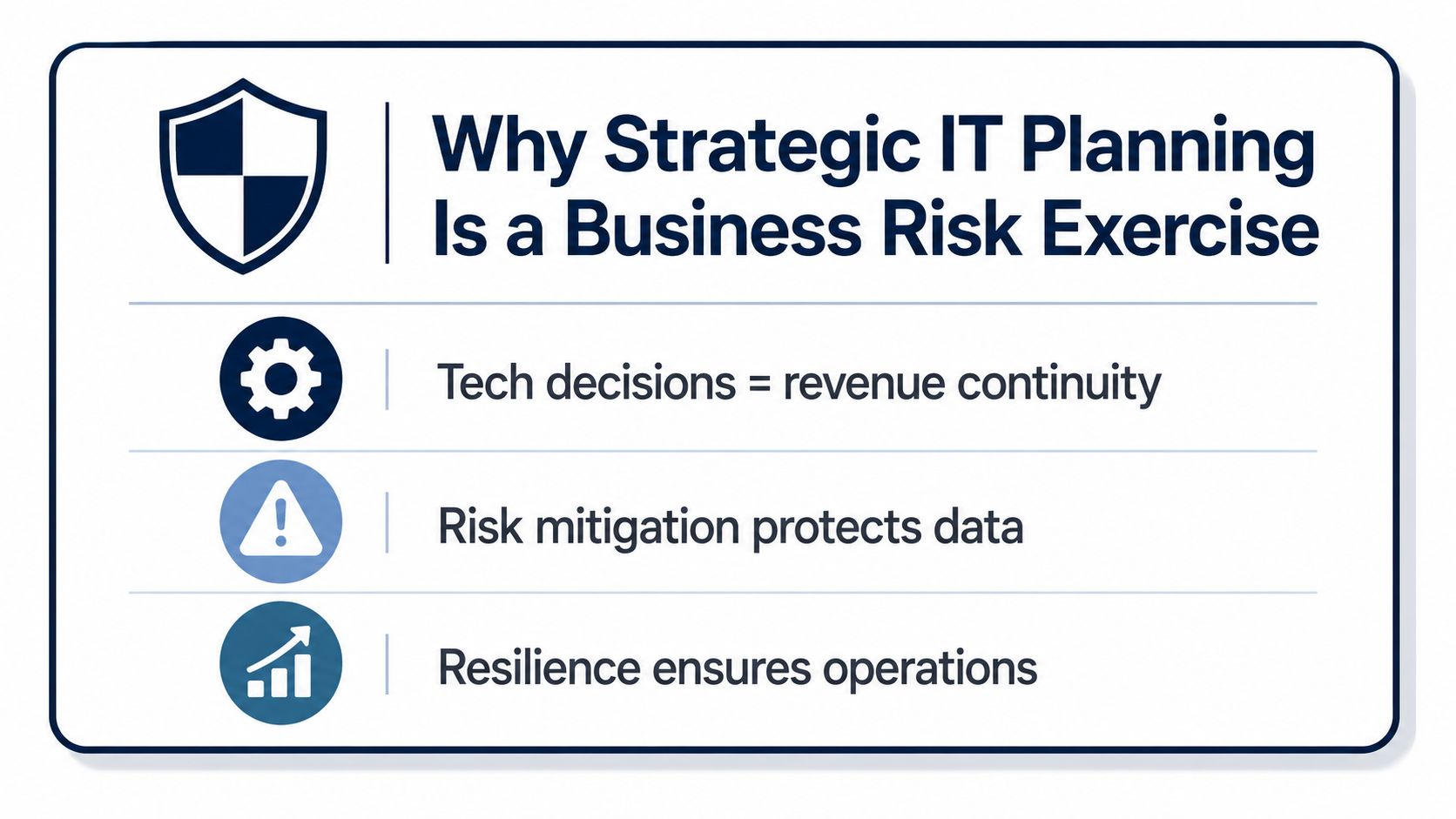
A weak IT plan fails in the same places a weak business plan fails, at revenue continuity, customer trust, and operational control. That's why I don't talk about strategic IT planning as an upgrade list. I talk about it as a business continuity decision that has to survive outages, staff turnover, compliance reviews, and budget pressure.
The IBM definition is the right starting point, because it frames IT strategic planning as a roadmap that aligns hardware, software, and networking with business objectives, not a catalogue of tools. IBM's IT strategic planning overview makes the alignment issue explicit. If a project doesn't protect revenue, reduce cost, lower risk, or satisfy a compliance obligation, it doesn't belong in the plan yet.
A serious plan has more than ambition. It should include a current-state view, a business alignment map, an operating model, a budget view, a security and compliance sequence, governance rules, and a review cadence. Without those pieces, you get a wishlist that sounds good in a meeting and falls apart in execution.
Practical rule: if the owner can't explain how an initiative affects uptime, data protection, or audit readiness in one sentence, the initiative isn't ready for funding.
This is especially true in regulated Canadian sectors. A clinic, a law office, a manufacturer, or a finance team doesn't get rewarded for “digital transformation” in the abstract. They get rewarded when the systems stay up, records stay protected, and people can prove controls were in place.
The other hard truth is that most strategic plans die in the gap between approval and action. The MIT Sloan review notes that only 24% of projects recommended in IT strategic plans are ultimately executed, and that planners most often hit excess resource demand and weak top-management commitment. MIT Sloan's six stages of IT strategic management is blunt about the fix, build the framework, assess external forces, map strengths and weaknesses, define action programs, budget resources, and set governance processes. That's not theory. That's how you keep the plan from becoming decorative.
If you're spending the next 90 days on strategic IT planning, start with a hard question. Do you need a plan, or do you need someone to run the planning process with you? If you don't have internal capacity to hold decisions, assign owners, and keep funding aligned, the plan will stall before it matters.
A roadmap built on assumptions collapses the first time something breaks. I always push clients to start with the estate they already own, because that's where hidden risk lives, old hardware, expired licences, unmanaged cloud accounts, and admin access no one can fully explain.
Start with hardware and lifecycle status. Know what is in service, what is near replacement, and what would hurt most if it failed this quarter. Then document software and licences, because stale subscriptions and random renewals drain budget and create support gaps.
Next comes network topology and identity and access. You need to know who can reach what, which accounts have administrative power, and where access is broader than it should be. Finally, capture data and backup posture, including where critical data lives, how often it's backed up, and how recovery works when a restore is needed.
Bottom line: if you can't restore your most important data quickly enough to keep the business running, you don't have resilience, you have an assumption.
The owner of each layer should be named. Finance can help with licence truth. Operations usually knows which devices are business-critical. IT, internal or external, should own identity, backup, and technical validation. If no one is accountable, the inventory turns into a spreadsheet no one trusts.
Shadow IT is where SMBs get blindsided. Unmanaged cloud accounts, old contractor credentials, and orphaned admin logins make the business look cleaner than it is. That's why the audit should become a one-page risk register with severity, business impact, and recovery-time impact. The point isn't perfection. The point is to know what must be fixed now and what can wait.
If you want a practical framework for the asset side of the house, this guide on IT asset management is worth keeping beside the audit template. It's the sort of discipline that makes every later budget conversation easier.
When the audit is done properly, the plan writes itself in part. You'll see which systems are brittle, where access is over-permissioned, and which backups would save you in a bad week. That's the difference between a strategic plan and a hopeful one.
Most IT plans go soft here. The owner hears a proposal for Microsoft 365 hardening, endpoint protection, or a portal migration, and everyone starts talking about features instead of outcomes. That's the wrong conversation. Every initiative should answer four business questions, what revenue does it protect or create, what cost does it reduce, what risk does it lower, and what compliance obligation does it satisfy.
If the answer is weak on all four, park the initiative. If it clearly helps on one and doesn't hurt the others, it may deserve priority. That discipline keeps the plan honest when the CFO starts asking why the business is spending on one item before another.
A mid-sized healthcare clinic is a good example. Hardening Microsoft 365 protects patient communication and reduces account-compromise exposure. Endpoint protection lowers the chance that one infected laptop becomes a clinic-wide outage. A patient-portal migration can support acquisition and service delivery, but only if uptime, workflow, and access control are addressed first.
The alignment rule is simple, business first, tooling second. A technology decision earns its place when it supports a measurable business outcome the owner cares about. That's the logic behind a real technology alignment process, not a vanity IT roadmap.
| IT Initiative | Revenue Impact | Cost Reduction | Risk Reduction | Compliance Fit | Priority Score |
|---|---|---|---|---|---|
| Microsoft 365 hardening | Protects client communication | Reduces incident clean-up | High | Strong | High |
| Endpoint protection | Indirect | Avoids rework | High | Strong | High |
| Patient portal migration | Supports acquisition and service | Can reduce manual follow-up | Medium | Strong | Medium |
| New collaboration tool | Unclear | Unclear | Low | Weak | Low |
The matrix does not need to be fancy. What it needs is discipline. Rank initiatives by impact and effort, then fund the highest-value items first. A plan that tries to do everything in the next 12 months usually does nothing well.
I'd also be direct with the board or owner. The point isn't to build a perfect technology environment. The point is to move the business to a stronger operating position without wasting cash on tools that don't change the outcome.
A roadmap only works if the operating model behind it fits the business. A small company does not need a full internal IT department just to say it has one. A larger SMB may need that depth, but many need a co-managed setup or a vCIO-led structure because the business is not yet big enough to carry everything in-house.
| Model | Best fit | Strength | Trade-off |
|---|---|---|---|
| Fully insourced | Larger internal IT need | Full control | Highest staffing burden |
| Co-managed | Growing SMB with internal lead | Flexibility and shared responsibility | Requires clear role definition |
| Outsourced vCIO-led | Smaller team or limited internal capacity | Strategic depth without a full department | Less direct control |
The right choice depends on team size, sector, compliance load, and growth stage. A regulated clinic with a lean internal team often needs more structure than a retail business with simpler workflows. A manufacturer adding sites may need cloud architecture, security, and support coverage that a generalist cannot keep up with alone.
A managed services partner only helps if the operating model is clear. Look for documented engagement methods, responsive support, and sector awareness. If healthcare is in scope, ask how they handle compliance pressure, access control, and recovery testing. If the relationship is project-based, read preventing Upwork deal failures before you assume milestone language alone will protect execution.
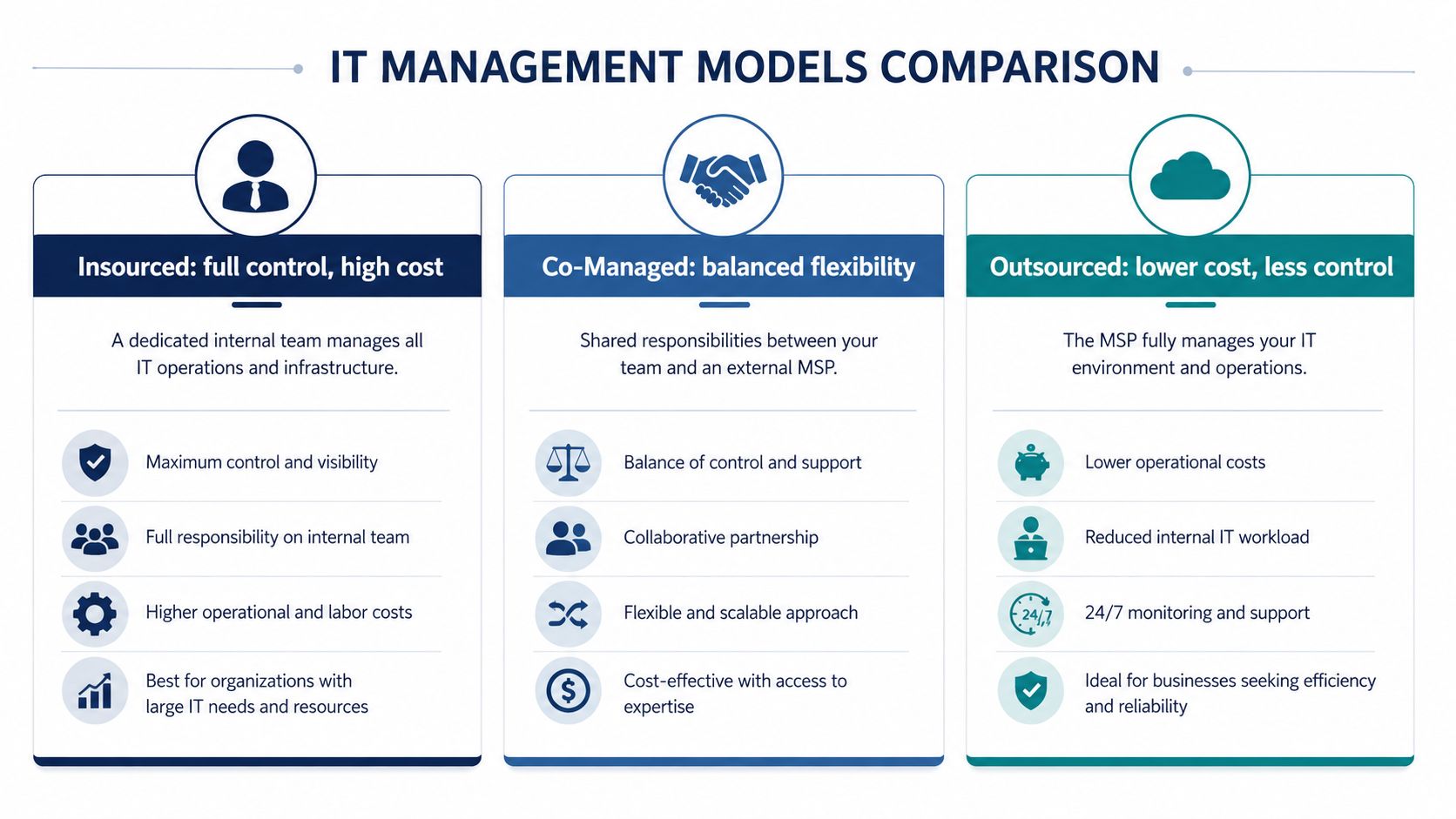
The practical recommendation is blunt. If your internal team spends most of its time keeping the lights on, do not expect that person to also lead architecture, security, and multi-year planning alone. If you need strategic execution without full headcount, a co-managed or vCIO-led model is usually the cleaner choice. For owners comparing that path with a fractional IT model, the question is whether you need a named person, a shared support bench, or both.
CloudOrbis Inc. is one example of that kind of support model in Canada, with managed IT, cybersecurity, cloud, and vCIO services built for SMB operations. That only matters if the structure matches the business need, because the wrong model creates more meetings instead of momentum.
If the budget appears as a surprise, the plan is already weak. Strategic IT planning needs a recurring operating-line mindset, not a one-time capital conversation that gets reopened every time something breaks.
For a 50-person SMB, the core buckets are straightforward, hardware refresh, software licences, cloud subscriptions, cybersecurity tools, managed services, project work, and contingency. Some of those costs sit naturally in operating expense. Others may be treated as capital depending on the asset and accounting approach, but the business decision is the same, fund the lifecycle before the lifecycle funds you with downtime.
The strongest budgeting case uses avoided harm, not vague productivity claims. If a security upgrade reduces the chance of an incident, the value is in avoided breach response, avoided downtime, and avoided overtime for already-stretched staff. If a refresh plan avoids emergency vendor premiums and last-minute remediation, that belongs in the ROI conversation too.
Finance rule: do not approve software before you have a realistic support and replacement plan around it.
Many SMB plans go wrong. They buy licences, then discover they can't support the rollout. They budget for cloud, then underfund migration and training. They approve security tools, then leave the team with no time to run them properly.
A practical way to think about the budget is annual rhythm, not one-off drama. Review spend quarterly, adjust for project timing, and keep a reserve for unplanned remediation. That makes the plan more defensible in front of finance and more survivable for operations.
The strongest ROI case is the one tied to a specific business pain the owner already feels. If a tool reduces manual work, tie it to labour reclaimed. If it lowers outage exposure, tie it to business continuity. If it reduces compliance friction, tie it to audit effort and remediation burden. That's how a budget gets approved and stays approved.
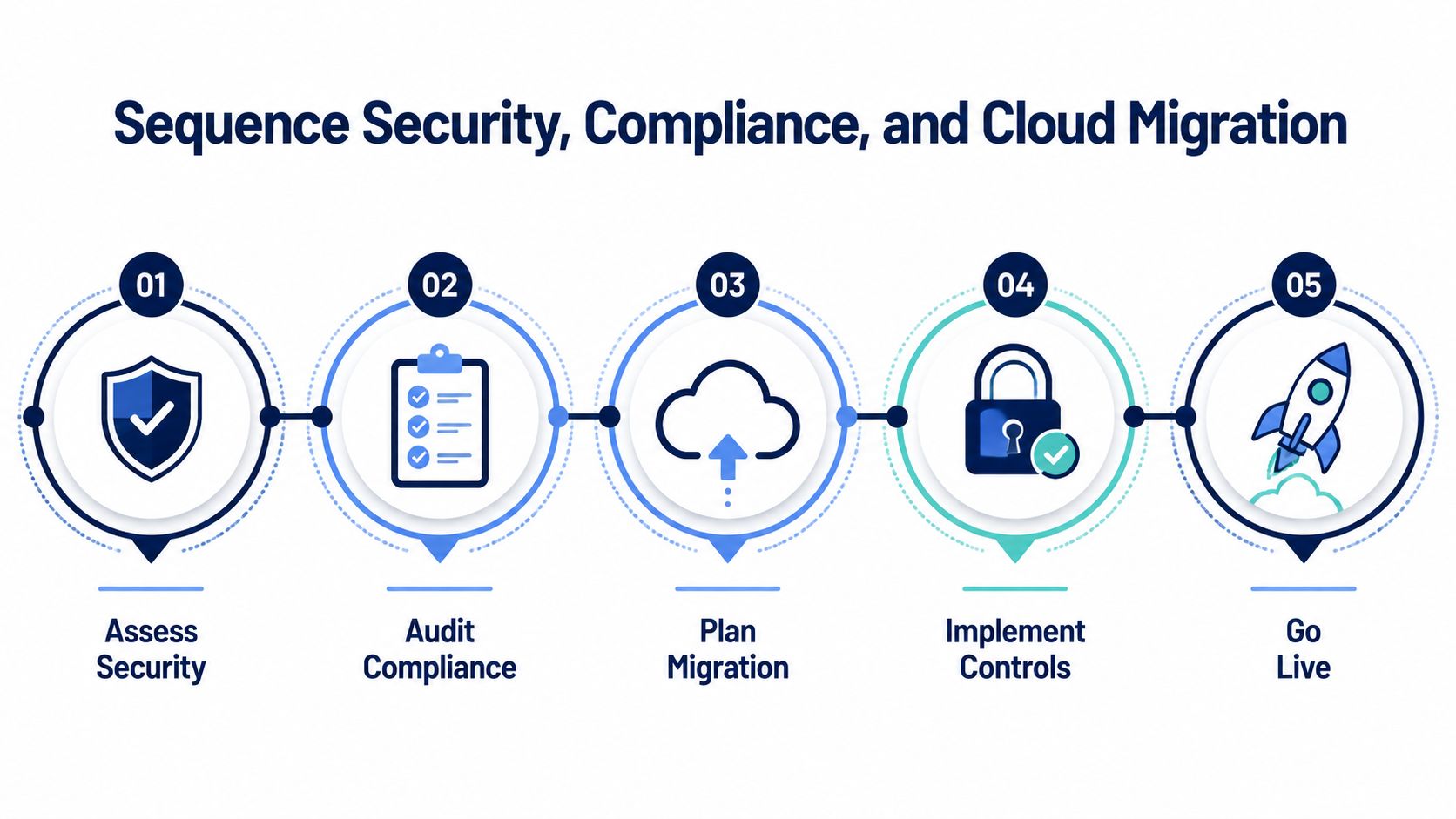
SMBs lose money when they run security, compliance, and cloud migration as separate projects. The timelines collide, controls get duplicated, and the team ends up paying twice for the same outcome. The better move is to run them as one programme with a fixed order.
Start with identity and access, backup and disaster recovery, and endpoint protection. Those are the controls that reduce exposure before any major migration work begins. Then add the relevant compliance obligations, whether that's HIPAA, PIPEDA, Law 25, or a sector-specific rule set.
Only after that should cloud modernisation move forward. If your Microsoft 365 environment, collaboration stack, or data platform is being changed, the security base has to be stable first. That order keeps you from modernising into a mess.
For a practical sequence and control focus, this cloud security posture management resource is a useful companion piece. It keeps the conversation grounded in controls, not slogans.
The cloud decision itself should be judged on business facts, sovereignty, data residency, integration with Microsoft 365 and Dynamics 365, and exit strategy. Those criteria matter more than shiny feature lists because they determine whether the move will fit the company's operating reality.
If you need a compliance lens while planning the sequence, 2026 compliance tips from Jumpstart Partners is a sensible reference point for the kinds of controls that tend to survive audits. The right takeaway is not to chase every framework at once. It's to make sure the migration calendar matches the compliance calendar, not fights it.
Most plans fail after approval because nobody owns the operating rhythm. A binder on a shelf is not strategic IT planning. A monthly steering meeting, a named executive sponsor, and a partner who drives follow-through are what keep the work funded.
The KPI set should be small and useful, not decorative. Measure uptime, patch compliance, mean time to resolve, security incident count, project milestone adherence, and budget variance against the approved plan. Those tell you whether the business is getting more stable, not just busier.
If you want a clean way to evaluate leadership against those outcomes, this guide on how to rate executive effectiveness is a helpful lens. In practice, the sponsor has to do more than attend meetings. They need to remove blockers, approve trade-offs, and keep the plan aligned with business priorities.
Training and communication are not optional extras. When people know what's changing, why it matters, and who to call, adoption goes up and frustration goes down. That's especially important during migrations, identity changes, and new security controls.
A simple annual cadence works well. Review the estate, refresh the risk register, revalidate priorities, and compare actual progress against the original roadmap. If the business has changed, the plan should change too.
A plan that doesn't get reviewed becomes a history document, not a management tool.
If you want help building a governance cadence that sticks, this change management process resource aligns well with the execution side of the work. The test is whether the business still has a live plan six months after approval.
CloudOrbis Inc. helps Canadian SMBs turn strategic IT planning into an operating model with assessment, vCIO guidance, cybersecurity, cloud, backup, and managed support. If you're ready to fund the right priorities, tighten governance, and build a plan your team can execute, visit CloudOrbis Inc. and start the conversation.
September 25, 2026
Is VoIP Good for Small Business in Canada? a 2026 GuideIs VoIP good for small business in Canada? Explore costs, benefits, reliability, security, and migration tips for SMBs considering VoIP in 2026.
Read Full Post
September 24, 2026
Helpdesk vs Service Desk: Choosing the Right IT SupportHelpdesk vs service desk: understand the key differences and choose the right IT support model for your organization in 2026.
Read Full Post
September 23, 2026
DDoS Protection for Canadian SMBs: What Works in 2026Learn what DDoS protection really does, the latest Canada-specific threats, and a practical playbook for small and mid-sized businesses
Read Full Post
