Fractional IT Leadership for Canadian SMBs
Discover how fractional IT provides Canadian SMBs in healthcare and manufacturing with expert technology leadership without the full-time executive cost.

Discover how fractional IT provides Canadian SMBs in healthcare and manufacturing with expert technology leadership without the full-time executive cost.
Imagine having a seasoned Chief Information Officer guiding your technology strategy, but only paying for the exact amount of expertise you need. That's the simple idea behind fractional IT. It provides access to high-level, strategic technology leadership on a part-time or "fractional" basis, helping align your tech with your core business goals without the cost of a full-time executive.
For many medium-sized Canadian businesses, technology often feels like a necessary expense rather than a strategic asset. Your day-to-day IT support might keep operations running, but who is steering the ship? This is where the concept of fractional IT becomes critical.
Think of it this way: you likely work with a part-time CFO or an external accounting firm for expert financial guidance. You wouldn't expect your bookkeeper to develop your company's long-term financial strategy, and the same logic applies to technology. Fractional IT provides that C-suite level direction, focusing on the big picture.
A fractional IT leader isn't there to fix a printer or reset a password. Instead, their role is to answer the crucial strategic questions that drive growth and mitigate risk.
This strategic function is built on several key pillars that differentiate it from daily operational support. A fractional leader concentrates on high-value activities that have a direct impact on business outcomes.
Their primary responsibilities include:
This approach transforms IT from a reactive cost centre into a proactive engine for growth. By focusing on strategy, a fractional leader ensures your technology isn't just working, it's working for you, helping you gain a competitive edge in your market.
To help you quickly grasp the concept, here's a summary of what fractional IT is all about.
| Core Concept | Primary Focus | Ideal For | Key Outcome |
|---|---|---|---|
| On-demand strategic IT leadership. | Aligning technology with long-term business goals. | Businesses needing C-suite expertise without the full-time cost. | IT becomes a strategic driver for growth and efficiency. |
This table shows how fractional IT fills a critical gap for businesses that have outgrown basic support but aren't ready for a full-time executive.
For Canadian medium-sized businesses, especially in sectors like construction, logistics, and legal services, the need for strategic IT guidance has never been greater. Digital transformation is no longer optional, and cybersecurity threats are increasingly sophisticated. However, the six-figure salary of a full-time CIO is often out of reach.
The fractional model provides a practical solution. It bridges the gap between basic IT support and the strategic leadership required to navigate today's complex business environment. For a deeper dive into this type of strategic role, you can explore whether your business needs a virtual CIO and how it differs from traditional management. This flexible approach delivers the expertise needed to make informed decisions, manage risks, and unlock new opportunities for innovation and growth.
Navigating the world of IT services can feel like solving a puzzle where all the pieces look frustratingly similar. Do you need a high-level strategist to map out your technology vision? Or do you need a hands-on team to manage the day-to-day work? Maybe you need a bit of both.
The biggest point of confusion for most business leaders is telling the difference between fractional IT and managed IT services. While they both involve bringing in an external partner, their functions are very different.
Think of it like building a house. You need an architect to design the blueprint and a general contractor to manage the crew building it. One focuses on the "why," and the other gets the "how" done.
A fractional IT leader is your strategic architect. Their primary role is to ensure your technology aligns perfectly with your long-term business goals. They build the IT roadmap, manage the budget, oversee cybersecurity governance, and make sure every dollar you spend on tech drives growth. They are part of your leadership team, offering executive-level guidance without the full-time executive salary.
On the other hand, a managed services provider (MSP) is your operational crew. They are responsible for keeping your IT environment running smoothly, securely, and efficiently every single day. Their world revolves around critical tasks like helpdesk support, network monitoring, software patching, and data backups. If you want to dive deeper into this model, you can learn more about what a managed IT service includes in our guide.
This infographic illustrates the top-down approach of a fractional IT role, where everything starts with leadership and strategy.
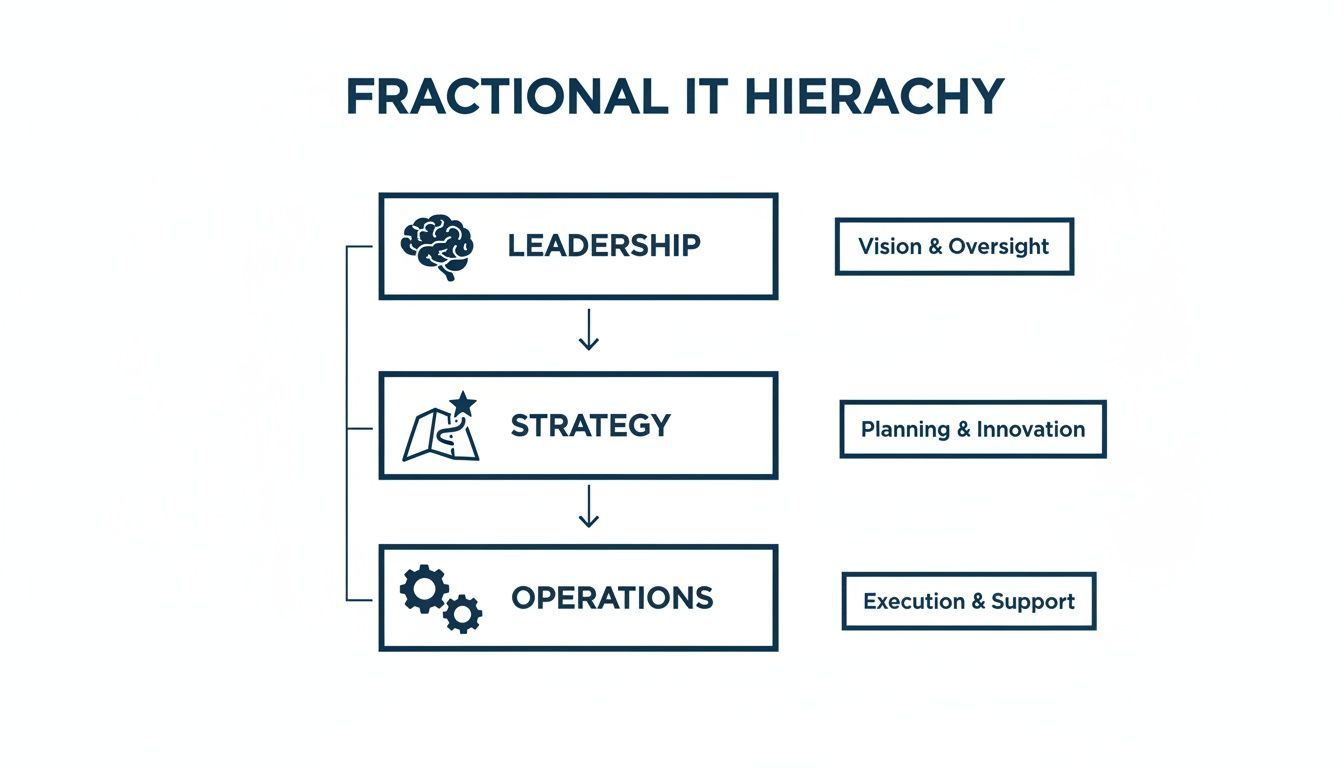
As the diagram shows, a fractional leader’s value comes from setting high-level direction, which then guides the hands-on work needed to achieve those business goals.
For many Canadian businesses, the choice isn't a simple either/or. Many companies already have an internal IT team or a single IT manager who handles daily tickets and tasks. But that person might not have the time, specialized skills, or resources for big-picture strategic planning or advanced cybersecurity.
This is where the co-managed IT model shines. It is all about creating a powerful partnership between your in-house staff and an external provider.
In a co-managed setup, your internal team continues to handle frontline support and familiar tasks, while the external partner brings strategic oversight, advanced tools, and specialized expertise to the table. It's a team-up that boosts your existing capabilities.
This hybrid approach lets you keep your valuable internal knowledge while plugging critical gaps in strategy, security, or project management. It prevents your IT manager from getting buried in tasks and empowers them with the resources of a much larger, specialized team.
To make these distinctions clearer, here’s a quick comparison of the three models.
| Service Model | Primary Role | Typical Activities | Best Fit Scenario |
|---|---|---|---|
| Fractional IT | Strategic Leadership | IT roadmapping, budget management, vendor relations, cybersecurity governance. | Your business lacks a clear tech vision and needs executive-level guidance. |
| Managed IT | Operational Execution | Helpdesk support, network monitoring, data backup, software patching. | Your team is bogged down by daily tech issues and system downtime. |
| Co-Managed IT | Collaborative Partnership | Project management, advanced security, strategic support, specialized tools. | You have an in-house IT team that needs extra support for strategy or projects. |
This table helps illustrate that the "best" model really depends on where your specific needs lie, whether in the boardroom, on the front lines, or somewhere in between.
So, which model is right for you? It all comes down to your company's current situation, resources, and where you want to go. By asking the right questions, you can determine what you truly need.
Consider these scenarios:
By honestly assessing whether your biggest IT headaches are rooted in strategy, operations, or a mix of both, you can confidently choose the service model that will transform your technology from a problem into a powerful engine for growth.
Let's move beyond the theory. The tangible results of fractional IT leadership are what truly matter for Canadian businesses. Bringing this model into your company isn't just about trimming the budget for an executive salary; it’s about gaining a distinct strategic advantage that directly fuels growth and stability.
The benefits are not abstract concepts, they translate into real-world solutions for the specific challenges you face every day. This approach is what turns technology from a confusing cost centre into a powerful engine for profitability and innovation. For many businesses, the value becomes crystal clear when they see strategic IT guidance solve their most persistent problems, from compliance headaches to operational bottlenecks.
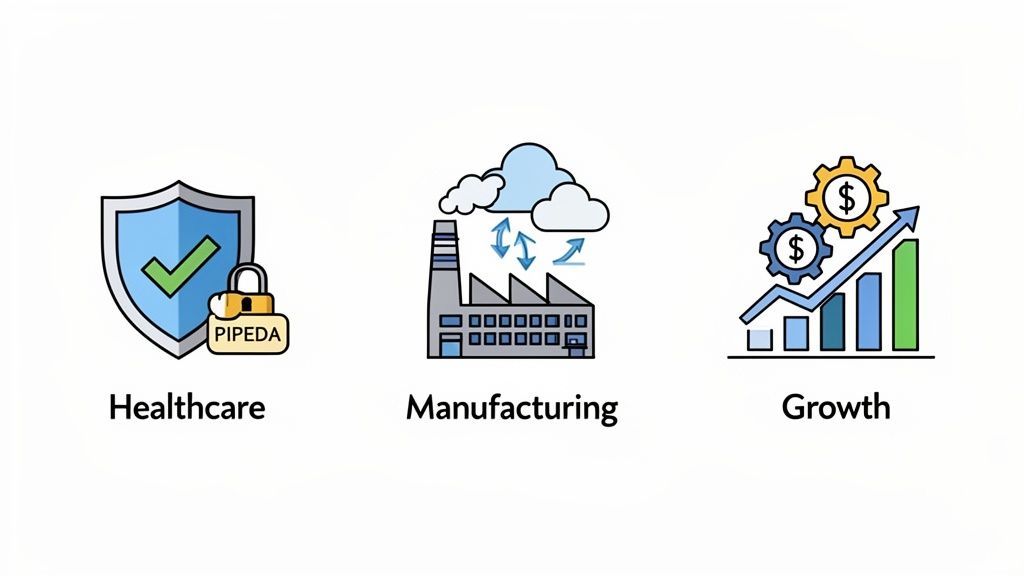
One of the most immediate advantages of fractional IT is gaining access to a deep well of specialized knowledge that would be almost impossible to find in a single full-time hire. A seasoned fractional leader brings years of cross-industry experience to the table, having solved complex problems for multiple organizations like yours.
This kind of expertise is critical in highly regulated sectors. For a healthcare clinic in Ontario, it means having a leader who can confidently navigate the complexities of PIPEDA and provincial health information laws, ensuring patient data is always secure and compliant. For a financial services firm, it means having someone who deeply understands the stringent data sovereignty and security requirements unique to their industry.
This on-demand expertise ensures your business is always guided by best practices, no matter how specific or niche the challenge might be.
For most medium-sized businesses, cybersecurity can feel like an overwhelming and ever-shifting threat. Many simply lack the internal expertise to develop a truly robust security strategy, leaving them dangerously vulnerable to attacks that can be financially devastating.
A fractional IT leader makes cybersecurity a boardroom conversation, not an afterthought. They work to build a proactive security culture from the top down, shifting your entire organization's mindset.
This includes:
A significant advantage of this strategic approach is gaining access to specialized knowledge, like adopting comprehensive cybersecurity tips for small businesses, which transforms your defence from purely reactive to genuinely proactive.
Without strategic direction, technology investments often become reactive and disjointed. You buy new software to fix one problem, only to create another one somewhere else. A fractional IT leader eliminates this expensive guesswork by creating a clear, actionable technology roadmap aligned with your long-term business goals.
A technology roadmap is more than just a list of projects; it's a strategic document that ensures every dollar spent on IT moves your business forward. It provides clarity, predictability, and a direct line of sight between technology spending and business outcomes.
For a manufacturing firm, this roadmap might focus on using cloud solutions to streamline the supply chain or implementing IoT sensors for predictive maintenance to prevent costly downtime. For a construction company, it could involve adopting mobile technologies to improve collaboration between the office and job sites. This strategic planning ensures your technology isn't just supporting your business, it's actively accelerating its growth.
While a fractional leader sets the high-level strategy, understanding the benefits of managed IT services can clarify how that strategy gets executed on a daily basis. By linking top-level planning to daily operations, you create a powerful synergy that maximizes your return on investment.
Bringing a fractional IT leader on board is about more than just filling a role; it is a fundamental shift in how your business approaches technology. This move transforms your IT function from a reactive support crew, constantly putting out fires, into a proactive driver of your business strategy. To make this transition work, you need a clear roadmap, one that starts with an honest look at where you are and a solid vision for where you want to go. It is a deliberate process that turns IT from an operational cost into a strategic investment that delivers real value.
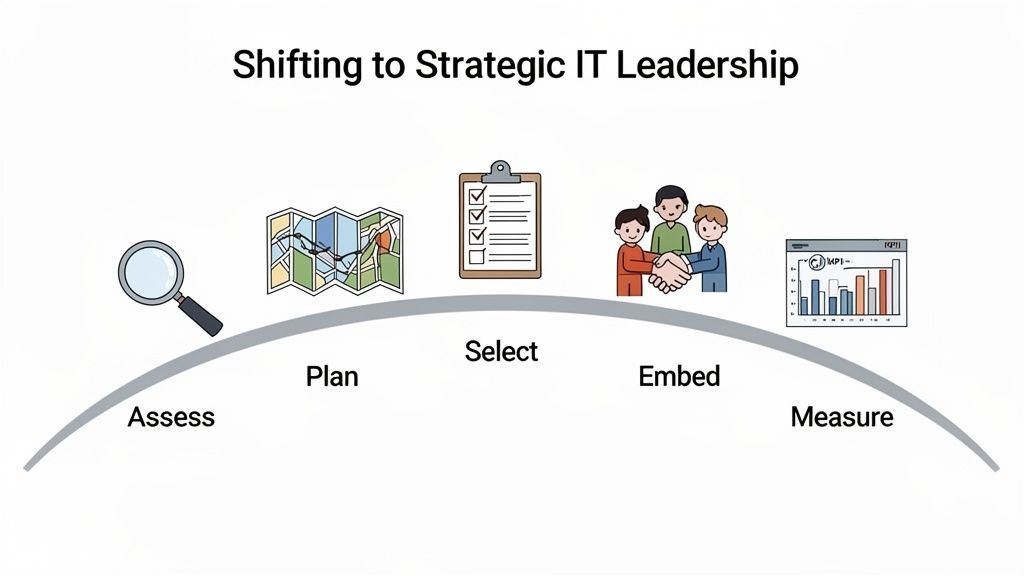
First, you need an honest assessment of your current IT capabilities. This isn't about making a simple list of your hardware and software. It is about digging deep to understand how technology is truly serving (or failing) your business right now. You must pinpoint your strengths and, more importantly, your strategic gaps.
Ask yourself some tough questions:
The answers give you a baseline. They help you define the exact problems a fractional IT leader needs to solve and clarify what success will look like. You can’t chart a new course without knowing your starting point. For more on this discovery process, check out our guide on IT strategy and consulting.
Bringing in a fractional leader isn't just a technical change; it's a cultural one. This is especially true for teams that are used to seeing IT as a simple helpdesk function. Your employees and existing IT staff need to understand that this new role is about strategic guidance, not just troubleshooting printer jams.
Start by communicating the "why" behind this decision. Explain how strategic IT leadership will fuel company growth, strengthen security, and ultimately make everyone’s job easier. You need to set clear expectations about the fractional leader’s role and how they will interact with every department.
The goal is to build a partnership where the fractional leader is seen as a core part of the leadership team, someone who enables business success through technology, rather than just managing systems.
Once you know what you need and have prepared your team for the change, it is time to choose the right partner. Look for a fractional IT provider with proven experience in your industry and a deep understanding of the unique challenges Canadian medium-sized businesses face.
After you have made your choice, the real work begins: embedding them into your operations. This is not an arm's-length relationship.
This deep integration ensures they operate as a true partner, not just an external consultant. As your business evolves, managing old technology also becomes a key part of corporate governance, a process often guided by a strategic guide for commercial ITAD.
Finally, to ensure this partnership delivers real value, you must establish clear Key Performance Indicators (KPIs) from the very beginning. These are not just tech metrics; they should directly connect IT initiatives to business outcomes.
Effective KPIs might include:
The business environment is also shifting rapidly. In 2025, AI adoption in Canadian workplaces has hit a tipping point. Employee access to workplace-approved AI tools has nearly doubled year-over-year, jumping from 28% in 2024 to 51% in 2025, signalling a massive shift toward integrating fractional AI capabilities. Discover more insights about AI adoption trends in Canadian workplaces.
By setting and tracking the right KPIs, you can confidently measure the impact of your fractional IT leader and ensure their strategic guidance translates into sustainable growth and a powerful competitive advantage.
Picking a fractional IT partner is a significant business decision, one that can set the course for your company for years. It is about more than just a flashy sales pitch. You are looking for a true strategic ally who understands not just the tech, but the very core of your business and where you want to take it.
Finding that perfect fit means you have to be methodical. You need to focus on finding a partner with deep expertise, a proven process, and the kind of leadership that aligns with your own. This is about finding a partner who can integrate into your leadership team and deliver real, measurable value from day one.
Generic IT advice will not suffice. Your business has its own set of challenges, regulations, and competitive pressures that are unique to your industry. A partner who has already worked in your sector, whether that’s healthcare, manufacturing, or finance, will already speak your language.
They should be able to show you they understand things like:
This specialized knowledge is what separates good advice from great advice. It ensures their recommendations are not only technically solid but also practical and designed to give you an edge.
A top-tier fractional IT partner does not just improvise; they work from a proven framework. Ask them to walk you through their process for creating a technology roadmap, optimizing your budget, and managing risk. A structured approach is a clear sign that they are methodical and focused on results.
A proven framework demonstrates that the provider has a repeatable process for delivering strategic value. It’s the difference between hiring a consultant who improvises and partnering with a strategist who executes a plan.
This is especially critical with new tech appearing constantly. For example, while Canadian businesses are adopting generative AI, very few, a mere 2%, are actually seeing a return on that investment. A partner with a solid strategic framework can close that gap, ensuring your tech dollars deliver real business value. You can learn more about AI ROI findings for Canadian businesses to get a better sense of this challenge.
Do not be shy during the evaluation process. Asking tough, insightful questions is the best way to uncover a potential partner’s real capabilities and priorities. These questions should dig into everything from their leadership style to their technical expertise.
Here are a few to get you started:
Choosing the right partner is the first step in turning your IT from a simple cost centre into a powerful strategic asset. For more help with your decision, our guide on selecting the right IT outsourcing company offers even more insights into the vetting process.
So, after digging into what fractional IT is and how it works, we get to the big question: Is it actually the right move for your business?
The answer really comes down to where you are right now and, more importantly, where you are headed. This isn't a silver bullet for every company, but for a certain kind of business hitting a specific stage, it can be a genuine turning point.
The perfect fit for fractional IT is a business on the verge of major growth. You have probably moved past the point where basic, break-fix IT support is enough. You know technology needs to be a core part of your strategy, but a six-figure salary plus benefits on a full-time, C-level technology executive is not in the cards yet.
If the challenges we've discussed feel a little too familiar, you are likely at that tipping point.
Ask yourself if any of these sound like your current reality:
If you are nodding along, then fractional IT was practically designed to solve these exact problems. It brings in the high-level strategic thinking you need to build a solid, growth-ready technology foundation, but without the significant overhead of another C-suite salary.
Think of a fractional IT model as an investment in direction. It’s about making sure your technology doesn’t just keep the lights on, it actively fuels your growth and sharpens your competitive edge.
Today's business climate demands that kind of foresight. Just look at the latest data from Statistics Canada for Q2 2025: AI adoption among Canadian firms shot up to 12.2% from 6.1% in just one year, and another 14.5% are planning to implement it soon. Read the full research on AI adoption in Canada. This isn't just a trend; it's a massive shift that makes strategic guidance non-negotiable for any medium-sized business that wants to compete.
At CloudOrbis, providing that strategic leadership is what we do best. Our fractional and co-managed IT services are built from the ground up to empower Canadian medium-sized businesses, turning technology from a necessary evil into your most powerful asset. If you see your business in this guide, it's probably time for a conversation.
Thinking about bringing in fractional IT leadership? It's a big decision, and you probably have questions. To help you get a clearer picture, we've gathered the most common questions business leaders ask us about this model. We've kept the answers practical and straight to the point, so you can figure out if it's the right strategic move for your company.
Hiring a full-time executive is a major investment, and the cost savings with a fractional leader are significant. In Canada, a Chief Information Officer's salary can easily top $150,000 a year, before you even factor in benefits, bonuses, and other overhead.
A fractional IT engagement, on the other hand, is just a fraction of that cost. It is typically structured as a predictable monthly retainer based on how much strategic involvement your business actually needs. This makes top-tier expertise accessible and affordable for medium-sized businesses, giving you a much healthier return on your leadership investment.
Nearly every engagement kicks off with a deep dive into your current technology, business workflows, and long-term goals. From that discovery process, the fractional leader crafts a multi-year IT roadmap, helps you build realistic tech budgets, and puts clear governance policies in place to manage risk.
They become a true part of your leadership team. This means they will often:
The time commitment is flexible and built around your needs. It could be just a few hours a month for high-level guidance or much more hands-on during a major initiative like a cloud migration or ERP implementation.
Absolutely. In fact, that's one of the most powerful ways to use the model. A fractional leader is there to guide, mentor, and elevate your existing team, not replace them. This approach shines in a co-managed setup where your internal staff or a managed services provider (MSP) handles the day-to-day operational tasks.
The fractional leader provides the high-level strategy that connects your tech team's daily work to your company's biggest goals. This synergy builds a powerhouse IT function that drives real results.
The return on investment from fractional IT shows up in both hard numbers and less tangible, but equally important, benefits.
On the quantitative side, you can track concrete results like cost savings from smarter tech spending, less system downtime, and better efficiency across your departments. Qualitatively, the ROI is clear in a much stronger cybersecurity posture, smoother regulatory compliance, more confident strategic decisions from your leadership team, and the ability to use technology as a real competitive advantage.
At CloudOrbis Inc., our fractional and co-managed IT services are designed specifically to bring this level of strategic leadership to Canadian SMBs. If the challenges and opportunities in this guide sound familiar, it might be time to see how a flexible, expert-driven approach to IT can unlock your company’s full potential. Contact us today to schedule a consultation.
Book a 30-minute call with a senior engineer. No sales script, just straight answers about your environment.


