
September 13, 2026
Third-Party Risk Management for Canadian SMBsMaster third-party risk management for your Canadian SMB. Learn OSFI compliance, vendor monitoring frameworks, and how to secure your supply chain.
Read Full Post%20(1).webp)
Usman Malik
Chief Executive Officer
September 14, 2026
Canada's critical-severity cyber incidents rose from 2,163 in 2017 to 3,960 in 2023, while high-severity incidents increased from 6,681 to 9,602 over the same period, according to the National Cyber Threat Assessment 2025–2026. For a busy operations leader, the practical lesson is clear: running a scanner is useful, but a scanner report isn't a vulnerability program.
Vulnerability assessment tells you what weaknesses were found during a defined review. Vulnerability management turns those findings into an operating process with ownership, prioritization, remediation deadlines, verification, and reporting. If your team receives a PDF after each scan but can't show who fixed each issue, when it was fixed, and whether the fix was confirmed, you're running assessments, not managing vulnerabilities.
NIST defines vulnerability assessment as a systematic examination of an information system or product to determine whether security measures are adequate, identify deficiencies, evaluate proposed measures, and confirm adequacy after implementation in its formal vulnerability assessment definition. In plain language, assessment is a structured inspection.
A scanner reviews a defined group of systems, applications, devices, or configurations. It identifies known weaknesses, missing patches, insecure settings, and other conditions that could increase risk. The result is usually a finding list or report containing affected assets, severity information, and recommended actions.
That output matters. You can't remediate what you haven't found, and assessment provides the visibility needed for patch planning, audit evidence, and technical risk review. CloudOrbis also explains the practical role of this service in its vulnerability assessment services overview.
The limitation is timing. An assessment shows conditions at the time of the review, within the scope the team selected. It doesn't, by itself, prove that assets were fully inventoried, that findings were assigned to accountable owners, or that remediation was completed and validated.
Canada's federal vulnerability management guidance describes vulnerability management as an ongoing risk-management function. The process includes inventorying IT assets, mapping business processes to those assets, detecting vulnerabilities, assessing vulnerability risk, and carrying out mitigation activities, as set out in the Government of Canada vulnerability management guideline.
A mature program therefore answers operational questions that an assessment report leaves open:
Practical rule: If the process ends when the report is delivered, you have visibility. You don't yet have control.
Canadian guidance also recommends risk-based metrics, including vulnerabilities per 100 assets and weighting findings by exploitability, such as inclusion in the Known Exploited Vulnerabilities catalog or evidence of active exploitation. It uses a scored risk matrix with a total of 50 points to determine testing and remediation time frames, demonstrating that deadlines and prioritization belong inside the management process, not after it.
The distinction matters because Canadian organizations face changing exposure across endpoints, cloud services, applications, suppliers, and remote access. Vulnerability assessment is the evidence-gathering activity. Vulnerability management is the repeatable business process that decides what happens next.
The easiest way to understand vulnerability management vs vulnerability assessment is to compare what each discipline does with the same finding. An assessment might identify an outdated application on a finance workstation. Management determines whether that workstation supports a critical process, whether the application is reachable, who owns it, what compensating controls exist, when it must be updated, and how the fix will be confirmed.
| Dimension | Vulnerability Assessment | Vulnerability Management |
|---|---|---|
| Scope | Reviews a defined environment, system set, or application at a point in time | Maintains visibility across infrastructure, cloud workloads, identities, applications, business units, and relevant third parties |
| Frequency | Often periodic, such as an annual or quarterly review | Recurring and event-driven, with rescans after material changes or newly identified vulnerabilities |
| Process | Discover, classify, and report weaknesses | Discover, analyse, prioritize, remediate, verify, document, and report |
| Tools | Point scanning tools and assessment reports | Scanners connected to ticketing, patch coordination, dashboards, asset records, and workflow automation |
| Result | A finding list with severity and recommendations | A managed remediation queue with owners, deadlines, exceptions, validation evidence, and trend metrics |
Assessment scope is usually agreed before the scan begins. That can be appropriate for a specific application review, a merger-related baseline, or an audit requirement. The risk appears when the defined scope excludes cloud workloads, shadow IT, identity systems, remote endpoints, or supplier-managed assets.
Management treats the inventory as a living business record. It connects technology to business processes, which helps an operations leader distinguish a vulnerability on a public-facing service from one on an isolated administrative device. Canada's federal guidance explicitly places asset inventory and business-process mapping inside the vulnerability management function, not outside it.
A periodic scan can provide a useful baseline, but it leaves gaps between scan dates. The Canadian Centre for Cyber Security's patch management guidance says scanning schedules can be frequency-based or event-driven. It also calls for analysis of results and remediation of legitimate vulnerabilities within organization-defined response times.
That means a new internet-facing service, major software change, security advisory, or newly identified exploited vulnerability should trigger review rather than wait for the next calendar scan. The CloudOrbis guide to vulnerability scanning provides useful context for the scanning component, but scanning remains only one control within the larger program.
Nessus, Qualys, and Rapid7 InsightVM can identify weaknesses. A management platform or integrated operating model adds asset context, ticket creation, remediation tracking, patch coordination, exception records, and executive dashboards.
The output changes accordingly. Assessment produces a snapshot. Management produces evidence of risk reduction over time, such as outstanding findings by owner, age, severity, affected business service, remediation status, and verified closure. Those measures help leadership decide where to invest rather than reviewing another long list of technical findings.
Assessment isn't an alternative to vulnerability management. It's one stage within it. The Canadian lifecycle begins with understanding the environment, then moves through analysis, prioritization, mitigation, validation, and reporting.
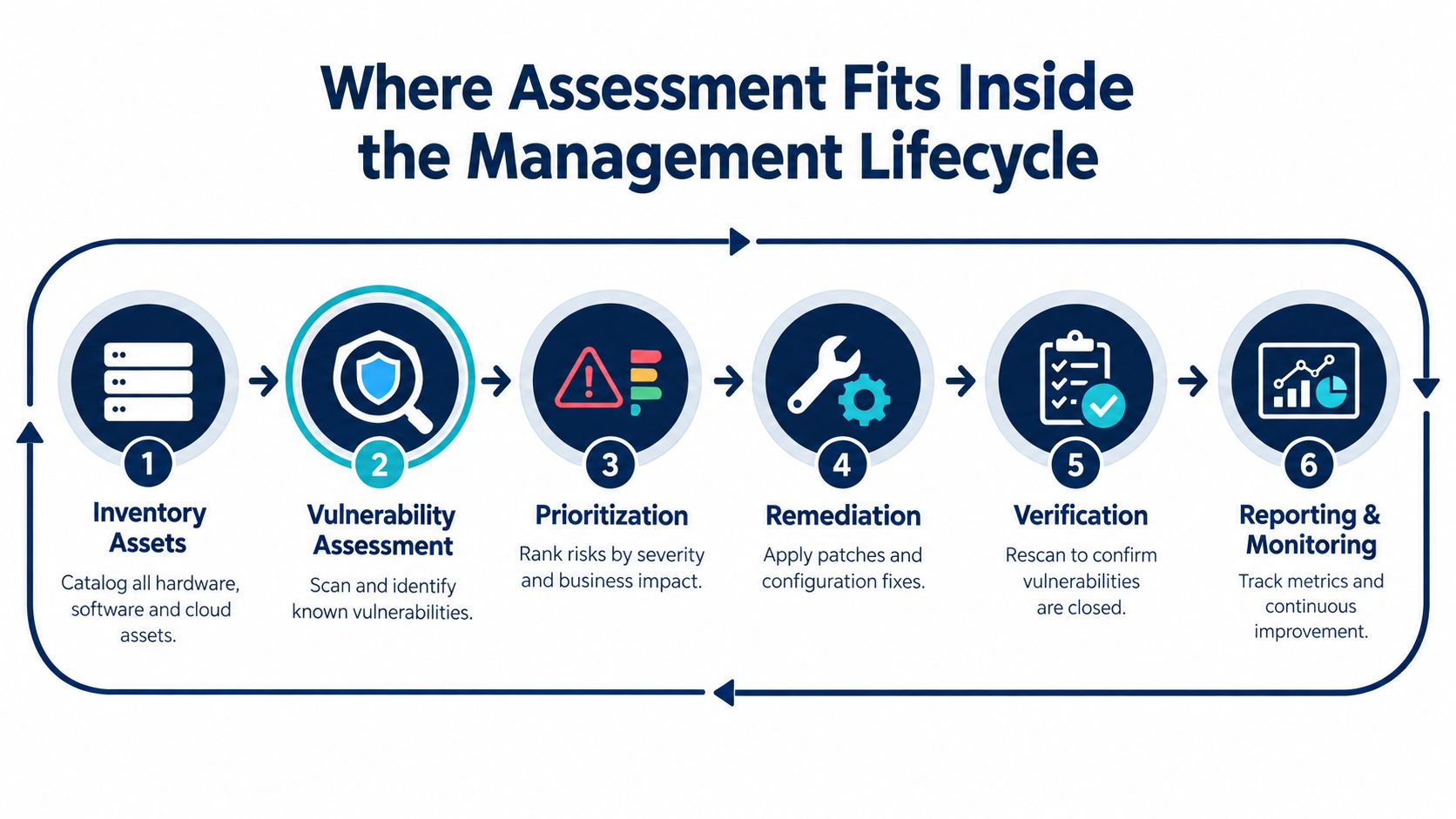
Assessment primarily feeds the discovery and analysis stages. Its findings become useful management inputs only after someone connects them to an asset owner, a business service, a risk decision, and a remediation path.
Prioritization shouldn't rely on severity alone. Teams can use CVSS as one signal, then add exploit availability and asset criticality. Canada's federal guidance specifically recommends weighting by exploitability, including issues listed in the Known Exploited Vulnerabilities catalog or actively exploited in the wild. A lower-scored weakness on a critical, externally exposed service may deserve faster action than a higher-scored issue on a tightly isolated asset.
Many organizations can prove that they scanned. Far fewer can prove that they closed findings within defined risk-based time frames. The Cyber Centre's IT security risk assessment guidance directs organizations to scan at an organization-defined frequency and when new vulnerabilities are identified, analyse results, and remediate legitimate vulnerabilities according to risk-based response times.
That recurring loop is what auditors and regulators expect to see in environments subject to PIPEDA, PHIPA, PCI DSS, or contractual security requirements. A report that says a vulnerability existed is evidence of detection. A ticket, approved decision, remediation record, rescan result, and management trend provide evidence of control.
For a practical overview of the broader operating model, see CloudOrbis's vulnerability management resource.
The right answer depends less on company size than on exposure, accountability, and operational capacity. A smaller organization with consumer data, few internet-facing services, disciplined patching, and reliable endpoint protection may manage its risk with periodic assessments and a strong remediation routine. That approach still requires named owners and documented follow-through.
A healthcare provider or financial firm faces a different standard. PHIPA and provincial health information laws raise the consequences of weak protection around personal health information. Financial organizations must consider OSFI B-13 expectations, PCI DSS obligations where payment cards are involved, and contractual requirements that demand repeatable evidence. Federal contractors working within ITSG-33 environments also need documented risk decisions and control evidence.
| Criterion | Assessment Only, Most SMBs | Full Management, Regulated Industries |
|---|---|---|
| Security staffing | A small IT team can review findings and complete remediation consistently | Limited internal capacity requires assigned workflow ownership and service-level tracking |
| Internet-facing assets | A relatively stable, well-understood environment may support periodic review | Multiple public services, remote access paths, or cloud workloads require recurring visibility |
| Compliance | Customer questionnaires or general security expectations may be manageable with assessment records | PHIPA, OSFI B-13, PCI DSS, ITSG-33, and contractual audits require stronger evidence of recurring review |
| Incident history | No major incident and reliable patch discipline support a focused model | Prior incidents, recurring findings, or active threat concerns justify continuous prioritization |
| M&A and change | Stable operations make periodic reassessment practical | Acquisitions, integrations, and rapidly changing environments require event-driven discovery |
Answer these questions:
If the answers are mostly yes, an assessment-led program may be sufficient for the current environment. If several answers are no, build vulnerability management rather than buying another scanner. Penetration testing can add a different form of validation, and CloudOrbis outlines that service in its penetration testing services overview, but it doesn't replace continuous vulnerability operations.
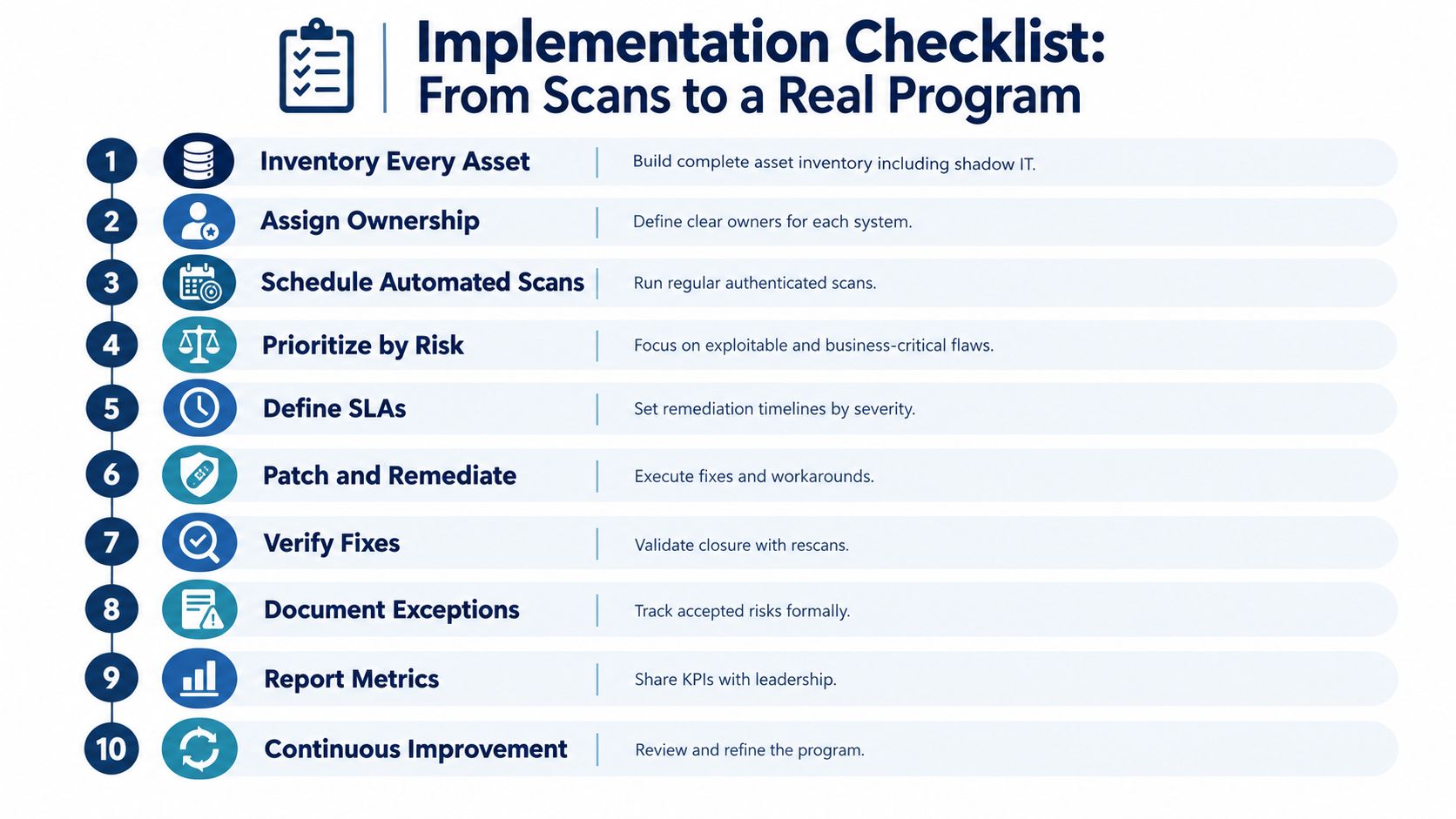
The shift from ad hoc scanning to management doesn't require a complex transformation project. It requires an ordered set of decisions that someone owns and repeats.
Inventory every asset. Include on-premises systems, cloud workloads, endpoints, applications, and shadow IT. Start with procurement records, cloud consoles, endpoint tools, and network discovery, then reconcile the lists.
Assign ownership. Give every important asset a business or technical owner. An unassigned finding will usually become an ageing finding.
Schedule automated scans. Choose authenticated scanning where appropriate and use a tool such as Nessus, Qualys, or Rapid7 InsightVM. Build event-driven scans into change management rather than relying only on a calendar.
Prioritize by risk. Combine severity with exploitability, business criticality, exposure, and compensating controls. Don't let a raw scanner ranking become your entire risk model.
Define response SLAs. Publish deadlines by risk category, document who can approve exceptions, and make the targets realistic for clinical, manufacturing, finance, and other uptime-sensitive environments.
Patch and remediate. Coordinate application updates, operating-system patches, configuration changes, isolation, and other mitigations. The Cyber Centre's patch-management guidance supports a process based on analysed results and organization-defined response times.
Integrate findings into tickets. A finding should create a work item with the affected asset, evidence, owner, priority, due date, and required action. Avoid copying findings manually between reports and email.
Verify fixes. Rescan the affected asset or use another reliable validation method. Close the ticket only when the evidence supports closure.
Document exceptions. Record the reason, business owner, expiry or review date, compensating controls, and residual risk. An exception isn't remediation, but an undocumented exception is invisible risk.
Report and improve. Give leadership a monthly view of open findings, ageing, overdue work, recurring weaknesses, verified closures, exceptions, and asset coverage. Review the process after incidents, major changes, and annual tabletop exercises.
Canada's federal guidance makes the timing decision part of risk management. It recommends using a scored matrix, with a total of 50 points, to determine testing and remediation time frames in the applicable context, as described in the Government of Canada vulnerability management guideline. Your organization may use a different model, but it should be documented, repeatable, and tied to business risk.
Many Canadian SMBs don't need another dashboard. They need someone to operate the process when the internal IT team is already handling users, projects, outages, vendors, backups, and compliance requests.
A managed provider can consolidate scanning, asset context, prioritization, remediation coordination, verification, and reporting under one operating agreement. That reduces the handoffs that cause findings to sit untouched, while internal IT retains visibility into business priorities and change windows.
The model should begin with discovery and a risk baseline. The provider then scopes and onboards the environment, deploys enterprise-grade scanning, documents a severity-based remediation workflow, and connects findings to accountable owners. Monthly executive reporting should map results to relevant NIST and ITSG-33 controls, with clear evidence of open risk, completed work, exceptions, and verification.
For organizations considering this route, managed security services from CloudOrbis represent one available operating model. CloudOrbis Inc. can provide vulnerability assessment and management support alongside managed IT services, including a 24/7, Canada-based helpdesk for operational support and incident response coordination.
The business case is continuity. A repeatable provider-led process can continue through staff absences, changing priorities, acquisitions, and audit preparation while giving leadership a predictable monthly operating model. It also gives your team a practical place to start when alerts are accumulating but no one has enough time to turn them into verified remediation.
CloudOrbis Inc. helps Canadian SMBs build right-sized vulnerability programs that connect asset discovery, risk prioritization, remediation tracking, verification, and executive reporting. Visit CloudOrbis Inc. to request a 30-minute consultation and scope a practical approach for your healthcare, finance, or other regulated environment.
September 13, 2026
Third-Party Risk Management for Canadian SMBsMaster third-party risk management for your Canadian SMB. Learn OSFI compliance, vendor monitoring frameworks, and how to secure your supply chain.
Read Full Post
September 12, 2026
Managed Services Cost: A Practical Guide for Canadian SMBsUnderstand managed services cost for Canadian SMBs. Learn pricing models, industry factors, ROI, and how to choose the right provider for your business.
Read Full Post
September 11, 2026
Managed EDR Services: A Practical Guide for Canadian SMBsLearn how managed EDR services detect, contain, and respond to threats around the clock. A practical guide for Canadian SMBs evaluating providers, pricing
Read Full Post
