

September 26, 2026
On-Premise to Cloud Migration Checklist: 10 StepsUse this on-premise to cloud migration checklist to plan assessment, compliance, backups, sequencing, testing, cutover, and optimization for SMBs.
Read Full Post%20(1).webp)
Usman Malik
Chief Executive Officer
June 28, 2026
You've patched the firewall, rolled out MFA, and told your team not to click suspicious links. On paper, that feels responsible. In practice, many Canadian businesses still carry hidden weaknesses in servers, laptops, cloud apps, remote access tools, and vendor-connected systems that nobody has checked properly in months.
That's the uncomfortable truth behind vulnerability assessment services. They aren't a luxury for banks and massive enterprises. They're a practical way for clinics, finance teams, manufacturers, and other mid-sized organisations to find what's exposed before an attacker does. If you lead a business in a regulated industry, waiting for an incident is the expensive option.
A common situation looks like this. A healthcare clinic upgrades Microsoft 365, adds endpoint protection, and outsources some IT support. The leadership team assumes the environment is reasonably secure. Then an insurer asks for proof of vulnerability management, or an auditor wants evidence that internet-facing systems are being reviewed. Suddenly, “we have antivirus” isn't an answer.
The risk is bigger than many leaders realise. According to the Canadian Centre for Cyber Security's National Cyber Threat Assessment 2025-2026, small and mid-sized businesses face a 45% increase in cyber attacks, and assessments found critical weaknesses in 68% of inspected IT environments, with 52% of healthcare providers in Ontario lacking adequate vulnerability management protocols (National Cyber Threat Assessment 2025-2026).
That should change how you think about security spending. The issue isn't only malware or phishing. It's also the forgotten VPN appliance, the unpatched web plugin, the misconfigured cloud storage setting, or the server nobody has reviewed since it was set up.
Most businesses don't ignore security on purpose. They miss issues because day-to-day IT work takes over.
Practical rule: If you can't point to a recent vulnerability report, a remediation list, and a retest date, you don't have a vulnerability management process. You have a hope-based security plan.
There's another angle many leaders miss. External digital services, integrations, and data collection workflows can introduce technical behaviours that trigger defensive controls or expose weak spots in web applications. If your team works with online data collection or automation, this guide on how to handle anti-bot systems is useful context for understanding how defensive web controls behave in practice.
If this broader risk picture sounds familiar, CloudOrbis has also outlined related concerns in its post on top cybersecurity threats for SMBs. The point is simple. You can't reduce risk you haven't identified.
A vulnerability assessment is a structured inspection of your digital environment. Think of it as hiring a building inspector for your IT estate. The inspector checks doors, windows, locks, wiring, and structural weak points. In the same way, vulnerability assessment services check systems, software, ports, configurations, and known exposures across your environment.

That doesn't mean chaos, downtime, or someone “hacking” your business. It means a provider uses established tools and human review to identify weaknesses, rank them by risk, and tell your team what to fix first.
A solid assessment usually includes several activities working together:
A good provider doesn't dump a spreadsheet on your desk and disappear. They connect findings to business consequences, especially where compliance, cyber insurance, client expectations, and operational continuity matter.
Many buyers get confused.
A vulnerability assessment is the inspector. It identifies known weaknesses across a broad area. A penetration test is the burglar simulation. It attempts to exploit weaknesses to prove what an attacker could do.
Use that distinction to avoid overspending.
| Service | Best for | Main outcome |
|---|---|---|
| Vulnerability assessment | Ongoing visibility, compliance support, broad risk reduction | A prioritised list of weaknesses and remediation guidance |
| Penetration testing | High-risk applications, external attack simulations, proving exploitability | Evidence of how specific weaknesses could be abused |
If you run a clinic, accounting firm, or manufacturing operation, a vulnerability assessment is usually the first smart investment. It gives you coverage and direction. Penetration testing becomes more useful after you've handled the obvious weaknesses.
For teams expanding their wider security programme, CloudOrbis has a broader overview in this guide to cyber security services. It also helps to look beyond your perimeter. Services such as GoSafe Dark Web monitoring can complement assessments by showing whether business credentials or exposed data are surfacing where they shouldn't.
A vulnerability assessment should answer three questions fast. What's exposed, what matters most, and who needs to fix it.
Not every assessment solves the same problem. If you choose the wrong type, you'll spend money and still miss the exposure that matters.
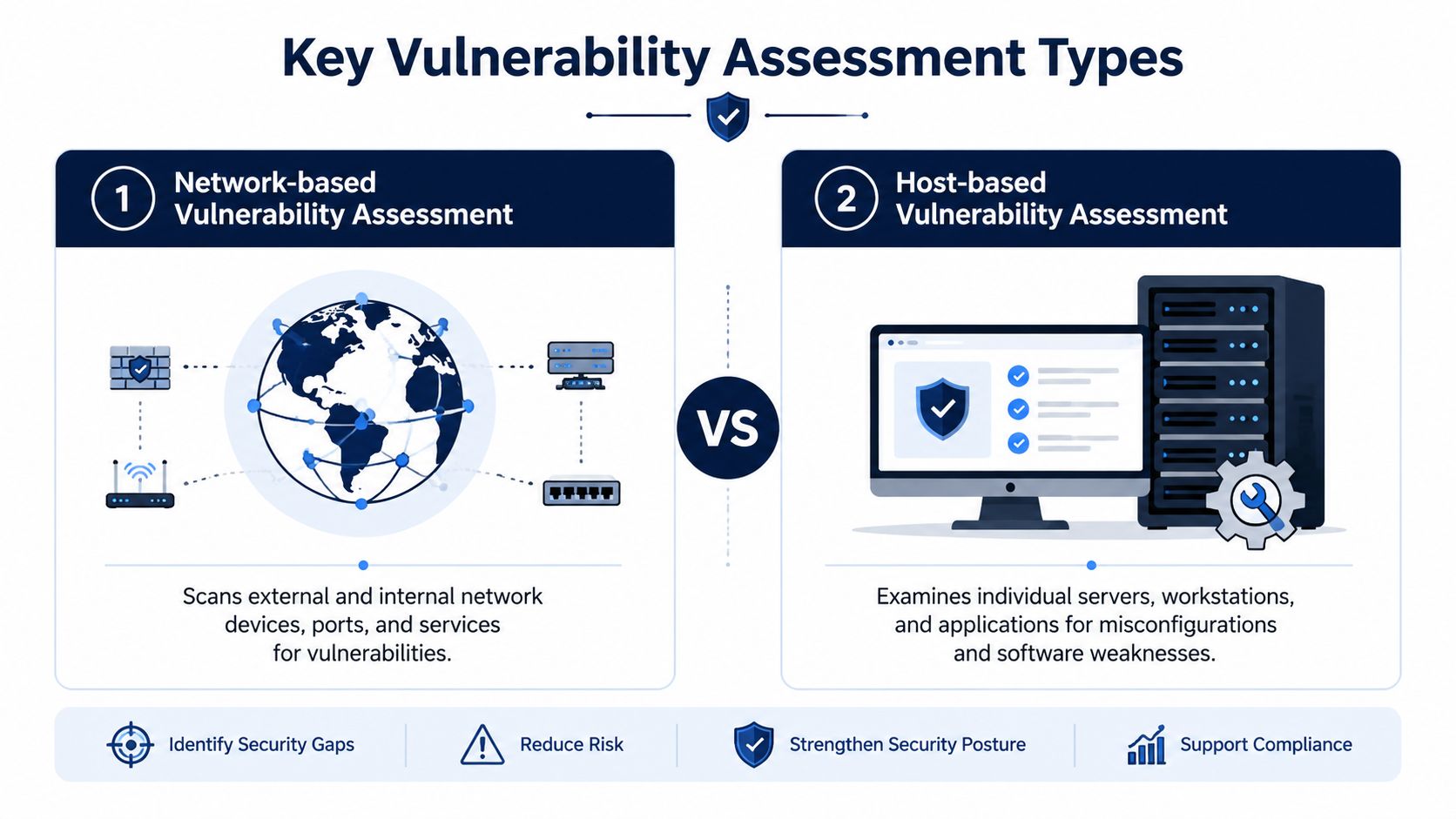
This type looks at your external and internal network footprint. It checks devices, ports, exposed services, and reachable systems for known weaknesses.
It's the right choice when you want to understand what an attacker could discover from the outside, or when your office, clinic, warehouse, or multi-site operation has grown without a recent review. If remote access, firewalls, branch connections, or internet-facing systems are involved, start here.
Host-based assessments go deeper into individual servers, workstations, and endpoints. They focus on missing patches, insecure configurations, outdated software, and local weaknesses on specific systems.
These are particularly useful when you have sensitive user devices, shared terminals, or servers supporting accounting systems, patient records, or operational platforms. They're also valuable after mergers, office expansions, or managed IT transitions.
If your business runs a customer portal, booking system, payment workflow, or client-facing web application, you need application-focused testing. General network scanning won't tell you enough about how that software behaves or whether common web weaknesses exist.
This matters for legal, financial, and healthcare organisations that rely on portals for document exchange, scheduling, or client communications.
A cloud assessment reviews the configuration and exposure of your hosted environment. It looks for missteps in identity, storage, permissions, logging, and service settings across platforms such as Microsoft Azure or Amazon Web Services.
Many businesses think moving to the cloud automatically improves security. It doesn't. Cloud platforms give you powerful controls, but your team still needs to configure them correctly.
This distinction matters more than most proposals make clear.
If you only run unauthenticated scans, you may get a narrow picture. If you only run authenticated scans, you may miss how your external attack surface appears from the internet. Mature programmes often need both.
Use the business problem to decide.
| If your concern is... | The better fit is... |
|---|---|
| Internet-facing exposure | Network-based assessment |
| Server and endpoint hygiene | Host-based assessment |
| New web portal or client app | Application assessment |
| Azure or AWS misconfiguration risk | Cloud assessment |
| Internal depth and patch visibility | Authenticated scanning |
| External attacker perspective | Unauthenticated scanning |
If you're trying to prove exploitability rather than identify broad weaknesses, that's where penetration testing services become relevant. Don't bundle everything by default. Match the assessment type to the business decision you need to make.
Monday morning, your IT lead reports a critical flaw on a remote access system used by staff and vendors. By noon, leadership is asking three questions. Are regulated records exposed, what has to be fixed first, and how much will this cost? A vulnerability assessment engagement should answer those questions quickly and in a way a Canadian SMB can act on.
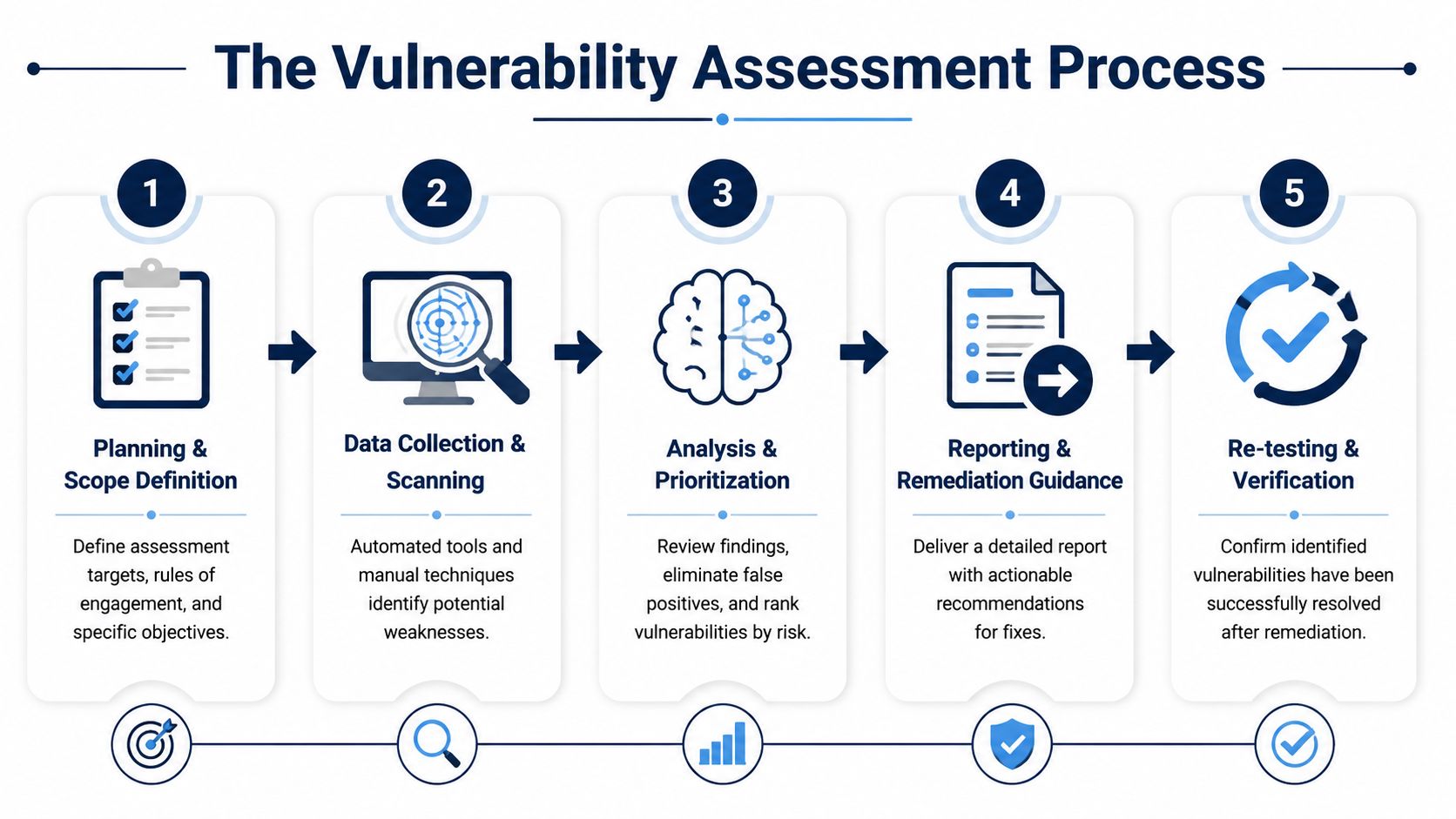
A good engagement is structured, scoped, and tied to business risk. For healthcare clinics, credit unions, insurance brokers, and other regulated mid-sized organisations, that matters more than buying the biggest toolset. You need a model that fits your environment, supports compliance work, and does not waste budget on low-value coverage.
Scoping
Start with decisions, not tools. Define what is in scope, which systems hold sensitive data, what downtime limits exist, who approves testing, and which locations, cloud tenants, applications, and network ranges are included. If the scope is vague, the results will be vague too.
Scanning
Approved tools check the selected assets for known vulnerabilities, missing patches, exposed services, and insecure configurations. This stage is fast, but speed is not the point. Coverage is.
Validation
Raw scanner output is not a decision-ready risk list. Someone has to review duplicates, remove false positives, confirm which findings are real, and add business context. This is the stage that separates a useful assessment from a noisy report.
Reporting and remediation planning
The provider should organise findings by business impact, affected systems, urgency, and fix path. Leadership needs to see which issues create compliance exposure and operational risk. IT needs clear remediation steps, ownership, and target dates.
Retesting
Fixes need verification. If a provider does not include retesting or a defined validation step after remediation, you are paying for detection without closure.
Buy a remediation process, not a scanner run.
A phased model is usually the right call.
Start with the systems that would create the biggest legal, operational, or reputational problem if compromised. That usually means internet-facing assets, remote access services, cloud administration paths, core servers, and any application that touches patient data or financial records.
Then widen the scope in planned waves. This keeps cost under control and gives small IT teams a realistic remediation load. It also aligns better with compliance programmes that need steady evidence of risk management instead of one oversized annual exercise.
A practical first engagement often includes these elements:
If you are comparing this work with a broader review of policies, controls, and governance, this guide to computer security audits for business risk and compliance reviews helps clarify the difference.
A vulnerability assessment report should help leaders decide and help technicians act. If it only does one of those jobs, it's weak.
The executive summary should be short and direct. It should explain where the major exposures sit, what business systems are affected, what needs attention first, and where compliance or operational risk is highest.
You don't need every technical detail in this section. You need a clear answer to questions like these:
If your report opens with pages of scanner output, it's written for machines, not decision-makers.
The technical section has a different job. It should list each vulnerability, affected assets, severity, evidence, likely cause, and recommended remediation steps. Such assignments include patching, configuration changes, segmentation, software updates, and control improvements.
A useful report also distinguishes between urgent action and scheduled maintenance. Not every item deserves the same response.
Decision cue: Critical and high-risk findings should trigger owner assignment and dates immediately. Lower-risk findings should still be tracked, but they shouldn't derail operational work.
Risk scores are meant to support judgement, not replace it. A technical score may indicate severity, but your business context determines priority.
For example, a weakness on a public-facing patient booking portal may deserve faster action than a similar weakness on an isolated internal test machine. Sensitive data, internet exposure, and operational dependence all matter.
Look for these report qualities:
| Report element | Why it matters |
|---|---|
| Executive summary | Helps leadership allocate budget and urgency |
| Technical evidence | Gives IT enough detail to reproduce and fix the issue |
| Risk ranking | Supports prioritisation |
| Remediation guidance | Turns findings into action |
| Retest status | Confirms whether the risk is actually reduced |
The best report is not the longest one. It's the one your team can use within the same week it arrives.
A clinic fails a vendor security review. A finance firm gets tougher questions from its cyber insurer. In both cases, the problem is the same. They treated vulnerability assessment as a technical task instead of a business control.
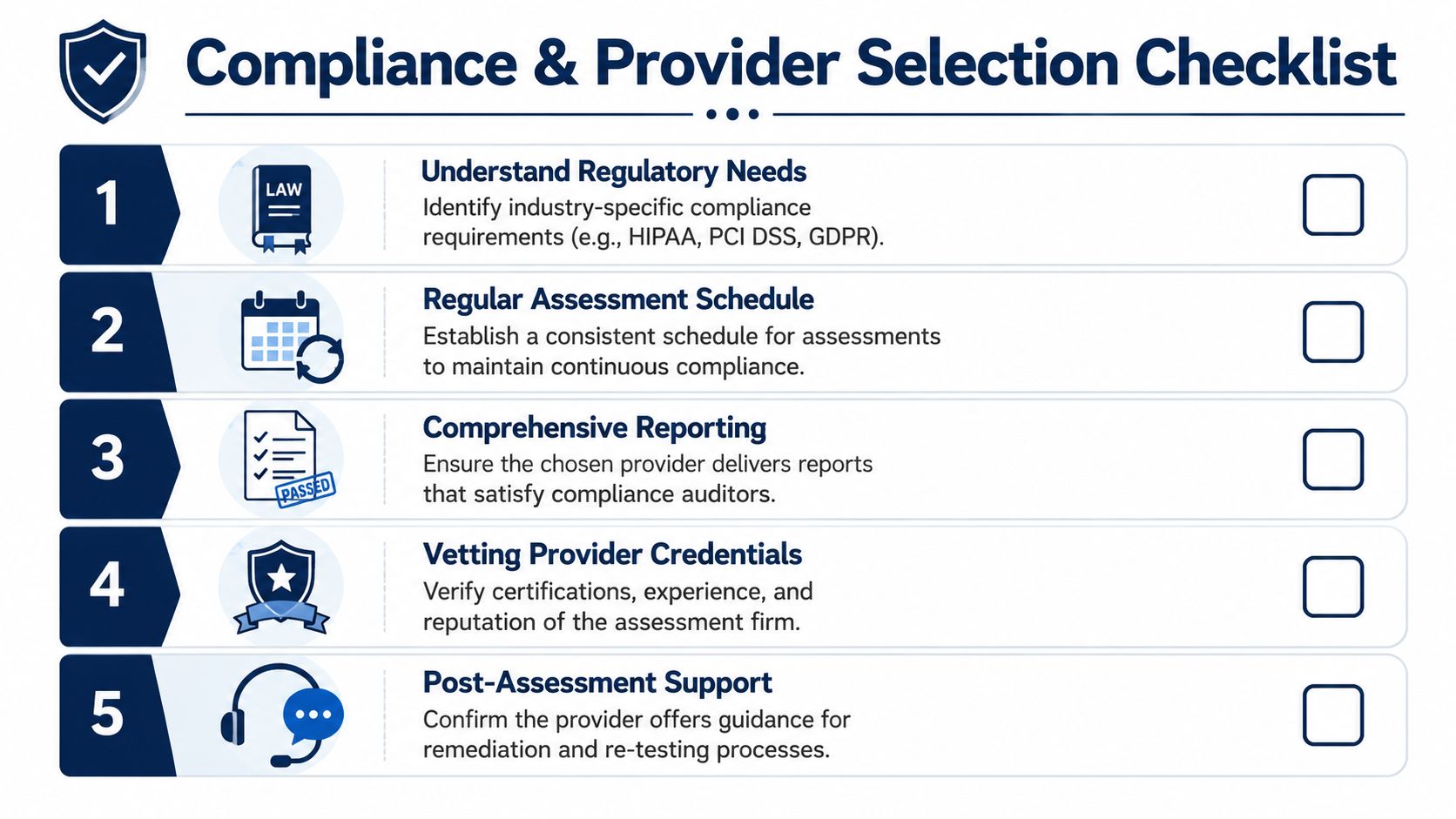
For Canadian SMBs in healthcare and finance, compliance is often the trigger that gets leadership to fund the work. Use that pressure properly. A good assessment program supports audit preparation, insurer reviews, client due diligence, and internal risk decisions at the same time.
The Government of Canada's Guideline on Vulnerability Management expects departments to perform external vulnerability scanning and sets firm remediation expectations for high-risk issues (Government of Canada vulnerability management guideline). Even if your business is not a federal department, the logic applies. Internet-facing weaknesses need a defined review cycle, owners, and deadlines.
For regulated SMBs, provider choice matters as much as the scan itself. You do not need an oversized enterprise program built for thousands of assets across global business units. You need a model that fits a Canadian clinic, credit union, accounting firm, or wealth practice with limited internal security staff, a clear compliance burden, and no room for vague reporting.
Start with four screening questions.
Many Canadian SMBs overspend by buying either a cheap scan with no interpretation or a security package designed for large enterprises. Neither serves a regulated business well. A better option is a right-sized provider that can assess a limited asset set, explain business impact clearly, and keep documentation ready for audits and client questionnaires.
CloudOrbis Inc. is one example of a Canada-based provider that includes vulnerability assessments within broader managed security support for SMBs. If you are comparing firms, review what a cybersecurity services company should cover before you sign anything.
Ask for a sample report. Ask how re-testing works. Ask where evidence is stored, how long it is retained, and who owns follow-up after the findings are delivered.
Those questions matter more than a polished sales deck.
If your leadership team is formalising oversight and approval paths, this article on Applying IT governance in the UK offers useful perspective on governance structures that support repeatable security decisions.
A clinic manager learns about a missed software patch only after a patient portal outage. A finance firm finds an exposed remote access path during a client security review. Both problems were preventable. Both become expensive once they disrupt operations, trigger reporting duties, or delay client trust.
That is the business case for vulnerability assessment services. You get a clear view of risk, a fix-first plan, and documentation that supports audits, insurance reviews, and customer due diligence.
For Canadian SMBs in regulated industries, the smart move is a right-sized assessment model. Start with the systems that create compliance exposure and business interruption, then expand as your inventory and obligations grow.
Assess internet-facing systems, staff endpoints, Microsoft 365 access paths, and patient-facing portals first. Require remediation timelines that match the severity of each finding, plus evidence your team can retain for privacy and compliance discussions. If your clinic depends on a small IT team or outsourced support, choose a provider that can retest fixes and keep reporting simple.
Focus on document portals, email dependencies, privileged accounts, and systems that store client financial or legal records. Your assessment should map technical findings to confidentiality risk, access control gaps, and likely business impact. If a report cannot help you answer a client questionnaire or regulator request, it is not good enough.
Review external access, site-to-site connections, servers tied to operations, and cloud platforms that support scheduling or inventory. Rank fixes by downtime risk and the chance of lateral movement into operational systems. A low-cost scan that ignores operational context will miss what matters.
If you need ongoing coverage instead of a one-time project, ask for a managed service priced by asset count, scope, and reporting cadence. Canadian SMBs usually get better value from a focused recurring program than from a large enterprise package with features they will not use. For pricing benchmarks, compare providers against current managed security market listings such as Clutch's managed security service provider directory.
Start small if you need to. Start now either way.
Security maturity comes from knowing what is exposed, what matters most to the business, and what gets fixed first.
If you want a practical assessment plan that fits your environment, compliance obligations, and budget, talk to CloudOrbis Inc.. The right engagement should give you a clear scope, a usable report, and a remediation path your team can execute.
September 26, 2026
On-Premise to Cloud Migration Checklist: 10 StepsUse this on-premise to cloud migration checklist to plan assessment, compliance, backups, sequencing, testing, cutover, and optimization for SMBs.
Read Full Post
September 25, 2026
Is VoIP Good for Small Business in Canada? a 2026 GuideIs VoIP good for small business in Canada? Explore costs, benefits, reliability, security, and migration tips for SMBs considering VoIP in 2026.
Read Full Post
September 24, 2026
Helpdesk vs Service Desk: Choosing the Right IT SupportHelpdesk vs service desk: understand the key differences and choose the right IT support model for your organization in 2026.
Read Full Post
