

September 24, 2026
Helpdesk vs Service Desk: Choosing the Right IT SupportHelpdesk vs service desk: understand the key differences and choose the right IT support model for your organization in 2026.
Read Full Post%20(1).webp)
Usman Malik
Chief Executive Officer
August 10, 2026
The board asks a simple question in a difficult moment. Are we in control of cyber risk, or are we hoping the next vendor outage, ransomware event, or audit request doesn't expose a weak spot? For many Canadian leaders, that question lands right after a client due diligence package, an insurer questionnaire, or a board meeting that wants evidence instead of reassurance.
That's where NIST Cybersecurity Framework 2.0 earns attention. It gives executives a shared language for cyber risk, one that turns scattered controls into a business-led programme with clear ownership, clearer priorities, and a repeatable way to show progress. For teams trying to connect governance, suppliers, and day-to-day security work, it's far more useful than a pile of disconnected best practices. If you're comparing cyber risk to broader business controls, this overview of understanding cyber threats is a helpful companion read, and it pairs well with a practical risk management framework.

A lot of organisations still treat cybersecurity like an IT maintenance issue. That approach breaks down the moment a director asks who owns third-party risk, how the company knows its backups will work, or what evidence proves the security programme is aligned to business priorities. The conversation has moved because the risk has moved.
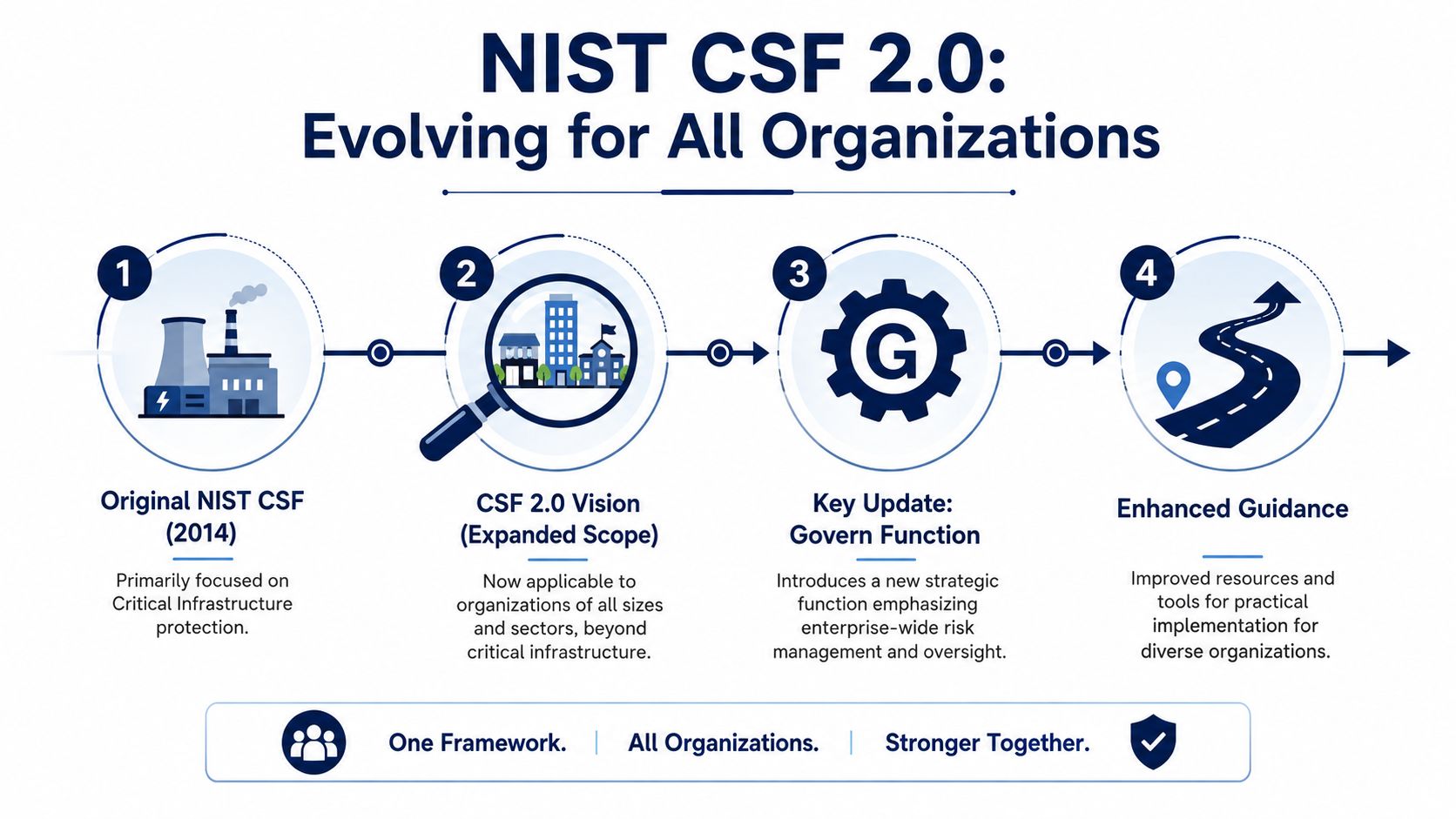
NIST CSF 2.0 fits that shift. NIST released the final version on February 26, 2024, and the update expands the framework beyond critical infrastructure to organisations of all sizes and sectors while adding Govern as a sixth core function and sharpening the focus on supply-chain risk management (NIST CSF 2.0 final release). For Canadian organisations that rely on MSPs, SaaS, Microsoft 365, and cross-border service chains, that matters because cyber decisions are no longer isolated IT choices. They're governance decisions.
A practical way to think about it is this, CSF 2.0 acts like a better operating blueprint. The old habit was to bolt on security tools and hope the whole structure held. The newer approach asks a simpler question first, what is the target posture, who is accountable, and how do we prove the gaps are being closed? That's a much better fit for boards, insurers, and regulated clients who want evidence, not vague confidence.
A Canadian SMB in a regulated sector does not need another abstract framework. It needs a way to decide what to fix first, who owns the decision, and how to show auditors, clients, and insurers that the work is being managed, not improvised. That is the core value of NIST Cybersecurity Framework 2.0.
The biggest shift is that NIST made the framework broad enough to fit outside critical infrastructure, so mid-sized healthcare groups, accounting firms, manufacturers, and logistics providers can use the same risk language as larger enterprises. That matters because many SMBs have spent years translating older framework language into their own operational reality. CSF 2.0 reduces that friction and makes the conversation with leadership more direct (NIST CSF 2.0 final release).
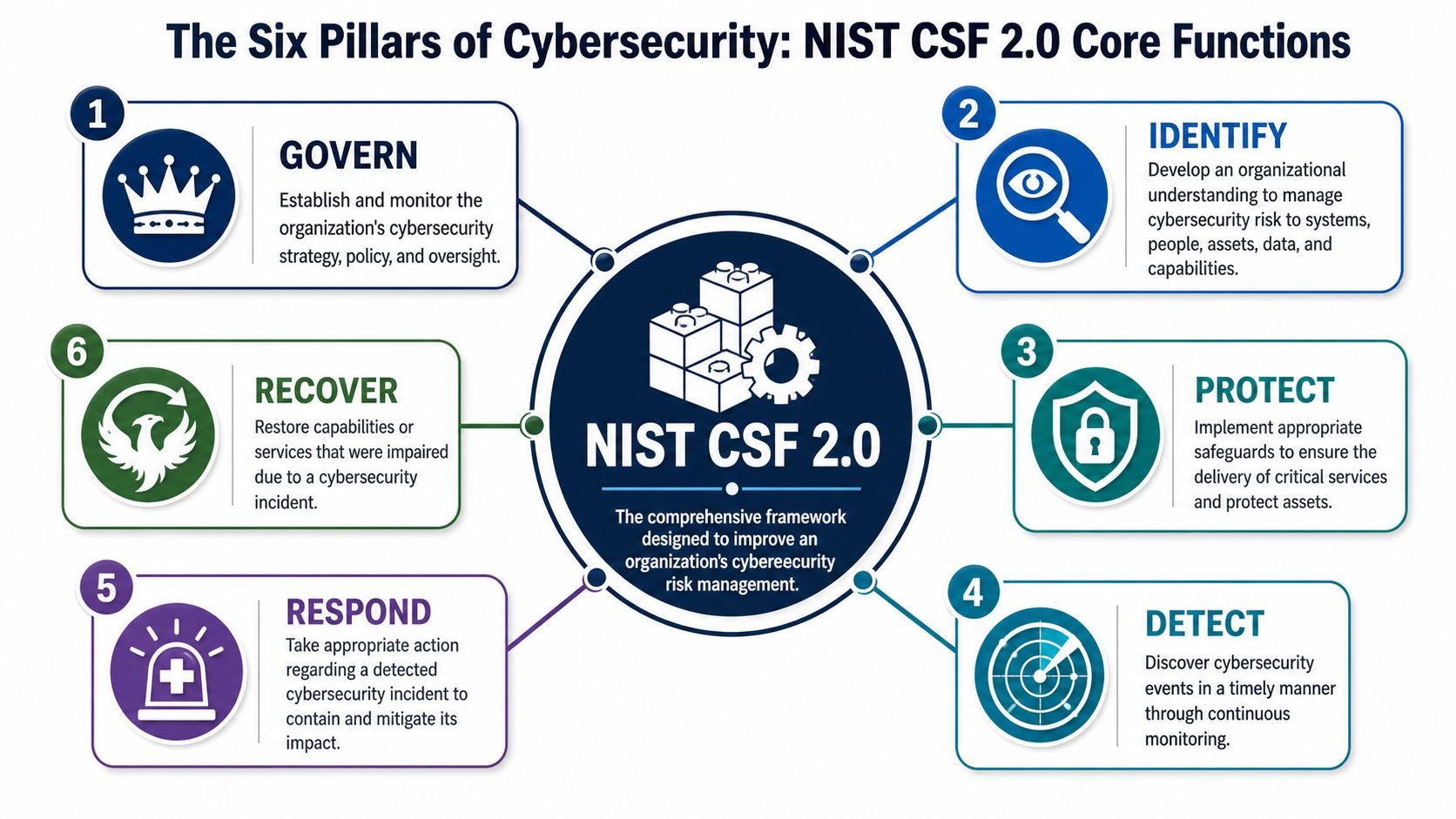
The framework is now built around six Functions, Govern, Identify, Protect, Detect, Respond, Recover, and NIST describes the Core as a hierarchy of Functions, Categories, and Subcategories that is sector-, country-, and technology-neutral (NIST CSF 2.0 guidance). For a busy executive team, that means the framework can be used to compare the current security posture with the target posture, then close the gap in a controlled order. That is a better planning model than buying tools one at a time and hoping the pieces add up.
For Canadian organisations, the update also fits how risk is managed in practice. Healthcare, legal, finance, manufacturing, and public sector teams need one structure that connects cyber controls to board oversight, procurement decisions, and legal obligations. CSF 2.0 gives them that common structure without forcing the same tool stack or maturity level on everyone.
Practical rule: if a framework cannot help you explain risk to a board member in plain language, it will stay too abstract to drive real decisions.
The reference materials are also useful because they go beyond broad theory. The CSF 2.0 reference mapping ties the framework to a substantial control set and shows how it can be connected to existing control families without turning into a loose checklist. That makes it easier to build an audit trail and a management report from the same model, while keeping the discussion tied to evidence instead of reassurance (CSF 2.0 reference mapping).
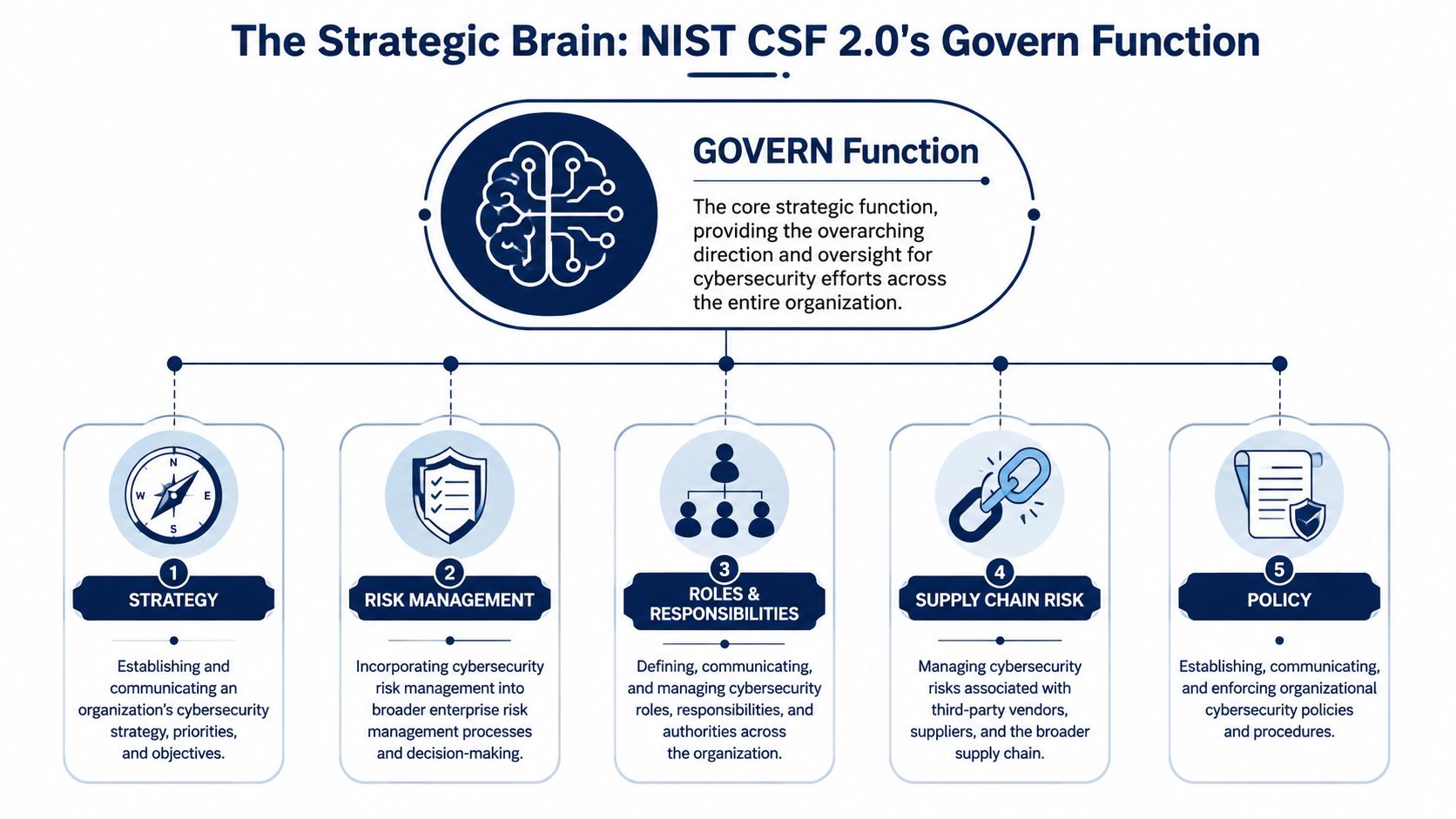
A Canadian healthcare provider can have strong endpoint tools, clean policies, and a decent incident response plan, yet still carry serious cyber risk if no one owns the decisions. That is the gap Govern fills in CSF 2.0. It defines who is accountable, how strategy is set, how risk is tracked, and how escalation works when business pressure collides with security reality.
NIST treats Govern as the layer that sets and monitors cybersecurity risk strategy. In practical terms, that means leadership defines the current and target Organizational Profiles first, then uses the gap between them to decide where to spend time and money. That order matters because Canadian SMBs in regulated sectors rarely have the budget to fix everything at once, and they cannot afford to buy controls without a clear priority.
A board does not need packet-level detail. It needs clear answers to a short list of business questions. Who owns the cyber program, who approves exceptions, and who reports risk? Which policies govern acceptable use, access, vendor onboarding, and incident handling? How does cyber risk appear in enterprise reporting, not just IT updates? How are vendors ranked, reviewed, and monitored over time? What evidence shows the controls are reducing exposure?
Those questions matter even more when third-party services are part of daily operations. A supplier breach, a weak contract clause, or an unreviewed cloud service can create the same business disruption as a direct attack, sometimes faster. Governance is where those supply chain risks get assigned, tracked, and challenged instead of being left inside procurement paperwork.
That is also why the governance discussion works best when it connects cyber, legal, procurement, and operations. Regulated organisations need one model that shows who accepts risk, who signs off on exceptions, and how issues move to senior leadership. If your organisation is also formalising broader technology oversight, a practical AI governance framework can sit alongside CSF 2.0 and help keep decisions consistent without replacing cyber controls.
A Canadian SMB in a regulated sector can have decent policies and still miss the real risk. The problem is usually not a lack of effort, it is a lack of balance. The six Functions keep the cyber program tied to business reality, so leadership can see where governance is weak, where suppliers add exposure, and where the organisation needs to act first.
Govern sets direction and oversight. It answers who decides, who reviews exceptions, and how cyber risk is reported to management and the board.
Identify shows what you have, systems, data, people, and dependencies, so hidden exposure does not stay hidden in procurement files or shadow IT.
Protect puts safeguards in place, like access controls and awareness training, so routine threats do not become routine incidents.
Detect watches for signs of trouble early enough to matter, especially in supplier accounts, cloud activity, and other places attackers often blend in.
Respond contains the issue and limits damage when an incident occurs, which is where a clear threat detection and response plan stops confusion from turning into downtime.
Recover restores services and evidence after the disruption, so the business can prove what happened, get back to work, and close gaps before the next event.
Cybersecurity programmes fail most often when they overbuild prevention and underbuild detection and response. That leaves leaders with good-looking controls and weak incident outcomes.
For a non-technical executive, the test is simple. If one function is weak, the others carry more load. A strong Protect posture means little if the business cannot Detect a vendor compromise quickly or Recover from a ransomware event without improvising. The framework makes those trade-offs visible, which matters when a supplier issue, a system outage, or a regulatory review can affect operations at the same time.
If your team already has endpoint protection or backup tools, CSF 2.0 helps you judge whether those tools support the whole lifecycle. That matters more than chasing a perfect score in one area. A balanced programme beats a flashy one every time.
A roadmap starts with an honest view of the business, not a new stack of tools. For Canadian SMBs in regulated sectors, that means mapping where customer data lives, which services would stop operations if they failed, which suppliers touch those services, and what level of cyber risk leadership will accept. NIST's Organizational Profiles make that exercise practical for teams that need structure without adding bureaucracy (NIST CSF profiles guidance).
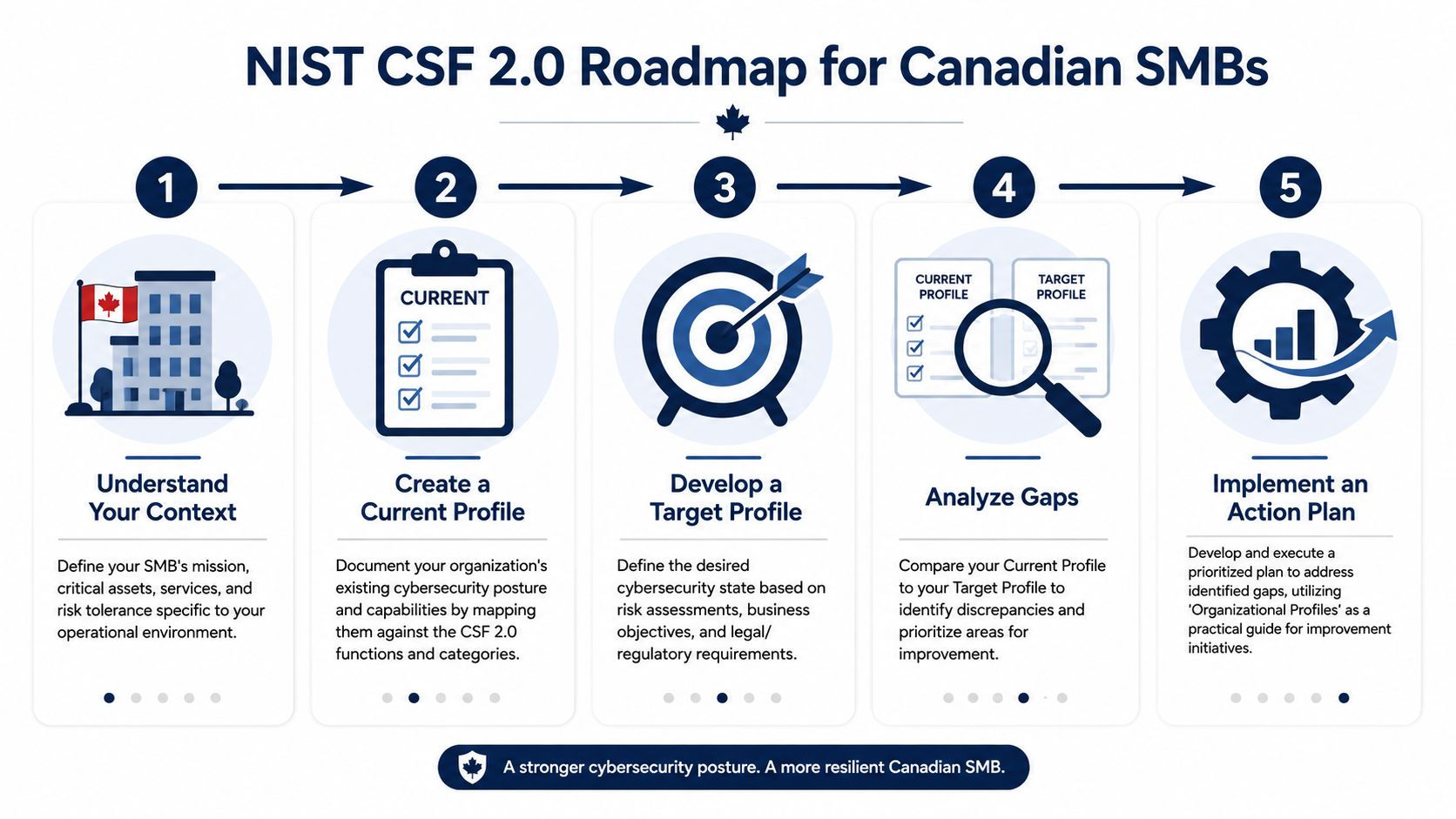
The first decision is what belongs in scope. Critical services, sensitive data, legal duties, vendor dependencies, and tolerance for downtime all need to be named up front. A manufacturer, a clinic, and a law firm will not have the same risk profile, and a generic plan usually leaves the highest-risk areas undercovered.
The next step is to document the Current Profile, the controls and practices the organisation runs today. Then define the Target Profile, which should reflect business goals, regulatory obligations, and a realistic view of risk appetite. The gap between those two profiles becomes the roadmap, and it shows where spending, process change, and leadership attention will matter most.
Good roadmap, bad roadmap: a good roadmap assigns ownership, sequence, and evidence. A bad one says “improve cybersecurity” and leaves the team to guess what that means.
NIST's guidance lays out an Organizational Profile cycle, scope, gather information, create the profile, analyse gaps and create an action plan, then implement and repeat (Organizational Profile cycle). That repetition matters because cyber risk changes as suppliers change, systems get replaced, and the business adds new services. A framework that is not revisited quickly turns into shelfware.
A useful action plan does not try to fix everything at once. It ranks gaps by business impact and exposure. If vendor oversight is the weakest point, start there. If incident response is undocumented, fix that before buying another preventative tool.
The sequence should also fit broader business change. A digital transformation roadmap treats security as part of the rollout plan, not as a separate cleanup project after the fact. That approach works for CSF 2.0 too, because leaders need evidence that the highest-risk gaps are being handled in order, not in random bursts when someone has time.
Different sectors adopt the same framework for different reasons. The common thread is that CSF 2.0 turns a vague security programme into a set of decisions that can be defended to clients, regulators, and insurers. The details change by industry, but the first priorities are usually very predictable.
Clinics, practices, and care groups care most about patient data protection, continuity, and vendor access. The strongest starting point is usually Protect, because access control, awareness training, and data handling discipline directly reduce the chance that sensitive records are exposed. Governance matters too, especially where service providers touch scheduling, billing, cloud storage, or backup systems.
For finance and accounting firms, the pressure usually comes from client trust, third-party services, and evidence requirements. CSF 2.0 helps leaders show that cyber risk is being managed as part of enterprise risk, not left to an overextended IT lead. The practical move is to connect policy, vendor review, and incident response to the same reporting rhythm the business already uses for operational risk.
Manufacturing teams tend to feel supply chain pressure first. Connected systems, MSP dependencies, and production uptime make Govern especially important because the business needs to know which vendors are critical, which controls are required before onboarding, and what happens if a supplier changes risk posture. The focus should be less on box-ticking and more on continuity across plants, systems, and service providers.
A key update in CSF 2.0 is the stronger emphasis on cybersecurity supply chain risk management within Govern. That gives Canadian SMBs that depend on MSPs, SaaS, and other suppliers a structured way to prioritise vendors, conduct due diligence, and reduce third-party risk (IBM CSF 2.0 summary). That's especially useful where one weak supplier can affect customer data, uptime, or compliance obligations across the whole business.
Most SMBs don't fail at cybersecurity because they don't care. They struggle because they're trying to build governance, controls, documentation, and monitoring while also running the business. CSF 2.0 helps, but it still needs disciplined execution, and that's where an experienced partner shortens the path.
A strong managed services provider can run the current-state assessment, help define the Current and Target Profiles, and turn gaps into a realistic roadmap. It can also support the operational work that follows, like policy updates, vendor review processes, evidence gathering, and ongoing reporting. That matters because the framework is only useful if it becomes part of management rhythm, not a once-a-year exercise.
For organisations looking to operationalise that work, a partner offering cyber security service can bridge the gap between strategy and execution. The right support keeps the programme moving, keeps leadership informed, and keeps the risk conversation grounded in business outcomes rather than technical noise.
If your organisation needs a practical way to turn NIST Cybersecurity Framework 2.0 into board-ready action, CloudOrbis Inc. can help you assess your current posture, build a clear roadmap, and strengthen governance around suppliers and critical systems. Visit CloudOrbis Inc. to start a conversation about aligning your cybersecurity programme with the way your business operates.
September 24, 2026
Helpdesk vs Service Desk: Choosing the Right IT SupportHelpdesk vs service desk: understand the key differences and choose the right IT support model for your organization in 2026.
Read Full Post
September 23, 2026
DDoS Protection for Canadian SMBs: What Works in 2026Learn what DDoS protection really does, the latest Canada-specific threats, and a practical playbook for small and mid-sized businesses
Read Full Post
September 22, 2026
Security Audit Services Guide for SMBs in CanadaDiscover why security audit services are vital for Canadian SMBs. Explore typical scope, deliverables, timelines, and tips to choose the right provider.
Read Full Post
