

September 17, 2026
Cloud Migration Roadmap Template That Prevents Costly ReworkGet a practical cloud migration roadmap template plus steps to customize it for assessment, waves, testing and cutover without budget surprises.
Read Full Post%20(1).webp)
Usman Malik
Chief Executive Officer
June 19, 2026
AI has already entered most mid-sized businesses, whether leadership approved it or not. A manager uses ChatGPT to draft a client email. Someone in finance drops spreadsheet content into a public tool to speed up analysis. Microsoft 365 rolls out a new Copilot feature, and staff start using it because it's built into the software they already know.
That doesn't mean your business is reckless. It means your business is normal.
The problem isn't that people want to work faster. The problem is that AI adoption often starts before rules, review, and ownership are in place. Teams move first. Governance follows later, if it follows at all. Businesses that already understand natural language processing can see why this happens so quickly. The tools feel familiar, useful, and low-friction.
An AI governance framework is how you regain control without shutting down progress. It gives your business a practical way to decide which AI uses are acceptable, which need review, who owns the risk, and how to keep data, security, and compliance under control. For Canadian SMBs, that matters because you likely don't have a dedicated AI office, a large legal team, or spare capacity to build bureaucracy for its own sake.
The first sign usually isn't dramatic. It's a small process shortcut.
A sales lead asks for better follow-up emails, and a rep starts using a public chatbot. HR wants help rewriting job descriptions and uses AI inside a browser extension. Operations discovers that a productivity suite now includes generative features and starts testing them on internal documents. None of this looks like a major transformation. Together, it creates one.
What makes unmanaged AI risky is that it spreads through ordinary work. Staff don't think they're launching a new technology program. They think they're saving time.
In practice, the biggest problems rarely begin with advanced machine learning projects. They begin with basic questions nobody answered:
Without those answers, businesses end up with inconsistent behaviour across departments. Marketing may use one standard, finance another, and operations no standard at all.
Unmanaged AI isn't just a technology issue. It's a decision-making issue that shows up in technology first.
Some leaders react by trying to block AI entirely. That feels safe, but it usually fails. Staff still find workarounds, vendors keep embedding AI into standard platforms, and the business misses useful gains.
A better approach is controlled adoption. Approve low-risk uses quickly. Review sensitive use cases more carefully. Put simple rules in place that people can follow. That's what an AI governance framework does when it's built for real operations instead of policy binders.
An AI governance framework sets the rules for how your business approves, uses, reviews, and retires AI tools. For a Canadian SMB, that means more than a policy statement. It means deciding who can use which tools, what data can be entered, when a use case needs review, and how decisions are recorded if a client, regulator, or insurer asks questions later.
AI adoption usually starts in small ways. A sales manager uses a meeting assistant. HR tests an AI writing tool. Finance turns on a new feature inside existing software. Governance brings those choices under one operating model so the business can move faster without losing control.
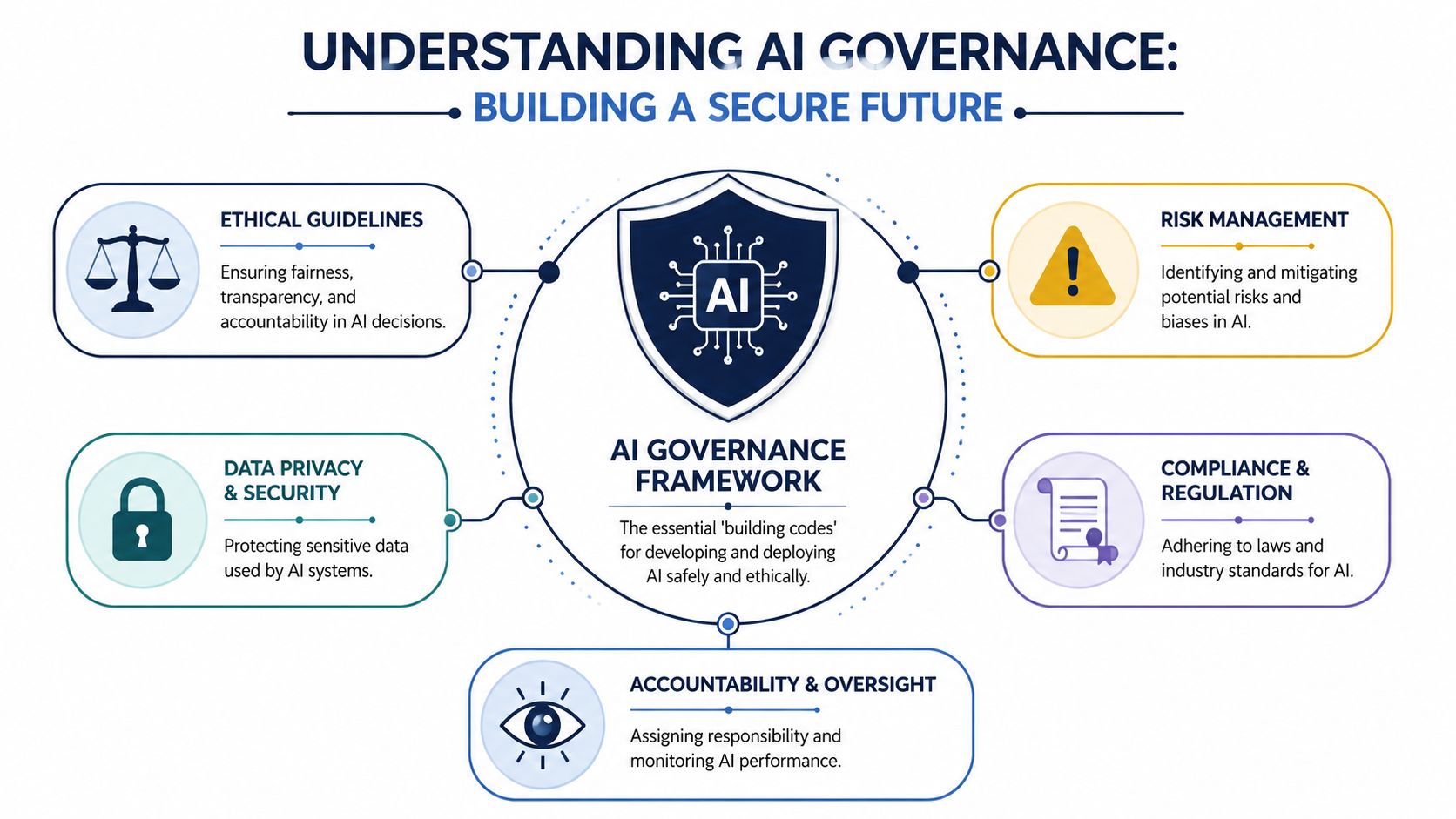
A policy on its own does very little. Staff need clear approval paths, IT needs visibility into what is being used, and leadership needs a way to judge whether a proposed use is low risk, sensitive, or off limits.
In practice, a workable framework combines people, processes, and technical controls. It covers the full lifecycle of AI use inside the company, from selecting tools and setting access rules to monitoring outputs and shutting a tool down if the risk changes. It should also connect to your broader data security management practices, because AI risk often starts with what employees paste, upload, or connect to a model.
For SMBs, the test is simple. Can managers and staff use it without waiting two weeks for an answer?
A useful framework answers questions like these:
Those are operational questions, not theory. If no one can answer them, the framework is still a draft.
Practical rule: If your framework does not assign ownership, set review steps, and create records, it is not ready for real use.
A mid-sized company does not need a large enterprise governance office to govern AI well. It needs clear accountabilities and a process people will follow. In many organizations, that means the business owner or executive sponsor sets risk tolerance, IT manages approved tools and access, department leaders approve routine use cases, and legal, privacy, or HR review the exceptions.
That structure is simpler than an enterprise model, but it is not weaker. It reflects the trade-off SMBs face. You need enough control to reduce privacy, security, compliance, and client risk, while keeping approvals fast enough that staff do not work around the rules.
Good governance gives the business a repeatable way to say yes, no, or not yet. That is what makes AI adoption safer and more useful.
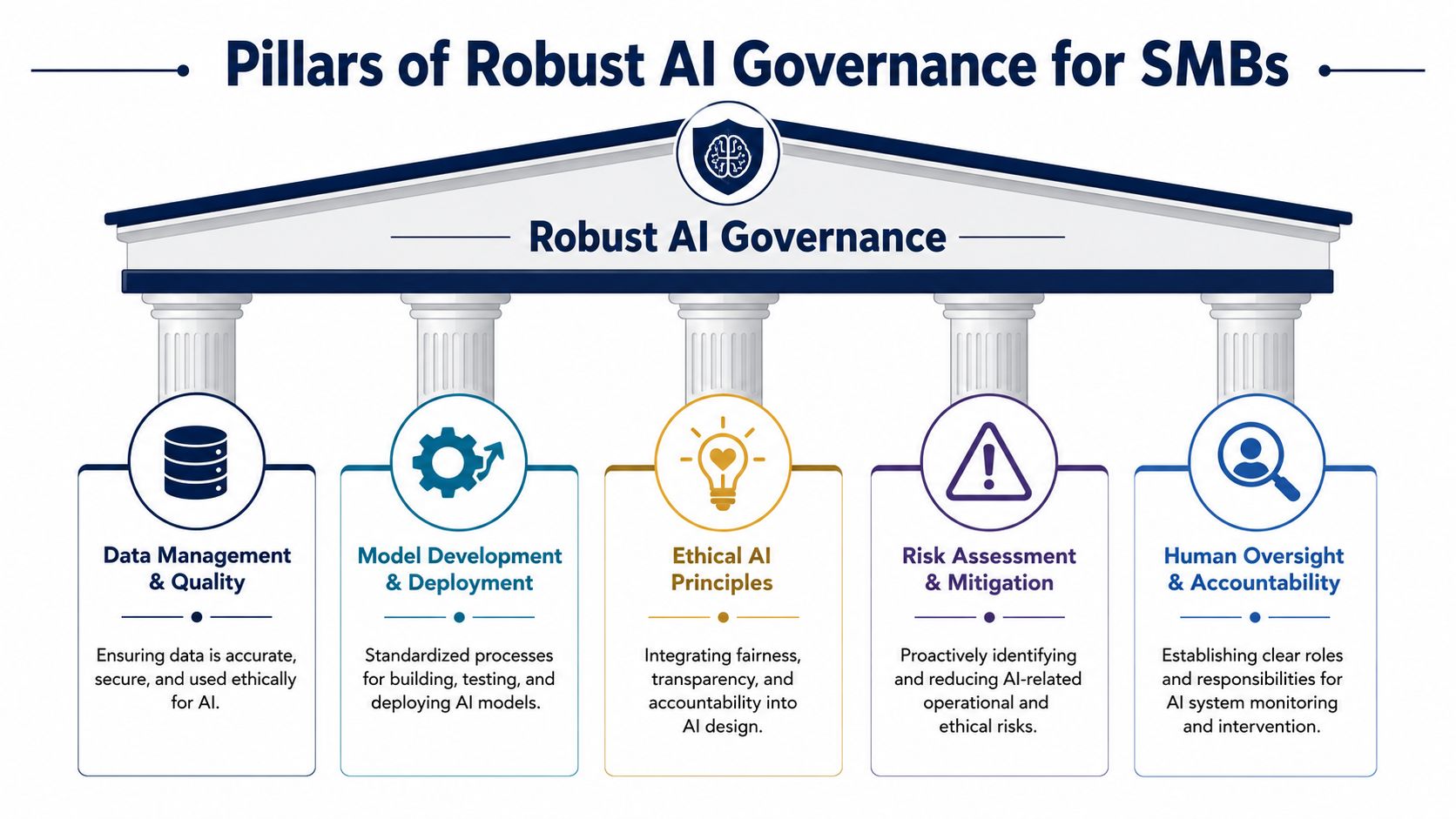
An effective AI governance framework holds up under day-to-day pressure. It gives your team a way to approve useful tools, limit predictable risk, and keep records that stand up when a client, regulator, or insurer asks questions.
For Canadian SMBs, the structure does not need to be complicated. It does need to cover the full operating picture. That usually includes policy, role clarity, risk rating, technical controls, and ongoing review. If one of those pieces is missing, problems show up fast. Staff start using public tools with business data, managers approve use cases without knowing the compliance impact, or a vendor changes a feature and no one notices until an output causes a client issue.
Start with the rules staff will use.
Your policy should state which AI tools are approved, what data can and cannot be entered, where human review is required, and when employees must escalate a use case before using it. Plain language matters here. If a sales manager, HR lead, or operations coordinator cannot read the policy once and understand the limits, the document will sit in a folder while staff make their own calls.
For most SMBs, the first version should stay tight. Cover approved tools, banned inputs, disclosure requirements for customer-facing content, and rules for decisions that affect hiring, pricing, service eligibility, or regulated records.
A workable framework answers the question SMB owners ask right away. Who does what on Monday morning?
Use a simple model that matches how the business already runs:
| Area | Primary owner | Typical responsibility |
|---|---|---|
| Tool approval | IT and business lead | Review platform fit and access needs |
| Privacy and compliance | Privacy, legal, or delegated lead | Check data handling and sector obligations |
| Security controls | IT or security provider | Manage access, logging, monitoring, and configuration |
| Business use case | Department owner | Confirm purpose, benefit, and operational impact |
| Exception handling | Executive sponsor | Resolve disputes and accept higher-risk decisions |
This is also the point where AI governance should connect to your broader data security management approach. If those efforts stay separate, teams end up with policy on one side and technical controls on the other, which is where gaps tend to appear.
Every AI use case should not go through the same approval path. That slows down low-risk work and gives high-risk work too little scrutiny.
A practical model uses a few clear risk tiers. An internal note-taking assistant sits in a different category than a tool used for hiring screening, financial recommendations, patient communication, or customer support responses sent without review. The goal is not perfect scoring. The goal is consistent decisions.
Rate each use case against a short set of factors:
That approach helps smaller organizations put effort where the business risk lies.
Approval is the start of governance, not the end of it.
AI tools change often. Vendors add new features, adjust model behavior, and expand data handling settings. Staff also find new uses that were never part of the original request. A framework stays effective only if it keeps working after a staffing change, a software update, or a rushed business request from a department head.
Monitoring should include:
For SMBs, that usually means assigning one owner to check approved tools on a set schedule, keeping a short exception log, and reviewing higher-risk use cases more often than routine internal ones. That is manageable, even with a lean team, and it is what turns governance from a policy document into an operating system.
Most SMBs don't fail because they disagree with governance. They fail because the first draft is too big to execute.
The practical burden often lands on smaller organizations that need clear guidance on training, escalation paths, and ongoing monitoring. Success is less about writing a perfect policy and more about creating repeatable operating processes that can survive staff turnover and model changes, especially with tools like Microsoft 365 Copilot, as explained in Washington University's overview of AI governance challenges and best practices.
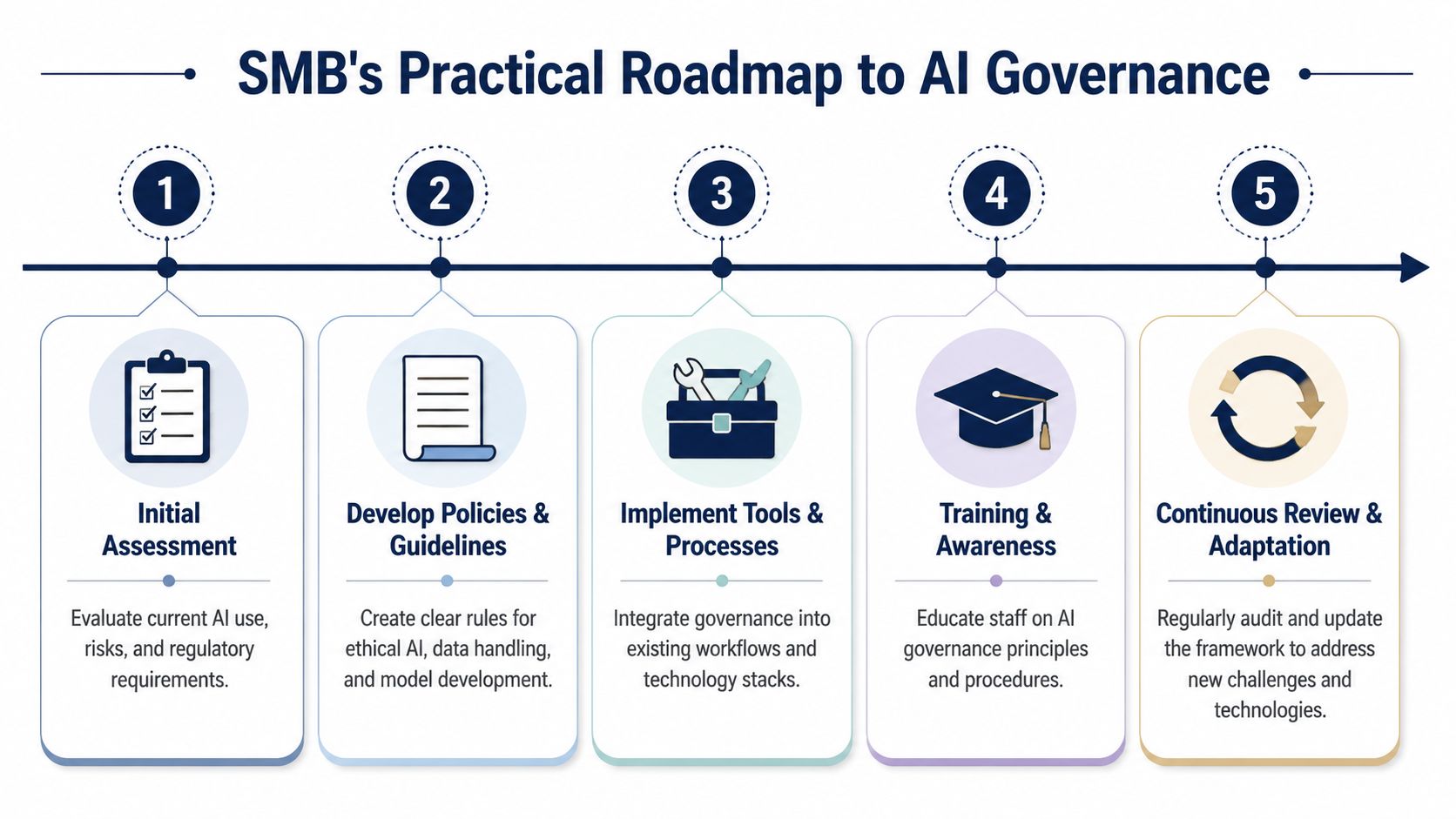
Before writing policy, find out what's already happening.
Ask department leaders which AI tools they're using, including embedded features in Microsoft 365, CRM systems, accounting platforms, design tools, and browser add-ons. Don't make this an audit trap. If staff think honesty leads to punishment, they'll hide usage.
Create a short inventory that captures:
You don't need a formal committee with ten stakeholders. Start with a compact working group that can make decisions.
For many businesses, that means:
If you already use a broader risk management framework, AI should plug into that process instead of becoming a parallel governance system.
Your first policy doesn't need to answer every edge case. It needs to answer the common ones well.
Focus on practical rules such as:
Most AI training fails because it stays abstract. Staff need examples tied to their jobs.
A finance team should know whether they can paste ledger data into an assistant. HR should know when AI-generated hiring content needs review. Customer-facing teams should know when disclosure or manual verification is required.
Good training answers, “What do I do on Tuesday morning?” Not, “What is responsible innovation?”
Once governance is live, keep the review process simple. Look at new tools, incidents, policy exceptions, and vendor feature changes. Update the framework when reality changes.
That cadence matters more than trying to create a flawless policy on day one.
A generic AI governance framework is a starting point, not the finish line. The controls that make sense for a healthcare clinic won't be identical to those for a manufacturer or a finance team.
Canada's federal AI governance foundation is the Directive on Automated Decision-Making, which took effect on April 1, 2019 and requires federal institutions using automated decision systems to complete an Algorithmic Impact Assessment, assign a risk level from I to IV, and apply stronger controls as risk rises. That model remains a useful reference point for regulated private-sector environments that need auditability and decision traceability, as described in this overview of Canadian AI governance foundations.
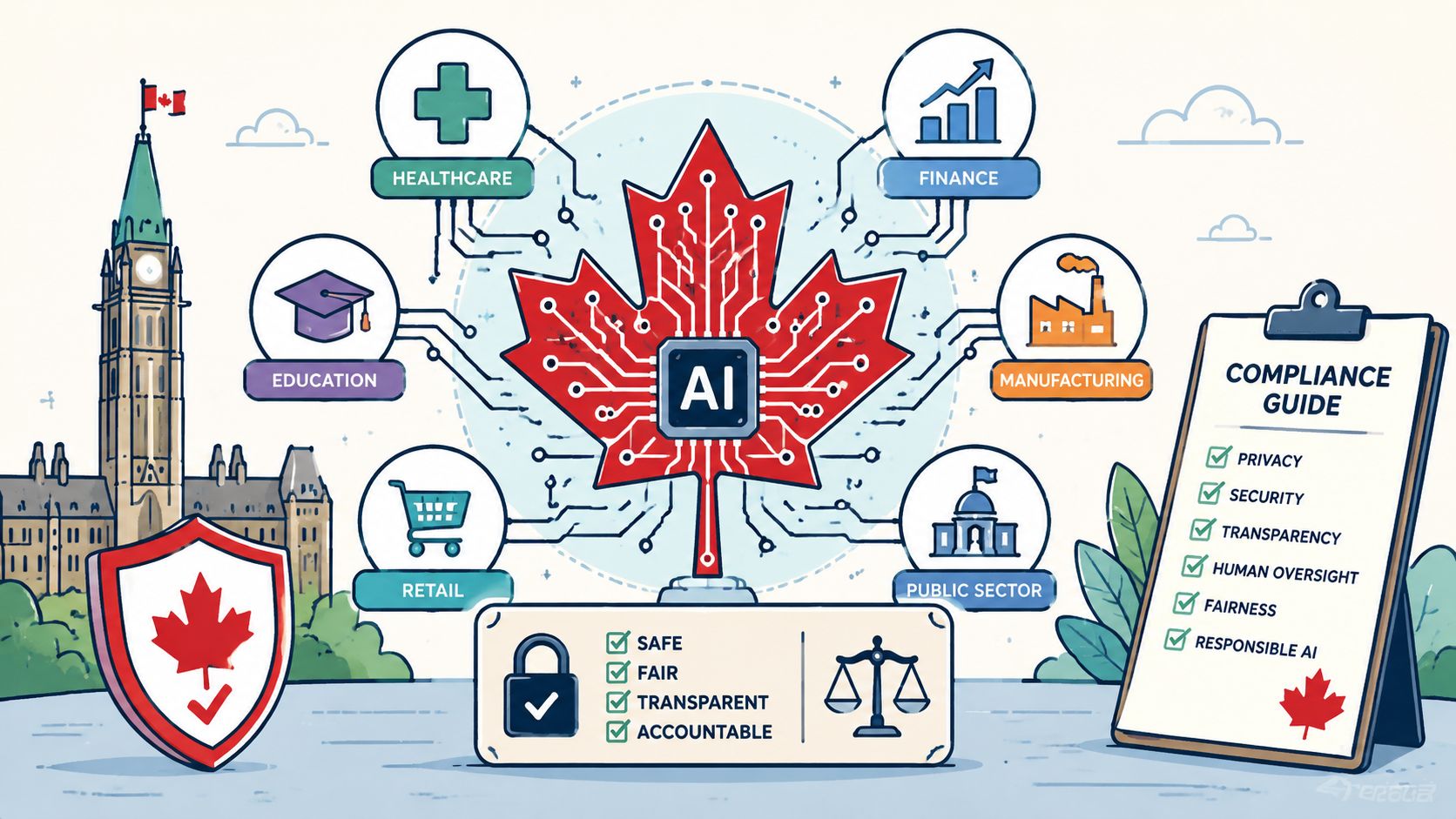
Here's how the same governance structure shifts by industry:
| Sector | Main AI concern | What governance should emphasize |
|---|---|---|
| Healthcare | Patient information and clinical impact | Strict data handling, human oversight, documented review |
| Finance | Decision fairness, explainability, client risk | Approval controls, traceability, escalation for sensitive outputs |
| Manufacturing | Operational reliability and proprietary data | Access control, system integrity, protection of internal process data |
Healthcare organizations need extra care when AI touches patient communications, records, triage support, or documentation workflows. The governance question isn't just whether the tool is useful. It's whether protected information is handled appropriately and whether a clinician remains accountable for important decisions.
If you're assessing AI in health-related workflows, a structured privacy impact assessment in Alberta can help shape the right review process.
In finance, accounting, and adjacent regulated functions, AI outputs often influence decisions that need to be explainable and defensible. Governance should focus on review steps, approval records, and clear limits on autonomous action.
Manufacturing firms often focus first on productivity, forecasting, maintenance, and process documentation. The key risk is usually less about public-facing bias and more about exposing proprietary operational data or relying on AI outputs in ways that affect uptime or safety.
The framework should reflect that reality. Same structure. Different emphasis.
Most mid-sized businesses don't need a full internal AI governance office. They need consistent execution.
That's where an external IT partner can help. Not by taking ownership away from leadership, but by making the framework workable. A good partner helps turn governance from a policy aspiration into an operating model with technical controls, review routines, and documented decisions.
An experienced managed provider can support the parts SMBs usually struggle to maintain:
For legal and compliance-heavy teams, it also helps to understand how specialized tools are emerging. This overview of AI tools for corporate lawyers is a useful example of why governance must address role-specific use cases, not just generic AI access.
A managed partner gives you access to strategy and execution without forcing you to build a large in-house function. That's especially valuable when your internal team is already busy with support, cybersecurity, vendor management, and day-to-day operations.
The right fit should help with:
If your business is already evaluating outside support, managed IT services in Canada can then become part of an AI governance strategy rather than a separate procurement decision.
Strong governance doesn't require a large internal team. It requires clear ownership, reliable controls, and someone making sure the process actually runs.
The businesses that benefit most from AI won't be the ones that move recklessly. They'll be the ones that create enough structure to move with confidence.
That's the value of an AI governance framework. It helps your team adopt useful tools faster because the decision path is clear. Staff know what's approved. Leaders know what needs review. IT knows where to apply controls. Compliance and security aren't left trying to catch up after deployment.
For Canadian SMBs, the goal isn't to copy a large enterprise program. It's to build a right-sized framework that matches your data, your industry, and your internal capacity. Start with the tools already in use. Assign owners. Define approval rules. Train people on real scenarios. Review the framework regularly and improve it as adoption grows.
AI doesn't need less governance because it's new. It needs better governance because it's already woven into everyday work.
If AI is showing up faster than your policies, controls, and review processes can keep up, CloudOrbis Inc. can help you build a practical governance approach that fits your business. From strategy and risk review to secure Microsoft 365 configuration, monitoring, and ongoing support, the right plan can make AI adoption safer, faster, and easier to manage.
September 17, 2026
Cloud Migration Roadmap Template That Prevents Costly ReworkGet a practical cloud migration roadmap template plus steps to customize it for assessment, waves, testing and cutover without budget surprises.
Read Full Post
September 16, 2026
How to Send Secure Email in Outlook Made SimpleLearn how to send secure email in Outlook with encryption, S/MIME and compliance tips for Canadian businesses. Step-by-step guide inside.
Read Full Post
September 15, 2026
Why Managed IT Services Matter for Canadian SMBsDiscover why managed IT services are a smart move for Canadian SMBs. Learn the benefits, real ROI, and how to choose the right provider.
Read Full Post
