

September 15, 2026
Why Managed IT Services Matter for Canadian SMBsDiscover why managed IT services are a smart move for Canadian SMBs. Learn the benefits, real ROI, and how to choose the right provider.
Read Full Post%20(1).webp)
Usman Malik
Chief Executive Officer
June 17, 2026
Every mid-sized organisation has this problem, even if it doesn't call it by name. Staff spend their day inside email threads, support tickets, contracts, intake forms, meeting notes, scanned PDFs, and compliance documents. The information is there, but it's trapped in language.
A clinic manager sees it in clinical notes that vary by provider. A legal office sees it in contract clauses buried in long documents. A finance team sees it in inboxes full of client requests, approvals, and exceptions. None of this looks like a traditional data issue, yet it slows decisions, creates rework, and increases compliance risk.
That's where natural language processing becomes practical. It gives software a way to work with human language so teams can classify, extract, summarise, route, and monitor information that used to require manual reading. For Canadian business leaders, especially in regulated sectors, the value isn't academic. It's fewer bottlenecks, cleaner audit trails, and more consistent handling of business-critical communication.
Consider a common operating pattern in a growing organisation. Customer issues arrive by email. Staff create tickets manually. Contracts go through shared folders. Notes from calls sit in Outlook, Microsoft Teams, or line-of-business systems. Important details exist, but they aren't structured in a way that systems can act on quickly.
That creates three business problems at once. Teams lose time hunting for information. Managers struggle to measure what's happening. Compliance leaders worry because important decisions are being made from inconsistent records.
A spreadsheet is easy for software to process because each value already sits in a defined field. Language doesn't work that way. People abbreviate, misspell, imply context, switch tone, and write the same request in many different ways.
An accounts message might say “need this approved today”. A support ticket might say “system is down again”. A clinician might use shorthand that makes sense to peers but not to a generic software tool. Humans infer the meaning quickly. Systems need help.
Practical rule: If your process depends on staff reading text and deciding what to do next, natural language processing is probably relevant.
The opportunity isn't “using AI” for its own sake. It's turning language-heavy workflows into more consistent operational steps.
That can mean:
For many Canadian SMBs, this is the first useful lens for natural language processing. It's not a moonshot. It's a way to make existing work easier to run, easier to govern, and easier to improve.
Natural language processing, often shortened to NLP, is the branch of computing focused on helping systems work with human language. That includes text and speech, but its underlying objective is more profound. The system has to identify what matters in the language, connect it to context, and trigger a useful action or insight.
A simple way to think about it is this. NLP teaches computers to read for purpose, not just to store words. If a person reads “Please cancel tomorrow's appointment and reschedule next week,” they know this is a service request with a date dependency. An NLP-enabled system aims to detect the same intent.
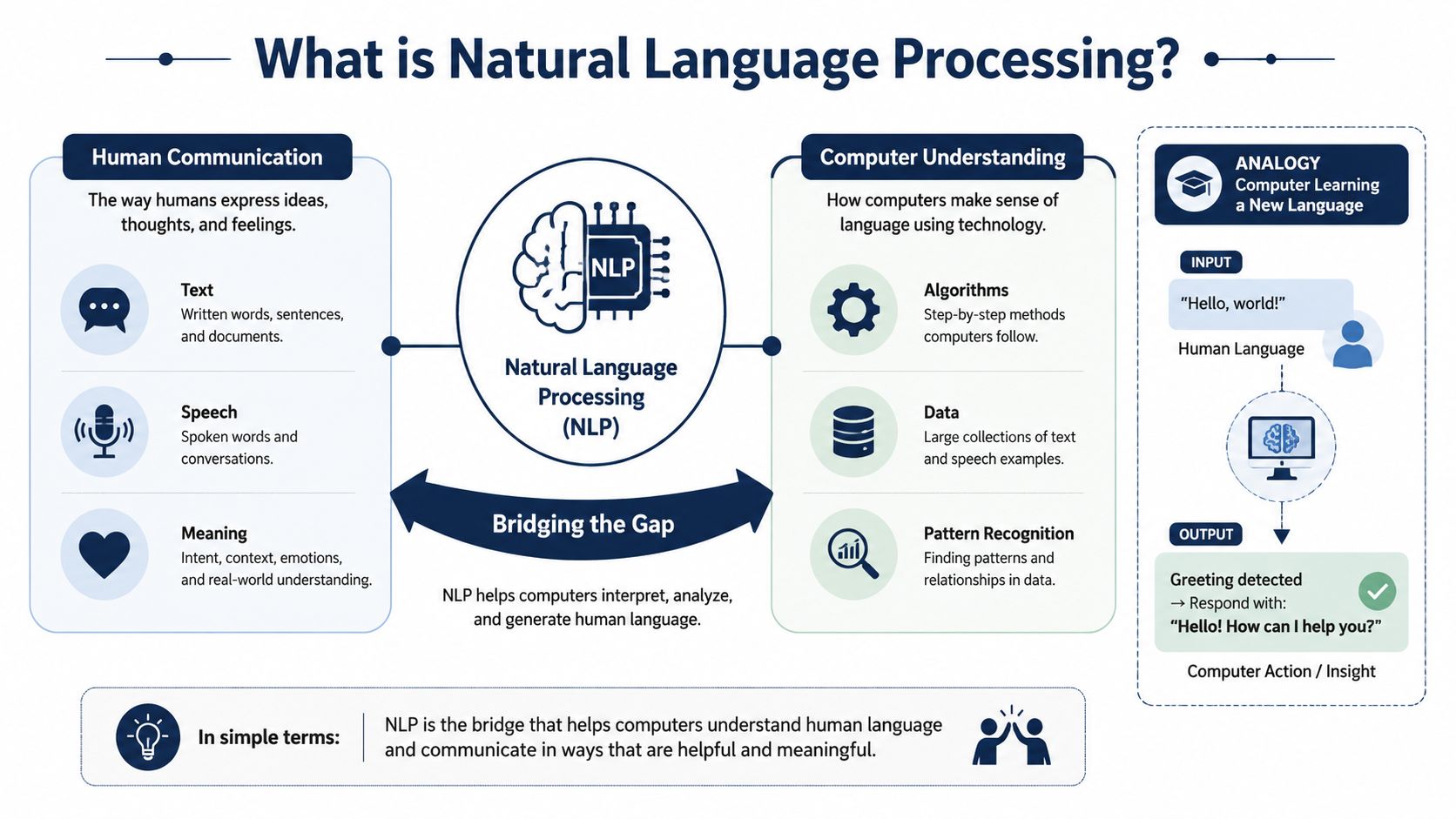
Business conversations often blur AI, machine learning, large language models, and natural language processing into one category. They overlap, but they aren't identical.
A practical distinction helps:
| Term | What it means in plain language | Business example |
|---|---|---|
| Artificial intelligence | The broad field of systems performing tasks associated with human judgement | A tool that recommends next actions |
| Machine learning | Systems learning patterns from data | A classifier that learns which tickets are urgent |
| Natural language processing | Systems working specifically with text or speech | Extracting obligations from contracts |
| Large language models | Modern language systems that can generate and interpret language across many tasks | Drafting summaries from meeting notes |
If you want a plain-English companion resource on the key concepts of natural language processing, that overview is useful for readers who want a second explanation from a different angle.
NLP has been developing for decades. A foundational milestone came in 1950, when Alan Turing published “Computing Machinery and Intelligence,” introducing the imitation game later known as the Turing test. In 1957, Noam Chomsky's Syntactic Structures influenced early rule-based approaches, and a 1964 U.S. National Research Council review through ALPAC became a major checkpoint in the field's development. By the 1990s, NLP shifted from hand-written rules toward statistical methods, and by the 2010s deep learning and later transformer-based models became dominant, as outlined in this historical review of NLP milestones.
That matters for business leaders because today's tools didn't appear overnight. They sit on more than 70 years of progress, which is one reason platforms like Microsoft Copilot feel approachable to non-technical teams. If your organisation is already exploring Microsoft's ecosystem, this practical guide on how to use Microsoft Copilot helps connect the concept to everyday work.
Natural language processing isn't software “understanding” language the way a person does. It's software finding enough structure and context in language to do useful work reliably.
Most leaders don't need to know the mathematics behind NLP. They do need to understand why some implementations work well and others disappoint. In practice, success often comes down to whether the organisation prepared its language data properly before asking a model to perform.
Computers don't receive language the way people do. They need the input broken down and normalised.
That usually begins with tokenization, which means splitting text into smaller units such as words, subwords, or sentences. Then come steps like stemming or lemmatization, which reduce words to a simpler base form, and stop-word removal, which strips out common words when they aren't helpful for the task.
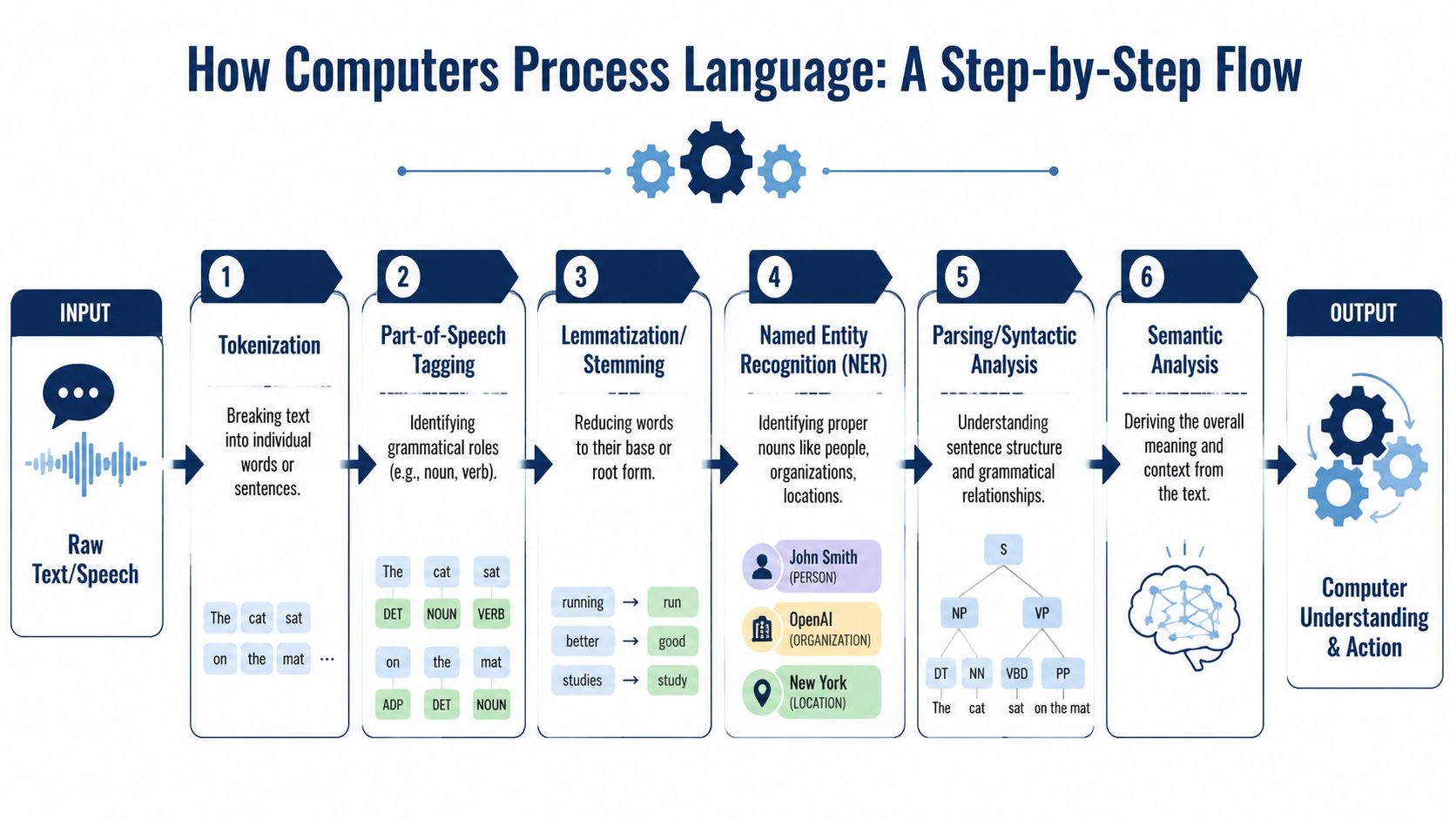
For Canadian organisations, this preprocessing work matters more than many buyers expect. Guidance on NLP preprocessing and text normalization notes that tokenization, stemming or lemmatization, stop-word removal, and text cleaning materially improve downstream model performance because they reduce sparsity and convert raw language into machine-usable features. It also notes that for organisations in places like Ontario or Alberta working with support tickets or clinical notes, the highest ROI usually comes from building a preprocessing pipeline before model selection.
Once the text is cleaned, the system needs ways to represent meaning. Older approaches often used Bag-of-Words or TF-IDF, which convert text into numerical features based on word presence and importance. These methods are still useful for targeted business tasks.
Newer systems use embeddings, which you can think of as a language map. Words or phrases with related meanings sit closer together in that map. That's how a system can learn that “invoice issue” and “billing problem” are related even when they use different wording.
Here's where people often get confused. The system isn't memorising language like a glossary. It's learning patterns of association from lots of examples.
Traditional NLP often handled language in smaller fragments. Modern architectures, especially transformers, are much better at considering context across a sentence, paragraph, or longer document. That's why current systems can do a stronger job with summarisation, classification, extraction, and question answering.
A short example makes this clear:
A context-aware model is more likely to connect “she” back to the patient and understand that the issue relates to a prescription workflow, not just generic dissatisfaction.
Leaders often focus first on the model brand. That's understandable, but it's usually the wrong first question. A stronger question is whether your data is ready for the task.
Use this sequence instead:
If your teams are already trying to pull insight from operational data, this overview of data management and analytics services is a useful complement because language processing is only one part of a broader data strategy.
The best NLP projects usually look boring at the start. They begin with data cleanup, workflow mapping, and a narrow business goal.
The most useful NLP applications aren't generic chatbots. They solve a narrow workflow problem where language creates friction, delay, or risk.
In healthcare, NLP is increasingly used for automated structuring of clinical notes, digital scribing, and disease detection, according to a 2022 review of clinical NLP applications. The same review makes an important point. These are narrow, task-specific deployments, not broad conversational tools trying to do everything.
That distinction matters. A clinic doesn't need an all-purpose language system first. It may need a tool that structures free-text notes into searchable records, flags missing documentation elements, or supports more consistent summaries for downstream review.
The operational value is straightforward:
Legal and finance teams deal with language that carries obligations, exceptions, timelines, and risk. NLP can help identify key clauses, classify documents, detect recurring terms, and route files for the right type of review.
This doesn't replace legal judgement. It supports it.
A practical deployment might flag indemnity language, payment terms, renewal wording, or approval triggers so staff start from a prioritised review queue rather than a blank page. That can improve consistency and reduce the chance that time-sensitive language gets missed in high-volume work.
Support teams are natural candidates for NLP because they already work with high volumes of text. Customer emails, chat messages, and ticket descriptions contain enough signal to route work more intelligently.
NLP can help with:
If your organisation is improving back-office processes more broadly, these workflow automation tools for business operations pair well with NLP because language-based classification is often the trigger that starts the workflow.
One of the most underused use cases is extracting insight from communication that already exists. Leadership teams often commission reports while sitting on a large store of untapped language data in surveys, service notes, complaint logs, and internal updates.
NLP can help surface patterns such as recurring service obstacles, common request types, supplier issues, or training gaps. This is especially useful when problems show up in narrative text long before they appear in a dashboard.
If staff keep saying the same thing in different words, NLP can help you find the pattern before it becomes a bigger operational issue.
The key is to pick a use case where a language bottleneck already exists. That's where business value shows up fastest.
Natural language processing projects fail less often because the model was weak and more often because governance was weak. Teams connect a tool to sensitive text, skip validation, and assume the output is “smart enough.” In regulated environments, that's a risky way to operate.
Language systems are only as useful as the data and workflow they sit inside. Before choosing a platform, decide what content the system will process, who owns that data, how it will be reviewed, and what action the output is allowed to trigger.
This matters in sectors dealing with personal health information, legal records, financial correspondence, or internal HR content. The language itself is often the sensitive asset.
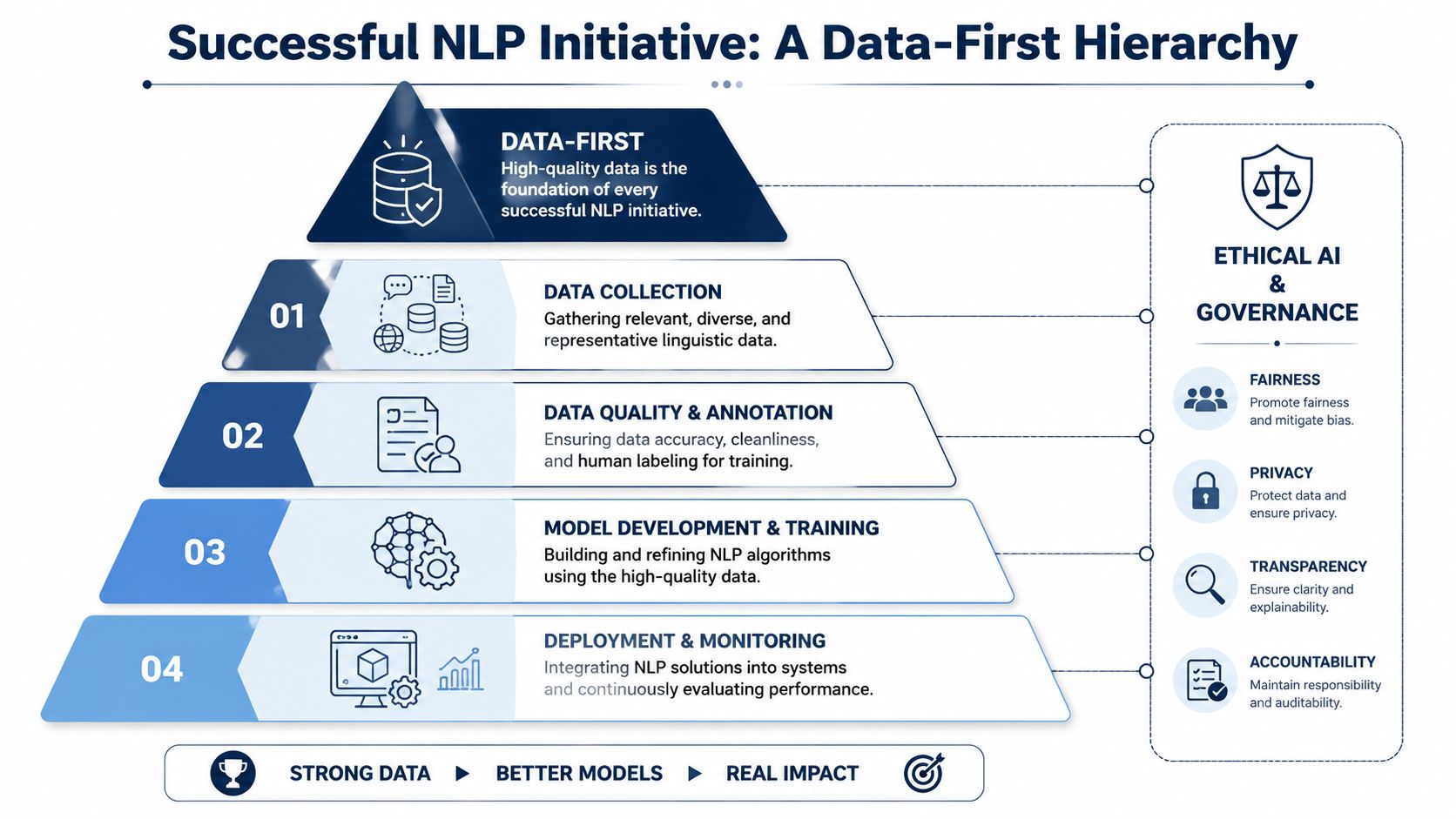
A sound NLP initiative needs clear controls, not just technical enthusiasm.
| Governance area | What to decide |
|---|---|
| Data access | Who can submit, view, and export processed text |
| Retention | How long source content and outputs should be kept |
| Auditability | How you'll trace why the system produced a result |
| Human review | Which outputs require validation before action |
| Vendor boundaries | What data leaves your environment and under what terms |
For Canadian organisations, privacy review can't be an afterthought. Teams should assess how proposed NLP workflows align with internal privacy obligations and sector-specific requirements, making a structured process such as a privacy impact assessment in Alberta highly relevant, especially when new tooling touches sensitive or regulated information.
Many NLP discussions focus on average accuracy. That sounds sensible until you remember where operational problems happen. They happen in unusual requests, ambiguous wording, accented speech, shorthand, and language variation.
Stanford Human-Centered AI notes in its work on equity across English dialects in NLP that NLP systems show observable performance drops across English dialects. For Canadian organisations, that's not a niche concern. It affects multilingual workplaces, public-facing services, and any environment where language variety is normal.
Buy for the edge case, not just the demo. The common case is rarely where compliance or service risk appears.
For most SMBs, the safest approach is staged adoption:
Natural language processing can improve efficiency and compliance, but only when organisations treat it as part of business operations, not just as a software feature.
Once the use case is clear, most leaders face the same decision. Should we build our own solution, buy an existing product, or combine platforms with outside expertise?
Building from scratch gives the most control. You can tailor workflows, tune prompts or models, define custom taxonomies, and integrate fully with your systems.
But it also demands the most from the organisation. You need data engineering, architecture, testing discipline, security controls, and ongoing monitoring. For most mid-sized businesses, that's too much overhead unless NLP is central to the business model.
Buying an off-the-shelf platform is usually the fastest route. This includes SaaS tools focused on contract review, service automation, transcription, document intelligence, and productivity platforms like Microsoft 365 Copilot.
The trade-off is flexibility. Prebuilt tools often work well for common workflows, but they may struggle with your exact terminology, governance requirements, or integration needs. In regulated settings, a primary challenge isn't merely whether the model can respond. IBM notes in its overview of how NLP supports enterprise communication workflows that the main bottleneck is often turning high-volume unstructured communications into structured, auditable signals, especially in healthcare, legal, and finance.
For many Canadian SMBs, the best path is hybrid. Use established platforms where they fit, then add configuration, workflow design, governance, and integration around them.
That approach often works better because the hard part isn't inventing language technology from zero. It's connecting the right tool to your actual process in a way that staff can trust and leadership can govern.
A simple comparison helps:
If your organisation is weighing those trade-offs in the broader IT context, this guide to choosing an IT consultant company is useful because NLP decisions often sit inside larger questions about architecture, risk, support, and long-term ownership.
Most organisations don't need an enterprise-wide NLP strategy on day one. They need one solid operational win.
Start with a language-heavy process that already causes delay, inconsistency, or manual effort. Good candidates include triaging service requests, structuring notes, extracting fields from documents, or reviewing recurring communications for compliance signals.
Use this list to ground the decision:
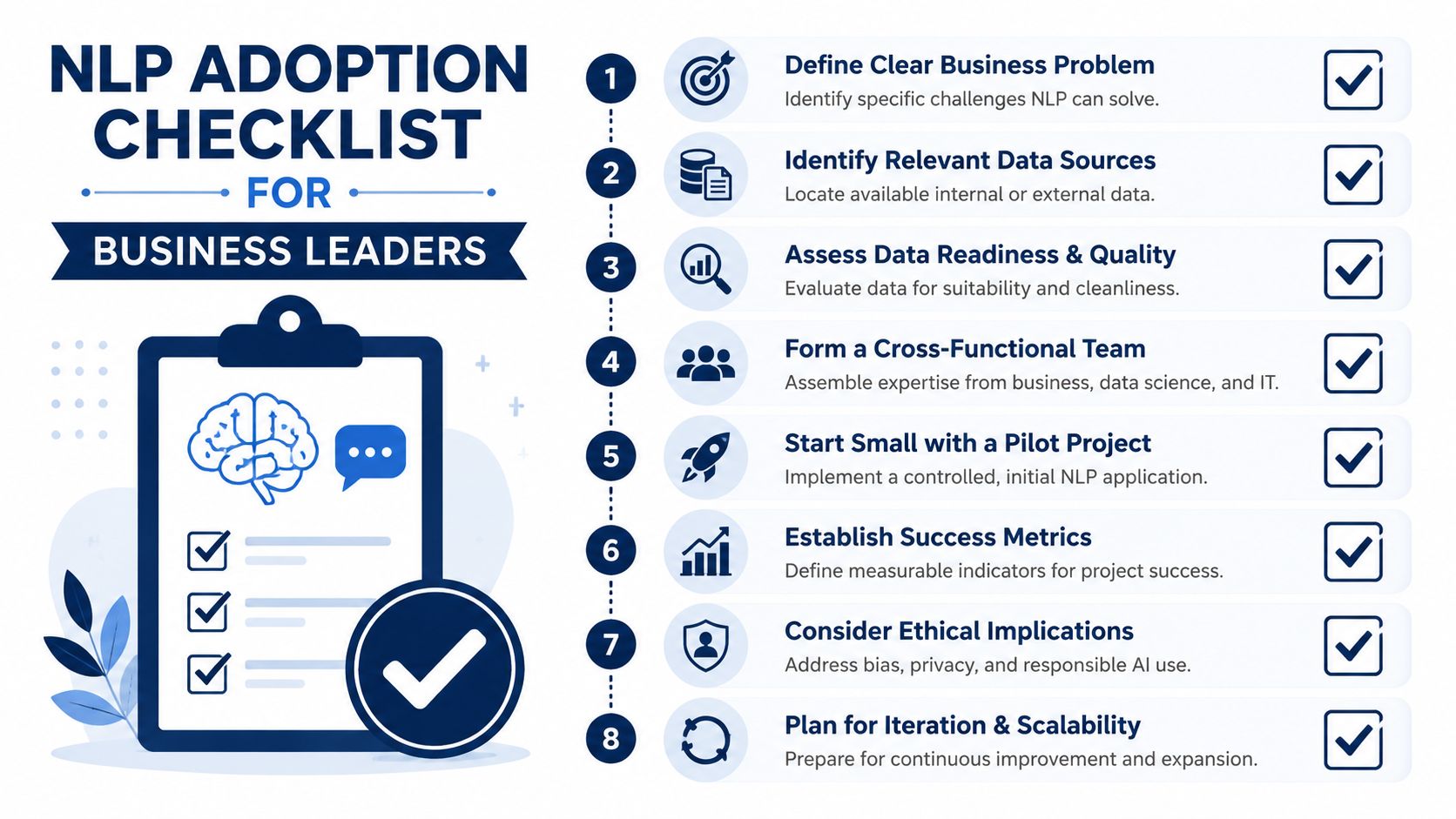
A strong NLP rollout feels controlled. The team knows what problem it's solving, what data it's using, and where human judgement still applies. That's especially important in healthcare, legal, and finance, where the cost of a bad assumption can be far higher than the cost of moving a bit slower at the start.
Natural language processing is no longer reserved for large enterprises or research labs. Used well, it helps mid-sized organisations turn text-heavy work into structured action. That means better efficiency, clearer oversight, and a stronger foundation for compliance.
If your team is evaluating language-heavy workflows and wants a practical roadmap, CloudOrbis Inc. can help you assess fit, governance, integration options, and rollout priorities for a secure, business-ready NLP strategy.
September 15, 2026
Why Managed IT Services Matter for Canadian SMBsDiscover why managed IT services are a smart move for Canadian SMBs. Learn the benefits, real ROI, and how to choose the right provider.
Read Full Post
September 14, 2026
Vulnerability Management vs Vulnerability AssessmentVulnerability management vs vulnerability assessment explained for Canadian SMBs. Compare scope, process, tools, and how to choose the right approach.
Read Full PostSeptember 13, 2026
Third-Party Risk Management for Canadian SMBsMaster third-party risk management for your Canadian SMB. Learn OSFI compliance, vendor monitoring frameworks, and how to secure your supply chain.
Read Full Post
