
September 15, 2026
Why Managed IT Services Matter for Canadian SMBsDiscover why managed IT services are a smart move for Canadian SMBs. Learn the benefits, real ROI, and how to choose the right provider.
Read Full Post%20(1).webp)
Usman Malik
Chief Executive Officer
August 1, 2026

You're probably living the same Calgary energy reality many operators are living right now. The field keeps moving, the wells still need attention, compliance doesn't pause, and the old SCADA or engineering stack that used to feel “good enough” now creates more friction than value. In that environment, the winning firms aren't the loudest growers, they're the ones that can keep crews connected, data clean, and systems resilient while everyone else is fighting outages and patchwork tools.
The calgary oil and gas industry still matters because it shapes who gets hired, which vendors stay busy, and which firms can keep margin when the cycle tightens. Calgary's advantage is no longer just location or legacy. It's the city's role as the operating and decision-making centre for a sector that is becoming more automated, more data-driven, and less forgiving of weak IT.
A Calgary operations manager is usually juggling three things at once, wells, compliance, and an aging digital stack that was never built for today's pace. One vendor needs secure file access, another needs remote visibility into a site, and the office wants clean reporting that matches what's happening in the field. If that sounds familiar, it's because the pressure point is no longer just production, it's coordination.
The local ecosystem is still large enough to matter, and that size creates opportunity for smaller firms that can move quickly. Calgary's own labour split shows the region had about 34,200 workers in oil and gas extraction and 18,500 in support activities in the Calgary CMA in Q3 2024, roughly 52,700 jobs directly tied to extraction and support functions, even after a 2.3% year-over-year contraction in extraction employment and a 1.8% increase in support activities (KiTalent). That mix tells you the market still depends on upstream activity, but it also rewards engineering, service, and operational support.
Mid-sized vendors don't win by matching the majors on scale. They win by being easier to do business with, faster to mobilise, and more reliable when sites are remote and time-sensitive. That means the differentiator is often your back office, not your equipment yard.
Practical rule: if your crews, sales team, and field systems can't share one trusted view of work, you're already paying for it through rework and delayed decisions.
For Calgary SMBs, IT stops being support and becomes part of the operating model. Firms that want to stay useful to producers, engineers, and field operators need stronger cybersecurity, better cloud discipline, and partner support that can handle the gaps an internal team can't cover alone. If you want a broader view of how the city's tech ecosystem is shaping that market, the overview at CloudOrbis on tech companies in Calgary is a useful companion read.
The numbers still justify attention, but they also explain why the sector is under pressure to become leaner. Alberta's oil and gas industry averaged about 6.7 million barrels of oil equivalent per day in 2024, a new record and more than 50% above 2010 levels (Canada Action). The province also accounted for about 75% of Canada's total oil and gas production on a BOE basis, which is why Calgary remains tightly linked to the national energy economy.
That scale is matched by economic weight. Alberta's oil and gas production generated $153 billion in total revenue in 2024, and the sector contributed $88 billion to provincial GDP, equal to 25% of Alberta's total economic output (Canada Action). Those are not abstract figures for a Calgary SMB. They translate into contracts, purchasing cycles, engineering work, maintenance demand, and a steady need for reliable vendors who can keep operating when prices, staffing, and project timing all shift.
The headcount story matters just as much as the production story. Alberta's oil sands facts page says the province's oil sands contain about 158.9 billion barrels of proven reserves, rank fourth in the world for proven oil reserves, and employed about 138,000 people in Alberta's upstream energy sector in 2022 (Alberta Oil Sands Facts). The federal Energy Fact Book also says Canada is the fourth-largest producer of crude oil and fifth-largest producer of natural gas globally, and that 97% of Canada's proven oil reserves are located in the oil sands (Natural Resources Canada).
Those facts point to a clear reality. Calgary isn't just serving producers, it's serving a supply chain with enough depth to support engineering firms, contractors, logistics providers, and specialised service companies. For SMBs, that means the competition is about responsiveness and resilience, not just technical ability.
If your company works anywhere in that chain, the question is simple, can your systems support fewer people doing more coordination, with less downtime and less manual chasing? That is why the cloud, remote access, and managed services conversation has shifted from convenience to competitiveness. A useful reference point for how that operating model stretches across energy work is Blue Gas Express energy operations, especially if you're mapping your own role in the chain.
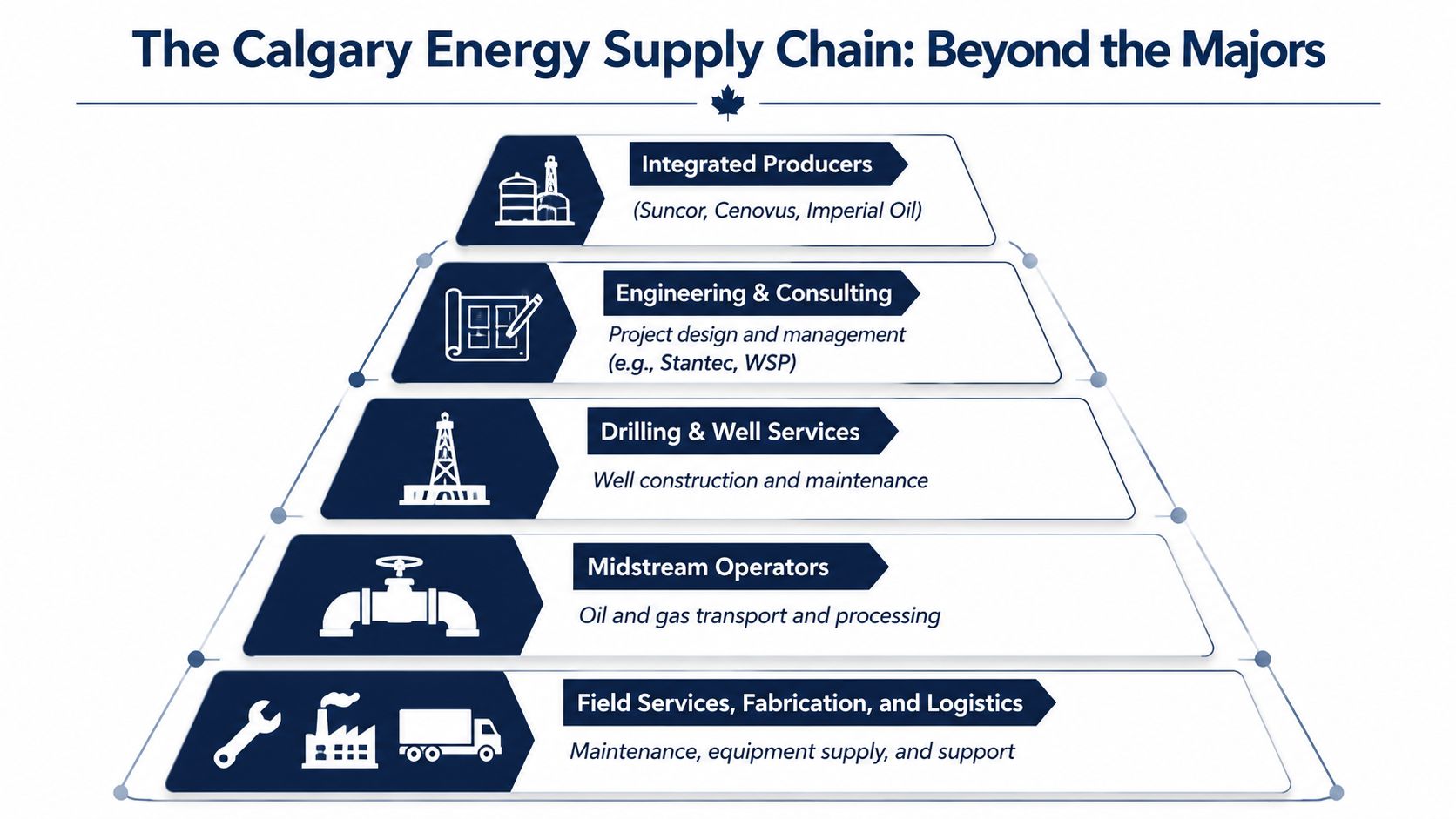
Calgary's energy ecosystem starts with the majors, but most SMBs feel the work through the layers below them. Integrated producers set the pace, engineering firms shape project plans, drilling contractors execute the work, midstream operators move and process volumes, and field-service vendors keep everything running when conditions get messy. If you sell into the sector, your customer is rarely just one company, it's a chain of handoffs.
The cleanest way to think about the market is in four steps. Producers define the asset and production goals. Engineering and consulting firms turn those goals into designs, permits, and project plans. Drilling, well services, and midstream operators make the assets functional. Field services, fabrication, and logistics keep the physical work moving and the equipment usable.
That flow matters because the IT decision often sits at the point where office work meets field execution. The engineering team needs collaboration tools, the service crew needs secure mobile access, and the operations lead needs reliable data from the edge back to headquarters. If those pieces aren't aligned, work slows down even when the field is ready.
The firms closest to the majors often have the strictest security and reporting requirements, even if they're small. That's why a service company with 40 people can need more mature IT controls than a much larger business in another industry. The issue isn't headcount, it's exposure.
The company that can prove control of its work, its data, and its devices is usually the one that gets invited back.
If you're mapping your own place in the chain, use that to decide whether your technology investments belong in operations, in customer delivery, or in compliance readiness. The clearer you are about where you sit, the easier it is to stop wasting money on tools that don't support your actual role. For firms trying to align process, handoffs, and support functions, manufacturing IT with Sheridan Technologies is a useful adjacent example of how operational IT gets structured around production realities.
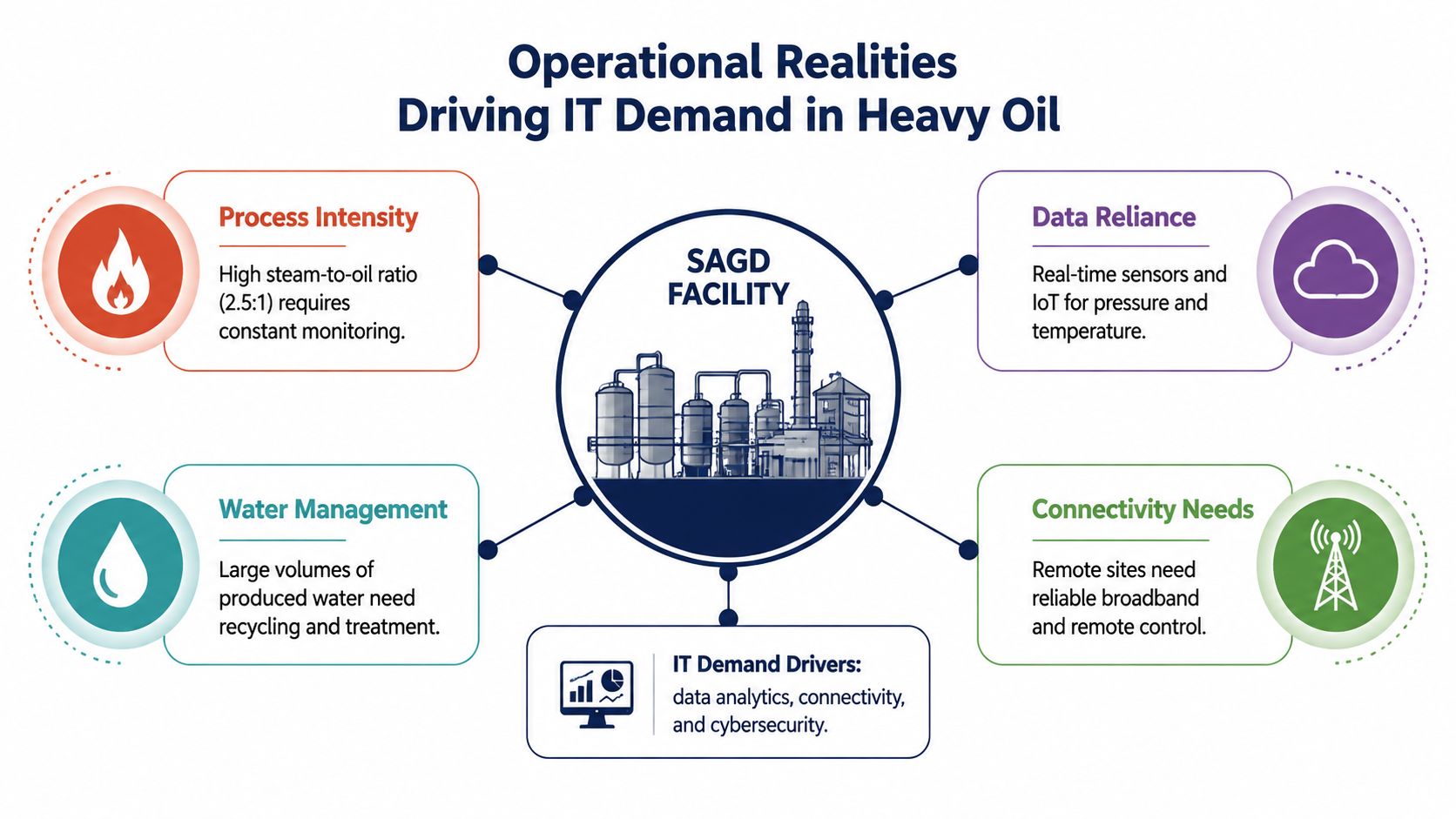
Heavy oil and SAGD work don't just create engineering complexity, they create digital complexity. A Calgary-linked University of Calgary and Enbridge presentation says CSS and SAGD commonly exceed 7 GJ per cubic metre of oil, consume about 0.2 m³ of water per cubic metre of oil after roughly 95% recycling, and emit about 0.5 to 2 tCO2e per cubic metre of oil (University of Calgary presentation). That kind of process intensity leaves no room for sloppy data handling.
When operations are that energy-intensive, a missed reading or delayed alert isn't a minor inconvenience. It can affect heat balance, water treatment, emissions tracking, and maintenance scheduling all at once. That's why remote monitoring, edge computing, and dependable integration between field sensors and corporate systems matter so much.
The trap is assuming another device or sensor will solve the problem. It won't, unless someone has already built the network, data model, and alert path that makes the new signal useful. In practice, the highest-value work is often boring work, stable connectivity, accurate tagging, disciplined device management, and clean handoff into reporting systems.
Alberta Innovates says routine venting could account for 2.8 Mt and methane slip from fuel and flaring for 3.5 Mt in emissions sources that still lack sufficient policy tools and commercially mature mitigation pathways (Alberta Innovates). The same source notes that more than 60% of Alberta's 370,000 inactive wells lack emissions monitoring systems, which creates a real detection gap.
That gap changes the IT job. Operators need platforms that can surface exceptions, connect sensors to action, and keep records defensible. If you can't trust the signal, you can't trust the decision.
Good rule: if the field system can't get data back to the office in a way finance, compliance, and operations all trust, the technology isn't finished yet.
For Calgary SMBs, that means designing systems around reliability first, then efficiency, then optimisation. The firms that do this well usually have less drama, fewer surprises, and far better control over maintenance and compliance spend. A practical reference on operational flow and digital support is CloudOrbis's guide to Azure migration in Calgary, especially if you're deciding what belongs in the cloud and what should stay closer to site.
The dangerous assumption in this market is that smaller oil and gas firms can ignore cybersecurity because they're not headline targets. That thinking is outdated. If you run remote sites, handle vendor data, or depend on field connectivity, you already have a target-rich environment. The attackers don't need to understand your whole business, they just need one weak point.
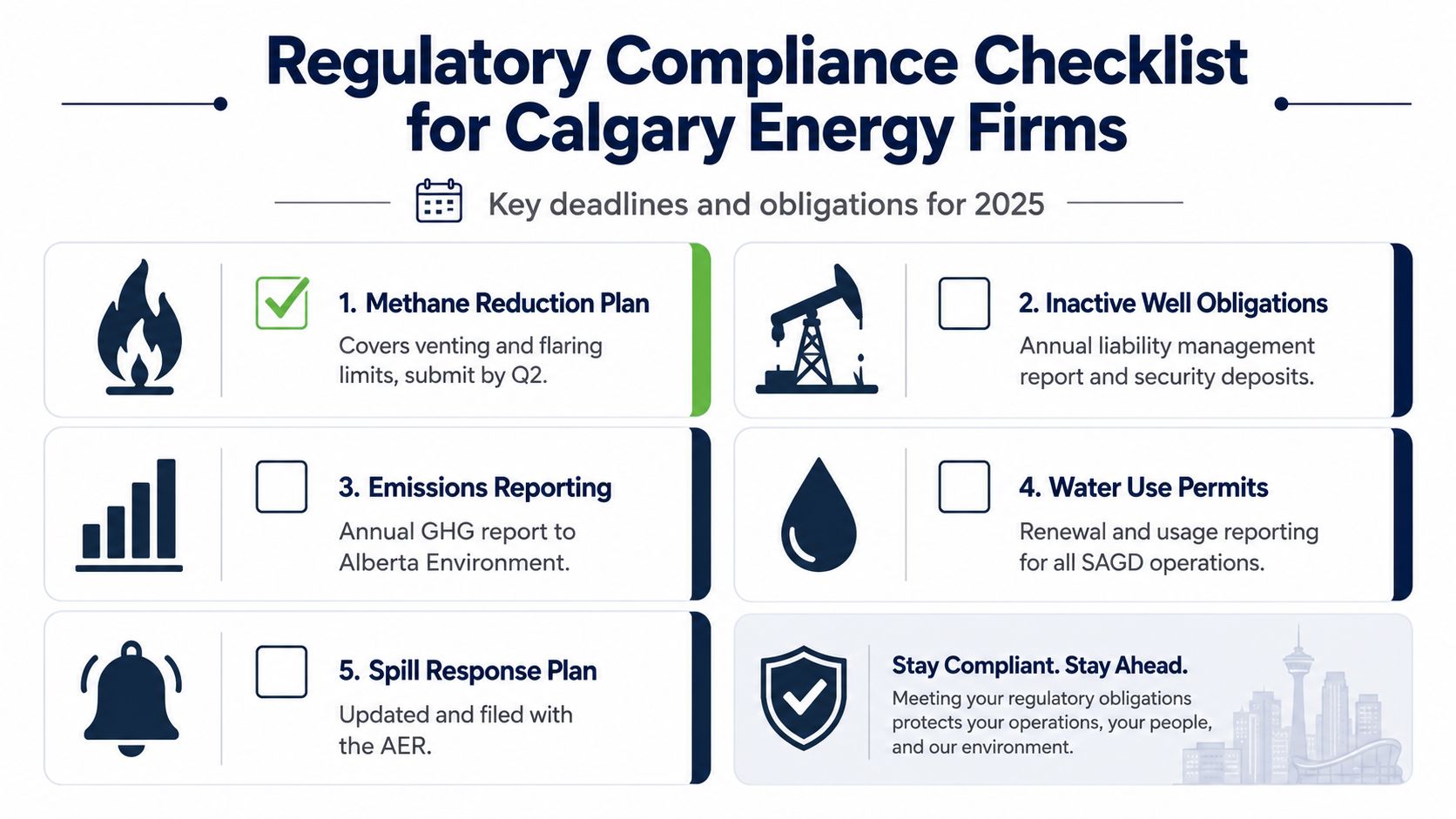
Calgary energy firms need tighter visibility into methane reduction, inactive well obligations, emissions reporting, water use permits, and spill response planning. Those obligations are not just paper work. They depend on clean records, timely reporting, and systems that can prove what happened when.
The monitoring problem is part of the compliance problem. If more than 60% of inactive wells lack emissions monitoring systems, then operators are dealing with blind spots that create operational and regulatory risk at the same time (Alberta Innovates). That is exactly where tank-vent instrumentation, LDAR platforms, and remote sensing start to pay for themselves.
A lot of Calgary SMBs still treat compliance software, security tools, and field systems as separate purchases. That's a mistake. The same environment that needs emissions records also needs access control, backup discipline, and audit trails that can stand up after an incident.
If you want a practical reminder of how these controls fit together for Alberta operators, the CloudOrbis IT compliance guide for the Alberta oil and gas industry is a useful starting point. It's not about buying more software. It's about building a cleaner evidence trail and reducing the chance that one incident becomes a production problem.
The Calgary oil and gas industry has a bigger attack surface than most owners admit. Remote access, third-party SCADA vendors, engineering workstations, and field laptops create multiple points where a weak password, an unpatched system, or a rushed vendor connection can turn into an outage. The risk is real, and it doesn't care whether you're a major producer or a 25-person contractor.
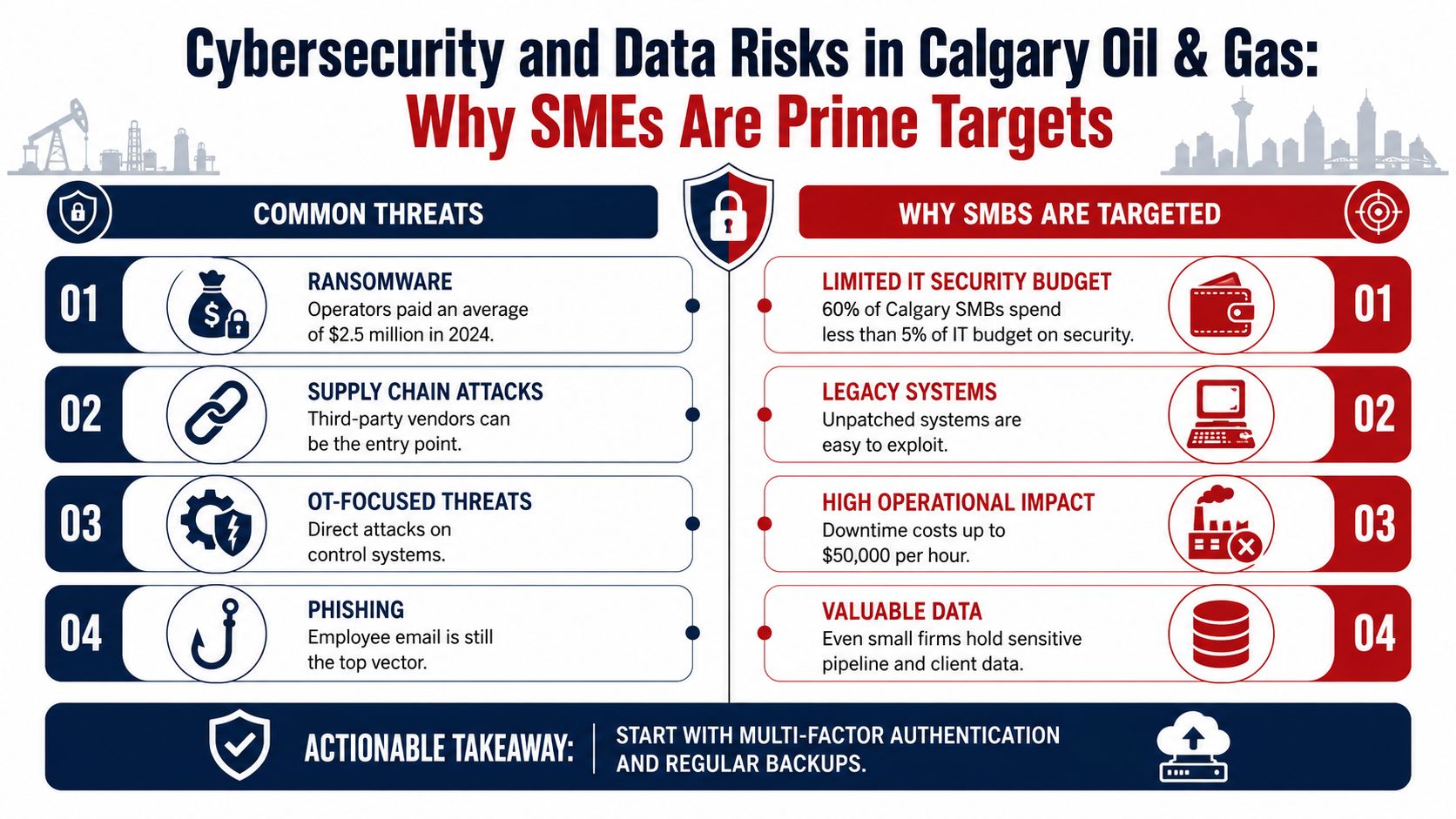
Ransomware gets attention because it stops work fast, but it's only one part of the picture. Supply chain attacks can arrive through a contractor, OT-focused threats can hit control systems directly, and phishing still works because people are busy and attackers know it. Calgary firms that rely on email approvals, shared file links, and vendor portals are exposed every day.
Small and mid-sized operators are attractive because they often have legacy systems and limited security depth. They also carry data that matters, client details, field records, engineering documents, and operational history. That makes them worth targeting even when they're not the biggest name on the lease.
A fully internal team rarely has enough breadth to cover 24/7 operations, cloud, security, and OT all at once. That is why co-managed IT makes sense for many Calgary firms. It gives you extra hands and specialised skills without forcing you to replace the people who already know the business.
If you want a sector-specific look at that security gap, CloudOrbis's cybersecurity services for the Alberta oil and gas industry is a sensible place to start. The point isn't to buy fear. It's to close the gaps that create downtime, data loss, and compliance pain.
Bottom line: security for oil and gas SMBs is not a luxury line item. It's part of keeping operations credible.
A representative Calgary field-services company usually looks like this. It has a small internal IT lead, a few overworked power users, some cloud tools, and a vendor list that grew faster than its standards did. The business can function, but every new project adds more risk than the last.
That is the point where co-managed IT stops being optional. The in-house team keeps ownership of business context, while a Canada-based partner handles the parts that need scale, repetition, or specialist depth, OT networking, vulnerability management, Microsoft 365 hardening, backup checks, and surge support during migrations or disaster recovery work. If you already have internal capability, the right partner should extend it, not bulldoze it.
The before-and-after is usually obvious. Before, the team spends too much time chasing tickets, vendor issues, and patch windows. After, they spend more time on operational priorities and less time firefighting. That's the practical gain, not abstract transformation language.
A firm in this position also needs to think about cash flow and project timing, especially when it's trying to preserve working capital through a volatile cycle. That's why operational support often pairs well with financial flexibility, and why small business factoring for drillers can matter in the same conversation, even though it solves a different problem. One keeps invoices moving, the other keeps systems stable.
Use three questions. Can your team cover after-hours issues without burning out? Do you have the skills to secure cloud, endpoints, and OT at the same time? Can you absorb a site move, audit, or recovery exercise without stalling the business?
If the answer is no to any of those, co-managed IT is probably the right maturity step. If you're barely maintaining day-to-day operations, a fully managed model may be the cleaner choice. For a deeper look at the structure, CloudOrbis's co-managed IT services for the Alberta oil and gas industry outlines how that division of labour typically works.
A Calgary field-services firm I'd expect to see in this market runs lean, wins work through responsiveness, and keeps just enough internal IT to stay functional. Then the cracks show. A ransomware scare, a slow backup restore, and a few too many cloud tools with different logins make it clear that “good enough” is eating margin.
The fix is not a giant transformation programme. It starts with a simple sequence.
The firms that do this well usually don't become flashy. They become steadier, easier to work with, and much harder to disrupt. That is what Calgary energy leaders should want right now, not more software for its own sake, but a business that can keep moving when the cycle, the field, or the threat environment changes.
If your Calgary operation needs steadier IT, tighter security, or a co-managed model that fits how energy firms work, CloudOrbis Inc. can help you build it without unnecessary disruption. Visit CloudOrbis Inc. to talk through managed IT, cybersecurity, cloud, and disaster recovery support for your team.
September 15, 2026
Why Managed IT Services Matter for Canadian SMBsDiscover why managed IT services are a smart move for Canadian SMBs. Learn the benefits, real ROI, and how to choose the right provider.
Read Full Post
September 14, 2026
Vulnerability Management vs Vulnerability AssessmentVulnerability management vs vulnerability assessment explained for Canadian SMBs. Compare scope, process, tools, and how to choose the right approach.
Read Full PostSeptember 13, 2026
Third-Party Risk Management for Canadian SMBsMaster third-party risk management for your Canadian SMB. Learn OSFI compliance, vendor monitoring frameworks, and how to secure your supply chain.
Read Full Post
