

September 16, 2026
How to Send Secure Email in Outlook Made SimpleLearn how to send secure email in Outlook with encryption, S/MIME and compliance tips for Canadian businesses. Step-by-step guide inside.
Read Full Post%20(1).webp)
Usman Malik
Chief Executive Officer
February 2, 2026
For any company in Alberta's oil and gas sector, IT compliance has moved from the backroom to the boardroom. It's no longer a task for the IT department to handle in isolation; it's a core operational mandate. Getting this right means digging into key provincial regulations from bodies like the AER and TIER and building essential strategies for cybersecurity and data management. When you nail this, compliance stops being a burden and becomes a powerful strategic advantage.
The ground is shifting for energy producers in Alberta. For years, the focus was squarely on production and operations. Now, that focus must include a complex web of digital responsibilities. This change is driven by a perfect storm of mounting regulatory pressure, a surge in cyber threats targeting critical infrastructure, and new environmental standards that hinge on accurate, secure data.
For business and IT leaders, this means it's time to reframe the conversation around compliance. This isn't just about ticking boxes to avoid a fine. It’s about building a more resilient, secure, and competitive operation from the ground up. Get your IT compliance in order, and you're not just satisfying a regulator—you're strengthening your defences against costly breaches and preparing your company for the future of energy production.
A major shift occurred on May 31, 2024, with the introduction of the Security Management for Critical Infrastructure Regulation (Alta Reg 84/2024). Under the Responsible Energy Development Act, this new rule is a big deal. It mandates that operators with "critical facilities"—which covers most petroleum and natural gas systems in the province—must implement comprehensive security management programs.
The message from regulators is crystal clear: cybersecurity and physical security are no longer separate concerns. They are intertwined, and they are non-negotiable.
Staring down the complex map of IT compliance in Alberta's energy sector can feel overwhelming, but the payoffs for creating a solid compliance framework are huge. Understanding the key benefits of meeting security compliance can give you the push needed to invest in the right strategies and people.
A strong compliance posture does more than just keep regulators happy; it builds trust with your stakeholders, partners, and investors. When you demonstrate a real commitment to securing your operations and data, you position your company as a reliable and forward-thinking leader in the industry. As you strengthen your digital backbone, it’s worth exploring specialized IT solutions tailored for the oil and gas industry to help meet these demanding requirements.
A proactive approach to IT compliance is a direct investment in operational continuity. By identifying and mitigating risks before they become incidents, you protect your assets, your people, and your bottom line from the severe disruptions of a security breach or system failure.
To help clarify the landscape, we've broken down the primary regulatory and security domains that Alberta's energy companies must address.
Each of these pillars requires a dedicated focus, but they all interconnect. A weakness in one area, like supply chain security, can easily expose you to risks in another, such as operational security. A holistic strategy is the only way forward.
For leaders in Alberta's energy sector, navigating the regulatory landscape can feel like trying to read a map in a moving truck. Two acronyms, however, are critical signposts for your operational and IT strategy: AER and TIER. Getting a handle on these provincial mandates is the first real step toward building a resilient, compliant, and secure business.
Think of the Alberta Energy Regulator (AER) and the Technology Innovation and Emissions Reduction (TIER) regulation as two different but connected systems. The AER is laser-focused on the physical and digital security of your assets. TIER, on the other hand, zeroes in on your environmental footprint, specifically your emissions. Both have massive implications for your IT infrastructure, how you manage data, and your overall security posture.
The Security Management for Critical Infrastructure Regulation puts the AER squarely in charge of your operational security. This regulation mandates that operators must create and maintain a formal Security Management Program (SMP) for any facility that's deemed "critical."
So, what’s a critical facility? The AER’s definition is quite broad, covering most petroleum and natural gas systems. If a problem at your facility could cause serious trouble for the public, the environment, or the energy supply, it’s almost certainly on their list. Your IT and OT (Operational Technology) systems are the nerve centre for protecting these assets.
The regulation is specific: your SMP must align with established standards, particularly CSA Z246.1. This standard lays out the requirements for security management in our industry. We're not just talking about fences and guards here; this is about locking down the digital controls that run your entire operation.
Your SMP has to cover a few key areas:
The AER’s mandate completely erases the old line between physical and cybersecurity. A compromised SCADA system is every bit as dangerous as a physical break-in, and your IT compliance program has to reflect that reality.
Hitting this level of security takes a deep understanding of both the rules and the tech. For many companies, bringing in experts provides the clarity needed to ensure the strategy is solid. You can explore a variety of compliance solutions designed to meet these stringent requirements.
While the AER is all about securing your operations, the TIER regulation is about environmental accountability. TIER is Alberta's system for managing greenhouse gas emissions from large industrial facilities, and it lives or dies on accurate, verifiable data. This is where your IT's role becomes absolutely critical.
Your company is on the hook for collecting, storing, and reporting precise emissions data. This isn't just an internal number to track; it's a legal declaration you submit to the government. Any mistake, whether it's accidental or malicious, can lead to huge financial penalties and a serious blow to your reputation.
Alberta's oil and gas industry—a powerhouse producing half of Canada's liquids and over 60% of its gas—is under intense scrutiny with TIER. Facilities must submit verified annual reports by June 30th, tracking emissions against set benchmarks. The numbers are staggering; regulated emissions from oil and gas production alone hit 153.6 MT CO2e in 2022. You can dig into the full compliance report on Alberta's official publications page if you want to see the details.
This places a heavy burden on your IT infrastructure. Your systems must guarantee:
Essentially, TIER makes your IT department the guardian of your environmental compliance record. Without robust systems and tight security controls, you simply can't provide the trustworthy data the regulation demands. This makes IT compliance for the Alberta oil & gas industry a core piece of your entire environmental strategy.
Knowing the provincial regulations is one thing, but actually putting them into practice is where the real work begins. To achieve IT compliance for the Alberta oil & gas industry, you must effectively secure both your Information Technology (IT) and your Operational Technology (OT) environments. While these two worlds are connected, they present completely different security puzzles.
Your IT systems—things like email, servers, and workstations—are familiar territory for most. But your OT environment is a different beast entirely. It includes the Industrial Control Systems (ICS) and SCADA systems that manage physical processes out in the field. These systems were often designed for reliability and uptime, not security, leaving many without modern protective features. That makes them prime targets.
The best strategy for protecting these blended environments is a Zero-Trust Architecture. This modern approach is built on a simple but powerful principle: "never trust, always verify."
Think of traditional network security like a castle with a strong moat and high walls. Once an attacker gets past that perimeter, they have free rein to move around inside. That model is dangerously outdated. A Zero-Trust network is more like a high-security facility where every single door, down every hallway, requires a unique and constantly verified keycard swipe. This approach dramatically limits an attacker's ability to move laterally and cause widespread damage.
For Alberta operators, this means consistent risk assessments and threat intelligence are non-negotiable. You need to find vulnerabilities before they turn into major incidents. A Zero-Trust architecture is the perfect response, as every access request gets validated and strict "least-privilege" controls are enforced. In fact, pilot programs have shown this method can slash insider risks by 40-50%.
The diagram below shows how AER and TIER regulations are interconnected pillars of your compliance responsibilities.
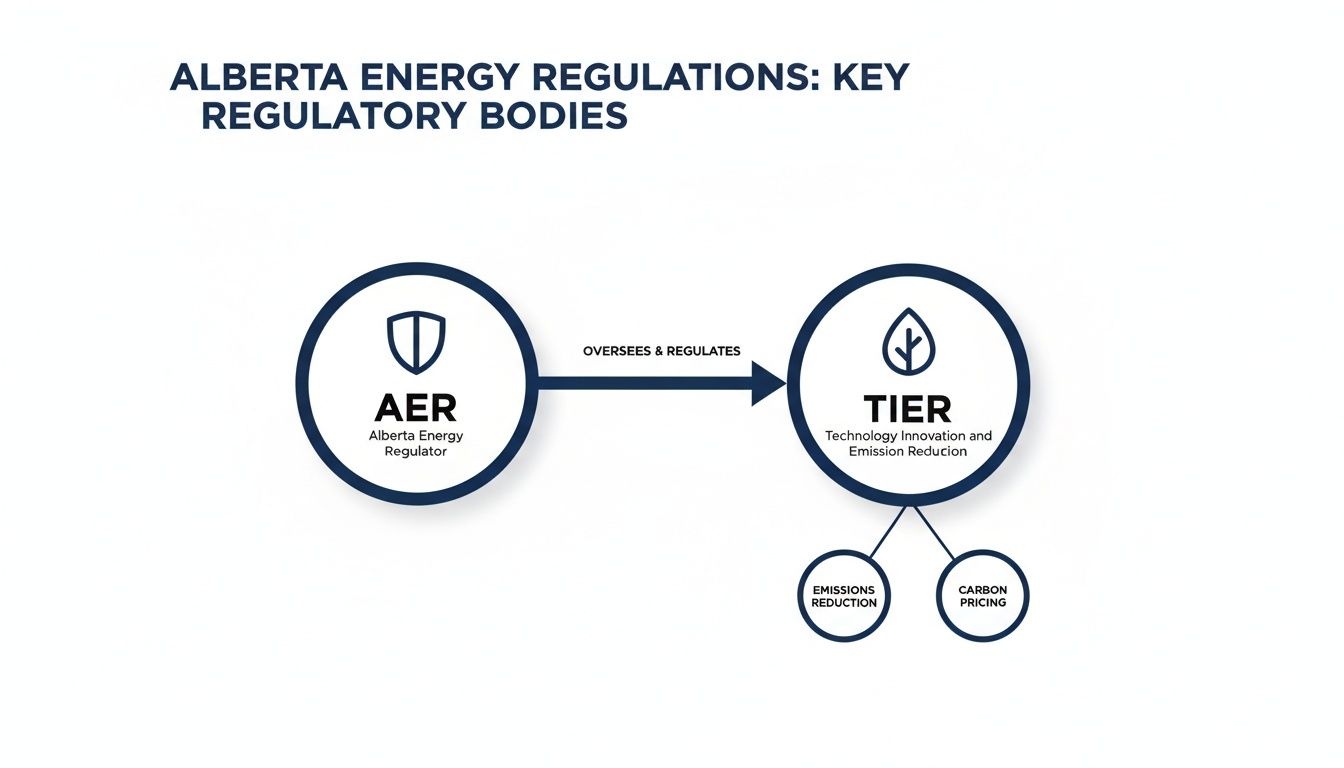
What this visual makes clear is that both operational security (AER) and environmental reporting (TIER) depend on secure, trustworthy technology. It reinforces why you need a unified cybersecurity strategy that covers both.
Putting a Zero-Trust framework into action involves several key technical controls tailored to the unique risks of the energy sector. These aren’t one-time fixes; they are ongoing processes that build layers of defence around your most valuable assets.
Here are three foundational controls you should prioritize:
Network Segmentation: This is the practice of dividing your network into smaller, isolated zones. Think of it like installing fire doors in a large building—if a fire breaks out in one section, the doors contain it. In your network, this means isolating critical OT systems from your corporate IT network and the internet, which severely restricts potential attack paths.
Continuous Vulnerability Management: Your systems are never static; new vulnerabilities are discovered every day. A continuous management program means regularly scanning your IT and OT assets for weaknesses, prioritizing them based on risk, and applying patches or fixes promptly. Proactively finding these issues is a key part of staying compliant. You can learn more about how we proactively find weaknesses in our guide on penetration testing services.
Robust Access Controls: Zero Trust demands strict control over who can access what. This means enforcing the principle of least privilege—giving users access only to the data and systems absolutely necessary for their jobs. It also involves using multi-factor authentication (MFA) wherever possible, especially for remote access to sensitive systems.
By combining these controls, you create a defensive posture where a single point of failure is far less likely to result in a catastrophic breach. It's about building resilience directly into the fabric of your digital infrastructure.
High-tech systems and complex software are crucial for IT compliance in Alberta's oil and gas industry, but they only solve part of the puzzle. At the end of the day, your people are both your biggest asset and your first line of defence against cyber threats. Creating a security-first culture isn't just a "nice-to-have"—it's a core compliance requirement.
This is about more than a once-a-year presentation. We’re talking about building a genuine "human firewall," where every single employee understands the why behind your security policies. When your team is trained and alert, you actively prevent the kinds of breaches that lead to steep regulatory fines and crippling operational downtime.

Let's be honest: traditional, passive training methods rarely stick. Real security awareness needs to be active, engaging, and constantly reinforced. Forget the annual slideshow; a modern training program is a dynamic, ongoing effort.
The key is creating learning experiences that actually mean something to your team. When employees are active participants in their own security education, they’re far more likely to remember the lessons and apply them when it counts.
Here are three powerful ways to start building your human firewall:
Phishing Simulations: Don't just tell your staff about phishing—show them. Regularly send out simulated phishing emails to test their awareness. These controlled drills are a safe way for employees to learn how to spot malicious emails, providing an immediate and memorable lesson for anyone who clicks. A solid defence against phishing is a must, and you can dive deeper into essential email security best practices to really lock things down.
Incident Response Drills: The worst time to test your emergency plan is during a real crisis. Run hands-on drills that walk through a simulated security incident, like a ransomware attack or a data breach. These exercises ensure everyone knows their role and can act decisively when the pressure is on.
Role-Specific Training: A field operator in Fort McMurray faces completely different cyber risks than an accountant in a Calgary office tower. Your training needs to reflect that. Tailor your content to address the specific threats and data-handling duties relevant to each role, making it practical and actionable for everyone.
The ultimate aim is to weave security into the very fabric of your company. That happens when every team member—from the boardroom to the drill site—feels a personal sense of ownership for protecting the company's data and systems.
A strong security culture is one where an employee who spots something unusual feels empowered and encouraged to report it immediately, without fear of blame. This vigilance is your most effective early warning system against sophisticated cyber threats.
This kind of cultural shift doesn't happen overnight. It takes consistent messaging from leadership, positive reinforcement for good security habits, and open communication about the threats you're facing. When you show that security is a team sport, you turn your workforce from a potential weak link into your most powerful defensive asset.
Getting compliant is a huge step, but it’s really just the starting line. For real operational resilience in Alberta's oil and gas sector, you need to be able to prove your controls are working, day in and day out, and know exactly what to do when something goes wrong. This means moving away from a project-based mindset and embracing a constant state of audit-readiness alongside a tested Incident Response Plan (IRP).
These two functions go hand-in-hand. The same meticulous documentation and logging that prepares you for an audit is the critical evidence you'll need to investigate and recover from a security breach. It’s a proactive stance, and it's essential for meeting the demands of IT compliance for the Alberta oil & gas industry.
An AER audit shouldn't kick off a frantic, last-minute scramble for documents. It should be a routine event where you can confidently present well-organized proof of your compliance. The secret is building processes that generate this evidence as a natural part of your daily operations, not as a panicked afterthought.
An audit-ready state is built on three pillars: rock-solid documentation, automated log collection, and clear proof that your controls are actually effective. Auditors don't just want to see what you’ve implemented; they need to see that it’s working as intended, every single day.
When an AER auditor reviews your security management program, they are looking for a living, breathing system—not a dusty binder of policies. They want to see consistent execution, from documented risk assessments and employee training records to logs showing that access controls are being enforced.
To get ready for that level of scrutiny, your goal is to create a comprehensive and easy-to-access repository of compliance artifacts. Think of this as your "evidence locker"—it’s your undeniable proof that you are meeting your regulatory obligations.
Here are the essential components to include:
No matter how strong your defences are, you have to prepare for the possibility of a security incident. A well-defined IRP is your playbook for managing a crisis, minimizing the damage, and getting operations back online as quickly as possible. In the energy sector, this plan absolutely must cover scenarios unique to both your IT and OT environments.
An effective IRP follows a clear, four-stage lifecycle:
Moving a compliance strategy from paper into the real world is where the real work begins. For many energy firms, trying to navigate the complex maze of IT compliance for the Alberta oil & gas industry on their own is a monumental task. This is where partnering with an external expert isn't just helpful—it can be a complete game-changer, giving you the specialized knowledge and resources to meet regulatory demands head-on.
This is especially true if you already have some IT staff but need to level up their capabilities. A co-managed IT model strikes the perfect balance, blending your team's internal knowledge of the business with a partner's deep expertise in cybersecurity and compliance.
A co-managed partnership isn’t about replacing your IT team; it’s about making them stronger. Think of it as bringing in a specialist. Your partner brings advanced tools and niche skills that are often too expensive or impractical to develop in-house. This frees up your team to focus on day-to-day operations and strategic projects, while the partner handles the heavy lifting of advanced security and compliance.
Of course, when you're selecting a partner, a thorough process of Vendor Due Diligence is non-negotiable. You need to evaluate potential risks and ensure they align with your specific operational and regulatory needs.
Here’s what a great co-managed partnership brings to the table:
Perhaps the most powerful advantage of a strategic partnership is getting access to a virtual Chief Information Officer (vCIO). A vCIO isn’t just another tech expert; they are a high-level technology advisor who sits down with your leadership team to ensure your IT roadmap perfectly supports your business goals and compliance duties.
A vCIO bridges the critical gap between technology and business strategy. They translate complex regulatory requirements into a clear, actionable IT plan that supports growth, mitigates risk, and delivers a measurable return on investment.
This kind of strategic guidance is invaluable. Instead of making technology decisions in a silo, a vCIO helps you prioritize investments, plan for what's next, and clearly demonstrate to auditors and stakeholders that your IT infrastructure is a cornerstone of your business's resilience and success. By tying every technical control back to a specific business goal or regulatory rule, a vCIO makes your compliance efforts both more effective and easier to justify. This strategic oversight is the final piece of the puzzle for mastering IT compliance in Alberta's demanding energy sector.
When you're navigating IT compliance in Alberta's oil and gas sector, a lot of questions pop up. Let's tackle some of the most common ones to clear things up and help you find the answers you need, fast.
The single most critical first step for any operator in Alberta is a thorough risk assessment. This isn't just a box to tick; it's the absolute bedrock of your entire compliance strategy.
This process involves mapping out all your IT and OT assets, pinpointing which ones are deemed "critical" under AER regulations, and then taking a hard look at their current weak spots. Without this foundational understanding, any compliance effort is just guesswork—unfocused, inefficient, and likely to fail an audit.
TIER compliance places a massive responsibility on your IT department, specifically around data integrity. The regulation hinges on precise, verifiable emissions data that must be reported annually.
This means your IT team is on the hook for implementing and securing the systems that collect, store, and report this environmental data. They become directly responsible for shielding this information from any tampering or loss, ensuring the systems are always up, and guaranteeing the pinpoint accuracy regulators demand.
A failure in data management is a failure in TIER compliance. Your IT infrastructure is the guardian of your environmental record, making its security and reliability absolutely essential for avoiding significant financial penalties.
Yes, you can. While "Zero-Trust" sounds like something only massive enterprises can pull off, it's completely accessible and affordable for medium-sized operators.
You don't have to implement everything at once. A Zero-Trust approach can be rolled out in manageable phases, starting with your most critical assets to get the biggest impact right away. What's more, partnering with a managed IT service provider like CloudOrbis often makes this level of security much more cost-effective. You get access to a shared pool of expertise and advanced tools, giving you enterprise-grade protection without the huge upfront capital cost.
Ready to build a resilient, audit-ready compliance strategy for your operations? The experts at CloudOrbis Inc. can help you navigate AER and TIER regulations with tailored IT and cybersecurity solutions. Strengthen your compliance posture today.
September 16, 2026
How to Send Secure Email in Outlook Made SimpleLearn how to send secure email in Outlook with encryption, S/MIME and compliance tips for Canadian businesses. Step-by-step guide inside.
Read Full Post
September 15, 2026
Why Managed IT Services Matter for Canadian SMBsDiscover why managed IT services are a smart move for Canadian SMBs. Learn the benefits, real ROI, and how to choose the right provider.
Read Full Post
September 14, 2026
Vulnerability Management vs Vulnerability AssessmentVulnerability management vs vulnerability assessment explained for Canadian SMBs. Compare scope, process, tools, and how to choose the right approach.
Read Full Post
