

September 16, 2026
How to Send Secure Email in Outlook Made SimpleLearn how to send secure email in Outlook with encryption, S/MIME and compliance tips for Canadian businesses. Step-by-step guide inside.
Read Full Post%20(1).webp)
Usman Malik
Chief Executive Officer
August 2, 2026
You're staring at another surprise invoice, another “urgent” fix, and another morning where the team can't get into the systems they need. That's the break fix vs managed services decision, not a pricing debate, but a question of whether your business can afford to keep gambling on when things break.
A server fails at 8:40 a.m., a provider promises a two-hour response, and half a workday disappears before anyone even starts repairing the damage. The file shares are down, client calls are delayed, and your staff starts improvising with phones, email, and printed documents. That's the kind of disruption break-fix creates when nobody is watching the environment before failure. Managed services changes the operating model by building in prevention, monitoring, and planned response instead of waiting for the collapse.
| Criterion | Break-Fix | Managed Services |
|---|---|---|
| Cost model | Variable, incident-based | Predictable monthly subscription |
| Trigger | Failure | Prevention and monitoring |
| Accountability | Per ticket or per hour | SLA-bound service delivery |
| Security coverage | Ad hoc | Continuous controls and oversight |
| Compliance support | Limited documentation | Ongoing logging and records |
At 8:40 a.m. on a Tuesday, a 22-person accounting firm in Ontario loses its main server. The office manager calls the break-fix provider, gets told the response window is two hours, and then spends the rest of the morning explaining to clients why documents are late. By the time a technician arrives, the damage is already done, because the loss is not just the server failure. It is the idle staff, the delayed filings, and the trust problem that starts the moment phones keep ringing and nobody can answer with certainty.
That is the break fix vs managed services decision in plain terms. One model waits for the billable crisis. The other is built to stop a failure from turning into a business problem.
Break-fix works like a panic button. Something breaks, someone gets called, and the billing begins. If your business is tiny, low-tech, and tolerant of disruption, that can be a rational arrangement for a while. For everyone else, it is a way to trade visible monthly spend for invisible operational risk.
Managed services flips the logic. The provider watches systems, maintains them, documents the work, and keeps a standing process for response. For Canadian firms in Ontario, Alberta, and other regulated or operationally sensitive markets, that difference matters because downtime timing becomes more predictable only when prevention is part of the contract. A clear service governance comparison helps show why the operating model matters more than the sticker price.
A cheap support model that arrives after the damage has already spread is not cheap for long.
The test is simple. Cost matters. Security matters. Compliance matters. All of them depend on whether your IT partner is waiting for failure or managing against it.
Break-fix is simple. Something breaks, you call for help, you pay for the incident, and the relationship usually ends when the issue is closed. The provider may bill per ticket, per hour, or per project, but the operating logic stays the same. Nothing meaningful happens between failures.
Managed services works on a different model. You pay a predictable subscription for ongoing support, continuous monitoring, documented service levels, and preventive maintenance. The provider is accountable to an SLA, not just a one-time fix, which means the job includes keeping systems healthy, not only rescuing them when they fail.
There is also co-managed IT, the practical middle path for businesses with an internal IT lead. Your in-house person keeps control of day-to-day priorities while an external provider handles specialised coverage, after-hours support, or security operations. That setup works well when the business already has technical ownership in place and needs extra depth rather than a full replacement.
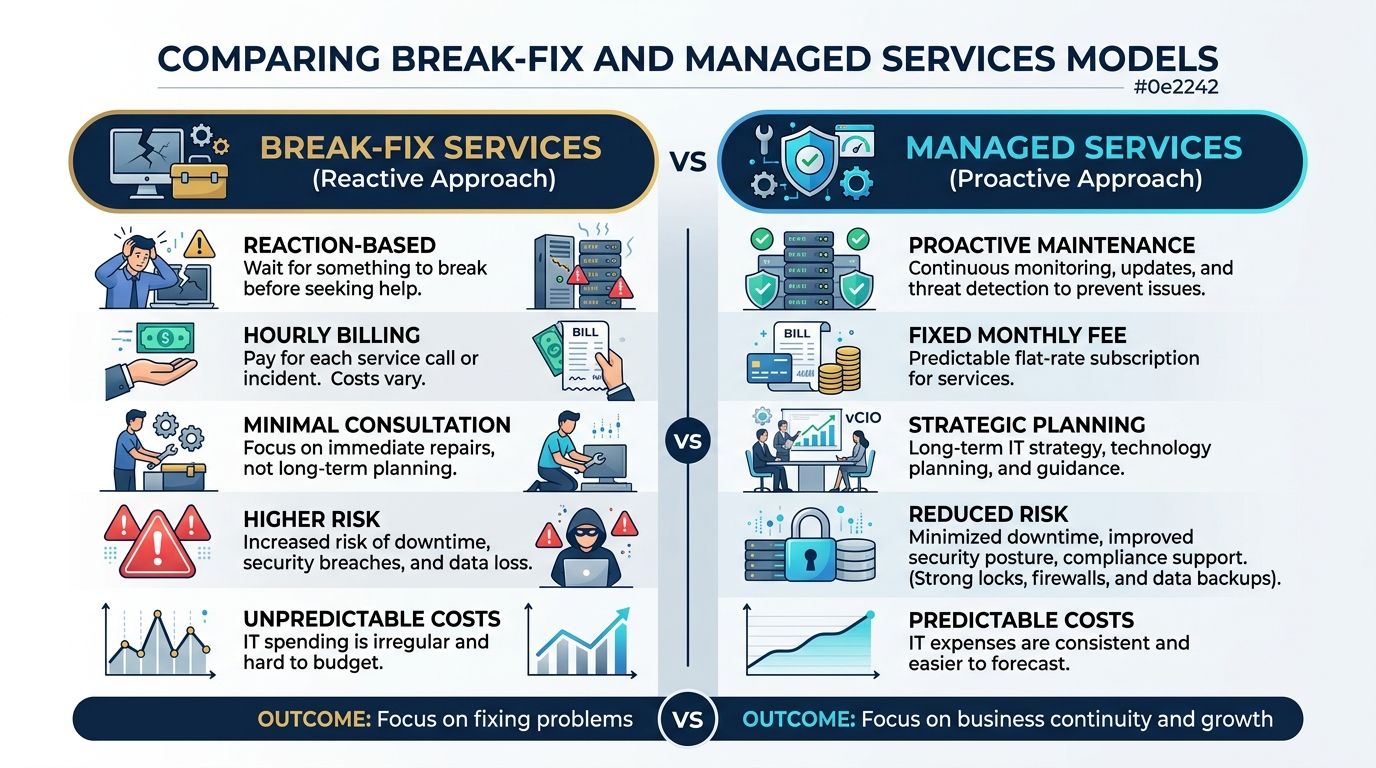
The clearest way to read the difference is simple. Break-fix is event-driven. Managed services is governance-driven. One is built around interruption, the other around continuity.
If you want a plain-language primer on managed support, CloudOrbis has a useful overview in what is managed IT services. Read it if you are still separating the sales language from the operating model.
The wrong way to compare these models is to ask which one is “better” in the abstract. The right way is to ask which one performs better on the criteria that hurt your business when they go wrong.
| Criterion | Break-Fix | Managed Services |
|---|---|---|
| Cost predictability | Low | High |
| Response time | Depends on the incident and queue | Governed by SLAs |
| Security coverage | Reactive and uneven | Continuous and layered |
| Patching cadence | Often deferred until there's a problem | Planned and recurring |
| Compliance documentation | Sparse unless you build it yourself | Built into the operating process |
| Scalability | Harder to standardise | Easier to extend across users and sites |
| Strategic input | Limited | Ongoing advisory and planning |
Break-fix can look cheaper because you only pay when you need help. That's the only advantage most owners see, and on paper it's real. If your environment is small, simple, and not operationally critical, a per-incident model can feel rational because you're not funding support you may not use every month.
Practical rule: if your business can survive a day of delay without payroll, client service, or production slipping, break-fix may still be viable.
Managed services wins on the things that are hardest to budget for and easiest to ignore until they hurt. Monitoring catches trouble before users do. Planned maintenance replaces emergency repair. Documented SLAs make accountability measurable instead of emotional.
That's why CloudOrbis's managed services questionnaire is more useful than a generic sales call. It forces you to think through the environment you run, not the one you wish you had. If your systems support revenue, compliance, or public-facing service delivery, the managed model is usually the stronger fit because it changes the cost of failure itself.
Break-fix tends to treat security as a separate crisis. Managed services folds it into the support relationship through ongoing oversight, patching, and response readiness. That difference matters because strategy doesn't show up in a one-time invoice. It shows up in whether your provider is thinking about next month's risk before this month's outage.
Owners often compare a support invoice with a subscription and stop there. That comparison is incomplete, and it leads to bad decisions. In Canada, managed-services pricing for 10 to 50 user organisations is often cited at $12,000 to $40,000 annually, while compliance-heavy environments can rise to $20,000 to $60,000+ because patching, documentation, backup validation, and security controls require ongoing labour managed-service cost bands.
That range is not padding for convenience. It pays for work break-fix usually leaves out. Continuous patch management, endpoint protection, backup and disaster-recovery routines, and 24/7 monitoring all cost money because they reduce the chance that you'll pay far more during an outage.
Break-fix invoices look smaller because they hide the overall cost. They do not show the hours staff lose while they wait. They do not show the internal time spent coordinating the repair. They do not show the emergency hardware purchase, the after-hours labour, or the client churn that starts when service quality drops.
The financial picture gets harsher when cyber incidents enter it. A 2023 Canadian Centre for Cyber Security report put the average ransomware recovery cost for Canadian organisations at C$1.3 million, and it warned that ransomware often creates multi-day outages ransomware recovery cost context. That is why a managed subscription belongs in the prevention and resilience bucket, not the luxury bucket.
If downtime threatens revenue, client delivery, or regulated records, the “cheaper” model is only cheaper when nothing goes wrong.
For CFOs, the cleanest frame is simple. Compare the annual managed-services spend against the expected cost of interruption, recovery, and internal distraction. Then ask whether the lower sticker price is lower once you include the outage math. CloudOrbis's total cost of ownership guide is useful if you need to build that business case without hand-waving.
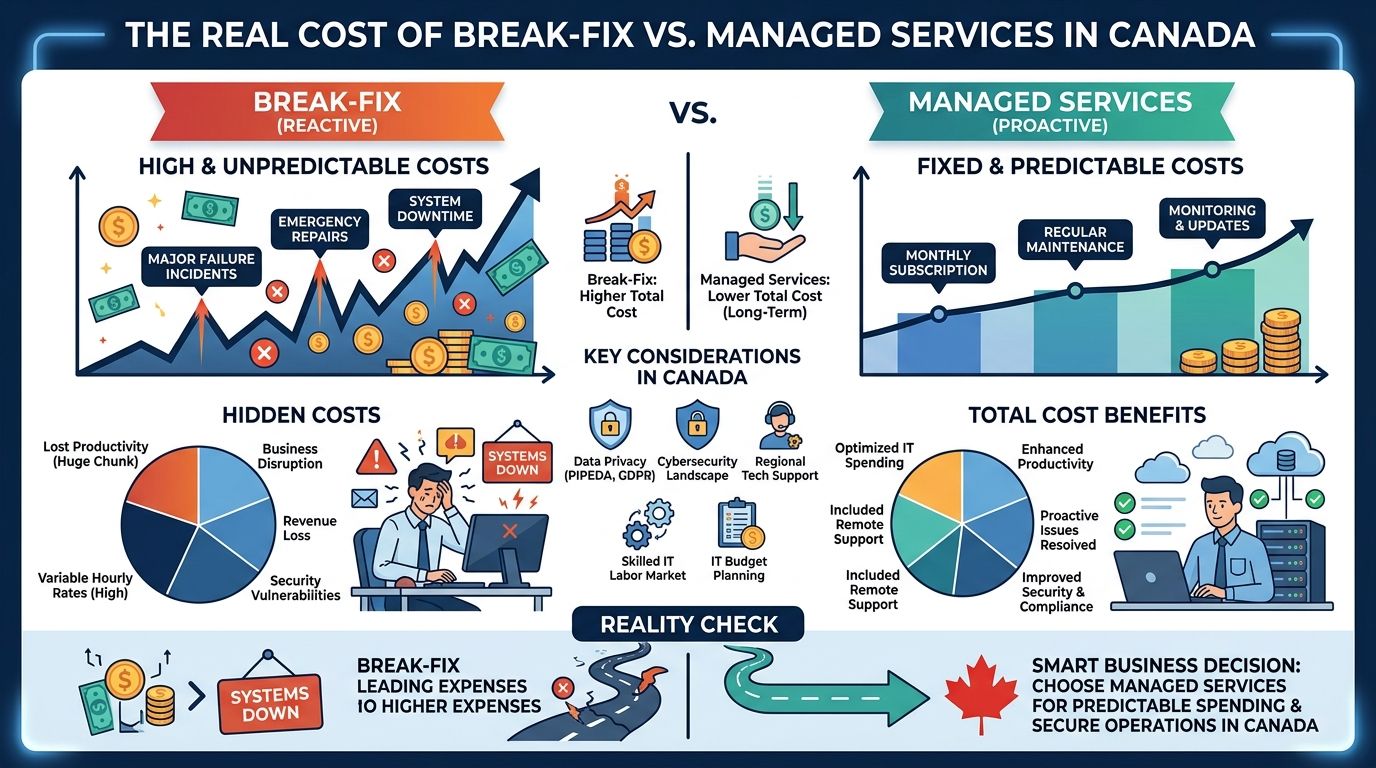
A provider that only shows up after failure can still look cheaper on paper. It is cheaper in the same way a fire extinguisher looks unnecessary until the kitchen catches fire. The test is whether your business can absorb the delay, the scramble, and the recovery work without missing payroll, missing service commitments, or turning a recoverable incident into a long disruption.
If you want a proper procurement conversation, force both models into the same ledger. Put the visible invoice on one side, then add labour lost, emergency response, cyber recovery, downtime, and missed delivery on the other. That is the cost picture business owners need before they sign anything.
In regulated Canadian environments, governance beats guesswork every time. Under PIPEDA, organisations must report a breach to the Privacy Commissioner and notify affected individuals if the breach poses a real risk of significant harm, and they must also keep records of every breach for at least 24 months PIPEDA breach obligations. That's not a casual requirement. It demands logging, oversight, and a defensible record of what happened and when.
Break-fix is weak here because it's built around the exception, not the routine. If you only engage a provider after something fails, you usually don't have the continuous patch history, access review trail, backup validation record, or incident-handling documentation an auditor expects. Managed services produces those artefacts as part of normal operations.
A sensible managed relationship gives you more than technical help. It gives you records. Patch logs. Monitoring alerts. Backup checks. Access reviews. Incident notes. Those are the breadcrumbs that let a business prove it took reasonable steps, instead of trying to reconstruct them after the fact.
If you're comparing security tooling and compliance platforms, a useful external reference is compare Vanta features and pricing, especially if your team is trying to understand how controls, evidence, and ongoing review fit together in practice. Tools alone won't save a weak operating model, but they can help formalise one that already values documentation.
For a deeper look at how this plays into managed security, CloudOrbis also has a focused piece on managed IT services security. That matters because the provider model shapes the evidence trail as much as the security stack does.
In regulated environments, prevention and documentation aren't optional extras. They're part of the job.
Legal, finance, and healthcare leaders should treat that as the baseline. If your IT partner can't show you how records are created, retained, and reviewed, you're not buying a managed service. You're buying a hopeful promise.
Healthcare clinics are the easiest case to call. Patient data is sensitive, service interruptions create immediate operational pain, and systems like EMRs can't just sit offline until someone has time to diagnose the issue. Managed services fits because availability, security, and documentation all matter at the same time. Break-fix might solve a one-off issue, but it doesn't give a clinic the control it needs over uptime and compliance habits.
Manufacturing and logistics have a different pressure point. Line-of-business systems, VoIP for shift coordination, and secure remote access for field staff all depend on steady support. A break-fix call after the floor is already stalled is the wrong kind of response. Managed or co-managed support makes more sense because these environments need maintenance, not rescue.
Legal and finance firms sit in the same camp for a different reason. They handle privileged client data, depend heavily on Microsoft 365 and similar collaboration tools, and can't afford sloppy oversight. If a business in those sectors is still treating IT like a repair shop, it has already outgrown the model.

A very small, low-tech operation with minimal data exposure and little tolerance for monthly overhead can still rationally stay with break-fix for a while. That's not a recommendation for most businesses. It's a boundary case. The moment downtime affects customers, payroll, compliance, or production, the argument for managed services gets much stronger.
If hardware recovery ever becomes the only issue you're trying to solve, specialised providers like mdrepairs hard drive recovery can help with a narrow technical problem. That's useful, but it's not the same thing as having a governed IT operation.
A lot of owners think the choice is binary. It isn't. If you already have an internal IT lead, co-managed IT can cover after-hours response, extra security depth, or project capacity without forcing a full handover. That's a sensible bridge when the business wants control and external coverage at the same time.
The mistake is using co-managed as a parking spot for indecision. If the arrangement never matures into clear ownership, documented support boundaries, and proper monitoring, it just delays the decision you already know you need to make.
The cleanest migration starts with assessment, then moves through strategy, implementation, training, and ongoing optimisation. CloudOrbis frames that work through a 10-step engagement process, which is the right way to do it because no serious business should rip and replace everything in one weekend. You start by identifying the systems that hurt most when they fail, then you stabilise them first.

If you're looking for a model example, CloudOrbis's co-managed IT services in Edmonton gives a practical frame for how shared responsibility can work without chaos. The point is not to replace every internal role. It's to make sure nothing falls through the cracks while the business grows.
The switch doesn't have to be dramatic. The switch has to be controlled.
That's the appeal of the managed model. It gives you a measured path out of reactive IT without forcing a risky reset.
Use this checklist this week. How many users rely on your systems every day? Do you handle regulated data or have breach-notification obligations? Can your business tolerate an unplanned outage without losing revenue, trust, or delivery dates? And have you already had more than one major interruption in the last year?
If those answers make you uncomfortable, you're past the point where break-fix is a smart default. CloudOrbis works with businesses that want a 24/7 Canada-based helpdesk, advanced cybersecurity, cloud migrations, backup and disaster recovery, business VoIP, and vCIO support as part of a structured engagement. If you're also comparing platforms and support tooling, is Atera right for your MSP can be useful background for understanding how managed-service operations are evaluated.
Use the numbers. If uptime matters, if records matter, and if surprise invoices are already annoying you, the managed model is probably the right next move.
CloudOrbis Inc. helps Canadian SMBs move from reactive IT to managed support with monitoring, cybersecurity, backup, cloud, and strategic guidance built around a clear engagement process. If you're tired of guessing what downtime will cost next, visit CloudOrbis Inc. and book a conversation about whether your current model still fits your business.
September 16, 2026
How to Send Secure Email in Outlook Made SimpleLearn how to send secure email in Outlook with encryption, S/MIME and compliance tips for Canadian businesses. Step-by-step guide inside.
Read Full Post
September 15, 2026
Why Managed IT Services Matter for Canadian SMBsDiscover why managed IT services are a smart move for Canadian SMBs. Learn the benefits, real ROI, and how to choose the right provider.
Read Full Post
September 14, 2026
Vulnerability Management vs Vulnerability AssessmentVulnerability management vs vulnerability assessment explained for Canadian SMBs. Compare scope, process, tools, and how to choose the right approach.
Read Full Post
