Digital Transformation Roadmap: Your 2026 SMB Guide
Build a practical digital transformation roadmap for your Canadian SMB. Our guide covers strategy, budget, security, & KPIs to drive real growth.

Build a practical digital transformation roadmap for your Canadian SMB. Our guide covers strategy, budget, security, & KPIs to drive real growth.

If you're leading a Canadian SMB, you may already feel the pressure from three directions at once. Your team wants better tools, your finance lead wants tighter control over spending, and your operations people can't afford downtime while systems change. That mix is exactly why so many firms stall at the starting line.
A digital transformation roadmap fixes that. Not by turning your business into a technology experiment, but by giving leadership a practical way to decide what changes first, what waits, and how each step supports the business.
A digital transformation roadmap is a business plan for technology change. It isn't a shopping list of software, and it isn't a vague innovation exercise. It's the working document that connects business priorities to specific initiatives, owners, timelines, risks, and measures of success.
For many SMB leaders, the problem isn't knowing that change is needed. It's knowing where to start. A mid-sized manufacturer in Ontario might be running production on one system, inventory on another, finance on a third, and still relying on spreadsheets and email for critical handoffs. Everyone knows the setup is slowing the business down, but nobody wants to trigger disruption by changing too much at once.
That's where a roadmap earns its keep.
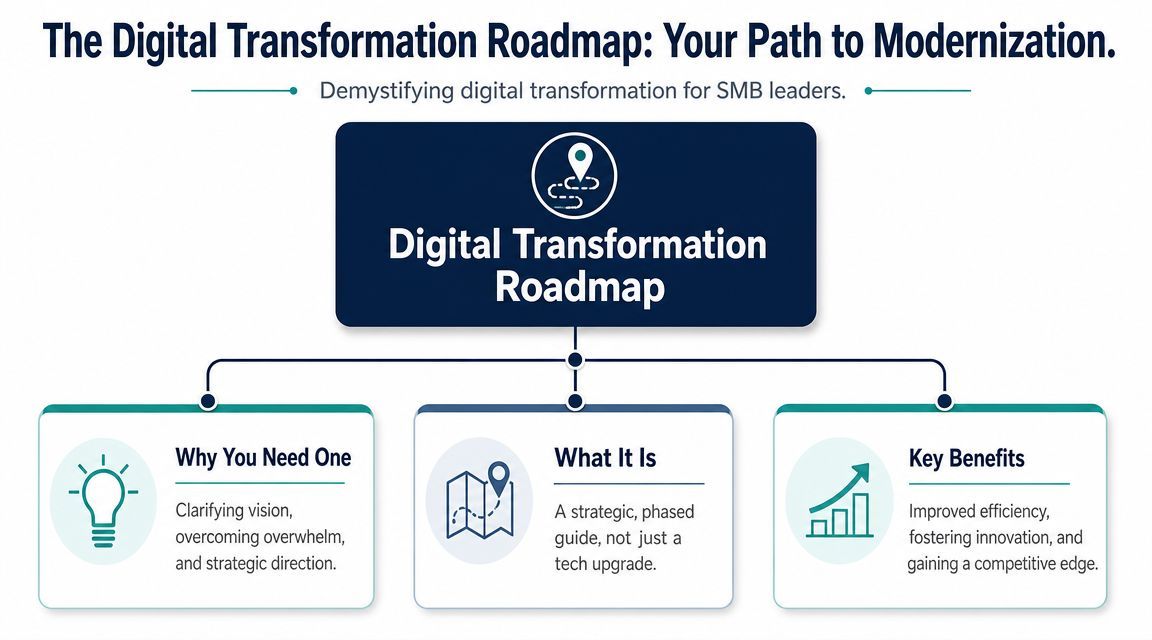
A roadmap should answer a short list of business questions clearly:
A roadmap turns vague ambition into an executable plan.
That shift matters because digital transformation is now mainstream. An estimated 90% of organizations are undergoing some form of digital transformation, according to industry coverage citing McKinsey research. For Canadian SMBs, that means a structured roadmap isn't optional if you need to justify spending on cloud, cybersecurity, and automation.
Without a roadmap, businesses usually fall into one of two traps. They either buy disconnected tools and create more complexity, or they delay decisions because every option feels risky. Neither works.
A good roadmap gives you a sequence. It helps leadership approve funding in stages, align departments around shared priorities, and reduce the odds of expensive rework. It also makes conversations with advisors and providers more productive because you can discuss business outcomes instead of isolated technical fixes.
If your current planning still revolves around renewal dates, support tickets, and one-off upgrades, it helps to step back and frame IT as a business capability. In this context, IT strategy and consulting becomes useful. It gives structure to decisions that often get made reactively.
A digital transformation roadmap isn't:
| Not a roadmap | What it actually is |
|---|---|
| A one-time IT project | An evolving business plan for change |
| A software shortlist | A sequence of business-led priorities |
| A technical architecture diagram | A guide for decision-making, funding, and execution |
If the document doesn't help leadership choose between competing initiatives, it isn't finished.
The best roadmaps start with disciplined discovery, a stage where many projects either gain traction or drift into guesswork. Teams that skip this phase usually end up solving symptoms instead of root problems.
BCG found that only 30% of transformations succeed overall, but success rises to 80% when organizations get key factors right, including integrated strategy and explicit progress monitoring. BCG also noted that only 40% of organizations achieved a fully integrated strategy, and only two out of five monitored progress adequately, compared with 90% of winning programs. That evidence from BCG's digital transformation research points to the same conclusion practitioners see every day. Discovery isn't overhead. It's risk control.
A solid current-state review looks at more than servers and software.
Start with capability and readiness. Who owns key processes? Where are staff relying on workarounds? Which managers are supportive, skeptical, or overloaded?
In a clinic setting, this might show up in patient intake. Front-desk staff may enter the same information into multiple systems because forms, scheduling, and billing aren't connected. The issue isn't only software. It's process design, staff burden, and error risk.
Look for steps that create delay, duplication, or confusion. Approval chains, onboarding, procurement, reporting, and document handling often hide the biggest friction.
Ask practical questions:
Map what you already have before adding anything new. That includes core applications, Microsoft 365 configuration, endpoint management, backups, identity controls, and integration gaps.
This is often the point where leadership realises the issue isn't “old tech” in general. It's fragmented tech with weak standards.
Data problems undermine transformation. If permissions are messy, records are duplicated, or reporting depends on manual exports, every new tool inherits the same weakness.
Practical rule: If your team doesn't trust the data today, adding automation or AI will only speed up bad outcomes.
Once discovery is complete, leadership needs a destination that people can understand. Not a slogan. A working vision.
A strong vision usually answers these questions:
For AI-related planning, some teams find it helpful to review outside frameworks before locking in priorities. A resource like rapid AI strategy development can help leaders think through readiness, governance, and business use cases before they commit to tooling decisions.
That kind of strategic framing is also where a virtual CIO can add value. The role isn't to make the roadmap more technical. It's to keep it aligned with business direction, risk tolerance, and execution capacity.
Most SMB roadmaps fail in the middle, not at the start. The vision sounds right, the team agrees in principle, and then actual constraints show up. Budget is tight. Staff are busy. A major system has to stay online. One department wants speed while another wants caution.
That is why the roadmap has to be phased.
For Canadian SMBs, digital transformation is often a 2 to 3 year journey, not a single project. Cost and time remain persistent barriers, and only 28% of small business owners felt ready for a major digital investment in research cited by Nextiva's digital transformation roadmap coverage. In practice, the businesses that keep moving are the ones that stage the work instead of trying to replace everything at once.

A roadmap should reflect operational reality. For most mid-market environments, this sequence works better than a big-bang approach.
The first phase is about reducing immediate risk and friction. That usually includes security gaps, inconsistent device management, backup issues, identity controls, poor documentation, unsupported systems, and critical workflow pain points.
This phase isn't glamorous, but it creates the conditions for everything that follows. If your team is still dealing with recurring outages, weak permissions, or manual account provisioning, advanced automation can wait.
Once the basics are under control, the next phase focuses on core platform improvements. That may include cloud migration, Microsoft 365 optimisation, line-of-business integrations, network redesign, workflow automation, or better collaboration standards.
Many organisations achieve meaningful operational gains. The key is to choose initiatives that remove bottlenecks across departments, not just improve one team's local process.
The final phase is where data maturity, automation, reporting, and more advanced capabilities start delivering wider value. This can include better analytics, structured process improvement, and selective AI use where governance is already in place.
When cash flow is tight, you don't need a perfect roadmap. You need a defensible one.
Use these filters:
A simple decision table helps:
| Initiative type | Fund now | Pilot | Defer |
|---|---|---|---|
| Security or compliance gap | Yes | Sometimes | Rarely |
| Core system dependency | Yes | Sometimes | Rarely |
| Department-specific improvement | Sometimes | Yes | Sometimes |
| Experimental capability | Rarely | Yes | Often |
Annual budgeting works better when each phase has a business case of its own. Don't ask for one large approval if the roadmap can be divided into measurable steps.
For example, phase one may be justified by resilience, reduced support burden, and stronger control over access. Phase two may be justified by better workflow speed and less duplication. Phase three may be justified by improved reporting and selective innovation.
A strategic planning exercise often benefits from external facilitation, especially when internal teams are balancing day-to-day support with long-range change. IT project planning is one formal way to structure scope, owners, dependencies, and phased delivery without losing control of budget.
If everything is a priority, the roadmap isn't doing its job.
This is the point in the process where one provider option may be to use CloudOrbis Inc. for managed planning support, roadmap development, and execution guidance alongside internal leadership. The practical value is coordination. Someone needs to keep scope, sequencing, and business goals aligned as the work moves.
Technology doesn't fail most roadmaps. Execution does.
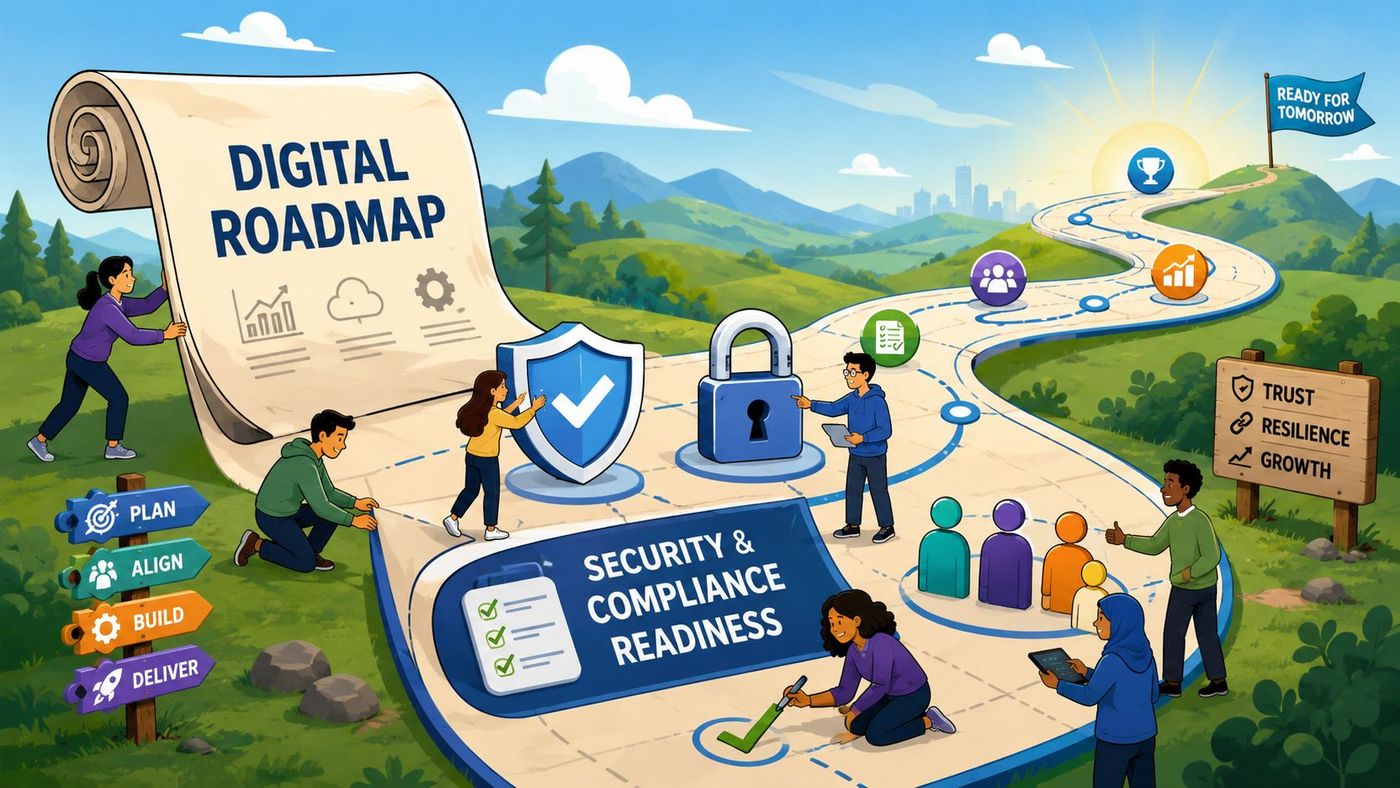
In SMB environments, execution usually breaks down in two places. Staff don't adopt the new way of working, or the business pushes ahead without putting the right security and compliance controls underneath the change. Both are avoidable if they are treated as core roadmap items instead of side tasks.
Most employees don't resist technology because they dislike improvement. They resist disruption that feels unclear, risky, or poorly timed.
A better approach is to make adoption local and practical.
Teams support change when leaders remove friction, answer questions quickly, and show that feedback leads to action.
This matters even more in healthcare, legal, finance, and other regulated environments. A roadmap that modernises collaboration but ignores access control, retention, auditability, and privacy obligations creates new exposure instead of reducing risk.
In practical terms, that means reviewing:
For Canadian organisations exploring AI, this is no longer theoretical. Statistics Canada reported that 12.2% of businesses were already using AI technologies in 2024, and guidance highlighted by Gemini points to the need for data classification, privacy controls, and audit logging before broad rollout of tools such as Microsoft 365 Copilot.
Many firms are asking the wrong first question. They ask which AI tool to deploy. The better question is whether the data environment is ready.
Before enabling AI in daily work, check for these conditions:
| Governance area | What to confirm |
|---|---|
| Data classification | Sensitive files are identified and handled consistently |
| Permission hygiene | Access is limited to the right people and groups |
| Privacy controls | Personal and regulated data are protected appropriately |
| Audit logging | Key actions can be reviewed and investigated |
| Human review | Staff know when outputs need validation |
If these foundations are weak, AI will expose them fast.
For organisations tightening controls as they modernise, cyber security services can support the governance side of the roadmap, especially where security uplift and business change need to happen together.
A roadmap shouldn't disappear into a slide deck after approval. It needs active management, clear measures, and regular decisions about what stays on track, what changes, and what stops.
For a mid-market organisation, the journey is typically a 2 to 3 year process, with the first year often focused on stabilization, the second on modernization, and the third on optimization. To manage that properly, the roadmap needs clear KPIs and milestones that show whether each phase is creating measurable business value, as outlined in SecureDataTech's guidance on a digital transformation roadmap for mid-market firms.

The wrong metrics make transformation look busy but not valuable. Uptime, ticket counts, and deployment status matter, but leadership also needs operational and user outcomes.
Use measures that connect to the original business case:
A simple quarterly review cadence works well for most SMBs. It doesn't need to become a bureaucracy.
A practical review meeting should answer four questions:
If your business includes software delivery or internal development work, supporting functions like engineering efficiency also belong in the conversation. A piece on improving developer productivity is useful context because it reminds leaders that productivity gains come from better systems, fewer blockers, and clearer workflows, not just faster coding tools.
Roadmaps stay useful when leadership treats them as a decision tool, not a reporting artifact.
The roadmap needs a home. That can be a project platform, a governance board pack, or a structured reporting environment. What matters is consistency. If finance has one version, operations has another, and IT has a third, alignment starts to erode.
For many SMBs, analytics and reporting forms part of transformation governance. Better reporting doesn't just show status. It helps leadership decide whether investments are producing the intended operational outcome.
A digital transformation roadmap gives SMB leaders a way to modernise without gambling on a massive one-time change. It helps you decide what matters now, what comes next, and what must wait. Its value lies in tying technology decisions back to business outcomes, operational risk, compliance needs, and staff capacity.
The pattern is consistent. Start with discovery. Build a clear vision. Sequence initiatives realistically. Treat change management and governance as part of the plan, not afterthoughts. Then measure progress often enough to keep the roadmap relevant.
That approach is especially important for Canadian businesses working in regulated, operationally demanding sectors. You need a plan that's ambitious enough to move the business forward and disciplined enough to survive real-world constraints.
If you need help building a practical roadmap for your business, CloudOrbis Inc. can work with your leadership team to assess your current environment, prioritise initiatives, and turn technology planning into a phased, business-focused strategy.
Book a 30-minute call with a senior engineer. No sales script, just straight answers about your environment.


