IT Infrastructure Optimization: A Practical Roadmap for SMBs
A step-by-step IT infrastructure optimization roadmap for SMBs covering discovery, network, cloud, security, KPIs, and compliance.

A step-by-step IT infrastructure optimization roadmap for SMBs covering discovery, network, cloud, security, KPIs, and compliance.

You already know the pattern. The helpdesk is busy before 9 a.m., a nurse or plant manager is waiting on a slow login, the cloud invoice lands higher than expected, and somebody asks why the patch window slipped again. That's IT infrastructure optimization in practice, not the polished version in vendor decks. The problem isn't that your environment is broken in one dramatic way, it's that it's been patched, layered, and extended until every decision now costs more than it should.
Canadian businesses are living this every day. Statistics Canada reports that annual operating spending on cloud computing reached $10.9 billion in 2023, up from $8.0 billion in 2022, a 36% year-over-year increase in a core infrastructure cost category, and procurement costs for cloud services rose from $5.7 billion to $7.1 billion, a 24% increase in the same period (Statistics Canada cloud spending data cited in the infrastructure metrics guide). That's why optimization isn't a nice-to-have cleanup project. It's financial control, service control, and risk control.
The trouble usually starts in a place nobody wants to own. A 75-person clinic adds a scheduler, a VoIP tool, a backup appliance, a few cloud services, and a couple of “temporary” fixes from three different vendors. Six months later, nobody can tell you which system owns which dependency, and the receptionist knows more about outages than the IT team does.
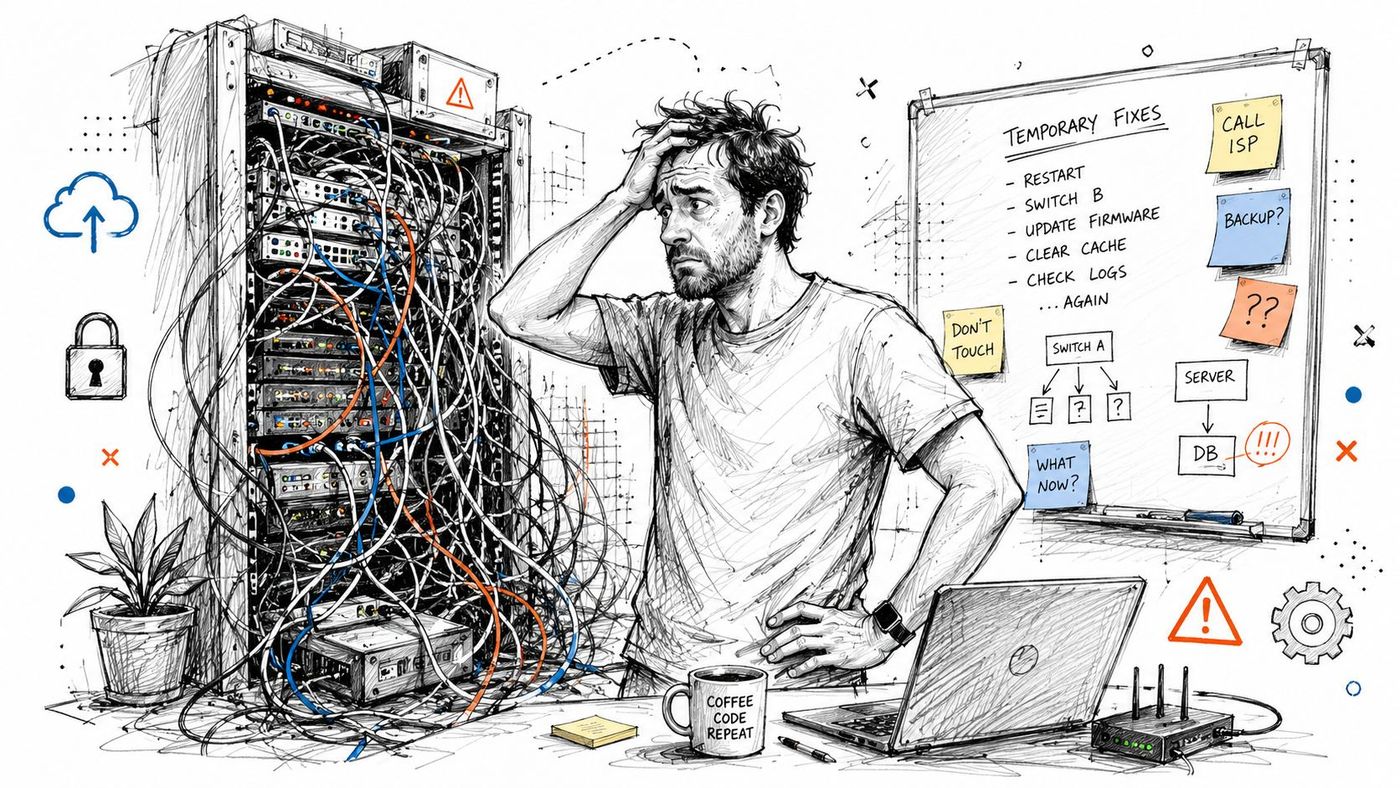
That's why leaders usually don't start with architecture. They start with a Tuesday morning incident, a surprise bill, or a failed audit. By then, the environment has already drifted from “a bit messy” into “structurally expensive.”
The first signal is rising ticket volume. Not every ticket means the same thing, but when users keep reporting slow systems, failed logins, broken sync, or unstable connections, the infrastructure is telling you it needs more than a tune-up. A healthy environment doesn't generate this much daily noise.
The second signal is cloud spend climbing faster than headcount. Statistics Canada's spending data shows that cloud operating costs and procurement costs both jumped sharply in 2023 (Statistics Canada cloud spending data cited in the infrastructure metrics guide). If your user base is flat and your infrastructure bill keeps rising, something is misaligned.
The third signal is patching cycles slipping. Once patching starts depending on overtime, favour-trading, and “we'll do it next week,” you've already moved beyond maintenance. That's when the smarter move is to assess legacy drift and replacement timing, not keep layering fixes on a tired stack. A practical example of that mindset is laid out in Wistec and legacy system upgrades, which treats old systems as a planning problem, not a sentimental one.
Practical rule: if users complain, finance complains, and patching keeps slipping, stop calling it optimisation work. You need structural change.
A creaking environment still functions, but it needs constant attention. An about to crack environment creates visible business drag, compliance exposure, and recurring outages. If the same issue shows up twice, you don't have an incident. You have a pattern.
That's the right moment to move into discovery, because guesswork is how SMBs burn budget while missing the actual bottleneck.
Start with a full inventory. Not a partial spreadsheet, not the list from procurement, and not the memory of the person who left six months ago. You need hardware, software, licences, contracts, utilisation metrics, end-of-life status, and dependency mappings in one place. If you miss SaaS subscriptions or shadow IT, consolidation will either miss savings or break something important, which is a very expensive way to learn the lesson.
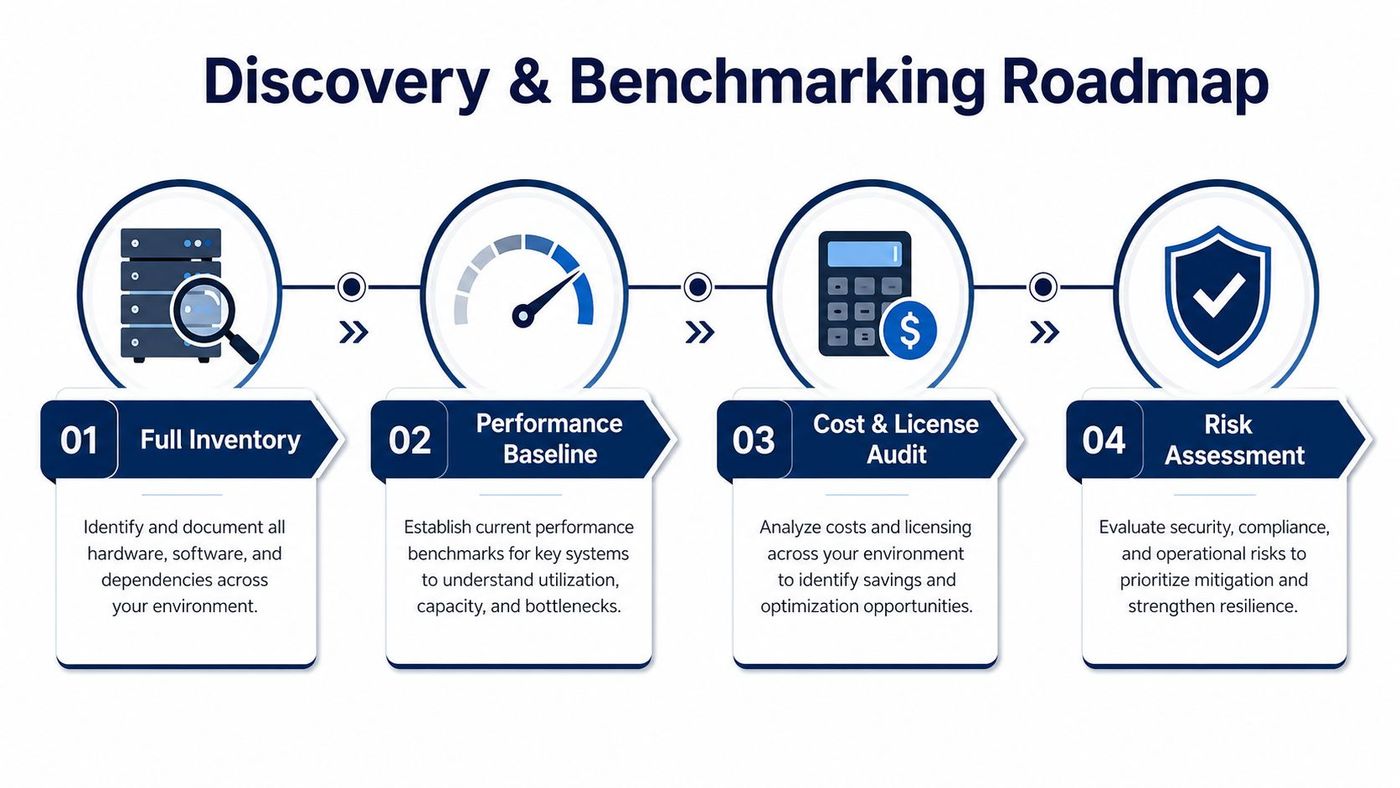
Your next move is to measure SLA latency percentiles. Track p50, p95, and p99, plus MTTR and uptime. Those are the numbers that show whether users are getting a predictable service, not just whether a dashboard looks busy. A practical workflow is to baseline those figures first, localize the bottleneck by tier, then validate the change for at least 14 days so you don't miss weekly traffic, batch jobs, or billing cycles (baseline method and 14-day validation window).
A lot of internal optimisation work fails because teams jump to the wrong tier. They start with the network when the database is the primary issue, or they right-size compute when storage is the actual drag. The result is wasted time, wasted budget, and a fresh round of “it still feels slow.”
Track cost trends over a 12 to 24 month window. Anything shorter is noise. You're trying to spot structural waste, not punish a seasonal spike or a one-off project. That means comparing cloud, licensing, and support costs against actual usage patterns, then asking who approved the spend and whether anyone is still using it.
Measure first, spend second. If you can't show the baseline, you can't prove the fix worked.
By the end of discovery, you should have three things in hand: an inventory, a dependency map, and a baseline report. The inventory shows what exists. The dependency map shows what breaks if you move it. The baseline shows whether the system is improving after you touch it.
If you want a practical checklist to keep the process tight, use the CloudOrbis IT infrastructure checklist as a working companion. It keeps the conversation grounded in what can be verified instead of what someone “thinks” is happening.
Don't treat optimisation as a flat backlog. Rank it. SMBs get the fastest payoff when they focus on the lanes that directly affect user experience, cost control, and business continuity. The wrong way to do this is to chase cosmetic wins, like a cleaner VPN portal, while ignoring stale licence assignments and cloud waste.
| Lane | Highest-leverage action | Impact | Effort | Typical payback |
|---|---|---|---|---|
| Network and connectivity | Remove weak links and standardise the path to critical services | High | Medium | Fast |
| Cloud cost and architecture | Right-size workloads and eliminate idle capacity | Very high | Medium | Fast to medium |
| Endpoints and user experience | Standardise device health and patch discipline | High | Medium | Medium |
| Security posture | Tighten identity, patching, and monitoring | High | Medium | Medium |
| Backup and disaster recovery | Verify restore and recovery procedures, not just backup jobs | High | Medium | Medium |
| Licensing and contracts | Reconcile assigned licences with actual use | High | Low to medium | Fast |
The ranking is blunt on purpose. Cloud cost and architecture often pays back quickly because idle or zombie instances, orphaned storage, and over-provisioning are common. That's the same reason Cloud cost management guidance from CloudOrbis belongs near the top of any SMB optimisation plan, not buried under general maintenance.
Network and connectivity comes first because users feel network pain immediately, and it contaminates every other metric. If connectivity is unstable, every optimisation conversation turns into blame theatre.
Cloud cost and architecture sits near the top because cloud waste is usually quiet, persistent, and avoidable. Right-sizing and workload placement are the fastest ways to stop paying for spare capacity nobody asked for.
Endpoints and user experience matter because the helpdesk still lives in the device layer. Old laptops, inconsistent patching, and bloated build images chew up time that should be spent on actual work.
Security posture is not a separate universe. It's part of optimisation because poor identity hygiene, weak patch cadence, and weak visibility all create avoidable cost.
Backup and disaster recovery belongs in the middle because a backup that can't restore is just expensive storage with good intentions.
Licensing and contracts often has the cleanest financial win. You just have to do the paperwork properly, which is apparently a radical idea in some organisations.
Fix the lane with the highest impact-to-effort ratio first, unless it carries an immediate compliance or continuity risk. That rule saves time and keeps the team from turning optimisation into a hobby.
The first 30 days should run in parallel, not as a neat little sequence. Network quick wins, identity and patching, backup verification, and licence cleanup all need motion at the same time. If you only tackle one lane at a time, the project turns into a queue, and queues are where good intentions go to die.

Assign an internal IT lead to coordinate technical work. Give a finance partner ownership of licence reconciliation. Put an executive sponsor on the hook for decisions that need escalation. If those roles aren't named, the project will drift into “everyone supports it” territory, which is another way of saying nobody owns the outcome.
Use a weekly cadence. Monday for status, Wednesday for blockers, Friday for validation. Keep the work visible and keep the decisions small enough to land.
A change-management reference point helps here. The CloudOrbis change management process is relevant because infrastructure work fails when communication and approval paths are vague.
Consolidation and right-sizing happen here. Remove duplicate tools, reduce over-provisioned capacity, and tidy the inventory gaps you found in discovery. Don't start this phase until the first month's fixes are stable, because stacking changes on unstable services is how teams create self-inflicted outages.
Now validate, document, and hand over. Recheck the baseline metrics, confirm the actual operating state, and update support documentation so the next engineer isn't guessing. If the numbers didn't move, stop pretending the change worked and look for the missed bottleneck.
Common stall point: newly discovered shadow IT expands the scope. Don't let it. Log it, assess it, and park it unless it's actively breaking the service or creating compliance exposure.
A managed-service engagement formalises this cadence because it forces the work into a repeatable rhythm, with owners, approvals, and validation windows already defined.
Boards don't care that you closed more tickets. They care whether the service got faster, the incidents got shorter, the cost dropped, and the risk exposure became more manageable. That's why the dashboard has to stay brutally simple.
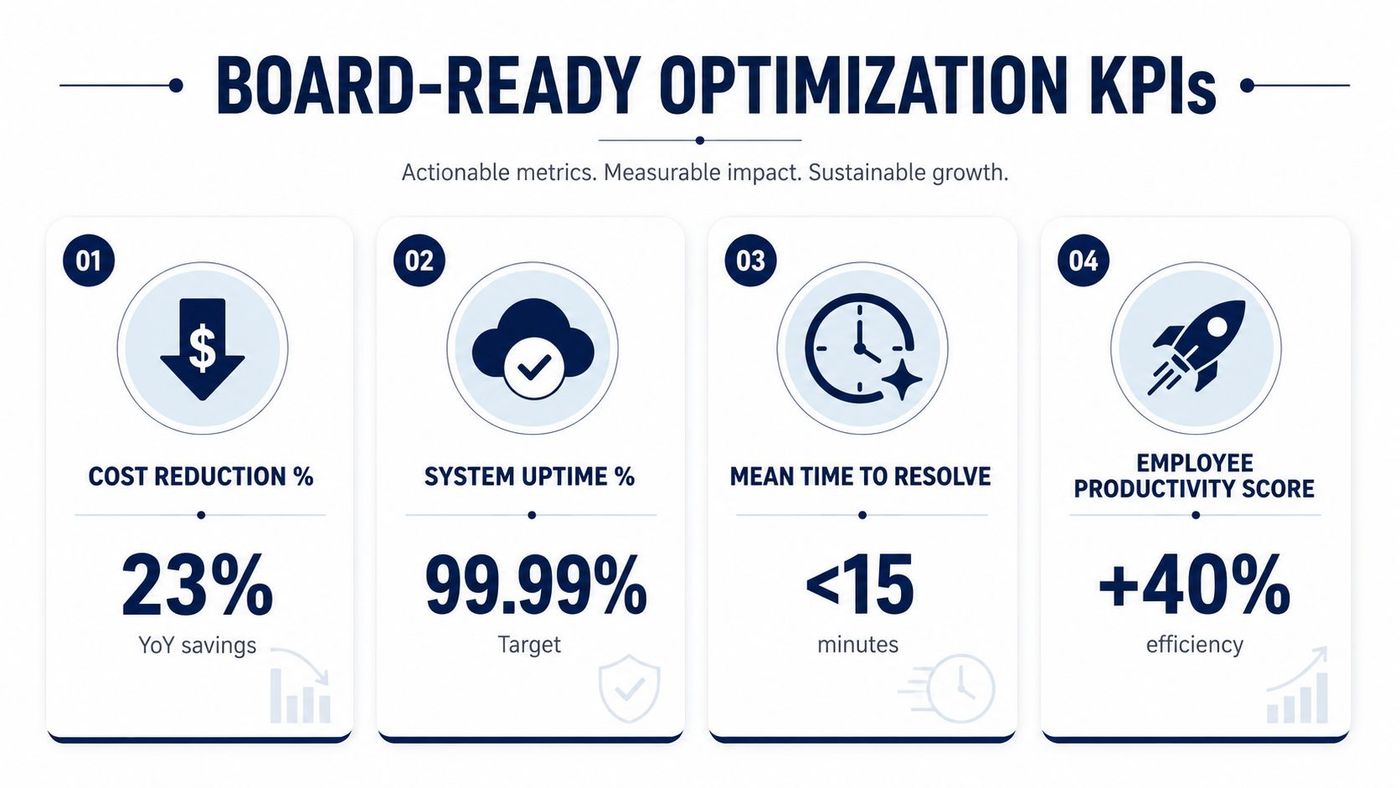
p95 latency and uptime tell you whether users are getting a stable service. MTTR tells you whether your operations team can recover quickly when things go wrong. Cloud and licence cost per employee keeps finance honest about whether spend is rising because the business grew or because nobody cleaned up the environment. The ratio of cyber-spend to total IT spend gives leadership a quick read on whether risk management is being treated as a serious operating cost.
Those metrics belong on one monthly page, alongside the discovery baseline. Everything else is secondary.
Skip vanity metrics that look good in slide decks but don't change behaviour. Number of tickets closed rewards volume, not resolution quality. Patch compliance percentage sounds impressive, but it can hide sloppy exception handling and badly timed updates. If a metric doesn't help a manager make a decision, it's noise.
For cost framing, keep the discussion tied to total ownership, not just acquisition cost. Total cost of ownership guidance from CloudOrbis fits well here because optimisation only matters if the run-rate, support load, and lifecycle burden improve.
Don't promise magic. Show the before-and-after baseline, the changes made, and the operational effect. That's enough for a CFO to see whether the programme is paying its way. If the service is faster, the incidents are shorter, and the spend is flatter, you've made the case.
Compliance gets a bad reputation because too many teams treat it like paperwork. That's lazy thinking. When done properly, compliance forces better architecture, because it pushes organisations to define access, logging, recovery, and change control instead of improvising them after an incident.
A compliant environment tightens identity and access controls so people only see what they should. It enforces encryption at rest and in transit, not as a branding exercise, but as a baseline control. It also demands auditable change management, tested backup and recovery procedures, and a documented incident response process.
Those are not separate from optimisation. They overlap directly with the security, backup, network, and endpoint lanes already discussed. In healthcare, that matters because the cost of sloppiness isn't theoretical. The same logic applies under PIPEDA, Law 25, and sector-specific obligations in finance and legal, even when the control names differ.
A useful healthcare-focused reference is the CloudOrbis HIPAA compliance checklist, because it keeps the conversation tied to operational controls instead of compliance theatre.
The worst compliance habit is treating it as an annual audit project. That turns controls into a scramble, and scrambles create exceptions. Continuous discipline is the right model, because infrastructure that is already measurable, documented, and monitored is much easier to defend when an auditor or regulator asks hard questions.
CloudOrbis uses a 10-step engagement model that starts with assessment and strategy, moves through implementation and training, and finishes with ongoing optimisation. That model isn't separate from the work above, it's the commercial wrapper that makes the work survivable for medium-sized teams.
Discovery and benchmarking fit into the opening assessment steps. The lane ranking maps to strategy. The 90-day playbook matches implementation. KPI reporting sits inside ongoing optimisation. Compliance controls run through the whole thing, not as a side quest.
If you're in a busy SMB, don't try to do all of this at once. Start with the four KPIs, pick the two lanes with the highest impact-to-effort ratio from the comparison table, and get a proper baseline before you spend another dollar on a fix you can't prove.
Book the assessment this week, because the environment won't get simpler on its own. Once you have the baseline, the decisions become much easier, and the budget stops leaking into guesswork.
A CTA for CloudOrbis Inc..
Book a 30-minute call with a senior engineer. No sales script, just straight answers about your environment.


